Publicado
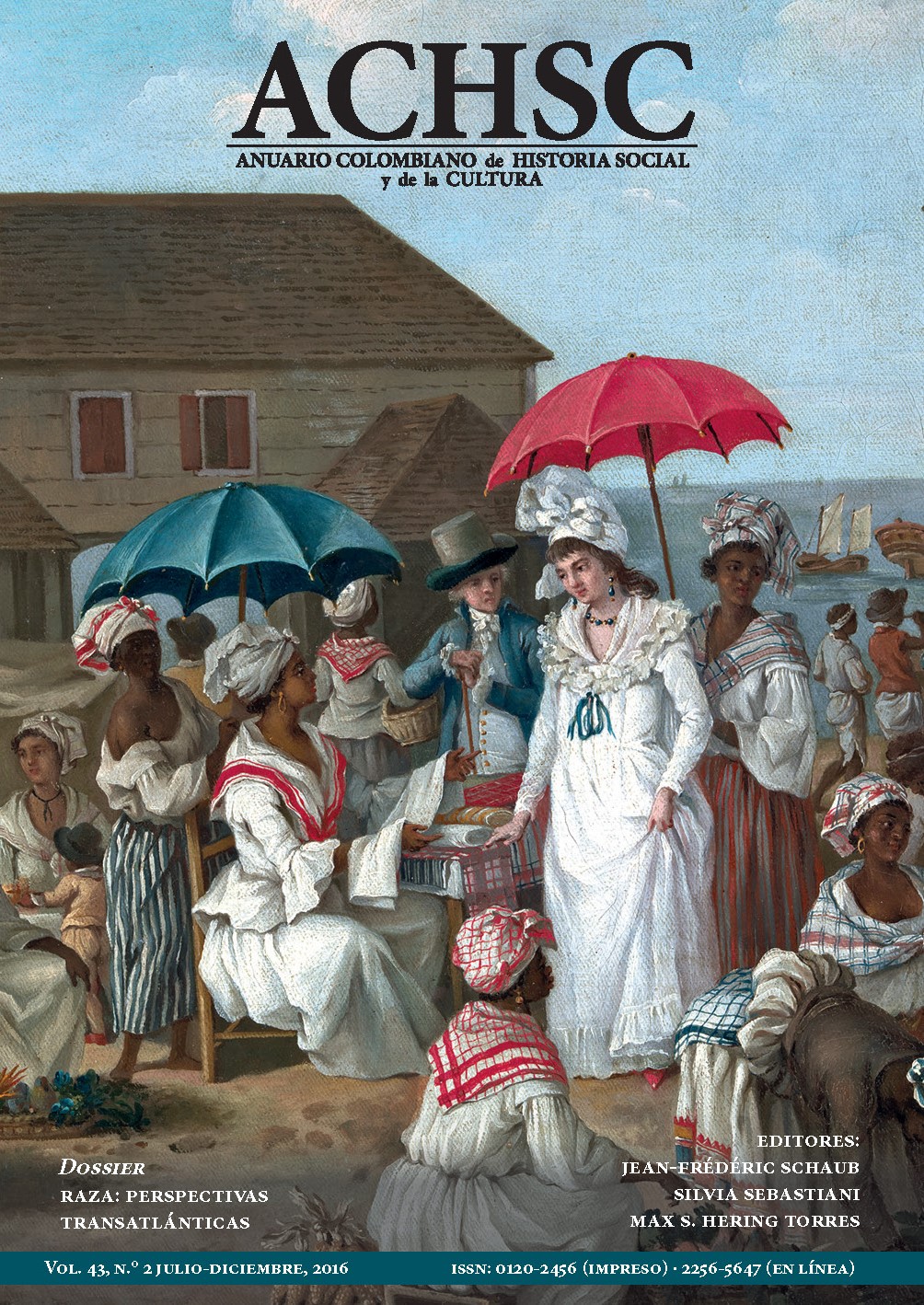
Blackness and Heathenism. Color, Theology, and Race in the Portuguese World, c. 1450-1600
Negrura y paganismo. Color, teología y raza en el mundo portugués, c. 1450-1600
DOI:
https://doi.org/10.15446/achsc.v43n2.59068Palabras clave:
Black africans, heathens, conversos, Portuguese Empire, jews, slavery, race. (en)Africanos negros, paganos, conversos, Imperio portugués, judíos, esclavitud, raza. (es)
The coexistence of a process of hierarchy and discrimination among human groups alongside dynamics of cultural and social hybridization in the Portuguese world in the early modern age has led to an intense historiographical debate. This article aims to contribute to extending our perspectives, focusing on the circulation of two global categories of classification: negro (Black) and gentio (Heathen) between the mid-fifteenth and late-sixteenth century. In particular, it explores the intersections between the perception of skin color and the reworking of theological concepts in a biologizing direction, which ran parallel to the development of an anti-Jewish theory based on blood purity. The line of enquiry leads from the coasts of West Africa, where it immediately meets the problem of slavery, to Brazil, via South Asia. The intense cross-fertilization of the categories of negro and gentio in the Portuguese world provides us with an alternative geography and institutional process of racialization to that of the Spanish Empire.
La coexistencia de un proceso de jerarquización y discriminación entre grupos humanos, junto a dinámicas de hibridación cultural y social en el mundo portugués de la Edad Moderna, ha llevado a un intenso debate historiográfico. Este artículo pretende contribuir a la ampliación de nuestras perspectivas, enfocándose en la circulación de dos categorías globales de clasificación: negro y gentio (pagano) entre mediados del siglo xv y finales del xvi. En particular, explora las intersecciones entre la percepción del color de la piel y la reformulación de conceptos teológicos en una dirección biologizante, hechos paralelos al desarrollo de una teoría anti-judía basada en la pureza de la sangre. La línea de investigación nos lleva de las costas occidentales de África, donde inmediatamente se encuentra con el problema de la esclavitud, hasta Brasil, pasando por el sur de Asia. El intenso intercambio de las categorías negros y gentios en el mundo portugués nos provee una geografía y un proceso institucional de racialización alternativo al del Imperio Español.
Referencias
I. Primary sources
Printed documents and manuscripts
Arquivo Portuguez-Oriental. Vols. 2, 5. Ed. Joaquim Heliodoro da Cunha Rivara. New Delhi: Asian Educational Service, 1992.
Barros, João de. Da Ásia… Dos feitos, que os Portuguezes fizeram no descubrimento, e conquista dos mares, e terras do Oriente. Lisbon: Na Régia Officina Typografica, 1777-1778.
Carta de El-Rei D. Manuel ao Rei Catholico narrando-lhe as viagens portuguezas à India desde 1500 até 1505. Ed. Prospero Peragallo. Lisbon: Typographia da Academia Real das Sciencias, 1892.
Copy of a Letter of the King of Portugal Sent to the King of Castile Concerning the Voyage and Success of India. Ed. Sergio J. Pacifici. Minneapolis: The University of Minnesota Press, 1955.
Descobrimentos Portugueses. Documentos para a sua História. Vol. 3. Ed. João Martins da Silva Marques. Lisbon: inic, 1971.
Documenta Indica. Vol. 1. Ed. Josef Wicki. Rome: Institutum Historicum Societatis Iesu, 1948.
Monumenta Brasiliae. Vol. 1. Ed. Serafim Leite. Rome: Institutum Historicum Societatis Iesu, 1956.
Monumenta Henricina. Vols. 12-13. Ed. António Joaquim Dias Dinis. Lisbon: Comissão Executiva das Comemoraões do V Centenário da morte do Infante D. Henrique, 1971-1972.
Manuel da Nóbrega, Cartas do Brasil e mais escritos. Ed. Serafim Leite. Coimbra: Imprensa da Universidade de Coimbra, 1955.
The Book of Duarte Barbosa: An Account of the Countries Bordering on the Indian Ocean and Their Inhabitants. Ed. Mansel Longworth Dames. London: Printed for the Hakluyt Society, 1918-1921.
(The) Prester John of the Indies of the Indies: A True Relation of the Lands of the Prester John Being the Narrative of the Portuguese Embassy to Ethiopia in 1520 Written by Father Francisco Alvares. Eds. G. F. Beckingham and G. W. B. Huntingford. Cambridge: Published for the Hakluyt Society at the University Press, 1961.
Zurara, Gomes Eanes de. Crónica de Guiné. Ed. José de Bragança. Porto: Civilização, 1973.
II. Secondary sources
Anderson, Robert Nelson. “The Quilombo of Palmares: A New Overview of a Maroon State in Seventeenth-Century Brazil”. Journal of Latin American Studies 28 (1996): 545-566.
Baquero Moreno, Humberto. “Movimentos sociais antijudaicos em Portugal no século XV”. Marginalidade e conflitos sociais em Portugal nos séculos XIV e XV. Estudos de História. Lisbon: Editorial Presença, 1985. 79-88.
Bethencourt, Francisco. Racisms: From the Crusades to the Twentieth Century. Princeton: Princeton University Press, 2013.
Barreto Xavier, Ângela. “Dissolver a diferença. Mestiçagem e conversão no império português”. Itinerários. A investigação nos 25 anos doics. Eds. Manuel Villaverde Cabral, Karin Wall, Sofia Aboim and Filipe Carreira da Silva. Lisbon: Imprensa de Ciências Sociais, 2008. 709-727.
Boxer, Charles Ralph. Race Relations in the Portuguese Colonial Empire, 1415-1825. Oxford: Clarendon Press, 1963.
Braude, Benjamin. “The Sons of Noah and the Construction of Ethnic and Geographical Identities in the Medieval and Early Modern Periods”. William and Mary Quarterly 54 (1997): 103-142.
Couto, Jorge. A construção do Brasil. Ameríndios, Portugueses e Africanos do início do povoamento a finais de Quinhentos. Lisbon: Cosmos, 1997.
Cummins, J. S., and Luís Rebelo de Sousa. “The Controversy over Charles Boxer’s Race Relations in the Portuguese Colonial Empire, 1415-1825”. Portuguese Studies 17 (2001): 233-246.
Delille, Gérard. “The Shed Blood of Christ: From Blood as Metaphor to Blood as Bearer of Identity”. Blood and Kinship: Matter for Metaphor from Ancient Rome to the Present. Eds. Christopher H. Johnson et al. New York: Berghahn Books, 2013. 125-143
Dias, José Sebastião da Silva. Os Descobrimentos e a problemática cultural do século xvi. Coimbra: Imprensa da Universidade de Coimbra, 1973.
Earle, T. F., and K. J. P. Lowe, eds. Black Africans in Renaissance Europe. Cambridge- New York: Cambridge University Press, 2005.
Elbl, Ivana. “The Volume of the Early Atlantic Slave Trade, 1450-1521”. Journal of African History 38 (1997): 31-75.
Freyre, Gilberto. The Masters and the Slaves: A Study in the Development of Brazilian Civilization. Trans. Samuel Putnam. New York: Alfred A. Knopf, 1946.
Gliozzi, Giuliano. Adamo e il Nuovo Mondo. La nascita dell’antropologia come ideologia coloniale dalle genealogie bibliche alle teorie razziali, 1500-1700. Florence: La Nuova Italia, 1977.
Graizbord, David L. Souls in Dispute: Converso Identities and the Jewish Diaspora, 1580-1700. Philadelphia: University of Pennsylvania Press, 2004.
Groebner, Valentin. “Complexio/Complexion: Categorizing Individual Natures, 1250-1600”. The Moral Authority of Nature. Eds. Lorraine Daston and Fernando Vidal. Chicago: Chicago University Press, 2003. 364-383.
Groebner, Valentin. “Haben Hautfarben eine Geschichte? Personenbeschreibungen und ihre Kategorien zwischen dem 13. und dem 16. Jahrhundert”. Zeitschrift für Historische Forschung 30 (2003): 1-18.
Gruzinski, Serge. Les quatre parties du monde. Histoire d’une mondialisation. Paris: Éditions de La Martinière, 2004.
Guha, Sumit. Beyond Caste: Identity and Power in South Asia, Past and Present. Leiden-Boston: Brill, 2013.
Halikowski-Smith, Stefan. “Carta de el-Rei D. Manuel”, Christian-Muslim Relations: A Bibliographical History. Vol. 6. Eds. David Thomas, John Chesworth et al. Leiden-Boston: Brill, 2014. 297-303.
Havik, Philip J. and Malyn Newitt, eds. Creole Societies in the Portuguese Colonial Empire. Newcastle: Cambridge Scholars Publishing, 2015.
Hering Torres, Max S., María Elena Martínez and David Nirenberg, eds. Race and Blood in the Iberian World. Zürich-Berlin: LIT, 2012.
Hernández Franco, Juan. Sangre limpia, sangre española. El debate sobre los estatutos de limpieza, siglos xv-xvii. Madrid: Cátedra, 2011.
Horta, José da Silva. “A categoria de gentio em Diogo de Sá: funções e níveis de significação”. Clio 10 (2004): 135-156.
Kitahara, Michio. Portuguese Colonialism and Japanese Slaves. Tokyo: Kadensha, 2013.
Kowner, Rotem. “Skin as Metaphor: Early European Racial Views on Japan, 1548- 1853”. Ethnohistory 51 (2004): 751-778.
Lima Cruz, Maria Augusta. “Exiles and Renegades in Early Sixteenth Century Portuguese India”. Indian Economic and Social History Review 23 (1986): 249-262.
Marcocci, Giuseppe. “Escravos ameríndios e negros africanos: uma história co¬nectada. Teorias e modelos de discriminação no império português (ca. 1450-1650)”. Tempo 30 (2011): 41-70.
Marcocci, Giuseppe. A consciência de um império. Portugal e o seu mundo, sécs. XV-XVII. Coimbra: Imprensa da Universidade de Coimbra, 2012.
Marcocci, Giuseppe. “Prism of Empire: The Shifting Image of Ethiopia in Renaissance Portugal (1500-1570)”. Portuguese Humanism and the Republic of Letters. Eds. Maria Berbara and Karl A. E. Enenkel. Leiden-Boston: Brill, 2012. 447-465.
Martínez, María Elena. Genealogical Fictions: Limpieza de Sangre, Religion, and Gender in Colonial Mexico. Stanford: Stanford University Press, 2008.
Mendonça, Délio de. Conversions and Citizenry: Goa under Portugal, 1510-1610. New Delhi: Concept Publishing Co., 2002.
Muchnik, Natalia. De paroles et de gestes. Construction marranes en terre d’Inquisition. Paris: École des Hautes Études en Sciences Sociales, 2014.
Newitt, Malyn. “Formal and Informal Empire in the History of Portuguese Expansion”. Portuguese Studies 17 (2001): 1-21.
Nirenberg, David. “Was There Race Before Modernity? The Example of ‘Jewish’ Blood in Late Medieval Spain”. The Origins of Racism in the West. Eds. Miriam Eliav-Feldon, Benjamin Isaac and Joseph Ziegler.
Cambridge-New York: Cambridge University Press, 2009. 232-264.
Nirenberg, David. Anti-Judaism: The Western Tradition. New York: W. W. Norton & Co., 2013.
Pagden, Anthony. The Fall of Natural Man: The American Indian and the Origins of Comparative Ethnology. Cambridge: Cambridge University Press, 1982.
Pallares-Burke, Maria Lúcia. “Gilberto Freyre Conference”. Portuguese Studies 27 (2011): 5-77.
Perrone-Moisés, Beatriz. “Índios livres e índios escravos. Os princípios da legislação indigenista do período colonial (séculos xvi a xviii)”. História dos índios no Brasil. Ed. Manuel Carneiro da Cunha. São Paulo: Companhia das Letras, 1998. 115-132.
Ramos Tinhorão, José. Os negros em Portugal. Uma presença silenciosa. Lisbon: Editorial Caminho, 1988.
Rappaport, Joanne. The Disappearing Mestizo: Configuring Difference in the Colonial New Kingdom of Granada. Durham: Duke University Press, 2014.
Russell-Wood, A. J. R. A World on the Move: The Portuguese in Africa, Asia and America, 1415-1808. Manchester: Carcanet / Calouste Gulbenkian Foundation, 1992.
Saunders, A. C. de C. M. A Social History of Black Slaves and Freedmen in Portugal, 1444-1555. Cambridge: Cambridge University Press, 1982.
Schaub, Jean-Frédéric. Pour une histoire politique de la race. Paris: Seuil, 2015.
Seijas, Tatiana. Asian Slaves to Colonial Mexico: From Chinos to Indians. New York: Cambridge University Press, 2014.
Soyer, François. The Persecution of the Jews and Muslims of Portugal: King Manuel I and the End of Religious Tolerance, 1496-7. Leiden-Boston: Brill, 2007.
Sweet, James H. “The Iberian Roots of American Racist Thought”. William and Mary Quarterly 54 (1997): 143-166.
Van Der Lugt, Maaike. “La peau noire dans la science médiévale”. Micrologus 13 (2005): 439-475.
Van Deusen, Nancy E. “Indios on the Move in the Sixteenth-Century Iberian World”. Journal of Global History 10 (2015): 387-409.
Van Deusen, Nancy E. Global Indios: The Indigenous Struggle for Justice in Sixteenth- Century Spain. Durham: Duke University Press, 2015.
Wachtel, Nathan. The Faith of Remembrance: Marrano Labyrinths. Trans. Nikki Halpern. Philadelphia: University of Pennsylvania Press, 2013.
Wolf, Kenneth B. “The “Moors” of West Africa and the Beginnings of the Portuguese Slave Trade”. Journal of Medieval and Renaissance Studies 24 (2003): 449-469.
Zeron, Carlos Alberto de Moura Ribeiro. Ligne de foi. La Compagnie de Jésus et l’esclavage dans le processus de formation de la société coloniale en Amérique portugaise, XVI-XVII siècles. Paris: Honoré Champion, 2009.
Dimensions
PlumX
Visitas a la página del resumen del artículo
Descargas
Cómo citar




Licencia
Derechos de autor 2016 Anuario Colombiano de Historia Social y de la Cultura

Esta obra está bajo una licencia internacional Creative Commons Atribución-NoComercial-SinDerivadas 4.0.