Correo Electrónico
 DNINFOA - SIA
 Bibliotecas
 Convocatorias
 Identidad U.N.


Publicado
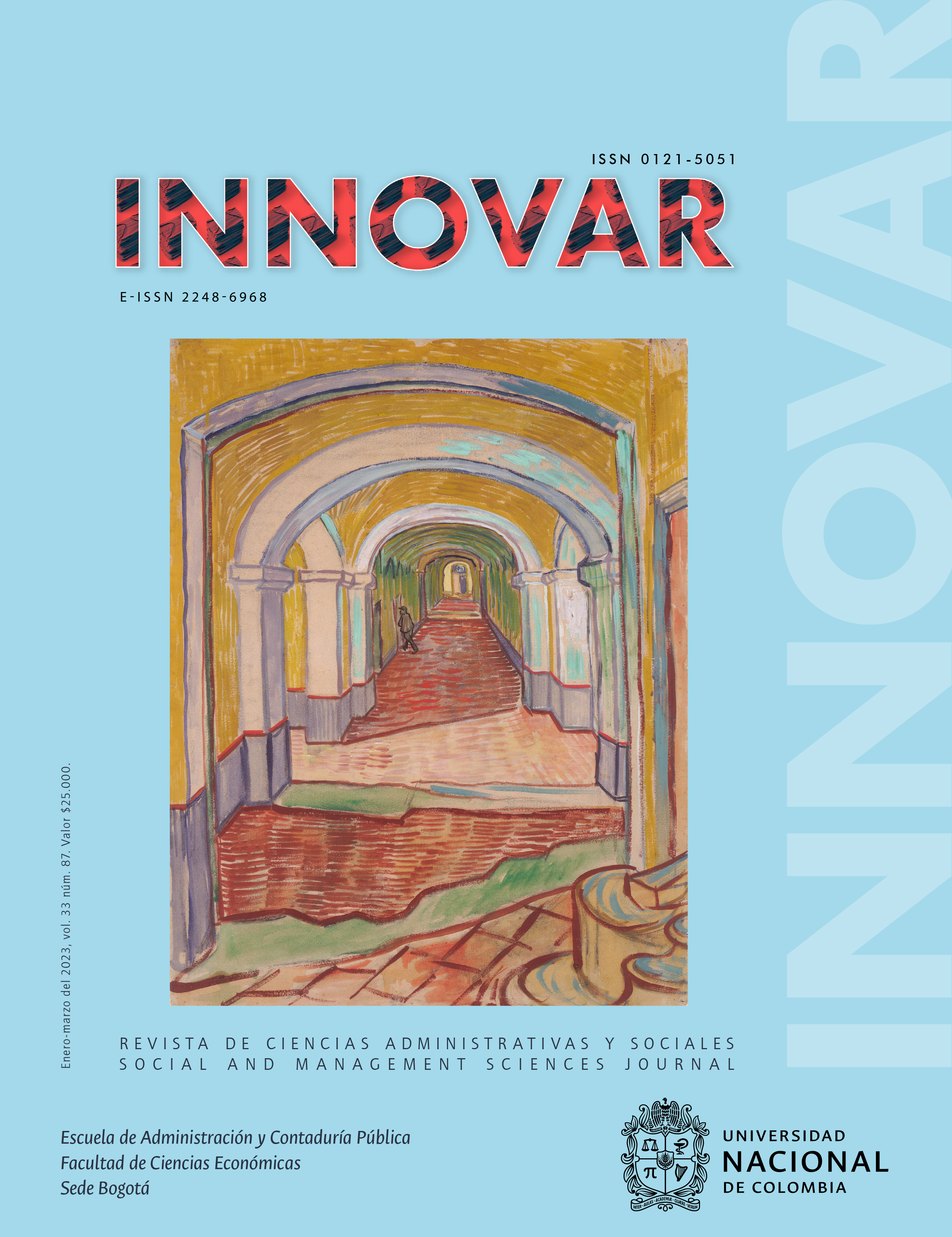
Higher Education Student Complaint Behavior in a Complex Service Ecosystem: A Value Co-creation Perspective
Comportamiento de queja de los estudiantes de educación superior en un ecosistema de servicios complejo: una perspectiva de cocreación de valor
Comportamento de reclamação de estudantes de ensino superior em um ecossistema de serviços complexo: uma perspectiva de cocriação de valor
DOI:
https://doi.org/10.15446/innovar.v33n87.105500Palabras clave:
Customer complaint behavior, Service-dominant logic, service ecosystem complexity, value co-creation, student complaint behavior (en)comportamento de reclamação do cliente, lógica dominante do serviço, complexidade do ecossistema de serviços, comportamento de reclamação do aluno, cocriação de valor (pt)
comportamiento de queja del cliente, lógica dominante del servicio, complejidad del ecosistema de servicios, comportamiento de queja de los estudiantes, cocreación de valor (es)
Descargas
During the global covid-19 pandemic, most of higher education institutions (heis) were forced to migrate to an e-learning methodology in order to continue their academic activities. At the same time, the student complaint behavior (scb) increased due to new experiences of dissatisfaction or non-satisfaction. In this context, and seeking to ensure student satisfaction, heis have managed this behavior in the same form that companies do with their customers. Therefore, we present a critical analysis on the generic and standardized approach in the literature and practice to understanding and managing scb in the same way as customer complaint behavior (ccb) is managed. A review of the literature on the theories and studies related to scb and ccb and the student/customer treatment debate are presented, highlighting the complexity of higher education (he) service, which is considered a pillar of development due to its social value. The authors argue the suitable application of the Service-Dominant Logic (sdl), specifically its value co-creation premise, as well as the principles of the Service Ecosystem theory to differentiate scb from ccb. This may allow heis to continue to ensure student satisfaction through the management of their complaints without compromising educational quality and service sustainability. The reflection hereby presented is limited to the Latin America region educational contexts and their structures.
durante la pandemia global de covid-19, la mayoría de las instituciones de educación superior (ies) se vieron obligadas a migrar hacia la metodología de e-learning con el fin de dar continuidad a sus actividades académicas. Al mismo tiempo, el comportamiento de queja de los estudiantes (cqe) reportó un incremento como resultado de nuevas experiencias de insatisfacción. En este contexto, y buscando garantizar la satisfacción de los estudiantes, las ies han gestionado el cqe de la misma forma que lo hacen las empresas con sus clientes. Por lo tanto, este trabajo presenta un análisis crítico frente al enfoque genérico y estandarizado —tanto en la literatura como en la práctica— que pretende la gestión del cqe bajo los mismos principios con los que se gestiona el comportamiento de queja del consumidor (cqc). Con tal fin, se presenta una revisión de la literatura sobre las teorías y estudios relacionados con el cqe y el cqc y el debate en torno a la gestión del estudiante/cliente, destacando la complejidad inherente a la prestación del servicio de educación superior (es), que es considerado un pilar del desarrollo debido a su valor social. Los autores defienden la adecuada aplicación de la lógica dominante del servicio (sdl, en inglés), específicamente su premisa de cocreación de valor, así como de los principios de la teoría del ecosistema de servicios para diferenciar un comportamiento de queja del otro. Esto puede propiciar que las ies continúen garantizando la satisfacción de sus estudiantes a través de la gestión de las quejas interpuestas por estos sin comprometer la calidad educativa y la sostenibilidad del servicio. La reflexión aquí abordada se circunscribe a los contextos educativos de la región latinoamericana.
Durante a pandemia global ocasionada pela covid-19, a maioria das instituições de ensino superior (IES) foi forçada a migrar para uma metodologia de e-learning, a fim de continuar suas atividades acadêmicas. Ao mesmo tempo, o comportamento de reclamação do aluno (CRA) aumentou devido a novas experiências de insatisfação ou não satisfação. Nesse contexto, e para garantir a satisfação dos alunos, as IES têm gerenciado esse comportamento da mesma forma que as empresas fazem com seus clientes. Por isso, apresentamos uma análise crítica sobre a abordagem genérica e padronizada na literatura e na prática de compreensão e gestão do CRA da mesma forma que o comportamento de reclamação do cliente (CRC) é gerenciado. Uma revisão da literatura sobre as teorias e estudos relacionados aos CRA e CRC e ao debate sobre tratamento aluno/cliente são apresentadas, com destaque para a complexidade do serviço de ensino superior, que é considerado um pilar de desenvolvimento devido ao seu valor social. Os autores argumentam a aplicação adequada da lógica dominante do serviço, especificamente sua premissa de cocriação de valor, bem como os princípios da teoria do ecossistema de serviços para diferenciar o CRA do CRC. Isso pode permitir que as IES continuem a garantir a satisfação dos alunos por meio da gestão de suas reclamações sem comprometer a qualidade educacional e a sustentabilidade dos serviços. A reflexão apresentada limita-se aos contextos educacionais da região da América Latina e suas estruturas.
Referencias
Altbach, P. G., Reisberg, L., & Rumbley, L. E. (2019). Trends in global higher education: Tracking an academic revolution. Brill. https://brill.com/view/title/36570
Aristovnik, A., Keržič, D., Ravšelj, D., Tomaževič, N., & Umek, L. (2020). Impacts of the COVID-19 pandemic on the life of higher education students: A global perspective. Sustainability, 12(20), 8438. https://doi.org/10.3390/su12208438
Banwait, K. (2021). The student as customer: A study of the intensified marketisation of higher education in England. University of Derby (United Kingdom). https://derby.openrepository.com/bitstream/handle/10545/622828/Kuldeep%20Thesis%20%20Final%20submission%20for%20UDORA%20copyright%20proof.pdf?sequence=6&isAllowed=y
Barile, S., Pels, J., Polese, F., & Saviano, M. (2012). An introduction to the viable systems approach and its contribution to marketing. Journal of Business Market Management, 5(2), 54-78. https://ssrn.com/abstract=2239812
Blau, I., & Shamir-Inbal, T. (2018). Digital technologies for promoting “student voice” and co-creating learning experience in an academic course. Instructional Science, 46(2), 315-336. https://doi.org/10.1007/s11251-017-9436-y
Blodgett, J. G., Hill, D. J., & Tax, S. S. (1997). The effects of distributive, procedural, and interactional justice on post complaint behavior. Journal of Retailing, 73(2), 185-210. https://doi.org/10.1016/S0022-4359(97)90003-8
Bovill, C., & Bulley, C. J. (2011). A model of active student participation in curriculum design: Exploring desirability and possibility. In C. Rust (Ed.), Improving Student Learning (ISL) 18: Global theories and local practices: Institutional, disciplinary and cultural variations (pp. 176-188). Oxford Brookes University
Bunce, L., Baird, A., & Jones, S. E. (2017). The student-as-consumer approach in higher education and its effects on academic performance. Studies in Higher Education, 42(11), 1958-1978. https://doi.org/10.1080/03075079.2015.1127908
Calma, A., & Dickson-Deane, C. (2020). The student as customer and quality in higher education. International Journal of Educational Management, 34(8), 1221-1235. https://doi.org/10.1108/IJEM-03-2019-0093
Chahal, H., & Devi, P. (2015). Consumer attitude towards service failure and recovery in higher education. Quality Assurance in Education, 23(1), 67-85. https://doi.org/10.1108/QAE-07-2013-0029
Crie, D. (2003). Consumers' complaint behaviour. Taxonomy, typology and determinants: Towards a unified ontology. Journal of Database Marketing & Customer Strategy Management, 11(1), 60-79. https://doi.org/10.1057/palgrave.dbm.3240206
Díaz-Méndez, M., & Gummesson, E. (2012). Value co-creation and university teaching quality: Consequences for the European Higher Education Area (EHEA). Journal of Service Management, 23(4), 571-592. https://doi.org/10.1108/TQM-03-2017-0031
Díaz-Méndez, M., Paredes, M. R., & Saren, M. (2019). Improving society by improving education through Service-Dominant Logic: Reframing the role of students in higher education. Sustainability, 11(19), 5292. https://doi.org/10.3390/su11195292
Díaz-Méndez, M., Saren, M., & Gummesson, E. (2017). Considering pollution in the higher education (HE) service ecosystem: The role of students’ evaluation surveys. The TQM Journal, 29(6), 767-782. https://doi.org/10.1108/TQM-03-2017-0031
Driscoll, C., & Wicks, D. (1998). The customer-driven approach in business education: A possible danger? Journal of Education for Business, 74(1), 58-61. https://doi.org/10.1080/08832329809601663
Dolinsky, A. L. (1994). A consumer complaint framework with resulting strategies: An application to higher education. Journal of Services Marketing, 8(3), 27-39. https://doi.org/10.1108/08876049410065598
Dollinger, M., Lodge, J., & Coates, H. (2018). Co-creation in higher education: Towards a conceptual model. Journal of Marketing for Higher Education, 28(2), 210-231. https://doi.org/10.1080/08841241.2018.1466756
Douglas, J., McClelland, R., & Davies, J. (2008). The development of a conceptual model of student satisfaction with their experience in higher education. Quality Assurance in Education, 16(1), 19-35. https://doi.org/10.1108/09684880810848396
Dubey, P., & Pandey, D. (2020). Distance learning in higher education during pandemic: Challenges and opportunities. International Journal of Indian Psychology, 8(2), 43-46. https://doi.org/10.25215/0802.204
Ferguson, G., & Phau, I. (2012). A cross-national investigation of university students' complaining behaviour and attitudes to complaining. Journal of International Education in Business, 5(1), 50-70. https://doi.org/10.1108/18363261211261755
Fitz-Patrick, M., Davey, J., & Dai, L. (2012). Chinese students' complaining behavior: Hearing the silence. Asia Pacific Journal of Marketing and Logistics, 24(5), 738-754. https://doi.org/10.1108/13555851211278349
Ford, R. C., & Bowen, D. E. (2008). A service-dominant logic for management education: It's time. Academy of Management Learning & Education, 7(2), 224-243. https://doi.org/10.5465/amle.2008.32712620
Gaebel, M., Zhang, T., Bunescu, L., & Stoeber, H. (2018). Learning and teaching in the European higher education area. European University Association. https://eric.ed.gov/?id=ED593591
Gillespie-Finney, T., & Zachary-Finney, R. (2010). Are students their universities' customers? An exploratory study. Education + Training, 52(4), 276-291. https://doi.org/10.1108/00400911011050954
Gilly, M. C., & Gelb, B. D. (1982). Post-purchase consumer processes and the complaining consumer. Journal of Consumer Research, 9(3), 323-328. https://doi.org/10.1086/208927
Golooba, M., & Ahlan, A. R. (2013). Service value co-creation in research and innovation practices in higher education institutions in Malaysia. Procedia Technology, 11, 342-347. https://doi.org/10.1016/j.protcy.2013.12.200
Goodman, J., & Newman, S. (2003). Understand customer behavior and complaints. Quality Progress, 36(1),51-55. https://www.proquest.com/magazines/understand-customer-behavior-complaints/docview/214764337/se-2
Guilbault, M. (2016). Students as customers in higher education: Reframing the debate. Journal of Marketing for Higher Education, 26(2), 132-142. https://doi.org/10.1080/08841241.2016.1245234
Gummesson, E. (2006). Many-to-many marketing as grand theory. In R. F. Lusch, S. L. Vargo (Eds.), The Service-Dominant Logic of Marketing: Dialog, debate, and directions (pp. 339-353). https://doi.org/10.4324/9781315699035
Gummesson, E. (2014). Many-to-many marketing as grand theory: A Nordic school contribution. In R. F. Lusch, S. L. Vargo (Eds.), The Service-Dominant Logic of Marketing: Dialog, debate, and directions (pp. 357-371). Routledge. https://www.taylorfrancis.com/chapters/edit/10.4324/9781315699035-40/many-many-marketing-grand-theory-nordic-school-contribution-evert-gummesson
Gummesson, E., Lusch, R. F., & Vargo, S. L. (2010). Transitioning from service management to Service-Dominant Logic: Observations and recommendations. International Journal of Quality and Service Sciences, 2(1), 8-22. https://doi.org/10.1108/17566691011026577
Gupta, T. (2018). The marketization of higher education. International Journal of Recent Research Aspects, 5(3), 1-8. http://www.ijrra.net/Vol5issue3/IJRRA-05-03-01.pdf
Haraldseid-Driftland, C., Aase, I., & Aase, K. (2019). Developing curriculum: Nursing students’ involvement in skills training design. In K. Trimmer, T. Newman, & F. Padró (Eds.), Ensuring Quality in Professional Education (Vol. I) (pp. 189-207). Palgrave Macmillan, Cham. https://doi.org/10.1007/978-3-030-01096-6_9
Hart, D. J., & Coates, N. F. (2010). International student complaint behaviour: How do East Asian students complain to their university? Journal of Further and Higher Education, 34(3), 303-319. https://doi.org/10.1080/0309877X.2010.484051
Hemsley-Brown, J., & Oplatka, I. (2006). Universities in a competitive global marketplace: A systematic review of the literature on higher education marketing. International Journal of Public Sector Management, 19(4), 316-338. https://doi.org/10.1108/09513550610669176
Hill, F. M. (1995). Managing service quality in higher education: The role of the student as primary consumer. Quality Assurance in Education, 3(3), 10-21. https://doi.org/10.1108/09684889510093497
Hurt, E. (2012). The marketization of higher education. College Literature, 39(2), 121-132. http://www.jstor.org/stable/23266076 DOI: https://doi.org/10.1353/lit.2012.0013
Iyer, R., & Muncy, J. A. (2008). Service recovery in marketing education: It's what we do that counts. Journal of Marketing Education, 30(1), 21-32. https://doi.org/10.1177/0273475307312195
Judson, K. M., & Taylor, S. A. (2014). Moving from marketization to marketing of higher education: The co-creation of value in higher education. Higher Education Studies, 4(1), 51-67. http://www.ccsenet.org/journal/index.php/hes DOI: https://doi.org/10.5539/hes.v4n1p51
Karunathilake, R. L. P., & Galdolage, B. S. (2021). Value co-creation and co-destruction in online education during the Covid19 pandemic: Special reference to Sri Lankan State Sector Universities. Journal of Business and Technology, 5(2), 14-28. http://doi.org/10.4038/jbt.v5i2.30
Koris, R., & Nokelainen, P. (2015). The student-customer orientation questionnaire (SCOQ) Application of customer metaphor to higher education. International Journal of Educational Management, 29(1), 115-138. https://doi.org/10.1108/IJEM-10-2013-0152
Lala, V., & Priluck, R. (2011). When students complain: An antecedent model of students’ intention to complain. Journal of Marketing Education, 33(3), 236-252. https://doi.org/10.1177/0273475311420229
Leem, B. H. (2021). An effect of value co-creation on student benefits in COVID-19 pandemic. International Journal of Engineering Business Management, 13. https://doi.org/10.1177/18479790211058320
Lei, S. I., & So, A. S. I. (2021). Online teaching and learning experiences during the COVID-19 pandemic–A comparison of teacher and student perceptions. Journal of Hospitality & Tourism Education, 33(3), 148-162. https://doi.org/10.1080/10963758.2021.1907196
Marinoni, G., Van’t Land, H., & Jensen, T. (2020). The impact of Covid-19 on higher education around the world. IAU Global Survey Report. The International Association of Universities [IAU]. https://www.uniss.it/sites/default/files/news/iau_covid19_and_he_survey_report_final_may_2020.pdf
McCabe, A., & O'Connor, U. (2014). Student-centred learning: The role and responsibility of the lecturer. Teaching in Higher Education, 19(4), 350-359. https://doi.org/10.1080/13562517.2013.860111
Meyer, M. W., & Norman, D. (2020). Changing design education for the 21st century. She Ji: The Journal of Design, Economics, and Innovation, 6(1), 13-49. https://doi.org/10.1016/j.sheji.2019.12.002
Mousavi, M., & Esfidani, M. R. (2013). A comprehensive model of customers’ complaint behavior. International Journal of Academic Research in Business and Social Sciences, 3(5), 548-569. https://hrmars.com/papers_submitted/9552/a-comprehensive-model-of-customers-complaint-behavior.pdf
Mukherjee, A., Pinto, M. B., & Malhotra, N. (2009). Power perceptions and modes of complaining in higher education. The Service Industries Journal, 29(11), 1615-1633. https://doi.org/10.1080/02642060902793383
Musselin, C. (2018). New forms of competition in higher education. Socio-Economic Review, 16(3), 657-683. https://doi.org/10.1093/ser/mwy033
Msosa, S. K. (2021). Service failure and complaints management in higher education institutions. International Journal of Research in Business and Social Science, 10(3), 514-521. https://doi.org/10.20525/ijrbs.v10i3.1098
Organisation for Economic Co-operation and Development [OECD]. 21st century learning: Research, innovation and policy. OECD. https://www.haiti-now.org/wp-content/uploads/2017/05/21st-Century-Learning.pdf
Perla, L., Agrati, L. S., & Vinci, V. (2019). The ‘sophisticated’ knowledge of e-teacher. Re-shape digital resources for online courses. In D. Burgos, M. Cimitile, P, Ducange, R. Pecori, P. Picerno, P. Raviolo, & C. M. Stracke (Eds.), International Workshop on Higher Education Learning Methodologies and Technologies Online (pp. 3-17). Springer, Cham. https://doi.org/10.1007/978-3-030-31284-8_1
Petruzzellis, L., d'Uggento, A. M., & Romanazzi, S. (2006). Student satisfaction and quality of service in Italian universities. Managing Service Quality: An International Journal, 16(4), 349-364. https://doi.org/10.1108/09604520610675694
Pucciarelli, F., & Kaplan, A. (2016). Competition and strategy in higher education: Managing complexity and uncertainty. Business Horizons, 59(3), 311-320. https://doi.org/10.1016/j.bushor.2016.01.003
Scott, T. (2021). Higher education's marketization impact on EFL instructor moral stress, identity, and agency. English Language Teaching, 14(1), 99-106. https://doi.org/10.5539/elt.v14n1p99
Seeman, E. D., & O’Hara, M. (2006). Customer relationship management in higher education: Using information systems to improve the student-school relationship. Campus-Wide Information Systems, 23(1), 24-34. https://doi.org/10.1108/10650740610639714
Senior, C., Moores, E., & Burgess, A. (2017). “I can't get no satisfaction”: Measuring student satisfaction in the age of a consumerist higher education. Frontiers in Psychology, 8, 980. https://doi.org/10.3389/fpsyg.2017.00980
Shupe, D. A. (1999). Productivity, quality, and accountability in higher education. The Journal of Continuing Higher Education, 47(1), 2-13. https://doi.org/10.1080/07377366.1999.10400360
Singh, J. (1988). Consumer complaint intentions and behavior: Definitional and taxonomical issues. Journal of Marketing, 52(1), 93-107. https://doi.org/10.1177/002224298805200108
Singh, J. (1990). Identifying consumer dissatisfaction response styles: An agenda for future research. European Journal of Marketing, 24(6), 55-72. https://doi.org/10.1108/03090569010140516
Singh, J., & Pandya, S. (1991). Exploring the effects of consumers′ dissatisfaction level on complaint behaviours. European Journal of Marketing, 25(9), 7-21. https://doi.org/10.1108/EUM0000000000621
Smørvik, K. K., & Vespestad, M. K. (2020). Bridging marketing and higher education: Resource integration, co-creation and student learning. Journal of Marketing for Higher Education, 30(2), 256-270. https://doi.org/10.1080/08841241.2020.1728465
Spohrer, J., & Maglio, P. P. (2008). The emergence of service science: Toward systematic service innovations to accelerate co-creation of value. Production and Operations Management, 17(3), 238-246. https://doi.org/10.3401/poms.1080.0027
Štimac, H., & Šimić, M. L. (2012). Competitiveness in higher education: A need for marketing orientation and service quality. Economics & Sociology, 5(2), 23-34. https://www.proquest.com/docview/1268704687?pq-origsite=gscholar&fromopenview=true DOI: https://doi.org/10.14254/2071-789X.2012/5-2/2
Su, C., & Bao, Y. (2001). Student complaint behavior based on power perception: A taxonomy. Services Marketing Quarterly, 22(3), 45-65. https://doi.org/10.1300/J396v22n03_03
Svensson, G., & Wood, G. (2007). Are university students really customers? When illusion may lead to delusion for all! International Journal of Educational Management, 21(1), 17-28. https://doi.org/10.1108/09513540710716795
Tax, S. S., Brown, S. W., & Chandrashekaran, M. (1998). Customer evaluations of service complaint experiences: Implications for relationship marketing. Journal of Marketing, 62(2), 60-76. https://doi.org/10.1177/002224299806200205
Tømte, C. E., Fossland, T., Aamodt, P. O., & Degn, L. (2019). Digitalisation in higher education: Mapping institutional approaches for teaching and learning. Quality in Higher Education, 25(1), 98-114. https://doi.org/10.1080/13538322.2019.1603611
Tomlinson, M. (2018). Conceptions of the value of higher education in a measured market. Higher Education, 75(4), 711-727. https://doi.org/10.1007/s10734-017-0165-6
Tronvoll, B. (2007). Customer complaint behaviour from the perspective of the service-dominant logic of marketing. Managing Service Quality: An International Journal, 17(6), 601-620. https://doi.org/10.1108/09604520710834966
Tronvoll, B. (2008). Customer complaint behaviour in service (Doctoral dissertation, Karlstad Universitet). Diva Portal. http://www.diva-portal.org/smash/get/diva2:5576/FULLTEXT01.pdf
Tronvoll, B. (2012). A dynamic model of customer complaining behaviour from the perspective of service-dominant logic. European Journal of Marketing, 46(1/2), 284-305. https://doi.org/10.1108/03090561211189338
University of Cambridge Institute for Manufacturing [IfM] & International Business Machines Corporation [IBM]. (2008). Succeeding through service innovation: A service perspective for education, research, business, and government. University of Cambridge Institute for Manufacturing. https://www.ifm.eng.cam.ac.uk/uploads/Resources/080428cambridge_ssme_whitepaper.pdf
Vargo, S. L., Akaka, M. A., & Vaughan, C. M. (2017). Conceptualizing value: A service-ecosystem view. Journal of Creating Value, 3(2), 117-124. https://doi.org/10.1177/2394964317732861
Vargo, S. L., Koskela-Huotari, K., & Vink, J. (2020). Service-dominant logic: Foundations and applications. In E. Bridges & K. Fowler (Eds.), The Routledge handbook of service research insights and ideas (pp. 3-23). Routledge. DOI: https://doi.org/10.4324/9781351245234-1
Vargo, S. L., & Lusch, R. F. (2004). Evolving to a new dominant logic for Marketing. Journal of Marketing, 68(1), 1-17. https://doi.org/10.1509/jmkg.68.1.1.24036
Vargo, S. L., & Lusch, R. F. (2008). Service-dominant logic: Continuing the evolution. Journal of the Academy of Marketing Science, 36(1), 1-10. https://doi.org/10.1007/s11747-007-0069-6
Vargo, S. L., & Lusch, R. F. (2016). Institutions and axioms: An extension and update of service-dominant logic. Journal of the Academy of Marketing Science, 44(1), 5-23. https://doi.org/10.1007/s11747-015-0456-3
Vargo, S. L., & Lusch, R. F. (2017). Service-dominant logic 2025. International Journal of Research in Marketing, 34(1), 46-67. https://doi.org/10.1016/j.ijresmar.2016.11.001
Wueste, D. E., & Fishman, T. (2010). The customer isn't always right: Limitations of 'customer service' approaches to education or why Higher Ed is not Burger King. International Journal for Educational Integrity, 6(1), 3-12. https://doi.org/10.21913/IJEI.v6i1.672
Yoke, L. B. (2018). Interrelationship between perceived instructor power, student dissatisfaction, and complaint behaviors in the context of higher education. International Education Studies, 11(7), 12-25. https://eric.ed.gov/?id=EJ1184010 DOI: https://doi.org/10.5539/ies.v11n7p12
Zeithaml, V. A., Berry, L. L., & Parasuraman, A. (1996). The behavioral consequences of service quality. Journal of Marketing, 60(2), 31-46. https://doi.org/10.1177/002224299606000203
Cómo citar
APA
ACM
ACS
ABNT
Chicago
Harvard
IEEE
MLA
Turabian
Vancouver
Descargar cita
CrossRef Cited-by
1. Sandra Rojas-Berrio, Javier A. Sánchez-Torres, Francisco-Javier Arroyo-Cañada, Flor Madrigal-Moreno. (2022). Retos del marketing desde la pandemia por COVID-19. Innovar, 33(87), p.3. https://doi.org/10.15446/innovar.v33n87.106350.
2. Jingwei Fan, Mei Tian. (2024). Satisfaction with Online Chinese Learning among International Students in China: A Study Based on the fsQCA Method. Sustainability, 16(3), p.1086. https://doi.org/10.3390/su16031086.
Dimensions
PlumX
Visitas a la página del resumen del artículo
Descargas
Licencia
Derechos de autor 2022 Innovar

Esta obra está bajo una licencia internacional Creative Commons Atribución-NoComercial-CompartirIgual 4.0.
Todos los artículos publicados por Innovar se encuentran disponibles globalmente con acceso abierto y licenciados bajo los términos de Creative Commons Atribución-No_Comercial-Sin_Derivadas 4.0 Internacional (CC BY-NC-ND 4.0).
Una vez seleccionados los artículos para un número, y antes de iniciar la etapa de cuidado y producción editorial, los autores deben firmar una cesión de derechos patrimoniales de su obra. Innovar se ciñe a las normas colombianas en materia de derechos de autor.
El material de esta revista puede ser reproducido o citado con carácter académico, citando la fuente.
Esta obra está bajo una Licencia Creative Commons: