Correo Electrónico
 DNINFOA - SIA
 Bibliotecas
 Convocatorias
 Identidad U.N.


Publicado
Quality tools and techniques, EFQM experience and strategy formation. Is there any relationship? The particular case of Spanish service firms
Técnicas y herramientas de la calidad, experiencia en el modelo EFQM y proceso de formación de la estrategia. ¿Existe algún tipo de relación? el caso específico de las empresas españolas de servicios
Técnicas e ferramentas da qualidade, experiência no modelo EFQM e processo de formação da estratégia. Existe algum tipo de relação? O caso específico das empresas espanholas de serviços
Palabras clave:
EFQM model, experience in quality management, quality tools and techniques application, rationality, emergence (en)EFQM, experiencia en gestión de calidad, aplicación de herramientas y técnicas de calidad, racionalidad, emergencia. (es)
EFQM, experiência em gestão de qualidade, aplicação de ferramentas e técnicas de qualidade, racionalidade, emergência (pt)
The study of the application of quality tools and techniques has been broadly covered by the specialist literature. To a lesser extent, the literature has analysed the strategic capability of the EFQM model, that is, its capacity to facilitate integrative (rational and emergent) strategy formation processes. But, the study of how the application of this model may affect how firms apply quality tools and techniques remain unexplored.
Taking this gap in the literature as a starting point, our research goal is threefold: first of all, we intend to study the relationship between the use of tools and techniques and the experience of a firm in the application of quality management and the EFQM Excellence Model; secondly, we have the intention of studying the extent to which quality tools and techniques may affect rationality and/or emergence in the strategy formation process; and thirdly, we try to analyse the effect of the experience in the use of the EFQM model on this relationship.
We employed a quantitative research methodology to try to reach these goals. As a consequence, some interesting results have come up. As an example, the experience in the application of the EFQM model has a moderating effect on how companies use quality tools and techniques. Concretely, a great experience in the employment of this model make firms to apply quality tools and techniques in a more participative way combined with high levels of formalisation and planning. Also, some other conclusions and implications have been drawn up.
La aplicación de las herramientas y técnicas de calidad ha sido ampliamente estudiada en la literatura especializada. La capacidad estratégica del modelo EFQM, es decir, su capacidad para facilitar un proceso de formación de la estrategia integrador (racional y emergente), también ha sido analizada, aunque en menor medida. Por el contrario, el estudio de cómo la utilización de este modelo puede afectar a la forma en que las empresas aplican a las herramientas y técnicas de calidad constituye un área todavía no explorada.
Tomando este gap en la literatura como punto de partida, nuestra investigación se plantea un triple objetivo: en primer lugar, tratamos de estudiar la relación entre la utilización de las técnicas y herramientas de calidad y la experiencia de la empresa en la aplicación de la gestión de la calidad y del modelo de excelencia EFQM; en segundo lugar, tenemos la intención de estudiar la medida en la cual estas técnicas y herramientas pueden afectar a la racionalidad y/o emergencia del proceso de formación de la estrategia; por último, intentamos analizar el efecto de la experiencia en la utilización del modelo EFQM en esta última relación.
Para tratar de alcanzar estos objetivos, han sido empleadas metodologías de investigación cuantitativas, de las que se han derivado algunos resultados interesantes. Así, por ejemplo, los resultados han revelado cómo la experiencia en la aplicación del modelo EFQM cumple un papel moderador en relación con cómo utilizan las empresas las técnicas y herramientas de calidad. Concretamente, una mayor experiencia en la utilización de este modelo hace que las empresas apliquen estas técnicas y herramientas de forma más participativa, en combinación con altos niveles de formalización y planificación. Asimismo otras conclusiones e implicaciones de interés han sido recogidas en el trabajo.
A aplicação das ferramentas e técnicas de qualidade tem sido amplamente estudada na literatura especializada. A capacidade estratégica do modelo EFQM, ou seja, sua capacidade para facilitar um processo de formação da estratégia integradora (racional e emergente), também tem sido analisada, ainda que em menor medida. Por outro lado, o estudo de como a utilização deste modelo pode afetar a forma em que as empresas aplicam as ferramentas e técnicas de qualidade constitui uma área qinda não explorada.
Tomando este gap na literatura como ponto de partida, nossa pesquisa propõe um triplo objetivo: em primeiro lugar, tratamos de estudar a relação entre a utilização das técnicas e ferramentas de qualidade e a experiência da empresa na aplicação da gestão da qualidade e do modelo de excelência EFQM; em segundo lugar, temos a intenção de estudar a medida na qual estas técnicas e ferramentas podem afetar a racionalidade e/ou emergência do processo de formação da estratégia; por último, tentamos analisar o efeito da experiência na utilização do modelo EFQM nesta última relação.
Para tentar alcançar estes objetivos, foram empregadas metodologias de pesquisa quantitativas, das quais derivaram alguns resultados interessantes. Assim, por exemplo, os resultados revelaram como a experiência na aplicação do modelo EFQM exerce um papel moderador em relação a como as empresas utilizam as técnicas e ferramentas de qualidade. Concretamente, uma maior experiência na utilização deste modelo faz com que as empresas apliquem estas técnicas e ferramentas de forma mais participativa, em combinação com altos níveis de formalização e planejamento. Da mesma forma, outras conclusões e implicações interessantes foram compiladas no trabalho.
Lorenzo Revuelto-Taboada*, Teresa Canet-Giner** & Francisco Balbastre-Benavent***
* Associate Professor. Department of Business Management (University of Valencia). E-mail: Lorenzo.Revuelto@uv.es
** Associate Professor. Department of Business Management (University of Valencia). E-mail: Teresa.Canet@uv.es
*** Associate Professor. Department of Business Management (University of Valencia). E-mail: Francisco.Balbastre@uv.es
Submitted: August 2011 Accepted: November 2011
Abstract :
The study of the application of quality tools and techniques has been broadly covered by the specialist literature. To a lesser extent, the literature has analysed the strategic capability of the EFQM model, that is, its capacity to facilitate integrative (rational and emergent) strategy formation processes. But, the study of how the application of this model may affect how firms apply quality tools and techniques remain unexplored.
Taking this gap in the literature as a starting point, our research goal is threefold: first of all, we intend to study the relationship between the use of tools and techniques and the experience of a firm in the application of quality management and the EFQM Excellence Model; secondly, we have the intention of studying the extent to which quality tools and techniques may affect rationality and/or emergence in the strategy formation process; and thirdly, we try to analyse the effect of the experience in the use of the EFQM model on this relationship.
We employed a quantitative research methodology to try to reach these goals. As a consequence, some interesting results have come up. As an example, the experience in the application of the EFQM model has a moderating effect on how companies use quality tools and techniques. Concretely, a great experience in the employment of this model make firms to apply quality tools and techniques in a more participative way combined with high levels of formalisation and planning. Also, some other conclusions and implications have been drawn up.
Keywords:
EFQM model, experience in quality management, quality tools and techniques application, rationality, emergence.
Resumen:
La aplicación de las herramientas y técnicas de calidad ha sido ampliamente estudiada en la literatura especializada. La capacidad estratégica del modelo EFQM, es decir, su capacidad para facilitar un proceso de formación de la estrategia integrador (racional y emergente), también ha sido analizada, aunque en menor medida. Por el contrario, el estudio de cómo la utilización de este modelo puede afectar a la forma en que las empresas aplican a las herramientas y técnicas de calidad constituye un área todavía no explorada.
Tomando este gap en la literatura como punto de partida, nuestra investigación se plantea un triple objetivo: en primer lugar, tratamos de estudiar la relación entre la utilización de las técnicas y herramientas de calidad y la experiencia de la empresa en la aplicación de la gestión de la calidad y del modelo de excelencia EFQM; en segundo lugar, tenemos la intención de estudiar la medida en la cual estas técnicas y herramientas pueden afectar a la racionalidad y/o emergencia del proceso de formación de la estrategia; por último, intentamos analizar el efecto de la experiencia en la utilización del modelo EFQM en esta última relación.
Para tratar de alcanzar estos objetivos, han sido empleadas metodologías de investigación cuantitativas, de las que se han derivado algunos resultados interesantes. Así, por ejemplo, los resultados han revelado cómo la experiencia en la aplicación del modelo EFQM cumple un papel moderador en relación con cómo utilizan las empresas las técnicas y herramientas de calidad. Concretamente, una mayor experiencia en la utilización de este modelo hace que las empresas apliquen estas técnicas y herramientas de forma más participativa, en combinación con altos niveles de formalización y planificación. Asimismo otras conclusiones e implicaciones de interés han sido recogidas en el trabajo.
Palabras clave:
EFQM, experiencia en gestión de calidad, aplicación de herramientas y técnicas de calidad, racionalidad, emergencia.
Résumé:
L'application des instruments et des techniques de qualité a été beaucoup étudiée dans les publications spécialisées. La capacité stratégique du modèle EFQM, c'est à dire, sa capacité à faciliter un processus de formation de la stratégie intégratrice (rationnelle et émergente), a aussi été analysée, bien qu'à un niveau moins important. Par contre, l'étude pour savoir comment l'utilisation de ce modèle peut affecter la façon par laquelle les entreprises appliquent les instruments et techniques de qualité constitue un terrain d'étude encore inexploré. Prenant ce point de départ dans les publications, notre recherche propose 3 objectifs; tout d'abord, nous voulons étudier la relation entre l'utilisation des techniques et instruments de qualité et l'expérience de l'entreprise dans l'application de la gestion de la qualité et du modèle d'excellence EFQM. Ensuite, nous avons l'intention d'étudier dans quelle mesure ces techniques et instruments peuvent affecter la rationalité et/ ou l'émergence du processus de formation de la stratégie. Finalement, nous essayons d'analyser l'effet de l'expérience dans l'utilisation du modèle EFQM dans cette dernière relation. Pour atteindre ces objectifs, des méthodologies d'investigation quantitatives ont été utilisées, et certains résultats intéressants se sont produits. Par exemple, les résultats ont révélé à quel point l'expérience joue un rôle modérateur dans l'application du modèle EFQM en rapport à la manière par laquelle les entreprises utilisent les techniques et instruments de qualité. Concrètement, une expérience importante de l'utilisation de ce modèle a pour effet que les entreprises appliquent ces techniques et instruments de façon plus participative, en combinaison avec de hauts niveaux de formalisation et de planification. D'autre conclusions et implications intéressantes ont été recueillies dans cette étude.
Mots-clefs :
EFQM, expérience en gestion de qualité, application d'instruments et technique de qualité, rationalité, émergence.
Resumo:
A aplicação das ferramentas e técnicas de qualidade tem sido amplamente estudada na literatura especializada. A capacidade estratégica do modelo EFQM, ou seja, sua capacidade para facilitar um processo de formação da estratégia integradora (racional e emergente), também tem sido analisada, ainda que em menor medida. Por outro lado, o estudo de como a utilização deste modelo pode afetar a forma em que as empresas aplicam as ferramentas e técnicas de qualidade constitui uma área qinda não explorada.
Tomando este gap na literatura como ponto de partida, nossa pesquisa propõe um triplo objetivo: em primeiro lugar, tratamos de estudar a relação entre a utilização das técnicas e ferramentas de qualidade e a experiência da empresa na aplicação da gestão da qualidade e do modelo de excelência EFQM; em segundo lugar, temos a intenção de estudar a medida na qual estas técnicas e ferramentas podem afetar a racionalidade e/ou emergência do processo de formação da estratégia; por último, tentamos analisar o efeito da experiência na utilização do modelo EFQM nesta última relação.
Para tentar alcançar estes objetivos, foram empregadas metodologias de pesquisa quantitativas, das quais derivaram alguns resultados interessantes. Assim, por exemplo, os resultados revelaram como a experiência na aplicação do modelo EFQM exerce um papel moderador em relação a como as empresas utilizam as técnicas e ferramentas de qualidade. Concretamente, uma maior experiência na utilização deste modelo faz com que as empresas apliquem estas técnicas e ferramentas de forma mais participativa, em combinação com altos níveis de formalização e planejamento. Da mesma forma, outras conclusões e implicações interessantes foram compiladas no trabalho.
Palavras Chave:
EFQM, experiência em gestão de qualidade, aplicação de ferramentas e técnicas de qualidade, racionalidade, emergência
The evolution of competitive arenas in the last decades and, above all, in recent years has aroused the need for today's firms to become more adaptive, market-oriented, and prepared to facilitate the change, and this urgency is not exclusive to manufacturing firms; the service sector is also in the same situation. Total quality management (TQM) has played an important role in this search, especially in recent times, and service organisations have been affected by this movement to the point that some literature claims that quality and satisfaction with the service have turned into the most significant factors for service firms to compete effectively in the marketplace (Chen, 2009; Edvardsson et al., 2000; Hu et al., 2009; Pao et al., 2010; Rhee & Rha, 2009; Sigala, 2009; Torres-Moraga, 2010).
TQM and continuous improvement are two topics that cannot be decoupled as the latter becomes one of the cornerstones for an effective TQM application. Also, the use of a selection of tools and techniques is necessary to support and develop a process of continuous improvement under a TQM framework. Thus, this relationship between the employment of tools and techniques under the framework of advanced quality management approaches (such as the TQM one) has been thoroughly and deeply studied by the specialized literature.
To this respect Dale (2007) hints that as the company becomes more mature on the TQM path tends to apply tools and techniques in a greater extent. More precisely, he makes reference to integration and complexity as two basic variables when analysing this relationship.
On the other hand, we can say that Business excellence models are considered useful frameworks to develop and continuously improve a management philosophy based on TQM principles (McAdam et al., 1998; Sinclair & Zairi, 2000), and that is why firms apply these models in order to adopt a TQM philosophy.
So, taking the above mentioned argument as a starting point we may derive that as the firm becomes more experienced and matured in the application of the EFQM model will tend to use continuous improvement quality tools and techniques in a greater extent, that is, in a more cumulative way and moving from the simpler to the more complex ones.
As stated before, this issue has already been studied broadly by the literature on quality management and, as a result, our contribution would be limited. However, if we introduce the strategic dimension into this picture our contribution becomes far greater. There is a debate about Excellence Models (particularly about the strategic capability of EFQM Excellence Models). Different authors (Balbastre, 2006; Balbastre & Canet, 2011; Kueng, 2000 or Williams et al., 2006) defend the strategic capability of the Model. The Model facilitates the adoption of an integrative strategy formation process in the organizations (Balbastre & Canet, 2011), more focused on participation and analysis.
At this point of our exposition some questions are arising: Is there any real relationship between the use of quality tools and techniques and the maturity and experience in the application of quality management? How are the experience and maturity in the application of the EFQM model and quality tools and techniques related? Is there any relationship between the use of advanced tools and techniques (such as the ISO 9001 standard) and the experience in the application of the EFQM Model and the features of the strategy formation process? Is the experience in the use of the model affecting how firms apply quality tools and techniques?
The research we present here aims at shedding light on these issues. Concretely, our research goal is threefold: First of all, we intend to study the relationship between the use of tools and techniques and the experience of a firm in the application of quality management and the EFQM Excellence Model; secondly, we have the intention of studying the extent to which quality tools and techniques may affect rationality and/or emergence in the strategy formation process; and thirdly, we try to analyse the effect of the experience in the use of the EFQM model on this relationship.
To try to reach these objectives we have structured this work as follows. First of all we show the theoretical framework where we analyse all the arguments to support our hypotheses. Later we make a brief reference to the research methods we have applied to the study. Then we show the main results. And finally, we draw some conclusions and implications as well as future research lines.
Quality tools and techniques and EFQM experience
As stated by the specialized literature, continuous improvement is one of the cornerstones of TQM application. In this context, "to support and develop a process of continuous improvement an organisation will need to use a selection of tools and techniques within a problem-solving approach" (Dale et al., 2007, p. 31).
A broad set of quality tools and techniques may be employed to this concern. In this range we can include from the most classical quality tools and techniques (checklists, flowcharts, the seven quality control tools, statistical process control, etc.) to other tools and techniques with a wider scope and deeper organisational implications such as benchmarking or total productive maintenance (Dale, 2007) as well as international standards such as the ISO 9001 or the ISO 14001 (Alic & Rusjan, 2011; Martinez-Costa & Martinez-Lorente, 2004; Suárez-Barraza & Miguel-Dávila, 2009; van der Wiele et al., 2001; Wilcock et al., 2006; Woerner, 1991).
These tools and techniques play a different role in the process of continuous improvement. Also, the maturity of a firm in TQM may affect how the company is going to apply them. Dale (2007), for instance, hints that as the company becomes more mature on the TQM path tends to apply tools and techniques in a greater extent. More precisely, he makes reference to integration (the use of integrated quality management tools and techniques) and complexity (the degree of use of sophisticated quality tools and techniques) as two basic variables when analysing this relationship. Particularly, the author (Dale, 2007, pp. 339-341) states that only as a result of the cumulative effect of a set of tools and techniques within a TQM approach the firm will start to see long-term benefits, and suggests that firms should begin with the application of simpler techniques (such as checklists, flowcharts or the seven original quality control tools) when the maturity and experience of the firm on TQM is short. This latter argument is also shared by Dale et al. (1998) and Fotopoulos and Psomas (2009).
Business excellence models are considered useful frameworks to develop and continuously improve a management philosophy based on TQM principles (McAdam et al., 1998; Sinclair & Zairi, 2000), and that is why firms apply these models in order to adopt a TQM philosophy. The EFQM Excellence Model is the framework commonly applied by European companies on their TQM path, like other models (Deming, Baldrige or Iberoamerican, for example) are applied in other geographical areas (Japan, US or Iberoamerica, respectively). Thus, the EFQM model embraces the TQM philosophy and encourages business improvement (Wilkinson and Dale, 2007). The latter allows us to state that the adoption of the EFQM model becomes a good indicator of TQM application.
Bearing in mind the above considerations we may formulate our four first hypotheses.
H1: The greater the experience of a firm in quality management, the more complex the quality tools and techniques that the firm applies are.
H2: The greater the experience of a firm in quality management, the more integrated the quality tools and techniques that the firm employs are.
H3: The greater the experience of a firm in the employment of the EFQM model, the more complex the quality tools and techniques that the firm applies are.
H4: The greater the experience of a firm in the application of the EFQM model, the more integrated the quality tools and techniques that the firm employs are.
Quality tools and techniques and strategy formation process. The experience in EFQM as a moderating factor
Traditionally, the study of the strategy formation process has become an important topic by the specialist literature. Some decades ago, authors such as Ansoff (1965), Lindblom (1959), Mintzberg (1990a, 1990b), or Quinn (1978) were already concerned about the analysis of how firms form their strategy, that is, how they formulate and implement their strategy to become more competitive. However, this interest has remained unaltered for today's researchers. Some examples are the works by Andersen (2004a, 2004b), Elbanna (2006), Jarzabkowski & Spee (2009), Johnson et al. (2003), or Slater et al. (2006).
The study of this phenomenon has generated two different and opposite research lines. The first one conceives strategy as a rational and prescriptive process where formal planning, formalisation and analysis are the basic features in the strategic process (Ansoff & McDonell, 1990; Ansoff & Sullivan, 1993; Brews & Hunt, 1999; Goll & Rasheed, 1997). The second one considers strategy as a process based on emergent issues such as empowerment, participation, involvement, and shared vision and values (Floyd & Wooldridge, 1996; Mintzberg, 1990b; Mintzberg et al., 1998). As a result, a considerable debate was generated in the specialist literature (Ansoff, 1991; Mintzberg, 1990b, 1991). To try to bridge these two trends, some proposals were developed more recently in the literature on strategic topics (Andersen, 2004a, 2004b; Grant, 2003; Hart & Banbury, 1994; Johnson et al., 2003). Consequently, this new research line sees strategy from an integrative perspective which puts together the need to adopt planned and rational processes and the need for flexibility and participation. In the end, this integration will facilitate a greater level of organisational flexibility (Andersen, 2004b; Grant, 2003; Regnér, 2003) and increase organisational performance (Andersen, 2004b; Brews & Hunt, 1999; Hart & Banbury, 1994; Hickson et al., 2003; Slater et al., 2006; Szulanski & Amin, 2001). In this context, Balbastre & Canet (2011, p. 4) define "strategic capability as the ability of an organisation to develop an integrative strategy formation process which generates, as a result, a greater organisational flexibility that leads to a greater organisational performance level", and propose that formal planning and analysis are the basic organisational variables that characterise the rational perspective whilst participation, empowerment and involvement become the primary variables underlying the emergent viewpoint in strategy formation (Balbastre & Canet, 2011, p. 8).
The study of the relationship between the application of quality tools and techniques and organisational performance has been widely covered by the specialized literature (for instance, Clargo, 2004; De Mast, 2006; Sousa et al., 2005). However, much less has been said about the link between the use of quality tools and techniques and strategy formation. Some works (Prašnikar et al., 2005; Yang & Yeh, 2009) have introduced the need to integrate some of these tools and techniques with strategic management in order to achieve positive organisational performance. But, the study of the particular dynamics and mechanisms through which these tools and techniques may affect rationality and/or emergence in strategy formation remain unexplored.
For instance, it is doubtless that the application of some complex quality tools and techniques such as the ISO 9001 standard will increase the degree of formalisation (Beck & Walgenbach, 2003; Merrill, 2003; Srivastav, 2010) and, as a result, organisational processes become more systematic and formal. Also, the application of the Balanced Score-Card (BSC) generates a greater level of formal planning in the firm and more control through the establishment of goals and indicators linked to basic organisational processes (Craig & Moores, 2005; Fletcher & Smith, 2004; Lawrie & Cobbold, 2004; Voelker et al., 2001). Thus, from this viewpoint it can be thought that the use of more sophisticated quality tools and techniques may have a positive effect on the rational perspective in strategy formation. But, the literature on these topics does not make any consideration (direct or indirect) about the relationship between the employment of simpler tools and techniques (Pareto's diagrams, control charts, statistical process control, design of experiments, for example) and strategy formation. Taking these arguments as a starting point we may formulate the following hypothesis.
H5: The use of complex or sophisticated quality tools and techniques such as the ISO 9001 standard or the BSC will have a positive impact on the level of formalisation and, in so doing, generate more rational strategy formation processes.
At this point it is interesting to introduce the EFQM model in our research landscape. The debate about the real strategic capability of the EFQM model is open in the specialized literature: some works argue that this model is only valid for strategy implementation purposes (Ahmed et al., 2003; Ghobadian & Woo, 1996; Leonard & McAdam, 2001, 2002, 2003, 2004; McAdam & Leonard, 2005; McAdam & O'Neill, 1999) whilst others (Balbastre, 2006; Balbastre & Canet, 2011; Conti, 1997, 2001; EFQM, 2010; Kueng, 2000; Williams et al., 2006) show an opposing viewpoint and recognise that this model facilitates strategy formulation and implementation through rational and emergent processes (in other words, this model contributes to facilitate an integrative strategy formation process).
In this respect, Balbastre & Canet (2011) argue that the very structure of the EFQM model facilitates rationality and emergence in both formulation and implementation processes. The content of the enablers criteria of this model as well as the elements of its working logic, named RADAR logic[1] (Results, Approach, Deployment, Assessment and Refinement), (EFQM, 2010), contribute to develop organisational mechanisms, processes and systems through which formal planning and analysis (that is, rationality) together with empowerment, participation and involvement (basic variables underlying emergence) are present in strategy formulation and implementation (Balbastre & Canet, 2011, pp. 5-6).
In addition to the arguments exposed above, the analysis of the time variable becomes fundamental when we talk about the effect of the application of the EFQM model (Williams et al., 2006). The specialized literature (Garvin, 1991; Hendricks & Singhal, 1996, 1997, 2001; Porter et al., 1998) manifests that it is necessary a long time frame to see the effects of the application of this model on organisational results, as the areas for improvement that are identified as a result of self-assessment (the diagnosis strategic tool through which the EFQM model is adopted) do not generate organisational improvement immediately, i.e. in the short term (Balbastre & Canet, 2011).
The comments exposed above lead us to think that as the experience of a firm in the application of the model becomes greater, rationality and emergence seems to be increased in the strategy formation process. But also, this fact may generate an indirect effect on the use of quality tools and techniques. The greater experience in the application of the model may modify the way through which these tools and techniques are employed. Since this experience contributes to develop more rationality and formal planning as well as participation, empowerment and involvement, it could be hoped that as the experience in the employment of the model is higher quality tools and techniques are applied in a more formalised and participative way. This reasoning makes us establish the following research questions.
RQ1: How the experience in the application of the EFQM model influence the strategy formation process?
RQ2: How the experience in the application of the EFQM model may modify the way through which quality tools and techniques are employed?
Finally, the study of this phenomenon acquires special relevance in the case of service firms. In today's environments, service organisations are increasingly resorting to the application of quality tools, techniques and systems to become more competitive (Banerji et al., 2005; Gupta et al., 2005; Lewis & Gabrielsen, 1998; Canet & Balbastre, 2011). More than likely, the importance of the customer in the delivery of a service (in many services, production and consumption take place at the same time) contributes to explain why service firms are greatly focused on customer satisfaction and service quality (Lewis, 2007) and, as a result, try to apply quality management practices to achieve these aims.
Taking the latter argument as a starting point, the specialized literature has paid a great attention to analyse the use of quality tools and techniques by service organisations (Beaumont et al., 1997; Gustafsson et al., 2003; Lee et al., 2009; McAdam & Canning, 2001; Sousa et al., 2005) and study the application of the EFQM model by this kind of firms (Bayo-Moriones et al., 2011; Behara & Gundersen, 2001; Calvo-Mora et al., 2005). However, the relationship of any of these constructs with strategy formation in the case of services has not been carried out yet. With the work we present here we try to make a contribution also in this field.
Sample
To try to reach the objectives stated above we have designed and applied a quantitative research methodology. We created a database of Spanish firms applying the EFQM Excellence Model and whose main activity was located at Spain. This fact guarantees that the firms are on the TQM path and also that they are familiar with the use of quality tools and techniques. The initial database registered 531 organisations involved in the adoption of the EFQM Excellence Model. The questionnaire was firstly e-mailed to the organisations, which they responded to by means of a telephone interview. As a result, we obtained 104 valid questionnaires, 80 of which were corresponding to service firms. This is the final sample we have employed for the analysis in this work. Most of the service firms analysed belong to the education or consulting sectors. 52% of the firms have less than 50 employees and the greater part of the studied firms have experience in the application of quality management (71% have been adopting a quality management approach for more than five years). The information was gathered from July to October 2009.
Measures and analysis
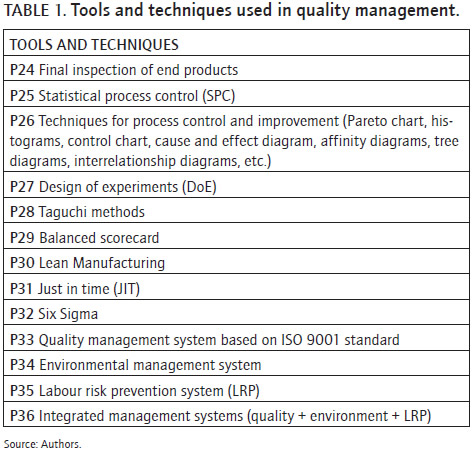
Scales used to measure variables are all five point Likert scales. To measure the complexity and level of integration of the quality tools and techniques we have employed 13 variables contained in Table 1 (P24 to P36), that show a broad range of quality tools that firms can use in a TQM context.
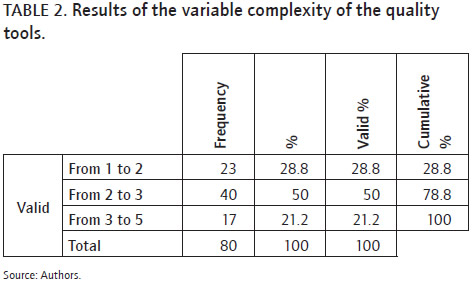
Complexity of the employed tools is a concept that has been measured through an index, considering a combination of the degrees of complexity of the different tools and its level of usage. Using experts' criteria we considered six degrees of complexity (in footnote 2 you can see the six groups of variables; every group is weighted differently depending on its degree of complexity). As a result, we have generated an index[2] that allowed us to measure the level of complexity in a five point scale. Three levels of complex ity were finally established (see Table 2). Results are summarized in Table 2.
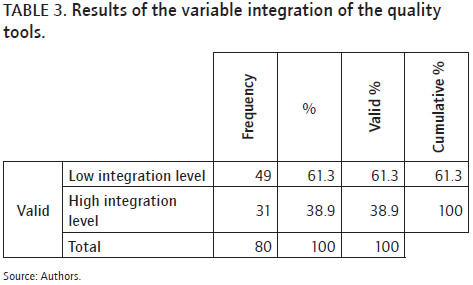
Integration of quality tools and techniques has been built taking a combination of the degree of use of Six Sigma tool and Integrated Management Systems (quality, environment and LRP) as a starting point. Again, we resorted to the criteria of experts to identify the indicators and the integration levels. Two levels of integration were finally established:
- Low level: The firm does not use these tools regularly.
- High level: The firm has a moderate/high level of usage of Six Sigma or/and Integrated Management Systems.
Results can be observed in Table 3.
We have measured the experience in quality management and the experience in the use of the EFQM model through two variables, P37 (Use of quality management) and P38 (Use of the EFQM Excellence Model) respectively in the original questionnaire. They were measured with a Likert scale, where: 1= less than a year; 2= between 1 & 2 years; 3= between 3 & 4 years; 4= between 5 & 7 years; 5= 8 years or more.
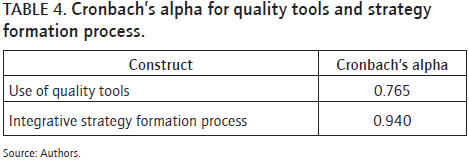
We have also measured the constructs "integrative strategy formation process" (variables P1 to P23) and "use of quality tools" (P24 to P36). We have analyzed internal consistency of both constructs through the Cronbach's alpha analysis to test their reliability. To this respect, Nunnally (1978) states that an exploratory research requires that the alpha value is equal or greater than 0.7. As we can appreciate, both constructs comply with the statistical requirements (see Table 4).
Additionally, we have developed an exploratory factor analysis and principal component analysis to establish a more coherent formation of the constructs. Results of rotated component matrix for the first construct "integrative strategy formation process" showed five factors explaining the 73.4% of variance, and the rest of statistics calculated (KMO, Bartlett's sphericity test) revealed the acceptability of the model. All the variables show values greater than 0.7 in their factors, and factors explain a great part of the variables analyzed.
Consequently, the structure of the construct "integrative strategy formation process" includes five factors with the following interpretation:
- FACTOR 1: Formalization and control (variables P7, P8, P11, P13 & P14)
- FACTOR 2: Degree of use of strategic analysis (variables P1, P2, P3 & P6)
- FACTOR 3: Employees' participation (variables P17, P18, P19 & P20)
- FACTOR 4: Reward systems (variables P22 & P23)
- FACTOR 5: Internal diagnosis (variable P5)
Results of the factor analysis are summarized in Table 5. Seven variables were removed from the analysis.
With respect to the second construct "use of quality tools" we have obtained four factors that explain the 63.7% of the variance. Statistic results are suitable and the final structure of the construct is formed by four groups of tools-four factors-that are understood as follows:
- FACTOR 1: Production-oriented quality tools (var. P27, P28, P30, P31 & P32)
- FACTOR 2: Management Systems (var. P33, P34, P35 & P36)
- FACTOR 3: Classical quality control tools (var. P24 & P25)
- FACTOR 4: Process control and improvement (var. P26 & P29)
Results are summarized in Table 6.
Also, as we want to analyze causal relationships among the considered variables we have employed correlations and linear regression analysis for the statistical contrast of the formulated hypotheses.
As we exposed in the theoretical framework, the hypotheses we have developed for our study are the following:
H1: The greater the experience of a firm in quality management, the more complex the quality tools and techniques that the firm applies are.
H2: The greater the experience of a firm in quality management, the more integrated the quality tools and techniques that the firm employs are.
H3: The greater the experience of a firm in the employment of the EFQM model, the more complex the quality tools and techniques that the firm applies are.
H4: The greater the experience of a firm in the application of the EFQM model, the more integrated the quality tools and techniques that the firm employs are.
Hypotheses H1 & H3 will be analyzed to test if there is any correlation between complexity and experience in quality management and the use of the EFQM Excellence Model. To do so, we have applied Spearman's correlations[3] (see Table 7).
From the analysis of the Spearman's Rho coefficient we can derive that experience in quality management permits the use of more complex tools; but we cannot conclude anything about the effect of the use of the EFQM Excellence Model on the complexity of the tools applied. Figure 1 shows the positive trend of complexity according to the increase of time and experience in the application of quality management.
As explained before in the Research methodology section, integration of quality tools and techniques is a concept obtained from a combination of two variables (the use of Six Sigma tool and Integrated Management Systems), obtaining as a result two integration levels (low and high).
To this respect, hypotheses H2 & H4 have been solved testing if there are significant differences on the integration level according to the experience of the firm in the application of quality management. To do so, we have employed the Pearson's Chi2 test -a non-parametric association test. This test is used to compare the proportion of firms in each integration level with respect to the different degrees of experience.
As shown in Table 8, the p-values of the association tests (p-value>0.05) reveal that there isn't a relationship between experience in quality management and experience in the application of the EFQM Excellence Model and the integration level of the tools and techniques applied.
Tables 9 and 10 contribute to explain this result. As can be observed in both tables, the percentage of firms classified in each integration level shows no significant differences with the global results for each degree of experience.
Bearing in mind all the results of the tests shown before, we may state that the degree of complexity of quality tools and techniques is only affected by the experience of the firm in quality management. However, neither the experience in quality management nor in the application of the EFQM model have a statistical relation with the degree of integration of quality tools and techniques. Table 11 illustrates the results of our study considering our initial hypotheses. Now, we have to test the degree of accomplishment of hypothesis 5 (see below).
H5: The use of complex or sophisticated quality tools and techniques such as the ISO 9001 standard or the BSC will have a positive impact on the level of formalisation and, in so doing, generate more rational strategy formation processes.
To do so, we have developed a correlation analysis between each one of the complex tools identified and the level of formalization and control-factor 1 of the construct integrative strategy formation process-to analyze the isolated influence of each technique. Afterwards, we have developed a multivariate model of linear regression to test if one of the techniques analyzed has more influence than other; that is, if a previous effect or relationship has changed with a joint analysis. Table 12 shows the Spearman's correlations relating the use of the tools and techniques with the level of formalization and control.
We can observe that, with the exception of the ISO 9001 standard, a greater use of complex quality tools produces a moderate raise of the formalization and control level. Above all, the use of the LRP system produces a clear and positive effect on formalization. The results with respect to the ISO 9001 standard are surprising, as the specialized literature assumes that the use of the ISO 9001 standards contributes to a clear formalization of organizational processes. But, in our case the results obtained indicate an opposite meaning. This fact may be mainly explained by the composition of our sample. The majority of the firms analyzed belong to the education sector, and these firms tend to apply the ISO 9001 standard in a very adaptive way, that is, introducing a low level of formalization in the documental system. Even more, some of them apply the EFQM Excellence Model and/or environmental standards but don't use the ISO 9001 standard, as they think the latter may restrict the application of the EFQM Excellence Model.
A multivariate model will permit to detect which of those tools are crucial in the increase of the level of formalization and control, as it considers interactions among variables and, in so doing, eliminates the redundant effects from the model and removes non-relevant variables. We have employed the stepwise method. The formulated regression model is illustrated in figure 2.
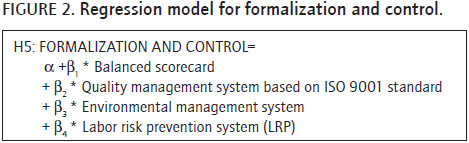
Table 13 shows the results of the regression analysis. As can be observed, the model has only included the LRP tool. The model is adequate as the F of Snedecor's value is significant at a 95% level (and also at a 99% level) and the Durbin-Watson statistic is also suitable (1.764).
However, the model does not completely explain the behavior of the formalization and control level (the R2 value is not very high: 0.086). As expected, this fact implies that there are other factors affecting the level of formalization and control in the strategy formation process different from those that are considered in the model. The equation resulting from the model we have proposed is the following[4].

As it can be seen, the tool that had a greater correlation with formalization and control has been incorporated into the model. This fact implies that the application of the rest of quality tools and techniques has a lesser and secondary effect on formalization and control.
Finally, we analyze if the experience in the application of the EFQM model affects the different variables we have employed in the theoretical framework to characterize the strategy formation process. In other words, if the strategy formation process becomes more participative or more formalized as a result of the application of the model.
Therefore, we must answer our research questions (see below).
RQ1: How the experience in the application of the EFQM model influences the strategy formation process?
RQ2: How the experience in the application of the EFQM model may modify the way through which quality tools and techniques are employed?
We have established 5 linear regression models in order to study the influence that the experience in the application of the EFQM model may have on the behaviour of service firms with respect to their use of quality tools and techniques and how they form their strategies. In these regression models the four factors or groups underlying the construct use of quality tools (see Table 6) become the independent variables, and the five factors or groups underlying the construct integrative strategy formation process (see Table 5) become the dependent variables. Also, the experience in the application of the EFQM Excellence Model will be introduced in this regression model as an independent variable to try to control its influence. Figure 3 illustrates the global model to be checked.
The linear regressions will be as follows:
FORMALIZATION AND CONTROL = α1 +β11 * Production- Oriented Quality Tools + β12 * Management Systems + β13 * Classical Quality Control Tools + β14 * Process Control and Improvement + β15 * Experience in EFQM Application
DEGREE OF USE OF STRATEGIC ANALYSIS = α2 +β21 * Production-Oriented Quality Tools + β22 * Management Systems + β23 * Classical Quality Control Tools + β24 * Process Control and Improvement + β25 * Experience in EFQM Application
EMPLOYEES' PARTICIPATION = α3 +β31 * Production-Oriented Quality Tools + β32 * Management Systems + β33 * Classical Quality Control Tools + β34 * Process Control and Improvement + β35 * Experience in EFQM Application
REWARD SYSTEMS = α4 +β41 * Production-Oriented Quality Tools + β42 * Management Systems + β43 * Classical Quality Control Tools + β44 * Process Control and Improvement + β45 * Experience in EFQM Application
INTERNAL DIAGNOSIS = α51 +β51 * Production-Oriented Quality Tools + β52 * Management Systems + β53 * Classical Quality Control Tools + β54 * Process Control and Improvement + β55 * Experience in EFQM Application
Table 14 summarizes the 5 regressions.
As Table 14 illustrates, all the models except from model 3 (Employees' participation) are suitable as the F of Snedecor values are significant at a 95% level and Durbin-Watson statistics are within the adequacy interval (1.5-2.5). However, these models do not have a great explicative capacity as the proportion of variance they explain does not reach, at best, 15%. Hence, as expected, there are other factors, apart from the ones that the model considers, that affect the strategy formation process.
After we have checked the adequacy of the models, the resulting equations are the following:
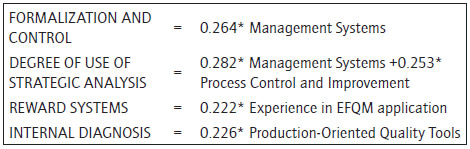
To end up with, figures 4, 5 and 6 illustrate the checked models as well as the significant relationships.


As suggested by the specialist literature, our research has revealed that the maturity or experience in the application of quality management affects the use of quality tools and techniques, and particularly affects the complexity of these tools and techniques. The greater the experience in quality management, the more complex the quality tools and techniques that the firm tends to apply.
However, this is not the case for those firms with a great experience in the application of the EFQM model. Our results do not allow us to make the same statement for these firms. One possible explanation to this fact is that the very nature of the model (it is a strategic framework) make companies to pay more attention to those tools and techniques with a greater strategic perspective. Also, the application of the EFQM Excellence Model is a result of the maturity and evolution in the application of a TQM framework for industrial firms (they firstly apply simpler tools; later, they apply more complex and sophisticated tools such as the ISO 9001 standard; and end up with the application of the EFQM model).
On the contrary, many service firms can be experienced in the use of the model, but don't need to have applied the ISO 9001 standard or use quality control tools previously. Different reasons contribute to explain this, among them, the nature of the activity, the requirements of the sector, or the culture of the firms competing in a particular service industry. In this case, it is very difficult to analyse the relationship between quality tools and techniques and experience, as in these cases complex tools such as the ISO 9001 standard are not commonly employed or are applied with more flexibility.
Also our results have revealed that neither the experience in quality management nor in the use of EFQM model show an influence on the level of integration of the tools and techniques analyzed. Probably, this result has to do with the fact that integrated management tools are more commonly used in production firms (i.e. lean manufacturing), and our analysis has been focused on the characteristics of the service firms. Consequently, our results can only support hypothesis H1.
With respect to the relationship between the use of complex (or more advanced) quality tools and techniques and rationality, our results show the existence of a positive correlation between the use of these sophisticated tools and techniques and formalisation. Particularly, our results show a positive and significant correlation with BSC, LRP and environmental standards and, in doing so, support H5. Results of the regression analysis show that labour risks prevention systems, among the different analyzed tools, have the greater influence on the level of formalization and control of the strategic process. The use of the ISO 9001 standard does not have a significant influence on the formalization construct. As we have exposed in the results section, many service firms belonging to education do not use this standard; it's a cultural question, as it has been observed in a qualitative work developed in the education sector (Balbastre et al., 2010).
Also, our study has revealed that the use of different groups of quality tools and techniques and the experience in the application of the model affect the strategy formation process. The use of management systems as well as tools for process control and improvement have a positive influence on the rational dimensions of the strategy formation process (formalization and control, and analysis). And the maturity in the application of the EFQM model leads to the use of reward systems that encourage autonomy and participation; these results show that a greater experience in the use of the EFQM model has an effect on the emergent dimension of the strategic process, as this experience promotes employees' participation. These results give support to literature suggesting that the use of the EFQM Excellence Model contributes to develop an integrative strategy formation process.
With the work presented here academicians may find a first approach to study how the use of quality tools and techniques is affected by the experience of the firm in the employment of a quality management framework. Also, it is noteworthy to see how the use of different tools and techniques affects the rationality and emergence of the strategic process, and how the experience in the use of the EFQM model facilitates the emergence of the strategy. Hence, we offer a new line of inquiry in this field that could be followed by academicians to deepen in the study of this phenomenon. Also, with this work businessmen can find evidence that the application of the EFQM model may contribute to generate more rational and emergent (integrative) organisational processes and a different application of quality tools and techniques.
Concerning the limitations of this research, we may state that a greater effort should be made in the literature review to analyse the effect of EFQM application on the use of quality tools and techniques. Also, the small size of our sample and the fact that we have only considered service firms may have conditioned our results. And some control variables such as the size of the firm or the characteristics of the activity developed should be considered in the analysis to try to avoid biases and to observe contextual effects that can enrich final results.
And last but not least, this research opens important future research lines. First of all, we could carry out the same study with a greater sample to see if the results remain similar. This would imply to broaden the sample size; but this effort would allow us to develop new and more complex statistical analysis that could enrich the results of the research. Also, we have studied how the experience in the use of the EFQM model modifies the use of quality tools and techniques. But a new research should be oriented to see if this change in the application of these tools and techniques also contributes to generate greater organisational results.
[1] These elements constitute the true spirit and philosophy behind the Model, since they represent the management culture underlying it. RADAR logic implies the need for a firm to establish goals in line with the organisation's policy and strategy, to plan actions taking these objectives as a starting point, to systematically deploy or implement what has been planned, to assess the results achieved, to try to learn from others, and to analyse organisational measures and what others are doing to identify vital information for improvement (EFQM, 2010). In other words, full-scale application of the RADAR logic contributes to ensuring that organisational processes become more rational, systematic and purpose-oriented.
[2] COM PLEX=(P24+2*(P25+P26)+3*(P27+P28)+4*(P30+P31+P32)+5*(P29+P33+P34+P35)+6*P36)/50.
[3] A version of Pearson' correlation when variables are not normally distributed.
[4] The equation of the model has been statistically tested.
Ahmed, A. M., Yang, J. B. & Dale, B. G. (2003). Self-assessment methodology: The route to business excellence. Quality Management Journal, 10(1), 43-57.
Alic, M. & Rusjan, B. (2011). Managerial relevance of internal audit. TQM Journal, 23(3), 284-300.
Andersen, T. J. (2004a). Integrating decentralized strategy making and strategic planning processes in dynamic environments. Journal of Management Studies, 41, 1271-1299.
Andersen, T. J. (2004b). Integrating the strategy formation process: An international perspective. European Management Journal, 22(3), 263-272.
Ansoff, H. I. (1965). Corporate strategy. New York, NY: McGraw-Hill.
Ansoff, H. I. (1991). Critique of Henry Mintzberg's The design school: Reconsidering the basic premises of strategic management. Strategic Management Journal, 12, 449-461.
Ansoff, H. I. & McDonell, E. (1990). Implanting strategic management. Englewood Cliffs, NY: Prentice-Hall.
Ansoff, H. I. & Sullivan, P. A. (1993). Optimizing profitability in turbulent environments: A formula for strategic success. Long Range Planning, 26(5), 11-22.
Balbastre, F. (2006). TQM Application through self-assessment and learning: Some experiences from two EQA applicants. The Quality Management Journal, 13(1), 7-25.
Balbastre, F., Redondo, A. & Revuelto, L. (2010). The EFQM model as a driver for organisational change. An especial reference to the strategy formation process. 1st Conference of the International Network of Business and Management Journals INBAM, Valencia.
Balbastre-Benavent, F. & Canet-Giner, M. T. (2011). The strategy formation process in the EFQM excellence model: A critical review and new perspectives. Total Quality Management & Business Excellence, 22(7), 727-742.
Banerji, K., Gundersen, D. E. & Behara, R. S. (2005). Quality management practices in Indian service firms. Total Quality Management & Business Excellence, 16(3), 321-330.
Bayo-Moriones, A., Merino-Díaz-de-Cerio, J., Escamilla-de-León, S. A. & Selvam, R. M. (2011). The impact of ISO 9000 and EFQM on the use of flexible work practices. International Journal of Production Economics, 130, 33-42.
Beaumont, N. B., Sohal, A. M. & Terziovski, M. (1997). Comparing quality management practices in the Australian service and manufacturing industries. The International Journal of Quality and Reliability Management, 14(8), 814-833.
Beck, N. & Walgenbach, P. (2003). ISO 9000 and formalization - How organizational contingencies affect organizational responses to institutional forces. Schmalenbach Business Review, 55(4), 293-320.
Behara, R. S. & Gundersen, D. E. (2001). Analysis of quality management practices in services. The International Journal of Quality and Reliability Management, 18(6), 584-603.
Brews, P. & Hunt, M. (1999). Learning to plan and planning to learn: Resolving the planning school/learning school debate. Strategic Management Journal, 20(10), 889-913.
Calvo-Mora, A., Leal, A. & Roldan, J. L. (2005). Relationships between the EFQM model criteria: A study in Spanish universities. Total Quality Management & Business Excellence, 16(6), 741-770.
Canet-Giner, M. T. & Balbastre-Benavent, F. (2011). Rationality, participation and results: The case of the European excellence model in a Spanish services context. The Service Industries Journal, 31(12), 1995-2017.
Chen, S. (2009). Establishment of a performance-evaluation model for service quality in the banking industry. The Service Industries Journal, 29(2), 235-247.
Clargo, M. (2004). The designer organisation: Organisations too can benefit from the application of design and quality tools, and with startling results! The International Journal of Quality & Reliability Management, 21(9), 973-983.
Conti, T. (1997). Organizational self-assessment. London: Chapman and Hall.
Conti, T. (2001). Why most companies do not give the most out of their self-assessments. 55th ASQ World Conference Proceedings, Milwaukee, 229-238.
Craig, J. & Moores, K. (2005). Balanced scorecards to drive the strategic planning of family firms. Family Business Review, 18(2), 105-122.
Dale, B. G. (2007). Tools and techniques: An overview. In B. G. Dale, A. van der Wiele & J. D. van Iwaarden (eds.), Managing quality (pp. 336-381). Oxford: Blackwell Publishing.
Dale, B. G., Boaden, R. J., Wilcox, M. & McQuater, R. E. (1998). The use of quality management techniques and tools: An examination of some key issues. International Journal of Technology Management, 16(4-6), 305-325.
Dale, B. G., van der Wiele, A. & van Iwaarden, J. D. (2007). TQM: An overview. In B. G. Dale, A. van der Wiele & J. D. van Iwaarden (eds.), Managing quality (pp. 3-38). Oxford: Blackwell Publishing.
De Mast, J. (2006). Six sigma and competitive advantage. Total Quality Management & Business Excellence, 17(4), 455-464.
Edvardsson, B., Johnson, M. D., Gustafsson, A. & Strandvik, T (2000). The effects of satisfaction and loyalty on profits and growth: Products versus services. Total Quality Management, 11(7), S917-S927.
Elbanna, S. (2006). Strategic decision-making: Process perspectives. International Journal of Management Reviews, 8(1), 1-20.
European Foundation for Quality Management (2010). EFQM excellence model 2010. Brussels: EFQM.
Fletcher, H. D. & Smith, D. B. (2004). Managing for value: Developing a performance measurement system integrating economic value added and the balanced scorecard in strategic planning. Journal of Business Strategies, 21(1), 1-17.
Floyd, S. W. & Wooldridge, B. (1996). The strategic middle manager: How to create and sustain competitive advantage. San Francisco, CA: Jossey-Bass.
Fotopoulos, C. & Psomas, E. (2009). The use of quality management tools and techniques in ISO 9001:2000 certified companies: The Greek case. International Journal of Productivity and Performance Management, 58(6), 564-580.
Garvin, D. A. (1991). How the Baldrige award really works. Harvard Business Review, 69(6), 80-93.
Ghobadian, A. & Woo, H. S. (1996). Characteristics, benefits and shortcomings of four major quality awards. International Journal of Quality and Reliability Management, 13(2), 10-44.
Goll, I. & Rasheed, A. M. A. (1997). Rational decision-making and firm performance: The moderating role of environment. Strategic Management Journal, 18(7), 583-591.
Grant, R. M. (2003). Strategic planning in a turbulent environment: Evidence from the oil majors. Strategic Management Journal, 24(6), 491-517.
Gupta, A., McDaniel, J. C. & Herath, S. K. (2005). Quality management in service firms: Sustaining structures of total quality service. Managing Service Quality, 15(4), 389-402.
Gustafsson, A., Nilsson, L. & Johnson, M. D. (2003). The role of quality practices in service organizations. International Journal of Service Industry Management, 14(2), 232-244.
Hart, S. L. & Banbury, C. (1994). How strategy-making processes can make a difference. Strategic Management Journal, 15, 251-269.
Hendricks, K. B. & Singhal, V. R. (1996). Quality awards and the market value of the firm: An empirical investigation. Management Science, 42, 415-436.
Hendricks, K. B. & Singhal, V. R. (1997). Does implementing an effective TQM program actually improve operating performance? Empirical evidence from firms that have won quality awards. Management Science, 43, 1258-1274.
Hendricks, K. B. & Singhal, V. R. (2001). Firm characteristics, total quality management, and financial performance. Journal of Operations Management, 19(3), 269-285.
Hickson, D. J., Miller, S. J. & Wilson, D. C. (2003). Planned or prioritized? Two options in managing the implementation of strategic decisions. Journal of Management Studies, 40, 1803-1836.
Hu, H., Kandampully, J. & Juwaheer, T. D. (2009). Relationships and impacts of service quality, perceived value, customer satisfaction, and image: An empirical study. The Service Industries Journal, 29(2), 111-125.
Jarzabkowski, P. & Spee, A. P. (2009). Strategy-as-practice: A review and future directions for the field. International Journal of Management Reviews, 11(1), 69-95.
Johnson, G., Melin, L. & Whittington, R. (2003). Micro strategy and strategizing: Towards an activity based view. Journal of Management Studies, 40(1), 3-22.
Kueng, P. (2000). Process performance measurement system: A tool to support process-based organizations. Total Quality Management, 11(1), 67-85.
Lawrie, G. & Cobbold, I. (2004). Third-generation balanced scorecard: Evolution of an effective strategic control tool. International Journal of Productivity and Performance Management, 53(7), 611- 623.
Lee, P. K. C., To, W. M. & Yu, B. T. W. (2009). The implementation and performance outcomes of ISO 9000 in service organizations. An empirical taxonomy. The International Journal of Quality & Reliability Management, 26(7), 646-662.
Leonard, D. & McAdam, R. (2001). The relationship between total quality management (TQM) and corporate strategy: The strategic impact of TQM. Strategic Change, 10(8), 439-448.
Leonard, D. & McAdam, R. (2002). The role of the business excellence model in operational and strategic decision making. Management Decision, 40(1), 17-25.
Leonard, D. & McAdam, R. (2003). An evaluative framework for TQM dynamics in organisations. International Journal of Operations and Production Management, 23(6), 652-677.
Leonard, D. & McAdam, R. (2004). Total quality management in strategy and operations: Dynamic grounded models. Journal of Manufacturing Technology Management, 15(3), 254-266.
Lewis, B. R. (2007). Managing service quality. In B. G. Dale, A. van der Wiele & J. D. van Iwaarden (eds.), Managing quality (pp. 234-257). Oxford: Blackwell Publishing.
Lewis, B. R. & Gabrielsen, G. O. S. (1998). Intraorganisational aspects of service quality management: The employees' perspective. The Service Industries Journal, 18(2), 64-89.
Lindblom, C. (1959). The science of muddling through. Public Administration Review, 19, 79-88.
Martinez-Costa, M. & Martinez-Lorente, A. R. (2004). ISO 9000 as a tool for TQM: A Spanish case study. Quality Management Journal, 11(4), 20-30.
McAdam, R. & Canning, N. (2001). ISO in the service sector: Perceptions of small professional firms. Managing Service Quality, 11(2), 80-92.
McAdam, R. & Leonard, D. (2005). A TQM dynamics perspective on Baldrige and business excellence model comparisons. Total Quality Management & Business Excellence, 16(6), 771-791.
McAdam, R. & O'Neill, E. (1999). Taking a critical perspective to the European business excellence model using a balanced scorecard approach: A case study in the service sector. Managing Service Quality, 9(3), 191-197.
McAdam, R., Leitch, C. & Harrison, R. (1998). The links between organisational learning and total quality: A critical review. Journal of European Industrial Training, 22(2), 47-56.
Merrill, P. (2003). ISO 9000:2000 - Less procedures and more planning. ASQ's Annual Quality Congress Proceedings, 57, 557-565.
Mintzberg, H. (1990a). Strategy formation: Ten schools of thought. In J. W. Fredrickson (ed.), Perspectives on strategic management (pp. 105-235). New York, NY: Harper Business.
Mintzberg, H. (1990b). The design school: Reconsidering the basic premises of strategic management. Strategic Management Journal, 11(3), 171-195.
Mintzberg, H. (1991). Learning 1, planning 0. Reply to Igor Ansoff. Strategic Management Journal, 12(6), 463-466.
Mintzberg, H., Ahlstrand, B. & Lampel, J. (1998). Strategy safari. Harlow: Prentice-Hall.
Nunnally, J. C. (1978). Psychometric theory. New York, NY: McGraw-Hill.
Pao, H., Wu, H. & Pan, W. (2010). How does a new institution spread? Travel agencies' adoption of the service quality assurance programme. The Service Industries Journal, 30(7), 1047-1061.
Porter, L., Oakland, J. & Gadd, K. (1998). Unlocking business performance with self assessment. Management Accounting, 76(8), 35-37.
Prasnikar, J., Debeljak, Z. & Ahcan, A. (2010). Benchmarking as a tool of strategic management. Total Quality Management & Business Excellence, 16(2), 257-275.
Quinn, J. B. (1978). Strategic change: Logical incrementalism. Sloan Management Review, 20(1), 7-21.
Regnér, P. (2003). Strategy creation in the periphery: Inductive versus deductive strategy making. Journal of Management Studies, 40(1), 57-82.
Rhee, S. & Rha, J. (2009). Public service quality and customer satisfaction: Exploring the attributes of service quality in the public sector. The Service Industries Journal, 29(11), 1491-1512.
Sigala, M. (2009). E-service quality and Web 2.0: Expanding quality models to include customer participation and inter-customer support. The Service Industries Journal, 29(10), 1341-1358.
Sinclair, D. & Zairi, M. (2000). Performance measurement: a critical analysis of the literature with respect to total quality management. International Journal of Management Reviews, 2(2), 145-168.
Slater, S. F., Olson, E. M. & Hult, G. T. M. (2006). The moderating influence of strategic orientation on the strategy formation capabilityperformance relationship. Strategic Management Journal, 27(12), 1221-1231.
Sousa, S. D., Aspinwall, E., Sampaio, P. A. & Guimarães, A. (2005). Performance measures and quality tools in Portuguese small and medium enterprises: Survey results. Total Quality Management & Business Excellence, 16(2), 277-307.
Srivastav, A. K. (2010). Impact of ISO 9000 implementation on the organisation. The International Journal of Quality & Reliability Management, 27(4), 438-450.
Suárez-Barraza, M. F. & Miguel-Dávila, C. B. (2009). En la búsqueda de un espacio de sostenibilidad: un estudio empírico de la aplicación de la mejora continua de procesos en ayuntamientos españoles. Innovar, 19(35), 47-64.
Szulanski, G. & Amin, K. (2001). Learning to make strategy: Balancing discipline and imagination. Long Range Planning, 34(5), 537-556.
Torres-Moraga, E. (2010). Escala propuesta para medir la calidad del servicio de los cines. Innovar, 20(36), 157-172.
van der Wiele, A., Williams, A. R. T., Brown, A. & Dale, B. G. (2001). The ISO 9000 series as a tool for organisational change: Is there a case? Business Process Management Journal, 7(4), 323-331.
Voelker, K. E., Rakich, J. S. & French, G. R. (2001). The balanced scorecard in healthcare organizations: A performance measurement and strategic planning methodology. Hospital Topics, 79(3), 13-24.
Wilcock, A., Karapetrovic, S., Boys, K. & Piche, P. (2006). Use of ISO 9004:2000 and other business excellence tools in Canada. The International Journal of Quality & Reliability Management, 23(7), 828-846.
Wilkinson, G. & Dale, B.G. (2007). Integrated management systems. In B. G. Dale, A. van der Wiele & J. D. van Iwaarden (eds.), Managing quality (pp. 310-335). Oxford: Blackwell Publishing.
Williams, R., Bertsch, B., van der Wiele, A., van Iwaarden, J. & Dale, B. G. (2006). Self-assessment against business excellence models: A critique and perspective. Total Quality Management and Business Excellence, 17(10), 1287-1300.
Woerner, S. (1991). Tools for quality management: ISO 9000 and Baldrige award. Adhesives Age, 34(13), 41-43.
Yang, C. & Yeh, C. (2009). An integrated implementation model of strategic planning, BSC and Hoshin management. Total Quality Management & Business Excellence, 20(9), 989-1002.
Referencias
Ahmed, A. M., Yang, J. B. & Dale, B. G. (2003). Self-assessment methodology: The route to business excellence. Quality Management Journal, 10(1), 43-57.
Alic, M. & Rusjan, B. (2011). Managerial relevance of internal audit. TQM Journal, 23(3), 284-300.
Andersen, T. J. (2004a). Integrating decentralized strategy making and strategic planning processes in dynamic environments. Journal of Management Studies, 41, 1271-1299.
Andersen, T. J. (2004b). Integrating the strategy formation process: An international perspective. European Management Journal, 22(3), 263-272.
Ansoff, H. I. (1965). Corporate strategy. New York, NY: McGraw-Hill.
Ansoff, H. I. (1991). Critique of Henry Mintzberg's The design school: Reconsidering the basic premises of strategic management. Strategic Management Journal, 12, 449-461.
Ansoff, H. I. & McDonell, E. (1990). Implanting strategic management. Englewood Cliffs, NY: Prentice-Hall.
Ansoff, H. I. & Sullivan, P. A. (1993). Optimizing profitability in turbulent environments: A formula for strategic success. Long Range Planning, 26(5), 11-22.
Balbastre, F. (2006). TQM Application through self-assessment and learning: Some experiences from two EQA applicants. The Quality Management Journal, 13(1), 7-25.
Balbastre, F., Redondo, A. & Revuelto, L. (2010). The EFQM model as a driver for organisational change. An especial reference to the strategy formation process. 1st Conference of the International Network of Business and Management Journals INBAM, Valencia.
Balbastre-Benavent, F. & Canet-Giner, M. T. (2011). The strategy formation process in the EFQM excellence model: A critical review and new perspectives. Total Quality Management & Business Excellence, 22(7), 727-742.
Banerji, K., Gundersen, D. E. & Behara, R. S. (2005). Quality management practices in Indian service firms. Total Quality Management & Business Excellence, 16(3), 321-330.
Bayo-Moriones, A., Merino-Díaz-de-Cerio, J., Escamilla-de-León, S. A. & Selvam, R. M. (2011). The impact of ISO 9000 and EFQM on the use of flexible work practices. International Journal of Production Economics, 130, 33-42.
Beaumont, N. B., Sohal, A. M. & Terziovski, M. (1997). Comparing quality management practices in the Australian service and manufacturing industries. The International Journal of Quality and Reliability Management, 14(8), 814-833.
Beck, N. & Walgenbach, P. (2003). ISO 9000 and formalization - How organizational contingencies affect organizational responses to institutional forces. Schmalenbach Business Review, 55(4), 293-320.
Behara, R. S. & Gundersen, D. E. (2001). Analysis of quality management practices in services. The International Journal of Quality and Reliability Management, 18(6), 584-603.
Brews, P. & Hunt, M. (1999). Learning to plan and planning to learn: Resolving the planning school/learning school debate. Strategic Management Journal, 20(10), 889-913.
Calvo-Mora, A., Leal, A. & Roldan, J. L. (2005). Relationships between the EFQM model criteria: A study in Spanish universities. Total Quality Management & Business Excellence, 16(6), 741-770.
Canet-Giner, M. T. & Balbastre-Benavent, F. (2011). Rationality, participation and results: The case of the European excellence model in a Spanish services context. The Service Industries Journal, 31(12), 1995-2017.
Chen, S. (2009). Establishment of a performance-evaluation model for service quality in the banking industry. The Service Industries Journal, 29(2), 235-247.
Clargo, M. (2004). The designer organisation: Organisations too can benefit from the application of design and quality tools, and with startling results! The International Journal of Quality & Reliability Management, 21(9), 973-983.
Conti, T. (1997). Organizational self-assessment. London: Chapman and Hall.
Conti, T. (2001). Why most companies do not give the most out of their self-assessments. 55th ASQ World Conference Proceedings, Milwaukee, 229-238.
Craig, J. & Moores, K. (2005). Balanced scorecards to drive the strategic planning of family firms. Family Business Review, 18(2), 105-122.
Dale, B. G. (2007). Tools and techniques: An overview. In B. G. Dale, A. van der Wiele & J. D. van Iwaarden (eds.), Managing quality (pp. 336-381). Oxford: Blackwell Publishing.
Dale, B. G., Boaden, R. J., Wilcox, M. & McQuater, R. E. (1998). The use of quality management techniques and tools: An examination of some key issues. International Journal of Technology Management, 16(4-6), 305-325.
Dale, B. G., van der Wiele, A. & van Iwaarden, J. D. (2007). TQM: An overview. In B. G. Dale, A. van der Wiele & J. D. van Iwaarden (eds.), Managing quality (pp. 3-38). Oxford: Blackwell Publishing.
De Mast, J. (2006). Six sigma and competitive advantage. Total Quality Management & Business Excellence, 17(4), 455-464.
Edvardsson, B., Johnson, M. D., Gustafsson, A. & Strandvik, T (2000). The effects of satisfaction and loyalty on profits and growth: Products versus services. Total Quality Management, 11(7), S917-S927.
Elbanna, S. (2006). Strategic decision-making: Process perspectives. International Journal of Management Reviews, 8(1), 1-20.
European Foundation for Quality Management (2010). EFQM excellence model 2010. Brussels: EFQM.
Fletcher, H. D. & Smith, D. B. (2004). Managing for value: Developing a performance measurement system integrating economic value added and the balanced scorecard in strategic planning. Journal of Business Strategies, 21(1), 1-17.
Floyd, S. W. & Wooldridge, B. (1996). The strategic middle manager: How to create and sustain competitive advantage. San Francisco, CA: Jossey-Bass.
Fotopoulos, C. & Psomas, E. (2009). The use of quality management tools and techniques in ISO 9001:2000 certified companies: The Greek case. International Journal of Productivity and Performance Management, 58(6), 564-580.
Garvin, D. A. (1991). How the Baldrige award really works. Harvard Business Review, 69(6), 80-93.
Ghobadian, A. & Woo, H. S. (1996). Characteristics, benefits and shortcomings of four major quality awards. International Journal of Quality and Reliability Management, 13(2), 10-44.
Goll, I. & Rasheed, A. M. A. (1997). Rational decision-making and firm performance: The moderating role of environment. Strategic Management Journal, 18(7), 583-591.
Grant, R. M. (2003). Strategic planning in a turbulent environment: Evidence from the oil majors. Strategic Management Journal, 24(6), 491-517.
Gupta, A., McDaniel, J. C. & Herath, S. K. (2005). Quality management in service firms: Sustaining structures of total quality service. Managing Service Quality, 15(4), 389-402.
Gustafsson, A., Nilsson, L. & Johnson, M. D. (2003). The role of quality practices in service organizations. International Journal of Service Industry Management, 14(2), 232-244.
Hart, S. L. & Banbury, C. (1994). How strategy-making processes can make a difference. Strategic Management Journal, 15, 251-269.
Hendricks, K. B. & Singhal, V. R. (1996). Quality awards and the market value of the firm: An empirical investigation. Management Science, 42, 415-436.
Hendricks, K. B. & Singhal, V. R. (1997). Does implementing an effective TQM program actually improve operating performance? Empirical evidence from firms that have won quality awards. Management Science, 43, 1258-1274.
Hendricks, K. B. & Singhal, V. R. (2001). Firm characteristics, total quality management, and financial performance. Journal of Operations Management, 19(3), 269-285.
Hickson, D. J., Miller, S. J. & Wilson, D. C. (2003). Planned or prioritized? Two options in managing the implementation of strategic decisions. Journal of Management Studies, 40, 1803-1836.
Hu, H., Kandampully, J. & Juwaheer, T. D. (2009). Relationships and impacts of service quality, perceived value, customer satisfaction, and image: An empirical study. The Service Industries Journal, 29(2), 111-125.
Jarzabkowski, P. & Spee, A. P. (2009). Strategy-as-practice: A review and future directions for the field. International Journal of Management Reviews, 11(1), 69-95.
Johnson, G., Melin, L. & Whittington, R. (2003). Micro strategy and strategizing: Towards an activity based view. Journal of Management Studies, 40(1), 3-22.
Kueng, P. (2000). Process performance measurement system: A tool to support process-based organizations. Total Quality Management, 11(1), 67-85.
Lawrie, G. & Cobbold, I. (2004). Third-generation balanced scorecard: Evolution of an effective strategic control tool. International Journal of Productivity and Performance Management, 53(7), 611- 623.
Lee, P. K. C., To, W. M. & Yu, B. T. W. (2009). The implementation and performance outcomes of ISO 9000 in service organizations. An empirical taxonomy. The International Journal of Quality & Reliability Management, 26(7), 646-662.
Leonard, D. & McAdam, R. (2001). The relationship between total quality management (TQM) and corporate strategy: The strategic impact of TQM. Strategic Change, 10(8), 439-448.
Leonard, D. & McAdam, R. (2002). The role of the business excellence model in operational and strategic decision making. Management Decision, 40(1), 17-25.
Leonard, D. & McAdam, R. (2003). An evaluative framework for TQM dynamics in organisations. International Journal of Operations and Production Management, 23(6), 652-677.
Leonard, D. & McAdam, R. (2004). Total quality management in strategy and operations: Dynamic grounded models. Journal of Manufacturing Technology Management, 15(3), 254-266.
Lewis, B. R. (2007). Managing service quality. In B. G. Dale, A. van der Wiele & J. D. van Iwaarden (eds.), Managing quality (pp. 234-257). Oxford: Blackwell Publishing.
Lewis, B. R. & Gabrielsen, G. O. S. (1998). Intraorganisational aspects of service quality management: The employees' perspective. The Service Industries Journal, 18(2), 64-89.
Lindblom, C. (1959). The science of muddling through. Public Administration Review, 19, 79-88.
Martinez-Costa, M. & Martinez-Lorente, A. R. (2004). ISO 9000 as a tool for TQM: A Spanish case study. Quality Management Journal, 11(4), 20-30.
McAdam, R. & Canning, N. (2001). ISO in the service sector: Perceptions of small professional firms. Managing Service Quality, 11(2), 80-92.
McAdam, R. & Leonard, D. (2005). A TQM dynamics perspective on Baldrige and business excellence model comparisons. Total Quality Management & Business Excellence, 16(6), 771-791.
McAdam, R. & O'Neill, E. (1999). Taking a critical perspective to the European business excellence model using a balanced scorecard approach: A case study in the service sector. Managing Service Quality, 9(3), 191-197.
McAdam, R., Leitch, C. & Harrison, R. (1998). The links between organisational learning and total quality: A critical review. Journal of European Industrial Training, 22(2), 47-56.
Merrill, P. (2003). ISO 9000:2000 - Less procedures and more planning. ASQ's Annual Quality Congress Proceedings, 57, 557-565.
Mintzberg, H. (1990a). Strategy formation: Ten schools of thought. In J. W. Fredrickson (ed.), Perspectives on strategic management (pp. 105-235). New York, NY: Harper Business.
Mintzberg, H. (1990b). The design school: Reconsidering the basic premises of strategic management. Strategic Management Journal, 11(3), 171-195.
Mintzberg, H. (1991). Learning 1, planning 0. Reply to Igor Ansoff. Strategic Management Journal, 12(6), 463-466.
Mintzberg, H., Ahlstrand, B. & Lampel, J. (1998). Strategy safari. Harlow: Prentice-Hall.
Nunnally, J. C. (1978). Psychometric theory. New York, NY: McGraw-Hill.
Pao, H., Wu, H. & Pan, W. (2010). How does a new institution spread? Travel agencies' adoption of the service quality assurance programme. The Service Industries Journal, 30(7), 1047-1061.
Porter, L., Oakland, J. & Gadd, K. (1998). Unlocking business performance with self assessment. Management Accounting, 76(8), 35-37.
Prasnikar, J., Debeljak, Z. & Ahcan, A. (2010). Benchmarking as a tool of strategic management. Total Quality Management & Business Excellence, 16(2), 257-275.
Quinn, J. B. (1978). Strategic change: Logical incrementalism. Sloan Management Review, 20(1), 7-21.
Regnér, P. (2003). Strategy creation in the periphery: Inductive versus deductive strategy making. Journal of Management Studies, 40(1), 57-82.
Rhee, S. & Rha, J. (2009). Public service quality and customer satisfaction: Exploring the attributes of service quality in the public sector. The Service Industries Journal, 29(11), 1491-1512.
Sigala, M. (2009). E-service quality and Web 2.0: Expanding quality models to include customer participation and inter-customer support. The Service Industries Journal, 29(10), 1341-1358.
Sinclair, D. & Zairi, M. (2000). Performance measurement: a critical analysis of the literature with respect to total quality management. International Journal of Management Reviews, 2(2), 145-168.
Slater, S. F., Olson, E. M. & Hult, G. T. M. (2006). The moderating influence of strategic orientation on the strategy formation capabilityperformance relationship. Strategic Management Journal, 27(12), 1221-1231.
Sousa, S. D., Aspinwall, E., Sampaio, P. A. & Guimarães, A. (2005). Performance measures and quality tools in Portuguese small and medium enterprises: Survey results. Total Quality Management & Business Excellence, 16(2), 277-307.
Srivastav, A. K. (2010). Impact of ISO 9000 implementation on the organisation. The International Journal of Quality & Reliability Management, 27(4), 438-450.
Suárez-Barraza, M. F. & Miguel-Dávila, C. B. (2009). En la búsqueda de un espacio de sostenibilidad: un estudio empírico de la aplicación de la mejora continua de procesos en ayuntamientos españoles. Innovar, 19(35), 47-64.
Szulanski, G. & Amin, K. (2001). Learning to make strategy: Balancing discipline and imagination. Long Range Planning, 34(5), 537-556.
Torres-Moraga, E. (2010). Escala propuesta para medir la calidad del servicio de los cines. Innovar, 20(36), 157-172.
van der Wiele, A., Williams, A. R. T., Brown, A. & Dale, B. G. (2001). The ISO 9000 series as a tool for organisational change: Is there a case? Business Process Management Journal, 7(4), 323-331.
Voelker, K. E., Rakich, J. S. & French, G. R. (2001). The balanced scorecard in healthcare organizations: A performance measurement and strategic planning methodology. Hospital Topics, 79(3), 13-24.
Wilcock, A., Karapetrovic, S., Boys, K. & Piche, P. (2006). Use of ISO 9004:2000 and other business excellence tools in Canada. The International Journal of Quality & Reliability Management, 23(7), 828-846.
Wilkinson, G. & Dale, B.G. (2007). Integrated management systems. In B. G. Dale, A. van der Wiele & J. D. van Iwaarden (eds.), Managing quality (pp. 310-335). Oxford: Blackwell Publishing.
Williams, R., Bertsch, B., van der Wiele, A., van Iwaarden, J. & Dale, B. G. (2006). Self-assessment against business excellence models: A critique and perspective. Total Quality Management and Business Excellence, 17(10), 1287-1300.
Woerner, S. (1991). Tools for quality management: ISO 9000 and Baldrige award. Adhesives Age, 34(13), 41-43.
Yang, C. & Yeh, C. (2009). An integrated implementation model of strategic planning, BSC and Hoshin management. Total Quality Management & Business Excellence, 20(9), 989-1002.
Cómo citar
APA
ACM
ACS
ABNT
Chicago
Harvard
IEEE
MLA
Turabian
Vancouver
Descargar cita
Visitas a la página del resumen del artículo
Descargas
Licencia
Derechos de autor 2011 Innovar

Esta obra está bajo una licencia internacional Creative Commons Reconocimiento-NoComercial-CompartirIgual 3.0.
Todos los artículos publicados por Innovar se encuentran disponibles globalmente con acceso abierto y licenciados bajo los términos de Creative Commons Atribución-No_Comercial-Sin_Derivadas 4.0 Internacional (CC BY-NC-ND 4.0).
Una vez seleccionados los artículos para un número, y antes de iniciar la etapa de cuidado y producción editorial, los autores deben firmar una cesión de derechos patrimoniales de su obra. Innovar se ciñe a las normas colombianas en materia de derechos de autor.
El material de esta revista puede ser reproducido o citado con carácter académico, citando la fuente.
Esta obra está bajo una Licencia Creative Commons: