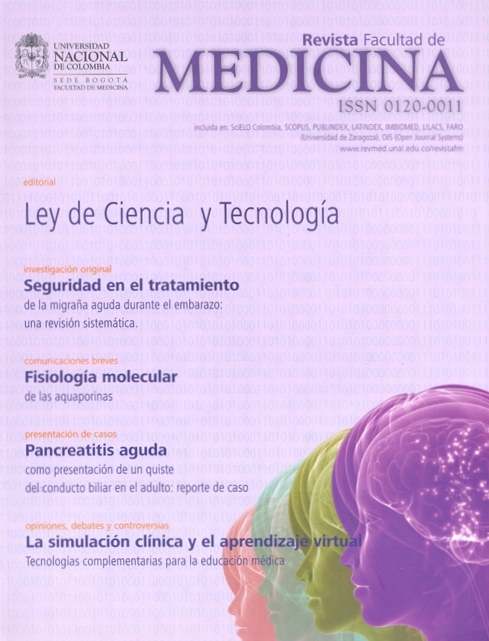
Publicado
Safety in the acute management of migraine during pregnancy: A sistematic Review
Seguridad en el tratamiento de la migraña aguda durante el embarazo: una revisión sistemática
Palabras clave:
migraine disorders, pregnancy, sumatriptan, congenital abnormalities. (en)transtornos de migraña, el embarazo, sumatriptán, anomalías congénitas. (es)
Background. Migraine is three times more frequent in females than males and is modulated by changes in ovarian hormones throughout different stages of a female's life; migraine thus begins with the onset of menstruation, improves during the second and third trimester of pregnancy and a remission may sometimes be brought about during menopause.
Objetive.Evaluating the safety of acute management of migraine during pregnancy.
Materials and methods.A systematic review was made of the literature concerning observational analytical studies. A systematic search and selection was made of all analytical studies (cohort studies and cases and controls studies) regarding the acute management of migraine during pregnancy published between January 1966 and September 2007. The search covered the COCHRANE, MEDLINE, EMBASE and LILACS databases. Data were extracted using the PECOT strategy bearing in mind the intervention strategy, methodological quality and presence of greater or lesser congenital malformations related to the different medicaments used for the acute management of migraine.Results. A total of 389 references were obtained of which 7 articles were selected by title and summary. Four articles complied with the inclusion criteria. No articles were found describing the risk of congenital malformations before being exposed to acetaminophen, antiinflammatory agents non-steroidal, ergot alkaloids and/ or opioids; just articles related to tryptans (specifically sumatryptan) were found.
Conclusions. Only data concerning the risk of congenital malformations arising from sumatryptan use was found regarding all the medicaments used for acute migraine attack, this being insufficient as the information was really poor and the studies had limitations, thereby making it difficult to make statements concerning their safety during pregnancy.
Antecedentes. La migraña es tres veces más frecuente en mujeres que en hombres y está modulada por cambios fisiológicos en los niveles de hormonas ováricas, durante las diferentes etapas de la vida de la mujer. La migraña se inicia con la aparición de la menstruación, mejora durante el segundo y tercer trimestre del embarazo y remite con frecuencia durante la menopausia. Objetivo. Evaluar la seguridad del tratamiento agudo de la migraña durante el embarazo.
Material y métodos. Se hizo una revisión sistemática de la literatura sobre estudios observacionales analíticos publicados entre enero de 1966 y septiembre de 2007. La búsqueda abarcó las bases de datos de COCHRANE, MEDLINE, EMBASE y LILACS. Los datos se obtuvieron mediante la utilización de PECOT teniendo en cuenta la estrategia de intervención, la calidad metodológica y la presencia de malformaciones congénitas relacionadas con los diferentes medicamentos utilizados para el tratamiento de la migraña aguda.
Resultados. Un total de 389 referencias se obtuvieron de los cuales siete artículos fueron seleccionados por el título y resumen. Cuatro artículos cumplieron con los criterios de inclusión. No se encontraron artículos que describen el riesgo de malformaciones congénitas antes de ser expuestos a acetaminofeno, antiinflamatorios no esteroideos, alcaloides del ergot y/o los opiáceos, sólo se encontraron artículos relacionados con triptanes.
Conclusión. Se encontró datos sobre el riesgo de malformaciones congénitas derivadas de la utilización del sumatriptan en relación con los medicamentos utilizados para el ataque agudo de migraña. La información fue escasa y los estudios tenían limitaciones, lo que hace difícil tener una guía sobre su seguridad durante el embarazo. Key words: trastornos de jaqueca, embarazo, sumatriptan, anomalías congénitas.
Referencias
Van de Ven RC, Kaja S, Plomp JJ, Frants RR, Van den Maagdenberg AM, Ferrari MD. Genetic models in migraine. Arch Neurol. 2007; 64:643-646.
Loder EW. Menstrual migraine: pathophysiology, diagnosis and impact. Headache. 2006; 46 [Suppl 2]:S55-S60.
Stewart WF. Lipton R. Silberstein S. Menstrual cycle and headache in a population sample of migraineurs. Neurology. 2000; 55: 1517-1523.
Wright DS, Patel MK. Focal migraine and pregnancy. BMJ. 1986; 293: 1557-1558.
Chancellor MD, Wroe SJ. Migraine occurring for the first time in pregnancy Headache. 1990; 30: 224- 227.
Stein GS. Headaches in the first postpartum week and their relationship to migraine. Headache. 1981; 21: 201-205.
Silberstein SD, Goadsby PJ, Lipton RB. Migraine: Diagnosis and treatment In Headache in Clinical Practice, pp 193-194. Isis Medical Media, Oxford 1998.
Stroup DF, Berlin JA, Morton SC, Olkin I, Williamson GD, Rennie D, et al. Meta-analysis of observational studies in epidemiology: a proposal for reporting. Meta-analysis of observational studies in epidemiology (MOOSE) Group. JAMA. 2000;283:2008-12.
New Zealand Guidelines Group Incorporated. Handbook for the preparation of explicit Evidence-based Clinical Practice Guidelines [Internet]. Wellington: NZGG; November 2001. [accessed on 26th April 2005]. Available at: http://www.nzgg.org.nz/download/ files/nzgg_guideline_handbook.pdf.
Moher D, Cook DJ, Eastwood S, Olkin I, Rennie D, Stroup DF. Improving the quality of reports of meta-analyses of randomised controlled trials: the QUORUM statement. Rev Esp Salud Publica. 2000; 74:107-118.
Kàllén B, Lygner PE. Delivery outcome in woman who used drugs for migraine during pregnancy with special reference to sumatriptan. Headache. 2001;41: 351-356.
Olesen C, Steffense FH, Sorensen HT, Nielsen GL, OlseN J. Pregnancy outcome following prescription for sumatriptan. Headache 2000;40: 20-24.
Maggioni F, Alessi C, Maggino T, Zanchin G. Headache during pregnancy. Cephalalgia. 1997; 17:765-769.
Shuhaiber S, Pastuszak A, Schick B, Matsui D, Spivey G, Brochu J, et al. Pregnancy outcome following first trimester exposure sumatriptan. Neurology. 1998;51:581-583.
Aromaa M, Rautava P, Lelenius H, Sillanpaa ML. Pre-pregnancy headache and the well-being of mother and newborn. Headache. 1996;36:409-415.
Reiff-Eldridge R, Heffner CR, Ephross SA, Tennis PS, White AD, Andrews EB. Monitoring pregnancy outcomes after prenatal drug exposure through prospective pregnancy registries: A pharmaceutical company commitment. Am J Obstet Gynecol. 2000;182:159-163.
O´Quinn S, Ephross A, Williams V, Davis RL, Gutterman DL, Fox AW. Pregnancy and perinatal outcomes in migraineurs using sumatriptan: a prospective study. Arch Gynecol Obstet. 1999;263: 7-12.
Fox AW, Chambers CD, Anderson PO, Diamond ML, Spierings EL. Evidence-based assessment of pregnancy outcome after sumatriptan exposure. Headache. 2002;42:8-15.
Visitas a la página del resumen del artículo
Descargas
Cómo citar
Licencia
Derechos de autor 2009 Revista de la Facultad de Medicina

Esta obra está bajo una licencia Creative Commons Reconocimiento 3.0 Unported.
-