Correo Electrónico
 DNINFOA - SIA
 Bibliotecas
 Convocatorias
 Identidad U.N.


Publicado
La encuesta como una estrategia educativa para propiciar en los estudiantes de Medicina, el análisis y la reflexión sobre el respeto a la confidencialidad.
The survey as an educational strategy to foster in students of medicine, analysis and reflection on the about confidentiality respect
Palabras clave:
bioética, aprendizaje, confidencialidad, estudiantes de medicina. (es)bioethics, learning, confidenciality, medicine students. (en)
Antecedentes. El desarrollo de la faceta bioética en los estudiantes de medicina constituye un gran reto educativo.
Objetivo. Propiciar en los estudiantes de medicina, a través de su participación en una encuesta, la reflexión sobre el respeto a la confidencialidad.
Material y métodos. Se incluyeron a 31 alumnos del curso de Bioética del octavo semestre. Se elaboró una encuesta con siete casos con implicaciones bioéticas, la cual, fue aplicada por los propios estudiantes, durante sus rotaciones clínicas, a 155 médicos a quienes se les preguntó si en cada caso respetaban o no la confidencialidad. Posteriormente, los alumnos resolvieron las preguntas: ¿cuál fue el caso de mayor controversia?, ¿qué problemáticas detectaste respecto a la confidencialidad?, ¿qué propones para favorecer las decisiones adecuadas en la confidencialidad?.
Resultados. Un caso de adicción y dos de enfermedades de transmisión sexual fueron los de mayor controversia; las problemáticas detectadas fueron: falta de conocimiento y experiencia respecto a la confidencialidad, decisiones éticas basadas en opiniones personales, temor de demandas por los pacientes; las propuestas que formularon los alumnos fueron: realización de sesiones de bioética, elaboración de guías, grupos de discusión, participación de comités de bioética e interconsulta con departamentos de bioética.
Conclusiones. La participación de los estudiantes en una encuesta, con casos de bioética, propició la reflexión sobre el respeto a la confidencialidad. Es importante que experiencias como ésta se implementen a fin de que los estudiantes examinen y articulen puntos de vista de otros, exploren el entorno en el cual se desenvuelven y, por ende, que contribuyan al desarrollo de su faceta bioética.
Background. The development of bioethics facet of medical students is a major educational challenge. Objective. Propitiate on medicine students a reflection regarding the respect of confidentiality through their participation on a survey.
Materials and methods. 31 students from the Bioethics course (8th semester) were included. A survey with seven cases with bioethical implications was created and later, applied by those students during their clinical rotations to 155 doctors. Later on, the students answered questions about confidentiality.
Results. A case of addiction and two of STD were the most controversial; the students proposals were: creation of bioethics committees, creation of guidelines, discussion groups, participation of bioethics committees and consultation with other bioethics departments.
Conclusions. The participation of students on a survey with bioethics cases led them to reflect on the respect of confidentiality. It is important implement experiences like this so that students can examine and articulate other people’s points of view, explore the environment in which they work and, therefore, contribute to the development of their bioethics approach.
OPINIONES, DEBATES Y CONTROVERSIAS
LA ENCUESTA COMO UNA ESTRATEGIA EDUCATIVA PARA PROPICIAR EN LOS ESTUDIANTES DE MEDICINA, EL ANÁLISIS Y LA REFLEXIÓN SOBRE EL RESPETO A LA CONFIDENCIALIDAD
The survey as an educational strategy to foster in students of medicine, analysis and reflection on the about confidentiality respect
María de la Luz Casas Martínez1 , David Servín Hernández2
1Médico Hematólogo. Doctor en Ciencias por UNAM, Jefe del Departamento de Bioética de la Escuela de Medicina de la Universidad Panamericana, México. Consejera de la Comisión Nacional de Bioética. Presidente de la Academia Nacional Mexicana de Biótica.2Maestro en Educación Médica por la UNAM, Subdirector de Educación Médica, Escuela de Medicina de la Universidad Panamericana, México. Correspondencia: mcasas@up.edu.mx Recibido: 20100810 Enviado a pares: 20100826 Aceptado publicación: 20100925
Resumen
Antecedentes. El desarrollo de la faceta bioética en los estudiantes de medicina constituye un gran reto educativo.
Objetivo. Propiciar en los estudiantes de medicina, a través de su participación en una encuesta, la reflexión sobre el respeto a la confidencialidad.
Material y métodos. Se incluyeron a 31 alumnos del curso de Bioética del octavo semestre. Se elaboró una encuesta con siete casos con implicaciones bioéticas, la cual, fue aplicada por los propios estudiantes, durante sus rotaciones clínicas, a 155 médicos a quienes se les preguntó si en cada caso respetaban o no la confidencialidad. Posteriormente, los alumnos resolvieron las preguntas: ¿cuál fue el caso de mayor controversia?, ¿qué problemáticas detectaste respecto a la confidencialidad?, ¿qué propones para favorecer las decisiones adecuadas en la confidencialidad?.
Resultados. Un caso de adicción y dos de enfermedades de transmisión sexual fueron los de mayor controversia; las problemáticas detectadas fueron: falta de conocimiento y experiencia respecto a la confidencialidad, decisiones éticas basadas en opiniones personales, temor de demandas por los pacientes; las propuestas que formularon los alumnos fueron: realización de sesiones de bioética, elaboración de guías, grupos de discusión, participación de comités de bioética e interconsulta con departamentos de bioética.
Conclusiones. La participación de los estudiantes en una encuesta, con casos de bioética, propició la reflexión sobre el respeto a la confidencialidad. Es importante que experiencias como ésta se implementen a fin de que los estudiantes examinen y articulen puntos de vista de otros, exploren el entorno en el cual se desenvuelven y, por ende, que contribuyan al desarrollo de su faceta bioética.
Palabras clave: bioética, aprendizaje, confidencialidad, estudiantes de medicina. Casas-Martínez M, Servín-Hernández D. La encuesta como una estrategia educativa para propiciar en los estudiantes de Medicina, el análisis y la reflexión sobre el respeto a la confidencialidad. rev.fac.med. 2010; 58: 353-360.
Summary
Background. The development of bioethics facet of medical students is a major educational challenge. Objective. Propitiate on medicine students a reflection regarding the respect of confidentiality through their participation on a survey.
Materials and methods. 31 students from the Bioethics course (8th semester) were included. A survey with seven cases with bioethical implications was created and later, applied by those students during their clinical rotations to 155 doctors. Later on, the students answered questions about confidentiality.
Results. A case of addiction and two of STD were the most controversial; the students proposals were: creation of bioethics committees, creation of guidelines, discussion groups, participation of bioethics committees and consultation with other bioethics departments.
Conclusions. The participation of students on a survey with bioethics cases led them to reflect on the respect of confidentiality. It is important implement experiences like this so that students can examine and articulate other peoples points of view, explore the environment in which they work and, therefore, contribute to the development of their bioethics approach.
Key words: bioethics, learning, confidenciality, medicine students.
Casas-Martínez M, Servín-Hernández D. The survey as an educational strategy to foster in students of medicine, analysis and reflection on the about confidentiality respect. rev.fac.med. 2010; 58: 353-360.
Introducción
El desarrollo de la faceta bioética en los estudiantes de medicina constituye un gran reto educativo (1). Uno de los primeros pasos para hacerle frente ha sido la implementación de diversas asignaturas de bioética en los planes de estudio, no obstante, también se ha señalado que tales cursos deben mejorarse (2).
Ha sido importante definir qué conocimientos bioéticos se han de enseñar a los alumnos, pero de antemano se ha considerado que las clases teóricas no son suficientes, por lo tanto, desde hace tiempo se ha puesto atención en la tarea de definir cuales serían las metodologías adecuadas, no solo para adquirir conocimientos teóricos sino sobre todo para establecer a lo largo de la carrera los escenarios académicos y clínicos adecuados que permitan al alumno vivir experiencias relevantes y estimular su análisis y su reflexión sobre los aspectos bioéticos (3).
En este sentido, ya se ha señalado la necesidad de aplicar los principios del aprendizaje basado en problemas a fin de identificar los problemas éticos de los casos clínicos, establecer necesidades de aprendizaje y discutir los modos de resolver los dilemas clínicos de índole bioética (4). Sin embargo, se reconoce que los estudiantes de medicina no llegan en estos escenarios educativos idóneos que les ayuden a aplicar lo aprendido teóricamente (5,6).
Por otro lado, no es fácil que los alumnos desarrollen su perfil ético si ellos se desenvuelven en ambientes clínicos adversos, es decir, se debe de tomar en cuenta el impacto negativo del denominado curriculum "oculto" que se da tanto en las escuelas como en las clínicas u hospitales. A menudo, en estos lugares los alumnos se exponen a constantes mensajes negativos y conflictivos acerca de la conducta ética en la práctica clínica (7,8).
Debido a todo lo anterior, para desarrollar la faceta ética en los estudiantes de medicina se requiere crear escenarios educativos adecuados que permitan estimular el análisis y la reflexión de los temas bioéticos, propiciar en los estudiantes el vivir y retroalimentarse de experiencias de aprendizaje significativas. Tales ambientes educativos no deben de estar alejados de los ambientes clínicos reales, en los cuales, los estudiantes se desenvuelven.
Asimismo, se han identificado diversas necesidades educativas, particularmente, en la formación de los principios bioéticos que subyacen en la atención y cuidado de los pacientes (9), en aspectos legales y con los enfermos terminales (10), acerca de las indicaciones de resucitación, sobre cómo comunicar malas noticias y lo relacionado con el consentimiento informado (11).
El respeto a la confidencialidad es una de las situaciones a la que se enfrentan frecuentemente los estudiantes (12), y a pesar de su importancia, no se le ha prestado atención en cómo la puede aprender el alumno. Por consiguiente, es primordial establecer cuales serían las estrategias de aprendizaje idóneos que favorezcan el desarrollo de dicha competencia ética (13).
El objetivo de este trabajo fue propiciar en los estudiantes de medicina, a través de su participación en una encuesta, la reflexión sobre el respeto a la confidencialidad.
Material y métodos
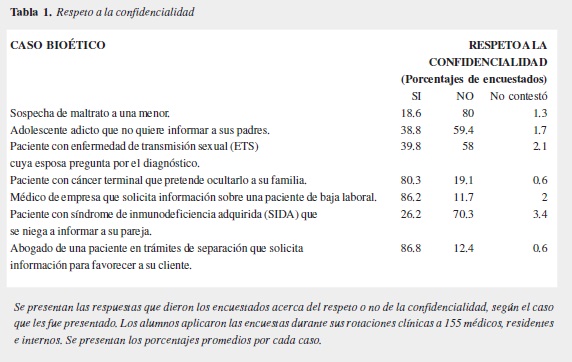
Se incluyeron a todos los alumnos (N=31) inscritos a la asignatura de Bioética III que se imparte en el octavo semestre de la carrera de medicina (Universidad Panamericana de México). Se elaboró una encuesta que incluyeron siete casos con implicaciones bioéticas: sospecha de maltrato a una menor; adolescente adicto que no quiere informar a sus padres; paciente con enfermedad de transmisión sexual (ETS) cuya esposa pregunta por el diagnóstico; paciente con cáncer terminal que pretende ocultarlo a su familia; médico de una empresa que solicita información de un paciente con baja laboral; paciente con síndrome de inmunodeficiencia adquirida (SIDA) que se niega a informar a su pareja; abogado que con información médica busca favorecer a su cliente. La encuesta fue aplicada por los propios alumnos, en los hospitales en los que se encontraban cumpliendo su rotación clínica, a 155 médicos, residentes e internos, a quienes se les preguntó individual y anónimamente si en cada caso descrito respetaban o no la confidencialidad.
Cada alumno aplicó un promedio de cinco encuestas. De acuerdo con la información que obtuvieron, los propios alumnos resolvieron por escrito las siguientes preguntas: ¿Cuál fue el caso de mayor controversia?, para lo cual, los alumnos estimaron para cada uno de los casos los porcentajes de los encuestados que señalaron el respeto o no a la confidencialidad o de quienes no contestaron, posteriormente, se compilaron los datos de todos los alumnos y se calcularon los porcentajes promedios por cada caso; ¿Qué problemáticas detectaste respecto a la confidencialidad? y ¿Qué propones para favorecer las decisiones adecuadas en el campo de la confidencialidad? Las respuestas que a éstas preguntas dieron los alumnos, se clasificaron y resumieron.
Resultados
Los alumnos identificaron como los casos de mayor controversia aquellos con un porcentaje de respeto a la confidencialidad menor del 40%: adolescente adicto (38.8%), ETS (39.8%) y SIDA (26.2%) (tabla 1).
Las problemáticas respecto a la confidencialidad detectadas por los alumnos fueron: falta de conocimiento respecto a la confidencialidad, decisiones éticas basadas en opiniones personales más que en principios éticos, falta de experiencia respecto a los casos planteados, indiferencia hacia los aspectos éticos, temor de demandas legales por parte de los pacientes.Las propuestas para favorecer las decisiones adecuadas en el campo de la confidencialidad que señalaron los alumnos fueron: realización de sesiones con casos bioéticos, elaboración de guías de confidencialidad, creación de grupos de discusión, mayor difusión de la ética, participación en la educación de los comités de bioética e interconsulta con departamentos de bioética en los hospitales y clínicas.
A continuación se presentan ejemplos representativos de las reflexiones que elaboraron por escrito los alumnos:
- Alumno A: "Noté lo complicado de tomar la decisión sobre en qué caso se debe guardar la
confidencialidad y en qué casos no, parecía que los encuestados no podían fundamentar sus respuestas.
Sería bueno reforzar las bases éticas, no es suficiente el criterio de cada persona para la decisión
en este tipo de casos, es necesario tener buenas bases éticas para tomar una buena decisión, sería
bueno prepararse en esto para el momento en que se necesite".
Alumno B: "Se hace notar que no hay suficiente información sobre los principios éticos que deben
manejarse en el ámbito médico ya que muchos entran en controversia al no tomar en cuenta las
consecuencias de una decisión. Sería importante una mayor información sobre las bases éticas durante
la formación de los estudiantes de medicina y también a los médicos para que los puedan
aplicar en su actuar clínico".
Alumno C: "Se encontró la duda respecto a cuando hay daño a terceros y cuando no, así como hasta
donde se puede y debe intervenir y la responsabilidad que ello conlleva. Los médicos deben preocuparse
por las situaciones que repercuten en la familia, en lo emocional, incluso, en lo social".
Alumno D: "Les costó trabajo decidirse tal vez porque sus ideas no están bien definidas, la mayoría
estuvo de acuerdo en el paciente con cáncer pero cuando llegaban al caso de SIDA entraban en
controversia y no estaban seguros de la respuesta. Parece que no tienen mucha información acerca
de la confidencialidad y con frecuencia no toman en cuenta la importancia del tema. Es importante
reforzar los principios éticos con casos clínicos y poner una oficina de orientación bioética en los
hospitales".
A fin de desarrollar la faceta ética de los estudiantes de medicina se deben de incorporar escenarios educativos que propicien un aprendizaje significativo. Este trabajo contribuye a ello ya que muestra cómo la participación de los estudiantes en la aplicación de una encuesta que incluye casos con implicaciones bioéticas, favorece las tareas de análisis y reflexión. Se enfoca en el respeto a la confidencial, tema que ha recibido una escasa atención en la implementación de las estrategias de aprendizaje de la bioética.
El análisis que los alumnos hacen se centró en qué caso acerca de la confidencialidad fue más polémico, y la reflexión de ellos mismos, se enfocó sobre las problemáticas detectadas y qué es lo que proponen para mejorar las decisiones respecto a la confidencialidad.
La importancia de la encuesta, como una tarea cumplida por los estudiantes, es que representa una experiencia que vivieron los alumnos y que les permitió explorar el entorno en el cual se desenvuelven, examinar y articular los puntos de vista de otros, y emitir sus propias conclusiones. Esto contribuye al desarrollo de su faceta bioética puesto que promueve la participación activa como mediadora del aprendizaje significativo
Los estudiantes en general le ponen mayor atención a lo largo de su carrera al conocimiento básico y clínico porque es lo que relacionan directamente con la función del médico, y los aspectos éticos los ven importantes pero no atractivos pues parecería que se ofrecen escenarios educativos poco atractivos. Al ponerles una tarea que promueva su participación y favorezca su reflexión, puede ayudar a que los estudiantes vean a la bioética menos distante al quehacer del médico y más interesante su estudio.
Se encontró que el análisis y reflexión les permitió identificar los casos más polémicos en cuanto al respeto de la confidencialidad. Para esto, los alumnos tuvieron que aplicar sus conocimientos teóricos y darse cuenta así de lo que han aprendido hasta ese momento. En esta medida, también los alumnos detectaron cuales fueron las problemáticas latentes: escaso conocimiento de los principios éticos relacionados con la confidencialidad o actitudes negativas hacía el ejercicio de la bioética. De este modo, ellos mismos, como estudiantes testifican dichas problemáticas y esto favorece la generación de una visión diferente a su propia formación bioética y de ocuparse en soluciones (14).
De hecho, se observó que los alumnos, en sus reflexiones, reconocieron por ellos mismos la necesidad de poner atención en aprender sobre los aspectos éticos, esto coincide con otros señalamientos que ya se han hecho (15,16). Cabe destacar que tal conclusión no es porque se les dio la información sino que se deriva de un hallazgo encontrado en su propia tarea de conocer la realidad que los rodea, es decir, su participación en la encuesta les permitió hacer sus propios descubrimientos. Esto permite promover que el alumno sea más analítico, perceptivo y reflexivo, elementos fundamentales a lo largo de su formación bioética (17).
La limitación del estudio es que no es longitudinal, es decir, no hace seguimiento de los alumnos para observar si en ellos se mantiene la capacidad de reflexión o sobre todo si esto motiva en su actuar a decisiones bioéticas adecuadas o no; se requiere otro diseño de investigación para ello.
Asimismo, un paso que necesariamente debe darse es establecer un plan de aprendizaje de la bioética desde la mira del desarrollo de las competencias del médico (18), es decir, que en forma integrada los estudiantes adquieran el conocimiento teórico de índole bioética, el saber cómo aplicar dicho conocimiento y, sobre todo, el desarrollar las actitudes, el razonamiento, y el criterio para tomar decisiones bioéticas consistentes.
Conclusiones
A pesar de que en las dos últimas décadas se ha puesto mucha atención en el profesionalismo médico, la formación relacionada con los temas bioéticos es muy compleja. Se ha señalado que son escasas las oportunidades que se les brindan a los alumnos para ocuparse de los temas de bioética de una manera significativa (19). En este trabajo, se ha planteado la encuesta como una estrategia educativa para promover en los alumnos su incorporación en una experiencia para conocer su entorno en relación al respeto de la confidencialidad, y se ha mostrado cómo les facilita el análisis y la reflexión de sus propios hallazgos. Es importante continuar construyendo escenarios educativos de esta naturaleza para que, siendo parte integral del currículo de medicina, contribuyan a la formación de la faceta ética del estudiante de medicina.
Agradecimientos
A todos los alumnos quienes con su participación entusiasta y responsable, junto con sus valiosas reflexiones, hicieron posible la realización de este trabajo.
Referencias
1. Branch W. The ethics of caring and medical education. Acad Med. 2000; 75: 127-132.
2. DuBois JM, Burkemper J. Ethics education in U.S. medical schools: a study of syllabi. Acad Med. 2002; 77: 432- 437.
3. Fentem P. Methods of teaching medical ethics at the University of Nottingham. J Med Ethics. 1985; 11: 27-28.
4. Tysinger J, Klonis L, Sadler J, Wagner J. Teaching ethics using small-group, problem-based learning. Med Ethics. 1997; 23: 315-318.
5. Roberts L, Teresita M, Lyketsos C, Hardee JT, Jacobson J, Walter R. What and how psychiatry residents at ten training programs wish to learn ethics. Acad Psychiatry. 1996; 20: 131-143.
6. Ginsburg S, Regehr G, Lingard L. The disavowed curriculum: understanding students reasoning in professionally challenging situations. J Gen Intern Med. 2003; 18: 1015-1022.
7. Hundert EM, Hafferty F, Christakis D. Characteristics of the informal curriculum and trainees ethical choices. Acad Med. 1996; 71: 624-642.
8. Hafferty FW, Franks R. The hidden curriculum, ethics teaching, and the structure of medical education. Acad Med. 1994; 69: 861- 871.
9. Weiss L, Geppert C, Warner T, Green K, Prosen L. Bioethics principles, informed consent, and ethical care for special populations: curricular needs expressed by men and women physicians-in-training. Psychosomatics. 2005; 46: 440-450
10. Jacobson JA, Tolle SW, Stocking C, Siegler M. Internal medicine residents preferences regarding medical ethics education. Acad Med. 1989; 64: 760-764.
11. Angelos P, DaRosa DA, Derossis AM, Kim B. Medical ethics curriculum for surgical residents: results of a pilot project. Surgery. 1999; 126: 701-707.
12. Kleinman I, Baylis F, Rodgers S, Singer P. Bioethics for clinicians: 8. Confidentiality. CMAJ. 1997; 156: 521- 524.
13. Bickel J. Medical students professional ethics: defining the problems and developing resources. Acad Med. 1991; 66: 726-729.
14. Henderson P, Johnson M. An innovative approach to developing the reflective skills of medical students. BMC Medical Education. 2002; 2: 4.
15. Olukoya A. Attitudes of medical students to medical ethics in their curriculum. Med Educ. 1983; 17: 83-86.
16. Kao A, Lim M, Spevick J, Barzansky B. Teaching and evaluating students professionalism in US medical schools, 2002-2003. JAMA. 2003; 290: 1151-1152.
17. Lakhan S, Hamlet S, McNamee T, Laird C. Time for a unified approach to medical ethics. Philosophy, Ethics, and Humanities in Medicine. 2009; 4: 13.
18. Couceiro-Vidal A. Enseñanza de la bioética y planes de estudios basados en competencias. Educ Med. 2008; 11: 69-76.
19. Kanter S, Wimmers P, Levine A. In-depth learning: one schools initiatives to foster integration of ethics, values, and the human dimensions of medicine. Acad Med. 2007; 82: 405-409.
Referencias
Branch W. The ethics of caring and medical education. Acad Med. 2000; 75: 127-132.
DuBois JM, Burkemper J. Ethics education in U.S. medical schools: a study of syllabi. Acad Med. 2002; 77: 432- 437.
Fentem P. Methods of teaching medical ethics at the University of Nottingham. J Med Ethics. 1985; 11: 27-28.
Tysinger J, Klonis L, Sadler J, Wagner J. Teaching ethics using small-group, problem-based learning. Med Ethics. 1997; 23: 315-318.
Roberts L, Teresita M, Lyketsos C, Hardee JT, Jacobson J, Walter R. What and how psychiatry residents at ten training programs wish to learn ethics. Acad Psychiatry. 1996; 20: 131-143.
Ginsburg S, Regehr G, Lingard L. The disavowed curriculum: understanding student’s reasoning in professionally challenging situations. J Gen Intern Med. 2003; 18: 1015-1022.
Hundert EM, Hafferty F, Christakis D. Characteristics of the informal curriculum and trainees’ ethical choices. Acad Med. 1996; 71: 624-642.
Hafferty FW, Franks R. The hidden curriculum, ethics teaching, and the structure of medical education. Acad Med. 1994; 69: 861- 871.
Weiss L, Geppert C, Warner T, Green K, Prosen L. Bioethics principles, informed consent, and ethical care for special populations: curricular needs expressed by men and women physicians-in-training. Psychosomatics. 2005; 46: 440-450
Jacobson JA, Tolle SW, Stocking C, Siegler M. Internal medicine residents’ preferences regarding medical ethics education. Acad Med. 1989; 64: 760-764.
Angelos P, DaRosa DA, Derossis AM, Kim B. Medical ethics curriculum for surgical residents: results of a pilot project. Surgery. 1999; 126: 701-707.
Kleinman I, Baylis F, Rodgers S, Singer P. Bioethics for clinicians: 8. Confidentiality. CMAJ. 1997; 156: 521- 524.
Bickel J. Medical students’ professional ethics: defining the problems and developing resources. Acad Med. 1991; 66: 726-729.
Henderson P, Johnson M. An innovative approach to developing the reflective skills of medical students. BMC Medical Education. 2002; 2: 4.
Olukoya A. Attitudes of medical students to medical ethics in their curriculum. Med Educ. 1983; 17: 83-86.
Kao A, Lim M, Spevick J, Barzansky B. Teaching and evaluating students’ professionalism in US medical schools, 2002-2003. JAMA. 2003; 290: 1151-1152.
Lakhan S, Hamlet S, McNamee T, Laird C. Time for a unified approach to medical ethics. Philosophy, Ethics, and Humanities in Medicine. 2009; 4: 13.
Couceiro-Vidal A. Enseñanza de la bioética y planes de estudios basados en competencias. Educ Med. 2008; 11: 69-76.
Kanter S, Wimmers P, Levine A. In-depth learning: one school’s initiatives to foster integration of ethics, values, and the human dimensions of medicine. Acad Med. 2007; 82: 405-409.
Cómo citar
APA
ACM
ACS
ABNT
Chicago
Harvard
IEEE
MLA
Turabian
Vancouver
Descargar cita
Visitas a la página del resumen del artículo
Descargas
Licencia
Derechos de autor 2010 Revista de la Facultad de Medicina

Esta obra está bajo una licencia Creative Commons Reconocimiento 3.0 Unported.
-