Publicado
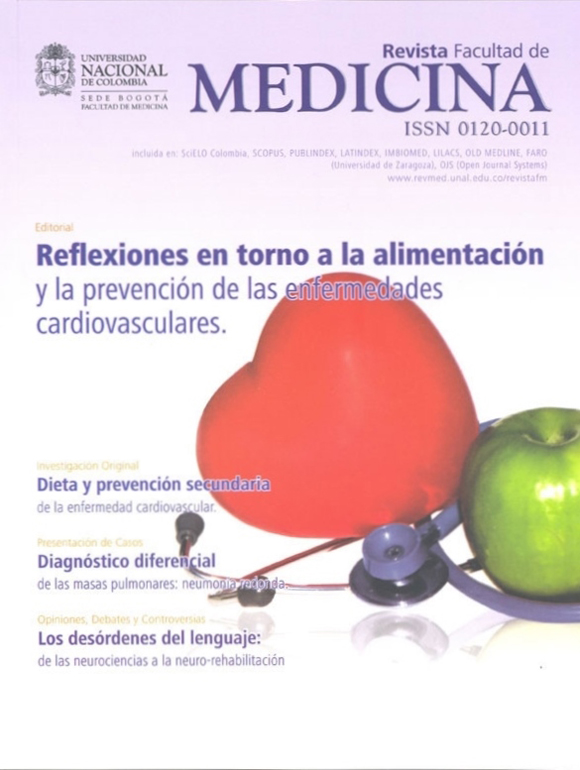
Dieta y prevención secundaria de la enfermedad cardiovascular
Diet and secondary prevention of cardiovascular disease
Palabras clave:
dieta, ácidos grasos omega-3, enfermedades cardiovasculares, prevención secundaria, tasa de mortalidad. (es)diet, fatty acids, omega-3, risk assessment, cardiovascular diseases, secondary prevention, mortality rate. (en)
Antecedentes. La evidencia de los efectos de la dieta como estrategia de manejo de los factores de riesgo cardiovascular en la prevención primaria es muy abundante y abarca todo tipo de situaciones y complicaciones, e incluye toda una gama de estudios desde casos y controles, cohortes retrospectivas, prospectivas y ensayos clínicos aleatorios controlados.
Objetivos. Establecer la evidencia a partir de estudios recientes y de guías revisadas y actualizadas de práctica clínica acerca de la prevención secundaria de la enfermedad cardiovascular mediante el manejo dietario.
Material y métodos. La búsqueda se realizó por medios electrónicos en las bases de datos con las palabras "secondary prevention", conexiones "Heart" y "cardiovascular risk". Se aceptaron únicamente los estudios cuyo objetivo principal fue la reducción de nuevos eventos cardiovasculares.
Resultados. La dieta de tipo mediterráneo mostró menores tasas de mortalidad global y de causa cardíaca. La dieta reductora de colesterol redujo la tasa de reinfartos y de aparición de angina, así como el infarto recurrente asociado al consumo del ácido graso 18:omega-3 (niveles de evidencia y recomendación: B-IIa). El pescado rico en grasa incrementó el riesgo de muerte y la muerte súbita por causa cardíaca en los sujetos con angina y favoreció la recurrencia de arritmias ventriculares (B-III). Los ácidos grasos omega-3 de pescado y vegetal no reducen los eventos cardiovasculares mayores en pacientes con terapia farmacológica adecuada antihipertensiva, antitrombótica y dislipidemia (B-III).
Conclusiones. Las dietas de tipo mediterráneo y reductora del colesterol ricas en ácidos grasos omega-3 probablemente tienen un efecto favorable en la prevención cardiovascular secundaria (B-IIa), este efecto desaparece si se asocia con tratamiento farmacológico de los factores cardiovasculares de riesgo (B-III). Los ácidos grasos omega-3 probablemente incrementan la mortalidad en pacientes con angina y favorecen la recurrencia de arritmias ventriculares (B-III).
Background. There is abundant evidence regarding the effects of diet as a strategy for managing cardiovascular risk factors in primary prevention, covering all types of situations and complications including a whole range of studies from cases and controls, retrospective cohorts, prospective studies to controlled random clinical trial.
Objectives. Establishing evidence from recent studies and revised and updated clinical practice guidelines about secondary prevention of cardiovascular disease by dietary management.
Materials and methods. Databases were electronically searched using the words «secondary prevention» and connectors «heart» and «cardiovascular risk.» Only studies whose main objective had been the reduction of new cardiovascular events were accepted.
Results. A Mediterranean-type diet was shown to be associated with lower overall mortality rates, particularly due to cardiac causes. A cholesterol-reducing diet lowered the recurrent heart-attack rate and appearance of angina, as well as recurrent heart-attacks associated with omega 3 fatty acid 18 consumption (recommendations and level of evidence: B-IIa). A fish fat oil rich diet increased the risk of death and sudden death from cardiac causes in subjects suffering from angina and favored the recurrence of ventricular arrhythmias (B-III). Omega-3 fatty acids from fish and vegetables did not reduce greater cardiovascular events in patients with suitable antihypertensive, antithrombotic and dyslipidaemia (BIII) pharmacological therapy.
Conclusions. Mediterranean-type diets and those reducing cholesterol rich in omega-3 fatty acids probably have a favourable effect on preventing secondary cardiovascular disease (B-IIa). Such effect disappears when associated with pharmacological treatment of cardiovascular risk factors (B-III). Omega-3 fatty acids probably increase mortality in patients suffering from angina and favour the recurrence of ventricular arrhythmias (B-III).
Referencias
Zarraga IGE, Schwarz ER. Impact of Dietary Patterns and Interventions on Cardiovascular Health. Circulation. 2006;114: 961-73.
Hu FB, Willett WC. Optimal Diets for Prevention of Coronary Heart Disease. JAMA. 2002; 288: 2569-78.
Rincón M, Sarmiento JM. Manejo no farmacológico de la hipertensión arterial y las dislipidemias. Rev Col Cardiol. 2006;12 (supl 1): 341-56.
Urina MA. Prevención cardiovascular y ácidos grasos. Rev Col Cardiol. 2006;12 (supl 1): 369-70.
Angarita CL. Ácidos grasos: una perspectiva interesante. Rev Col Cardiol. 2006;12 (supl 1): 371-73.
Ángel LA. Alcohol y enfermedad cardiovascular. Rev Col Cardiol 2006;12 (supl 1): 357-61.
Grundy SM. N-3 Fatty Acids. Priority for Post- Myocardial Infarction Clinical Trials (editorial). Circulation. 2003; 107: 1834-36.
Getz GS, Reardon CA. Nutrition and Cardiovascular Disease. Arterioscler Thromb Vasc Biol. 2007; 27: 2499-2506.
Spence JD. Nutrition and Stroke Prevention. Stroke 2006; 37: 2430-35.
Floras J, Bagai A. Polyunsaturated Fatty Acids and the Post-Infarct Patient. A Recipe for Baroreflex Health? (editorial comment). JACC. 2006;48:1607-09.
Tierney S, Fennessy F, Hayes DB. ABC of arterial and vascular disease. Secondary prevention of peripheral vascular disease. BMJ. 2000; 320: 1262-65.
Jacobson TA. Secondary Prevention of Coronary Artery Disease with Omega-3 Fatty Acids. Am J Cardiol. 2006; 98 (suppl): 61i-70i.
Smith SC Jr, Allen J, Blair SN, Bonow RO, Brass LM, Fonarow GC, et al. AHA/ACC Guidelines for Secondary Prevention for Patients With Coronary and Other Atherosclerotic Vascular Disease: 2006 Update: Endorsed by the National Heart, Lung, and Blood Institute. J Am Coll Cardiol. 2006; 47: 2130-39.
Leren P. The effect of plasma-cholesterol-lowering diet in male survivors of myocardial infarction. A controlled clinical trial. Bull N Y Acad Med. 1968; 44: 1012-20.
Barzi F, Woodward M, Marfisi M, Tavazzi L, Valagussa F, Marchioli R. Mediterranean diet and allcauses mortality after myocardial infarction: results from the GISSI Prevenzione trial. Europ J Clin Nutr. 2003; 57: 604-11.
Trichopoulou A, Bamia C, Trichopoulos D. Mediterranean Diet and Survival Among Patients With Coronary Heart Disease in Greece. Arch Intern Med. 2005; 165: 929-35.
British Medical Research Council. Controlled trial of soya-bean oil in myocardial infarction. Lancet. 1968; 2: 693-99.
Kris-Etherton P, Eckel RH, Howard BV. Lyon Diet Heart Study Benefits of a Mediterranean-Style, National Cholesterol Education Program/American Heart Association Step I Dietary Pattern on Cardiovascular Disease. Circulation. 2001;103: 1823-25.
Singh RA, Dubnov G, Niaz MA. Effect of an Indo- Mediterranean diet on progression of coronary artery disease in high risk patients (Indo-Mediterranean Diet Heart Study): a randomized single-blind trial. Lancet. 2002; 360: 1455-61.
Burr ML, Fehily AM, Gilbert JF, Rogers S, Holliday RM, Sweetnam PM, et al. Effects of changes in fat, fish, and fiber intakes on death and myocardial reinfarction: diet and reinfarction trial (DART). Lancet. 1989; 2: 757-61.
Burr ML, Ashfield-Watt PA, Dunstan FD, Fehily AM, Breay P, Ashton T, et al. Lack of benefit of dietary advice to men with angina: results of a controlled trial. Europ J Clin Nutr. 2003; 57: 193-200.
White C. Suspected research fraud: difficulties of getting at the truth. BMJ. 2005; 331: 281-88.
Kromhout D, Giltay EJ, Geleijnse JM; Alpha Omega Trial Group. n–3 fatty acids and cardiovascular events after myocardial infarction. N Engl J Med. 2010; 363: 2015-26.
Erkkilä AT, Lichtenstein AH, Mozaffarian D, Herrington DM. Fish intake is associated with reduced progression of coronary artery atherosclerosis in postmenopausal women with coronary artery disease. Am J Clin Nutr. 2004; 80: 626-32.
Erkkilä AT, Lehto S, Pyörälä K, Uusitupa MIJ. n_3 Fatty acids and 5-y risks of death and cardiovascular disease events in patients with coronary artery disease. Am J Clin Nutr. 2003; 78: 65-71.
Hooper L, Thompson RL, Harrison RA, Summerbell CD, Ness AR, Moore HJ, et al. Risks and benefits of omega 3 fats for mortality, cardiovascular disease, and cancer: systematic review. BMJ. 2006; 332; 752-60.
Wang C, Harris WS, Chung M, Lichtenstein AH, Balk EM, Kupelnick B, et al. n-3 Fatty acids from fish or fish-oil supplements, but not á-linolenic acid, benefit cardiovascular disease outcomes in primaryand secondary-prevention studies: a systematic review. Am J Clin Nutr. 2006; 84: 5-17.
European Heart Rhythm Association, Heart Rhythm Society, Zipes DP, Camm AJ, Borggrefe M, et al. ACC/AHA/ESC 2006 Guidelines for Management of Patients With Ventricular Arrhythmias and the Prevention of Sudden Cardiac Death: A Report of the American College of Cardiology/American Heart Association Task Force and the European Society of Cardiology Committee for Practice Guidelines (Writing Committee to Develop Guidelines for Management of Patients With Ventricular Arrhythmias and the Prevention of Sudden Cardiac Death). J Am Coll Cardiol. 2006; 48: 247-346.
Denke MA. Diet, Lifestyle, and Nonstatin Trials: Review of Time to Benefit. Am J Cardiol. 2005; 96: 3F-10F.
Newby LK, LaPointe NM, Chen AY, Kramer JM, Hammill BG, DeLong ER, et al. Long-Term Adherence to Evidence-Based Secondary Prevention Therapies in Coronary Artery Disease. Circulation. 2006;113: 203-12.
Capewell S, O'Flaherty M. Maximising secondary prevention therapies in patients with coronary heart disease. Heart. 2008; 94: 8-9.
Hackam DG, Spence JD. Combining Multiple Approaches for the Secondary Prevention of Vascular Events After Stroke A Quantitative Modeling Study. Stroke. 2007; 38: 1881-85.
Visitas a la página del resumen del artículo
Descargas
Cómo citar
Licencia
Derechos de autor 2011 Revista de la Facultad de Medicina

Esta obra está bajo una licencia Creative Commons Reconocimiento 3.0 Unported.
-