Publicado
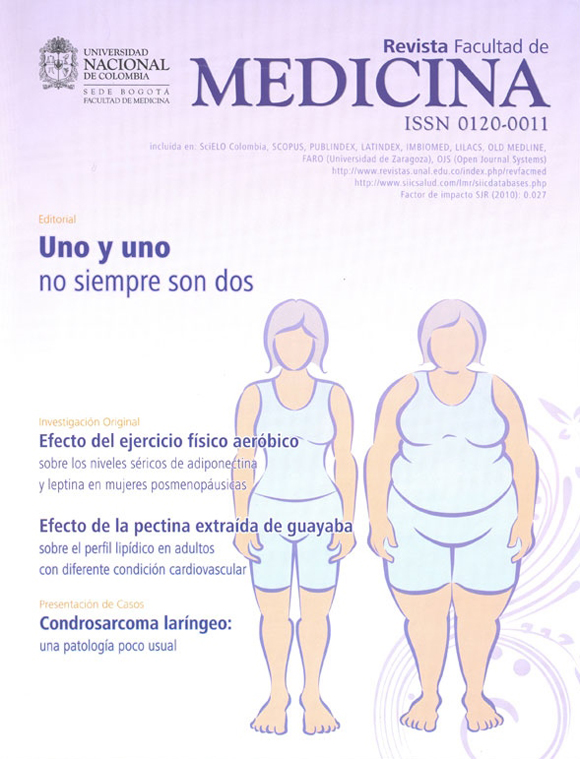
Efecto del ejercicio físico aeróbico sobre los niveles séricos de adiponectina y leptina en mujeres posmenopáusicas
The effect of aerobic exercise on serum adiponectin and leptin levels in postmenopausal females
Palabras clave:
leptina, adiponectina, posmenopausia, terapia por ejercicio, índice de masa corporal. (es)leptin, adiponectin, postmenopause, exercise, body mass index (BMI). (en)
Antecedentes. Las variaciones de peso corporal se acompañan de modificaciones en los niveles circulantes de adipocinas como la adiponectina y la leptina. Durante la posmenopausia se presenta una tendencia al incremento de peso. Se recomienda ejercicio físico, que tiene efectos sobre tejido adiposo y los factores de riesgo cardiovascular, como parte del tratamiento del sobrepeso y obesidad.
Objetivo. Determinar los efectos del ejercicio físico aeróbico controlado sobre los niveles sricos de adiponectina y leptina en mujeres posmenopáusicas con peso normal, sobrepeso u obesidad.
Material y mtodos. En un grupo de mujeres posmenopáusicas con peso normal (grupo N) y otro con sobrepeso u obesidad (grupo S), se estableció el impacto de un programa de ejercicio físico controlado supervisado de intensidad moderada a vigorosa (75-85% VO2máx), cuatro días por semana, por 16 semanas, sobre el peso, índice de masa corporal, porcentaje de grasa corporal y concentraciones sanguíneas de leptina y adiponectina. Para determinar la significancia estadística de las diferencias entre la semana 0 y 16 se utilizaron el test de Wilcoxon y el test de Mann-Whitney. Se consideró diferencia estadísticamente significativa cuando P < 0.05. Los análisis fueron efectuados con el software estadístico SPSS® 11.5.
Resultados. Se observó en el grupo N una disminución de peso, índice de masa corporal y porcentaje de grasa corporal despus del ejercicio físico, con significancia estadística para la reducción del peso (P< 0.01). En el grupo S la disminución en las tres variables antropomtricas fue estadísticamente significativa (P< 0.01). Se observó disminución de los niveles de leptina, con significancia estadística sólo en el grupo S (P<0.05). Las concentraciones de adiponectina aumentaron en el grupo S sin significancia estadística.
Conclusión. Si bien el ejercicio físico aeróbico controlado modificó benéficamente el peso en ambos grupos, los cambios en niveles circulantes de leptina se observaron sólo en mujeres con sobrepeso u obesidad. Las modificaciones de las concentraciones de adiponectina no presentaron significancia estadística.
Background. Body weight variations are usually accompanied by modifications occurring in levels of circulating adipokines, such as adiponectin and leptin. Women tend to gain weight during the postmenopausal period. Physical exercise is part of the recommended treatment for being overweight and suffering from obesity as it has effects on adipose tissue and cardiovascular risk factors.
Objective. Determining the effects of controlled aerobic exercise on normal weight, overweight and obese postmenopausal females' serum adiponectin and leptin levels.
Materials and methods. The impact of a supervised, controlled, physical exercise programme having moderate to vigorous intensity (75%-85% VO2máx) was established in a group of postmenopausal women having normal weight (group N) and another suffering from being overweight and/or obesity (group S). The programme involved four days a week and lasted for 16 weeks; weight, body mass index, body fat percentage and blood leptin and adiponectin concentrations were measured. Wilcoxon and Mann-Whitney tests were used for determining the statistical significance of differences between week 0 and 16. Differences were considered to be statistically significant when p<0.05. SPSS® 11.5 statistical software was used for such analysis.
Results. A reduction in weight, body mass index and body fat percentage following physical exercise was observed in group N, weight-loss being statistically significant (p<0.01). The reduction of three anthropometric variables in group S was statistically significant (p<0.01). Lower leptin levels were observed, only being statistically significant in group S (p<0.05). Adiponectin concentrations became increased in group S (not statistically significant).
Conclusion. Although controlled aerobic exercise may have led to beneficially modifying both groups' weight, changes in circulating leptin levels were only observed in overweight women or those suffering from obesity. Modifications in adiponectin concentrations were not statistically significant.
Referencias
Lobo RA. Metabolic syndrome after menopause and the role of hormones. Maturitas. 2008; 60: 10-18.
Izumi S, Muano T, Mori A, Kika G, Okuwaki S. Common carotid artery stiffness, cardiovascular function and lípid metabolismo after menopause. Life Sci. 2006; 78: 1696-1701.
Trayhum P. Endocrine and signalling role of adipose tissue: new perpectives on fat. Acta Physiol Scand. 2005; 184: 285-293.
Oswal A, Yeo G. Leptin and the control of body weight: a review of its diverse central targets, signaling mechanisms, and role in the pathogenesis of obesity. Obesity. 2010; 18: 221-229.
Guerre-Millo M. Adiponectin: an update. Diabetes Metab. 2008; 34: 12-18.
Kshatriya S, Reams GP, Spear RM, Freeman RH, Dietz JR, Villarreal D. Obesity hipertension: the emerging role of leptin in renal and cardiovascular dyshomeostasis. Curr Opin Nephrol Hypertens. 2010; 19: 72-78.
Han SH, Sakuma I, Shin EK, Koh KK. Antiatherosclerotic and anti-insulin resistance effects of adiponectin: basic and clinical studies. Prog Cardiovasc Dis. 2009; 52: 126-140.
Antoniades C, Antonopoulos AS, Tousoulis D, Stefanadis C. Adiponectin: from obesity to cardiovascular disease. Obes Rev. 2009; 10: 269-279.
You T, Nicklas BJ. Chronic inflammation: role of adipose tissue and modulation by weight loss. Curr Diabetes Rev. 2006; 2: 29-37.
Karolkiewicz J, Michalak E, Pospieszna B, Deskur-Smielecka E, Nowak A, Pilaczyñska-Szczeœniak £. Response of oxidative stress markers and antioxidant parameters to an 8-week aerobic physical activity program in healthy, postmenopausal women. Arch Gerontol Geriatr. 2009; 49: 67-71.
You T, Nicklas BJ. Effects of exercise on adipokines and the metabolic syndrome. Curr Diab Rep. 2008; 8: 7-11.
Polak J, Klincakova E, Moro C, Viquerie N, Berlan M, Hejnova J, et al Effect of aerobic training on plasma levels and subcutaneous abdominal adipose tissue gene expression of adiponectin, leptin, interleukin 6, and tumor necrosis factor alpha in obese women. Metabolism. 2006; 55:1375-1381.
Berg AH, Combs TP, Scherer PE. ACRP30/adiponectin: an adipokine regulating glucose and lipid metabolism. Trends Endocrinol Metab. 2002; 13: 84-89.
Corica F, Corsonello A, Lucchetti M, Malara A, De Domenico D, Cannavò L, et al. Relationship between metabolic syndrome and platelet responsiveness to leptin in overweight and obese patients. Int J Obes. 2007; 31: 842-849.
Pinet BM, Prud'homme D, Gallant CA, Boulay P. Exercise intensity prescription in obese individuals. Obesity. 2008; 16: 2088-2095.
Ministerio de Salud Resolución Número 8430 de 1993 Manejo ético de la investigación con seres humanos. (Octubre 4).
Ogden CL, Carroll MD, Curtin LR, McDowell MA, Tabak CJ, Flegal KM. Prevalence of overweight and obesity in the United States,1999-2004. JAMA. 2006; 295: 1549-1555.
Asikainen TM, Kukkonen-Harjula K, Miilunpalo S. Exercise for health for early postmenopausal women: a systematic review of randomised controlled trials. Sports Med. 2004; 34: 753-778.
Kraemer RR, Chu H, Castracane VD. Leptin and exercise. Exp Biol Med. 2002; 227: 701-708.
Kraemer RR, Johnson LG, Haltom R, Kraemer GR, Hebert EP, Gimpel T, et al. Serum leptin concentrations in response to acute exercise in postmenopausal women with and without hormone replacement therapy. Proc Soc Exp Biol Med. 1999; 221: 171-177.
Torjman MC, Zafeiridis A, Paolone AM, Wilkerson C, Considine RV. Serum leptin during recovery following maximal incremental and prolonged exercise. Int J Sports Med. 1999; 20: 444-450.
Thong FS, Hudson R, Ross R, Janssen I, Graham TE. Plasma leptin in moderately obese men: independent effects of weight loss and aerobic exercise. Am J Physiol Endocrinol Metab. 2000; 279: E307-313.
Beltowski J. Adiponectin and resistin: new hormones of white adipose tissue. Med Sci Monit. 2003; 9: 55-61.
Díez JJ, Iglesias P. The role of the novel adipocytederived hormona adiponectin in human disease. Eur J Endocrinol. 2003; 148: 293-300.
Yamamoto Y, Hirose H, Saito I, Tomita M, Taniyama M, Matsubara K. Correlation of the adipocytederived protein adiponectin with insulin resistance index and serum high-density lipoprotein-cholesterol, independent of body mass index, in the Japanese population. Clin Sci. 2002; 103: 137-142.
Kriketos AD, Greenfield JR, Peake PW, Furler SM, Denyer GS, Charlesworth JA, et al. Inflammation, insulin resistance, and adiposity: a study of first-degree relatives of type 2 diabetic subjects. Diabetes Care. 2004; 27: 2033-2040.
Hulver MW, Zheng D, Tanner CJ, Houmard JA, Kraus WE, Slentz CA et al. Adiponectin is not altered with exercise training despite enhanced insulin action. Am J Physiol Endocrinol Metab. 2002; 283: E861-865.
Kondo T, Kobayashi I, Murakami M. Effect of exercise on circulating adipokine levels in obese young women. Endocr J. 2006; 53: 189-195.
Reinehr T, Roth C, Menke T, Andler W. Adiponectin before and after weight loss in obese children. J Clin Endocrinol Metab. 2004; 89: 3790-3794.
Sabin MA, Holly JM, Shield JP, Turner SJ, Grohmann MJ, Stewart CE, et al. Mature subcutaneous and visceral adipocyte concentrations of adiponectin are highly correlated in prepubertal children and inversely related to body mass index standard deviation score. J Clin Endocrinol Metab. 2006; 91: 332-335.
Visitas a la página del resumen del artículo
Descargas
Cómo citar
Licencia
Derechos de autor 2011 Revista de la Facultad de Medicina

Esta obra está bajo una licencia Creative Commons Reconocimiento 3.0 Unported.
-