
Publicado
Evaluación del síndrome de apnea-hipopnea obstructiva del sueño (SAHOS) mediante instrumentos de medición como escalas y fórmulas matemáticas
Evaluation of obstructive sleep apnea-hypopnea syndrome (OSAHS) using measurement instruments such as scales and mathematical formulas
DOI:
https://doi.org/10.15446/revfacmed.v65n1Sup.59561Palabras clave:
Psicometría, Síndromes de la apnea del sueño, Diagnóstico, Escalas. (es)Psychometrics, Sleep Apnea Syndromes, Diagnosis, Scales. (en)
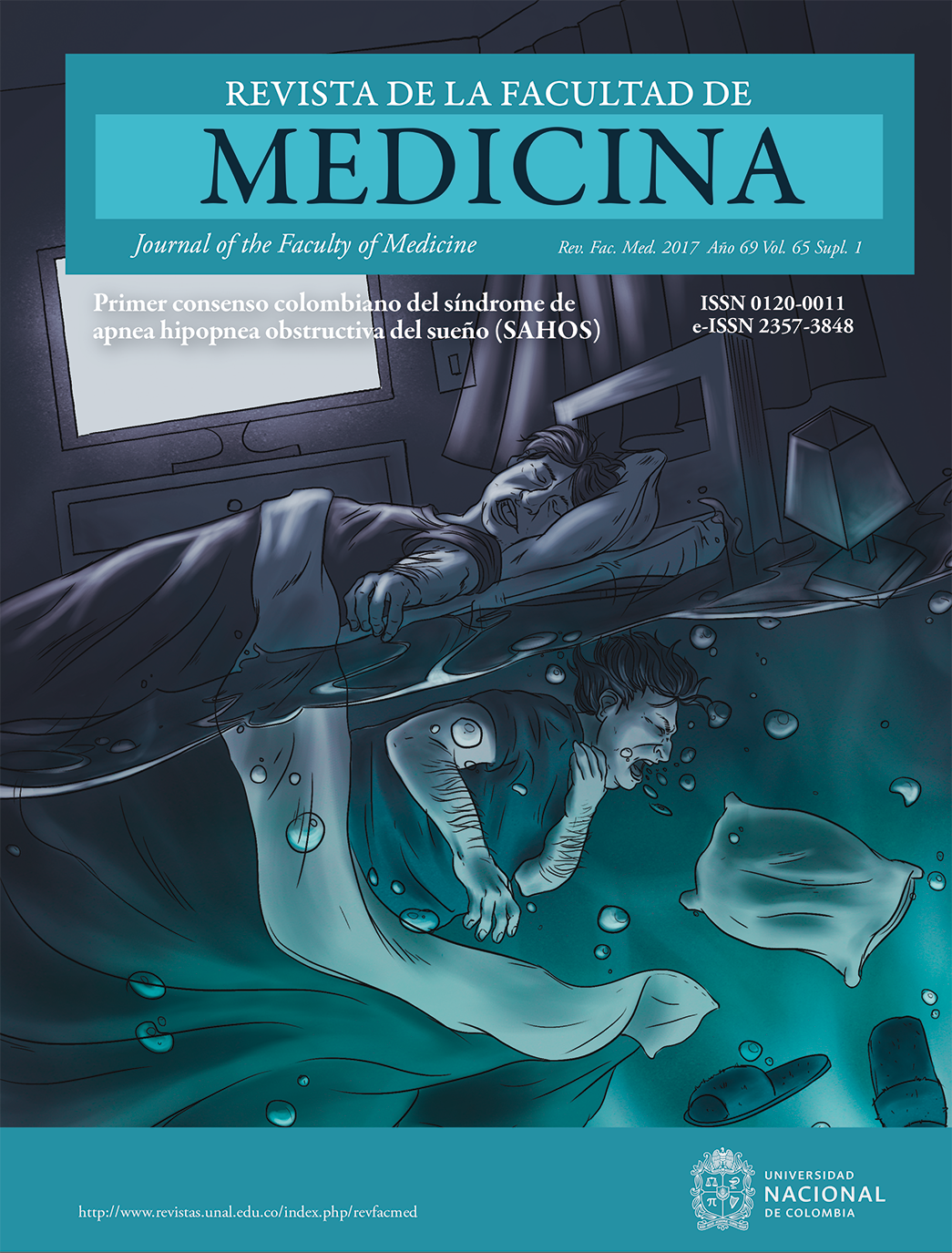
La psicometría del síndrome de apnea-hipopnea obstructiva del sueño (SAHOS) se puede proporcionar con el uso de variados métodos de evaluación como entrevistas clínicas, escalas, cuestionarios de sueño, autoregistros y registros psicofisiológicos. La prueba de oro para el diagnóstico de esta enfermedad sigue siendo la polisomnografía, la cual puede llegar a tener altos costos y dificultades para acceder al estudio. Debido a la alta morbimortalidad asociada a este síndrome, se requieren instrumentos que permitan la identificación rápida de individuos que puedan estar en riesgo de padecerlo. Por tales motivos, se han desarrollado herramientas que permiten detectar los pacientes en riesgo de presentar SAHOS, tales como el Cuestionario de Berlín, el STOP-Bang y la Escala de Somnolencia de Epworth. Es importante tener en cuenta los alcances y limitaciones de estas herramientas para escoger el instrumento indicado según lo que se desee evaluar.
Referencias
Ramachandran SK, Josephs LA. A meta-analysis of clinical screening tests for obstructive sleep apnea. Anesthesiology. 2009;110(4):928-39. http://doi.org/d5f8dc.
Netzer NC, Stoohs RA, Netzer CM, Clark K, Strohl KP. Using the Berlin Questionnaire to identify patients at risk for the sleep apnea syndrome. Ann Intern Med. 1999;131(7):485-91. http://doi.org/bnq4.
Chung F, Elsaid H. Screening for obstructive sleep apnea before surgery: why is it important? Curr Opin Anaesthesiol. 2009;22(3):405-11. http://doi.org/drpn5b.
Chung F, Subramanyam R, Liao P, Sasaki E, Shapiro C, Sun Y. High STOP-Bang score indicates a high probability of obstructive sleep apnoea. Br J Anaesth. 2012;108(5):768-75. http://doi.org/bnq5.
Chung F, Yang Y, Liao P. Predictive performance of the STOP-Bang score for identifying obstructive sleep apnea in obese patients. Obes Surg. 2013;23(12):2050-7. http://doi.org/bnq6.
Chung F, Liao P, Farney R. Correlation between the STOP-Bang score and the severity of Obstructive Sleep Apnea. Anesthesiology. 2015;122(6):1436-7. http://doi.org/bnq7.
Kim B, Lee EM, Chung YS, Kim WS, Lee SA. The utility of three screening questionnaires for obstructive sleep apnea in a sleep clinic setting. Yonsei Med J. 2015;56(3):684-90. http://doi.org/bnq8.
Polanía-Dussan I, Escobar-Cordoba F, Eslava-Schmalbach J, Netzer N. Validación colombiana del cuestionario de Berlín. Rev. Fac. Med. 2013;61(3):231-8.
Escobar-Córdoba F, Eslava-Schmalbach J. Validación colombiana del índice de calidad de sueño de Pittsburgh. Rev Neurol. 2005;40(3):150-5.
Chica-Urzola HL, Escobar-Córdoba F, Eslava-Schmalbach J. Validación de la Escala de Somnolencia de Epworth. Rev Salud Publica. 2007;9(4):558-67. http://doi.org/cpnqpz.
Chung F, Yegneswaran B, Liao P, Chung SA, Vairavanathan S, Islam S, et al. Validation of the Berlin questionnaire and American Society of Anesthesiologists checklist as screening tools for obstructive sleep apnea in surgical patients. Anesthesiology. 2008;108(5):822-30. http://doi.org/cskvs8.
Sharma SK, Vasudev C, Sinha S, Banga A, Pandey RM, Handa KK. Validation of the modified Berlin questionnaire to identify patients at risk for the obstructive sleep apnoea syndrome. Indian J Med Res. 2006;124(3):281-90.
Haraldsson PO, Carenfelt C, Knutsson E, Persson HE, Rinder J. Preliminary report: validity of symptom analysis and daytime polysomnography in diagnosis of sleep apnea. Sleep. 1992;15(3):261-3. http://doi.org/b626.
Weatherwax KJ, Lin X, Marzec ML, Malow BA. Obstructive sleep apnea in epilepsy patients: the Sleep Apnea scale of the Sleep Disorders Questionnaire (SA-SDQ) is a useful screening instrument for obstructive sleep apnea in a disease-specific population. Sleep Med. 2003;4(6):517-21. http://doi.org/bfbxx8.
Kushida CA, Efron B, Guilleminault C. A predictive morphometric model for the obstructive sleep apnea syndrome. Ann Intern Med. 1997;127(8 Pt 1):581-7. http://doi.org/bnk3.
Jung DG, Cho HY, Grunstein RR, Yee B. Predictive value of Kushida index and acoustic pharyngometry for the evaluation of upper airway in subjects with or without obstructive sleep apnea. J Korean Med Sci. 2004;19(5):662-7. http://doi.org/dnh5hm.
Gurubhagavatula I, Fields BG, Morales CR, Hurley S, Pien GW, Wick LC, et al. Screening for severe obstructive sleep apnea syndrome in hypertensive outpatients. J Clin Hypertens. 2013;15(4):279-88. http://doi.org/f4tfqx.
Gurubhagavatula I, Maislin G, Pack AI. An algorithm to stratify sleep apnea risk in a sleep disorders clinic population. Am J Respir Crit Care Med. 2001;164(10 Pt 1):1904-9. http://doi.org/bnrb.
Dixon JB, Schachter LM, O’Brien PE. Predicting sleep apnea and excessive day sleepiness in the severely obese: indicators for polysomnography. Chest. 2003;123(4):1134-41. http://doi.org/bj5pxz.
Gurubhagavatula I, Maislin G, Nkwuo JE, Pack AI. Occupational screening for obstructive sleep apnea in commercial drivers. Am J Respir Crit Care Med. 2004;170(4):371-6. http://doi.org/c4xjnr.
Battagel JM, L’Estrange PR. The cephalometric morphology of patients with obstructive sleep apnoea (OSA). Eur J Orthod. 1996;18(6):557-69. http://doi.org/bhdgfc.
Rodsutti J, Hensley M, Thakkinstian A, D’Este C, Attia J. A clinical decision rule to prioritize polysomnography in patients with suspected sleep apnea. Sleep. 2004;27(4):694-9. http://doi.org/b629.
Kirby SD, Eng P, Danter W, George CF, Francovic T, Ruby RR, et al. Neural network prediction of obstructive sleep apnea from clinical criteria. Chest. 1999;116(2):409-15. http://doi.org/b9t95n.
Ross SD, Sheinhait IA, Harrison KJ, Kvasz M, Connelly JE, Shea SA, et al. Systematic review and meta-analysis of the literature regarding the diagnosis of sleep apnea. Sleep. 2000;23(4):519-32. http://doi.org/b63b.
Braeckman L, Verpraet R, Van Risseghem M, Pevernagie D, De Bacquer D. Prevalence and correlates of poor sleep quality and daytime sleepiness in Belgian truck drivers. Chronobiol Int. 2011;28(2):126-34. http://doi.org/c3g5bj.
Netzer NC, Juhász J, Hofmann M, Hohl K, Strohl KP, Küpper TE. The need for pressure changes in CPAP therapy 2-3 months after initial treatment: a prospective trial in 905 patients with sleep-disordered breathing. Sleep Breath. 2011;15(1):107-12. http://doi.org/dbc6xd.
Hrubos-Strøm H, Einvik G, Nordhus IH, Randby A, Pallesen S, Moum T, et al. Sleep apnoea, anxiety, depression and somatoform pain: a community-based high-risk sample. Eur Respir J. 2012;40(2):400-7. http://doi.org/bnmt.
Dimensions
PlumX
Visitas a la página del resumen del artículo
Descargas
Cómo citar
Licencia
Derechos de autor 2017 Revista de la Facultad de Medicina

Esta obra está bajo una licencia Creative Commons Reconocimiento 3.0 Unported.
-









