Publicado
Fisiopatología del síndrome de apnea-hipopnea obstructiva del sueño (SAHOS)
Pathophysiology of obstructive sleep apnea-hypopnea syndrome (OSAHS)
DOI:
https://doi.org/10.15446/revfacmed.v65n1Sup.60091Palabras clave:
Síndromes de apnea del sueño, Sistema respiratorio, Hipercapnia, Hipofaringe, Nervio hipogloso. (es)Sleep Apnea Syndromes, Respiratory System, Hypercapnia, Hypopharynx, Hypoglossal Nerve. (en)
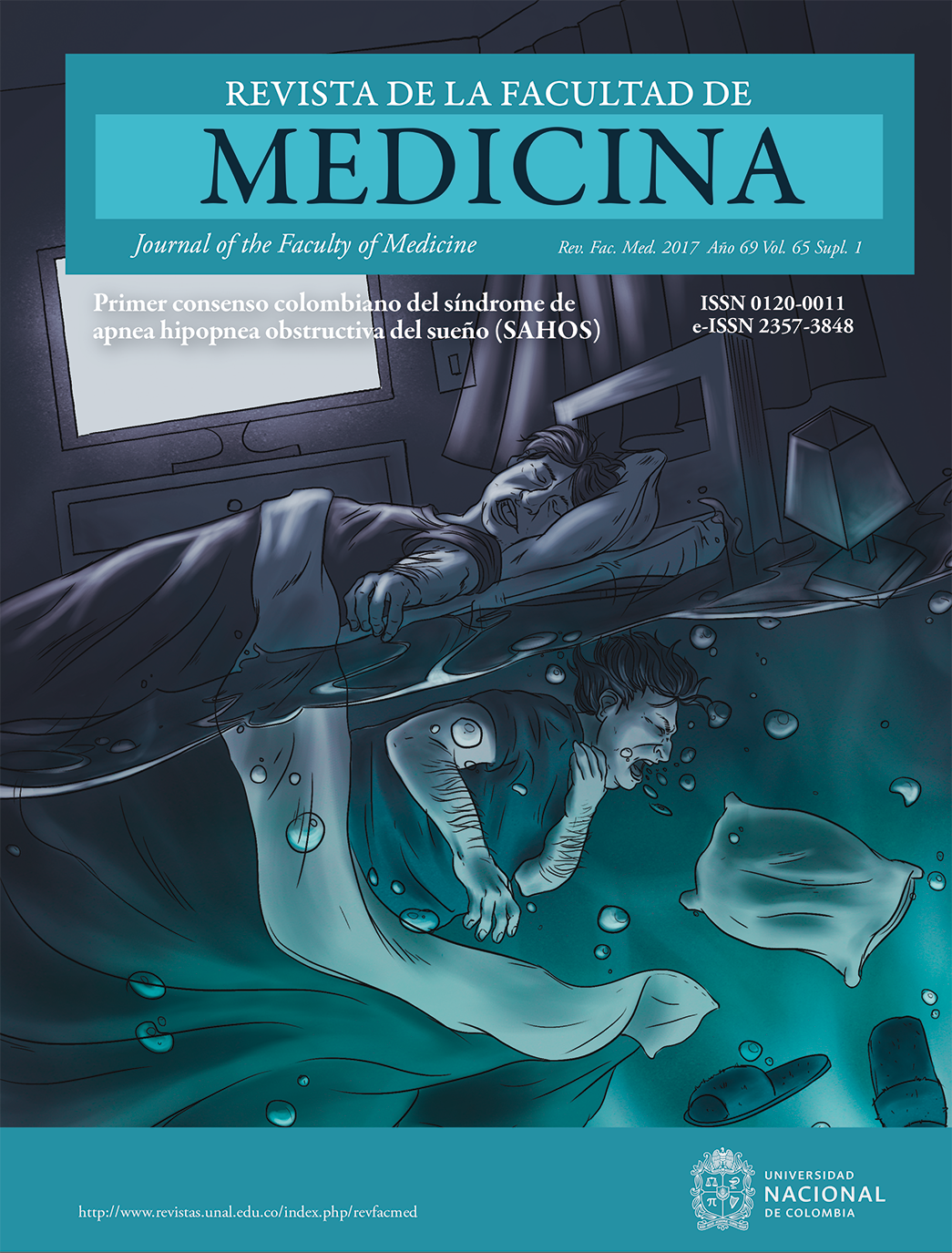
El síndrome de apnea-hipopnea obstructiva del sueño (SAHOS) es una enfermedad caracterizada por la obstrucción recurrente de la vía aérea superior (VAS), con disminución en el flujo de aire, hipoxemia intermitente y despertares durante el sueño. En la fisiopatología del SAHOS se presentan dos factores esenciales: las alteraciones anatómicas y la disminución o ausencia del control neural.
Durante el estudio del SAHOS se debe identificar el sitio o sitios de obstrucción de la VAS, que pueden ir desde las alas nasales hasta la hipofaringe. Otro factor importante en este síndrome es el influjo nervioso en el tono muscular de la hipofaringe, así como los cambios en el pH sanguíneo y secundarios a los microdespertares. La posición corporal y el estadio de sueño son factores determinantes de la severidad. La fisiopatología del SAHOS debe ser entendida para poder estudiar de forma adecuada a un paciente y darle la mejor opción de tratamiento.
Obstructive sleep apnea-hypopnea syndrome (OSAHS) is a disease characterized by recurrent upper airway obstruction (UAO), with decreased airflow, intermittent hypoxemia, and awakening during sleep. Two essential factors are related to the pathophysiology of OSAHS: anatomical alterations and reduction or absence of neural control.
While studying OSAHS, the site or sites of obstruction of the UA should be identified; they may extend from the nasal wings to the hypopharynx. Another important factor in this syndrome is the nervous influence on muscle tone of the hypopharynx, as well as the changes in blood pH, which are secondary to micro-arousals. Body position and sleep stage determine the severity. The pathophysiology of OSAHS should be understood to properly study a patient and provide the best treatment option.
Referencias
Chang ET, Yang MC, Wang HM, Lai HL. Snoring in a sitting position and neck circumference are predictors of sleep apnea in Chinese patients. Sleep Breath. 2014;18(1):133-6. http://doi.org/bnkb.
Schellenberg JB, Maislin G, Schwab RJ. Physical Findings and the Risk for Obstructive Sleep Apnea. The Importance of Oropharyngeal Structures. Am J Respir Crit Care Med. 2000;162(2 Pt 1):740-8. http://doi.org/bnkc.
Stradling JR, Crosby JH. Predictors and prevalence of obstructive sleep apnoea and snoring in 1001 middle aged men. Thorax. 1991;46(2):85-90. http://doi.org/bfdz7n.
Yagi H, Nakata S, Tsuge H, Yasuma F, Noda A, Morinaga M, et al. Morphological examination of upper airway in obstructive sleep. Auris Nasus Larynx. 2009;36(4):444-9. http://doi.org/bvrbtr.
Isaacs RS, Sykes JM. Anatomy and physiology of the upper airway. Anesthesiol Clin North America. 2002;20(4):733-45. http://doi.org/fnzpht.
Huang R, Li X, Rong Q. Control mechanism for the upper airway collapse in patients with obstructive sleep apnea syndrome: a finite element study. Sci China Life Sci. 2013;56(4):366-72. http://doi.org/bkrk.
Bilston LE, Gandevia SC. Biomechanical properties of the human upper airway and their effect on its behavior during breathing and in obstructive sleep apnea. J Appl Physiol. 2014;116(3):314-24. http://doi.org/bnkd.
Ramírez JM, García AJ 3rd, Anderson TM, Koschnitzky JE, Peng YJ, Kumar GK, et al. Central and peripheral factors contributing to obstructive sleep apneas. Respir Physiol Neurobiol. 2013;189(2):344-53. http://doi.org/bnkh.
Ishikawa T, Isono S, Aiba J, Tanaka A, Nishino T. Prone position increases collapsibility of the passive pharynx in infants and small children. Am J Respir Crit Care Med. 2002;166(5):760-764. http://doi.org/cnmmgj.
Marcus CL, McColley SA, Carroll JL, Loughlin GM, Smith PL, Schwartz AR. Upper airway collapsibility in children with obstructive sleep apnea syndrome. J Appl Physiol. 1994;77(2):918-24.
McNicholas WT, Coffey M, Boyle T. Effects of nasal airflow on breathing during sleep in normal humans. Am Rev Respir Dis. 1993;147(3):620-623. http://doi.org/bnkg.
Isono S, Feroah TR, Hajduk EA, Brabt R, Whitelaw WA, Remmers JE. Interaction of cross-sectional area, driving pressure, and airflow of passive velopharynx. J Appl Physiol. 1997;83(3):851-9.
Durán CJ, Rey J, De La Torre G, Aguirregomoscorta JM. Síndrome de apneas-hipopneas durante el sueño. In: Villasante C, editor. Enfermedades respiratorias. Madrid: Aula Médica; 2002. p. 265-81.
Barceló X, Mirapeix RM, Bugés J, Cobos A, Domingo C. Oropharyngeal examination to predict sleep apnea severity. Arch Otolaryngol Head Neck Surg. 2011;137(10):990-6. http://doi.org/d7b368.
Dimensions
PlumX
Visitas a la página del resumen del artículo
Descargas
Cómo citar
Licencia
Derechos de autor 2017 Revista de la Facultad de Medicina

Esta obra está bajo una licencia Creative Commons Reconocimiento 3.0 Unported.
-