Correo Electrónico
 DNINFOA - SIA
 Bibliotecas
 Convocatorias
 Identidad U.N.


Publicado
Second Language Class Planning: The Stages of Teaching-Learning as a Means of Promoting the Feeling of Pleasure
La planificación de la clase de segunda lengua: las fases de la enseñanza-aprendizaje como medio para promover el sentimiento de placer
DOI:
https://doi.org/10.15446/male.n13.89349Palabras clave:
class planning, comprehension/attention, didactic strategies, generalization/transfer, motivation/expectancy, pleasure, satisfaction, second language teaching. (en)comprensión/atención, enseñanza de segundas lenguas, estrategias didácticas, generalización/transferencia, motivación/expectativa, placer, planificación, satisfacción (es)
Descargas
The present paper studies how didactic and teaching strategies can promote pleasure in students after a series of class sessions. It focuses on the teaching of English and Spanish as a foreign language in the French university system. The term pleasure is studied as students’ satisfaction regarding the teaching and the strategies planned by the teacher instead of their academic success. Our initial hypothesis is that an in-depth preparation of activities and teaching and didactic resources, in accordance with the stages of learning, helps to promote pleasure in students regardless of the language or content of the class. Based on a common planning that takes into account the teaching-learning stages (motivation/expectancy, comprehension/attention, generalization/transfer), we carry out a classroom research to corroborate our hypothesis. We selected 180 university students through a convenience sampling. A self-administered pencil-and-paper questionnaire was used for data collection, considering 6 degrees of satisfaction on a Likert scale. The questionnaire assessed three aspects: the contents, the teacher's methodology and the students' participation. The quantitative analysis of the data shows that there seems to be a relationship between strict planning and the students' feeling of pleasure during learning.
El presente artículo examina cómo la didáctica y las estrategias pedagógicas pueden provocar en los estudiantes el placer de aprender después de haber seguido varias sesiones de clase. La experiencia se llevó a cabo en la enseñanza del inglés y del español como lengua extranjera en el sistema universitario en Francia. El placer no está relacionado con el rendimiento académico de los estudiantes, sino con la satisfacción que muestran estos frente a la enseñanza y a las estrategias utilizadas por el profesor. Nuestra hipótesis es que una profunda preparación de las actividades y de los recursos pedagógicos y didácticos, conforme a las etapas de aprendizaje en general, ayuda a promover el placer de aprender, independientemente de la lengua que se enseña, del contenido del curso o del nivel de los estudiantes. A partir de una planificación común que toma en cuenta las fases de enseñanza-aprendizaje (motivación/expectativa, comprensión/atención, generalización/transferencia), llevamos a cabo una investigación de aula para corroborar nuestra hipótesis. Para ello, se seleccionaron 180 estudiantes universitarios por medio de un muestreo de conveniencia. Para la recolección de datos, se empleó un cuestionario en papel autoadministrado teniendo en cuenta seis grados de satisfacción en una escala de Likert. Dicho cuestionario evaluaba tres aspectos: los contenidos, la metodología del profesor y la participación de los alumnos. El análisis cuantitativo de los datos deja traslucir que existe una relación entre una planificación estricta y el sentimiento de placer de los estudiantes durante el aprendizaje.
Second Language Class Planning: The Stages of Teaching-Learning as a Means of Promoting the Feeling of Pleasure
La planificación de la clase de segunda lengua: Las fases de la enseñanza-aprendizaje como medio para promover el sentimiento de placer
Aura Luz Duffé-Montalván1
Université Rennes 2, Rennes, France
Cristian Valdez2
Université Rennes 2, Rennes, France / Katholieke Universiteit Leuven (FunC), Leuven, Belgium
Saandia Ali3
Université Toulouse, Jean Jaurès, CNRS CLLE-ERSS (UMR 5263), Toulouse, France
Leonardo Contreras-Roa4
Université Rennes 2, Rennes, France
Abstract
The present paper studies how didactic and teaching strategies can promote pleasure in students after a series of class sessions. It focuses on the teaching of English and Spanish as a foreign language in the French university system. The term pleasure is studied as students’ satisfaction regarding the teaching and the strategies planned by the teacher instead of their academic success. Our initial hypothesis is that an in-depth preparation of activities and teaching and didactic resources, in accordance with the stages of learning, helps to promote pleasure in students regardless of the language or content of the class. Based on a common planning that takes into account the teaching-learning stages (motivation/expectancy, comprehension/attention, generalization/transfer), we carry out a classroom research to corroborate our hypothesis. We selected 180 university students through a convenience sampling. A self-administered pencil-and-paper questionnaire was used for data collection, considering 6 degrees of satisfaction on a Likert scale. The questionnaire assessed three aspects: the contents, the teacher's methodology and the students' participation. The quantitative analysis of the data shows that there seems to be a relationship between strict planning and the students' feeling of pleasure during learning.
Keywords: class planning, comprehension/attention, didactic strategies, generalization/transfer, motivation/expectancy, pleasure, satisfaction, second language teaching.
Resumen
El presente artículo examina cómo la didáctica y las estrategias pedagógicas pueden provocar en los estudiantes el placer de aprender después de haber seguido varias sesiones de clase. La experiencia se llevó a cabo en la enseñanza del inglés y del español como lengua extranjera en el sistema universitario en Francia. El placer no está relacionado con el rendimiento académico de los estudiantes, sino con la satisfacción que muestran estos frente a la enseñanza y a las estrategias utilizadas por el profesor. Nuestra hipótesis es que una profunda preparación de las actividades y de los recursos pedagógicos y didácticos, conforme a las etapas de aprendizaje en general, ayuda a promover el placer de aprender, independientemente de la lengua que se enseña, del contenido del curso o del nivel de los estudiantes. A partir de una planificación común que toma en cuenta las fases de enseñanza-aprendizaje (motivación/expectativa, comprensión/atención, generalización/transferencia), llevamos a cabo una investigación de aula para corroborar nuestra hipótesis. Para ello, se seleccionaron 180 estudiantes universitarios por medio de un muestreo de conveniencia. Para la recolección de datos, se empleó un cuestionario en papel autoadministrado teniendo en cuenta seis grados de satisfacción en una escala de Likert. Dicho cuestionario evaluaba tres aspectos: los contenidos, la metodología del profesor y la participación de los alumnos. El análisis cuantitativo de los datos deja traslucir que existe una relación entre una planificación estricta y el sentimiento de placer de los estudiantes durante el aprendizaje.
Palabras clave: comprensión/atención, enseñanza de segundas lenguas, estrategias didácticas, generalización/transferencia, motivación/expectativa, placer, planificación, satisfacción.
How to cite this article: Duffé-Montalván, A. L., Valdez, C., Ali, S., & Contreras-Roa, L. (2019). Second language class planning: the stages of teaching-learning as a means of promoting the feeling of pleasure. Matices en Lenguas Extranjeras, 0(13), 45-72. DOI: 10.15446/male.n13.89349
This work is published under the license Creative Commons Attribution 4.0
Jean François Dortier (2008, p. 479) posits that the affective domain remains an unexplored field of research, even though it sparks general public interest, especially among our students. This could be explained by the importance that has been given to the acquisition of knowledge as a result of the development of diverse scientific fields, rather than by the factors that contribute to or hinder this acquisition (Berthoz, 2016).
Research in psychology has thoroughly explored the affective domain and it distinguishes three sub-domains: “the motivation domain (needs, urges, desires, will), the personality or behavior domain (optimism, introversion), and the emotion domain (joy, fear, hatred, etc.)” (Chevallier-Gaté, 2014, p. 2). The former of these three domains has received much attention from researchers in education science (Delannoy, 2005; Meirieu, 1995), who have identified three actors of the learning context: the teacher, the student, and the knowledge (Houssaye, 1988). The interaction of these three parts and the role they play in the success or failure of learning has generated much reflection upon the factors that lead to these outcomes. Currently, research on the affective domain focusing particularly on foreign language learning is starting to arise. For instance, since its publication in 1999, the book Affect in Language Learning edited by Jane Arnold has been cited by over 2.000 studies, according to the Google Scholar database.
Research focused on the relationship between emotions and objective accomplishment exists in the field of learning (Niedenthal & Kitayama, 1994; Pestalozzi, 2008). The present study takes as a starting point the observation of students’ reactions (their opinions, participation, implication, and satisfaction) as they learn a foreign language (English and Spanish). We seek to analyze a still understudied phenomenon: the influence that conditions external to the learning process —such as class planning, approaches, and resources— have on student satisfaction.
The following points present the theoretical framework of our research and explain the context in which it was carried out.
Theoretical Framework: Research on Affect in Foreign Language Teaching and Learning
Studies in neurophysiology and psychology (Damasio & Damasio, 1989) have shown that several factors contribute to the acquisition of the communicative competence, for example: the influence of family, sociocultural and institutional contexts.
From the point of view of neurophysiology, when it comes to foreign language learning at least during the initial stages of adult learning, the learner is in a suffering position because, similar to an autistic person, he or she is incapable of constructing linguistic representations (unfamiliarity with the morphosyntactic structures and lexicon of the language in question) and, therefore, of communicating adequately (Escandell, 2012). In this context, during the learning process the learner will encounter periods of blockage and periods of satisfaction and contentment whenever he manages to communicate adequately in the target language. Cristine Arnaud (2006, p. 177) quotes Daniel Coste to underline the importance of affect:
[...] the language class is the only teaching instance in which the object of study is also its medium: students use the second language they are learning in order to learn it. Thus, because of the limitations of the verbal dimension, the affective one can have a big impact on the conditions in which learning takes place.
Since the second half of the 20th century, the research in psychodidactics has studied the relationship between the development of cognitive learning and the contents of a class (Bloom, 1956). However, the affective domain acquires importance through the research of Krathwohl & his collaborators (1999), even if this aspect had already been implicitly highlighted by the first great educators of the 18th and 19th centuries (Jean-Jacques Rousseau, Pestalozzi and Montessori, among others.)
David R. Krathwohl (1999), Benjamin Bloom’s contemporary and collaborator, expanded the research on affect in the teaching-learning process. His work focuses on the affective/social learning of any discipline. The taxonomy he proposes can be applied to foreign language teaching, and lets the teacher identify the verbs that can be used to propose activities in line with the affective domain. Didactic activities can be carried out in the following manner: the teacher asks students a set of questions concerning a specific topic and organizes a debate around their answers to elicit their opinions, obtaining thereby a sample of their affective state.
Lev Vygotsky remains one of the main references in research on the relationship between language development and sociocultural aspects. He considers learning as the result of two factors: the interpsychological (external) and the intrapsychological (the subject’s personality). Research on language proficiency and teaching must take into account these two elements, as they provide information concerning the learner’s emotions, affective state and, therefore, his learning process.
Recently, research inspired by Vygotsky and carried out by Lantolf (2000), Van Lier (1988, 2004), and Korthagen (2001, 2004) has underlined the involvement of the learner in his own learning process, particularly in foreign language learning. These authors propose that it is necessary to identify the knowledge already acquired by the student in order to arouse his interest towards new knowledge. Dialog and discussion are necessary tools to achieve a learning process that is well adapted to the student’s working rhythm, principles, and values, as well as to the common commitments of the participants of the language class. This procedure allows the students to achieve the tasks they are asked to accomplish.
All of these discussions attest to the fact that foreign language learning and teaching cover multiple research fields. It does not only amount to the transmission of knowledge or the development of language proficiency, but it also involves teacher-learner communication in a teaching-learning context. If the teacher seeks to promote a feeling of pleasure among students, his main task is to make them participate and feel involved in all the activities.
Teaching-Learning and Promoting Pleasure
Definition of pleasure
Jean-Pierre Pourtois & Nicole Mosconi (2002) associate pleasure to suffering, because they are affective states that play an essential role in learning and teaching. The authors identify the components of teaching —the teacher(s), the learner(s), and the knowledge— and define pleasure as the climate of understanding that is generated between the teacher and the student(s). The element of knowledge can also generate a state of pleasure if the students recognize its contribution as significant and appealing. However, a state of suffering is generated if these three elements face a disruption that interrupts communication and the teaching-learning process. Therefore, pleasure and suffering are opposite feelings that can be present during a class.
Furthermore, the same authors (Pourtois & Mosconi, 2002, pp. 141, 143, 207) recognize that the teaching strategies and approaches employed by the teacher are also factors that can generate various feelings among students. Thus, a specific activity can trigger feelings such as pleasure, rejection, indifference or suffering.
Finally, Pourtois & Mosconi (2002, pp. 239–240) justify the role of pleasure in the language class in the following manner:
But we sought to associate pleasure to suffering not to establish a beautiful symmetry, but to say loud and clear that there is more than suffering in learning and training —there are also moments of pleasure and strong satisfaction: the pleasure of educating ourselves for the sake of growth and to become more free, the pleasure of learning, searching, finding; the pleasure of instructing ourselves, of feeling ourselves change and of transforming our knowledge and how we see things, to gain power over our actions and reaching a sharper connection with the world. The pleasure of the educator who sees the child grow and thrive, or that of the instructor who sees the adult transform, become emancipated. There is no education without passion [...], and, therefore, there is no education without affection, pleasure and suffering.5
Jacques André (2005, p. 33) corroborates this idea by affirming that:
[...] Without desire or pleasure (and conversely, too, without suffering), there is no opportunity for exchange with others and no opportunity of deep learning either. Pleasure is the motor of all learning and, at the same time, its main fuel [...] Human being is a being of desire indeed. Desire is its basic structure. Without it, there is no life [...] Desire and pleasure are thus the basis of life, education and all success.6
Additionally, Antoine de la Garanderie (2004), who defends the concept of a pedagogy of accompaniment, makes a distinction between states of pleasure and acts of pleasure. The former is triggered by factors extrinsic to the individual, which provide him with momentary satisfaction. He is simply a receiver of information and fulfills a passive function. Pleasure “is nothing but a pleasure of products”. On the other hand, an act of pleasure is intrinsic to the individual, as he takes part in an activity and receives “pure satisfaction”7 (de la Garanderie, 2004, pp. 43–44). In this case, the person acts selflessly and the satisfaction he receives from his action exceeds his expectations.
Finally, Fabio Caon (2006, p. 10) establishes three aspects that need to be taken into account for language teaching: the language (the source-target language relationship), the culture (related to the learning of contents), and the person, the main component which allows to establish a relationship with others. The affective sphere plays a determining role over these three elements, since it enables significant learning.
These different approaches can be synthesized in the following definition, that bears in mind our experience as teachers and our perception of the context of language teaching-learning:
Pleasure can manifest itself through an act or a state of satisfaction felt by a person during or after the teaching-learning process. In this context, the learner, the teaching and the knowledge play specific roles.
The present study aims to examine how our didactic strategy choice can produce a state of satisfaction among students.
Pleasure and the teaching-learning process
This section seeks to describe the curriculum and the pedagogical activities that can be implemented to create a favorable climate for communicative exchange between the teacher and the learner.
Our research focused on the teaching of English and Spanish as foreign languages within three groups of learners: one group of French learners of English and two groups of French learners of Spanish. Based on a specific conception of teaching and learning, and following the teachers’ own experience, sequences of language teaching-learning were established. Furthermore, the guiding thread of this collaborative work integrates the psycho-didactic principles of R. Gagné (1968, 1977, 1983), an American educational psychologist. Gagné’s contribution has generated reflection on the organization of didactic activities, especially those aimed to promoting a feeling of pleasure among students.
Didactic strategies and Robert Gagné’s principles. The term didactic strategy was first used in the seventies in the context of the systematic approach introduced by Clifton Chadwick. Didactic strategies are the activities programmed to accomplish specific purposes (Chadwick, 1978, pp. 185–186).
Within this program, Robert Gagné’s principles become of precious value, as they provide a coherent and precise scientific foundation. Gagné proposes a series of psychological and didactic stages through which the learner has to go during the learning process. These stages take into account different psychological and didactic theories (cognitivist, behaviorist, constructivist, etc.) If these stages are skipped, it is highly likely that the didactic goals will not be accomplished. Robert Gagné identified 8 phases or stages of the teaching-learning process (Table I):
Table I The eight stages of the teaching-learning process
|
External events |
Internal events |
Didactic strategies |
|
Motivation |
Expectancy |
|
|
Comprehension |
Selective attention/perception |
|
|
Acquisition |
Codification/Access to storage |
|
|
Retention |
Storage |
|
|
Remembering |
Retrieval |
|
|
Action |
Response |
|
|
Reinforcement |
Encouragement |
|
|
Generalization |
Transfer |
|
Each stage demands a specific activity, as detailed in the table. The left column presents the events that belong to the teaching process, which Gagné calls external events. The middle column contains the internal events or the psychological processes experienced by the students while an external event is being implemented. The right column shows examples of ways to activate external and internal events during the teaching-learning process. These three parameters reconcile different teaching theories, since it is necessary to combine behaviorist activities (particularly during the acquisition, retention, and retrieval stages), with cognitivist activities (during the motivation, comprehension, and reinforcement stages) to attain the goals.
In our teaching practice, we have observed three broader stages among Gagné’s eight learning stages. We will identify them as the motivation/expectancy stage, the comprehension/selective attention-perception stage, and the generalization/transfer stage. They encompass psychological processes that act simultaneously during the teaching-learning process, and it is hard to dissociate them from one another. Concentrating on these three processes does not mean, however, that the other five are neglected; they are still implicitly present as these three broader processes are at work (Duffé Montalván, 2014).
Nonetheless, even though all current didactic proposals highlight the holistic and circular context in which learning takes place, we still witness that the teacher’s work in class interaction is perceived as sequential by students (Blanchet, 1995, p. 98). This fact proves that Gagné’s proposal is still pertinent nowadays.
The next section presents an example of class planning that takes into account the three stages we have introduced along with other didactic and teaching principles.
The stages of the teaching-learning process and pleasure
Motivation/expectancy stage is a decisive stage according to the psychological theories that inspired Robert Gagné. Its adequate development will make the student feel involved in his learning process.
Some teaching principles specify how the teacher should prepare for this stage. One of these principles states that “[…] good teaching cannot be reduced to technique; good teaching comes from the identity and integrity of the teacher […]” (Palmer, 1998, p. 10). In accordance to Palmer, we cannot convey clear and precise ideas —especially those concerning the attitudes that should be accepted, rejected or developed in class— if we do not understand our own values and demands in the first place. This should be clear prior to establishing the planning of a class.
It should also be taken into account that a student will hardly feel implied in class “if the teacher himself does not show interest in the students as individuals. Students’ interest in each other depends on the interest in them shown by the teacher, among other of his affective behaviors” (Arnaud, 2006, p. 192).
The ideas expressed in 1884 by John Milton Gregory are still relevant today, since “[a teacher] fired with enthusiasm will unconsciously inspire his pupils with his own interest” (Gregory, 2007, p. 27). We propose the following activities inspired by the aforementioned principles.
Didactic strategies: the teacher asks questions about the students’ mood to verify if they are paying attention to what he will say. He then recalls the activities carried out in the past classes, brings their attention to the objectives of the current class using the resources he has (body movements, gestures, moving around the classroom, voice, informatics resources, etc.), and presents the working plan of that day’s class, etc.
For example, when dealing with the topic “Immigration in the United States”, the teacher could ask: “Has anybody been to Florida in the United States? If so, what cultural and linguistic aspects caught your attention?”
Comprehension/selective attention-perception stage. At this stage, we direct the students’ thoughts to the elements they will have to learn. In order to do this, we can guide their attention and perception towards the elements that will help them understand meaning, for example, if the task requires understanding the meaning of a written message.
Robert Gagné postulates that this stage is also very important to achieve learning because all the proposed activities should aim to make the student feel directly involved by reading texts, solving problems, answering different questions, and completing exercises, etc. The teacher will have to make sure that all students can put in practice their own learning strategies thanks to the proposed tasks. This implies that the teacher will have to organize his class around specific situations that will develop the aimed linguistic and cultural skills.
When it comes to the affective dimension during this process, in accordance with the abovementioned, we can suggest that if the activities are programmed without considering the students’ affective implication, learning will remain superficial, as students will only have worked on a cognitive dimension. In this specific case, learning will amount to a memorization of concepts that will only last until new information is given to them.
The following activities that correspond to a class session are an example of classwork around selective comprehension and perception. However, given that every action taken in class depends on the topic and the objectives proposed, we will start by clarifying these two fields before moving onto the didactic activities. Moreover, the class topic and objectives will also guide the strategies chosen during the third stage (generalization/transfer).
Topic: Immigration in America and Europe
- Disciplinary objectives (content)
- Thinking about the subject of immigration in America and Europe
- Analyzing the socio-political situation of certain countries in Latin America and Europe.
- Language objectives (linguistic)
- Written and oral comprehension: answering questions about the content of the documents.
- Written production and oral interaction: in groups of two or three, writing comments about the topic. Debating about the different cases and points of view exposed in class.
- Affective objectives
- Organizing and harmonizing the information to defend a point of view on the subject.
- Proposing alternatives for the different analyzed cases, having identified the intrinsic values of every project and proposal.
Didactic strategies
- Prior to the class, the teacher has to find two different documents dealing with the topic.
- He will hand out one of the texts to groups of three to four students and will ask them to make a summary of the subject and the contents of the document.
- The teacher will write on the board all the ideas given by the students as they take turns to present their summaries.
- A short video report of a precise case of immigration will be presented. The main ideas of the report will be written down on the board.
- A debate will take place among students and the teacher will moderate it.
- Every participant will have the chance to present his point of view based on his personal experience and the information given in class.
Throughout this stage, the teacher steps back and gives the floor to the students, who will be strongly engaged in all the proposed activities.
Generalization/transfer stage. During this final stage, the student should be capable of generalizing and applying what he has learnt in new situations. This is called information transfer. The stages of action and reinforcement/encouragement will contribute to strengthening the learning as long as the student is prompted to solve by himself the different problems observed during the class analysis. In other words, after several exercises, the student should be mature enough to propose new areas of reflection.
The following activities serve as examples of exercises that can be used at this stage:
Some citizens have filed complaints about the constant deterioration of buildings and the rising crime rates in the neighborhood since a community of immigrants arrived in town. You have been assigned to create and conduct a survey to obtain an overview of people’s opinions. You will then have to present your opinion and propose a possible solution that respects the rights and duties of both citizens and immigrants in this specific context.
The student will have to find additional documents on the specific subject such as news reports, testimonials or songs, to find other explanations and points of view on the problem.
Figure 1 organizes the relationship between the three main stages of the teaching-learning process abovementioned and the language class objectives.
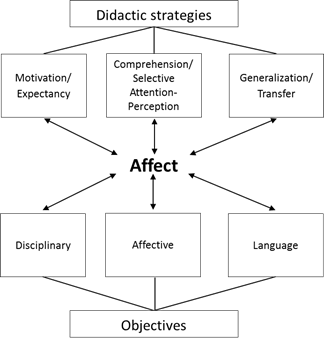
Figure 1: Relationships between linguistic objectives and disciplinary contents of the emotional domain
We conducted an experiment throughout a university semester that aimed to accommodate all these parameters in the language class. We will proceed to describe its stages and analyze its results.
Methodology: Implementation of the Teaching-Learning Stages to Promote Pleasure
Participants and time span of the experiments
This experiment brought together the classroom research experiences of two lecturers (one in English and the other in Spanish teaching) and a PhD student in didactics and applied linguistics. We wanted to verify if language teaching-learning strategies contribute to students’ pleasure in class (asides from pleasure triggered by obtaining a good mark).
To complete this experiment successfully, we first determined the time span in which the experiments would take place (the second semester of the 2014-2015 academic year), the number of students (180), and their year of study (Bachelor degree, years 1 and 2; Master’s degree, year 1). The necessary time to carry out the experiment was of at least one university semester. We therefore decided to perform our activities from January to April 2015.
At Rennes 2 University, classes are formed based on criteria that are external to our research since they are organized according to their year of study and their major. Each teacher selected two classes of students to take part in the experiment, all of which involved up to 30 students including: 60 first-year students (ba), 60 second-year students (BA), and 60 fourth-year students (ma). Thus, a convenience sampling (Mackey & Gass, 2005, p. 122) was realized. The students remained in their habitual teaching environment that helped us achieve face validity (Mackey & Gass, 2005, p. 107).
These methodological choices allowed us to test the hypothesis whereby teaching-learning strategies can be applied at all language proficiency levels (B1, B2, and C1) and enhance the students’ pleasure experience. It should be noted that the first- and second-year groups had the same number of weekly class hours (2), whereas fourth year students only had 1 hour. We wanted to measure how the quantity of weekly hours established by the university could influence the students’ answers concerning their degree of satisfaction.
Instruments: class plans, placement test, and questionnaire
Then, we prepared a placement test to detect the needs and expectations of students, that would help us define the contents and objectives of our class sessions (related to linguistic skills, subject matter, and affect, Mager 1994). The test was based on the European Framework for Languages that was introduced to the students in class. Relying on the descriptions of the various proficiency levels, students then evaluated themselves and identified their personal needs.
This procedure was followed by the planning of the teaching-learning stages that were to be developed in the class sessions. Regular meetings were held to establish the didactic principles we would implement at each stage of the teaching-learning process. We organized our class sessions by reformulating Robert Gagné’s stages into our own three: a motivation/attention stage, a comprehension/selective attention-perception stage, and a generalization/transfer stage. These meetings were a very rewarding exchange of knowledge and experience during which we shared our resources and points of view on teaching. This was done to seek the student’s implication and pleasure in class.
In an attempt to motivate our students in class, didactic activities in small groups of 2 or 3 students were organized. The resources were diversified and included audio, visual, and written documents used as a starting point for various teaching and learning tasks (such as debates, dialogues or information quests for instance).
Finally, in order to evaluate our research results and to draw complete conclusions, we created a satisfaction questionnaire to obtain qualitative and quantitative data for more robust conclusions. Given the number of students involved and bearing in mind both our objectives and the external circumstances where our academic research was carried out, a self-administered paper-and-pencil questionnaire seemed to be the best instrument to collect our data. The questionnaire covered all aspects of our class plans (i.e. contents, objectives, methods, and students’ participation in their own learning process).
Regarding the content validity (Mackey & Gass, 2005, p. 107; Porte, 2010, p. 81) of questionnaires we took the following decisions:
- The satisfaction questionnaire was designed to be as detailed and extensive as possible.
- We divided the questions into three groups. The first group contained nine items and dealt with the evaluation of contents (topics presented), activities, and resources used in the classroom. The second group contained seven items and dealt with the evaluation of the didactic and teaching approaches. These two groups meant to provide us with data to understand and explain the answers obtained in the third group of questions, that dealt with the evaluation of their own participation in the learning process. It contained six questions that provided us with information concerning how satisfied students were with our teaching.
Regarding the validity of results, questionnaires with incomplete or missing answers but with a general appreciation were considered if they contained at least 75% of total answers. The results obtained from 120 Spanish and 60 English students, along with our interpretations, state below.
Table II: Experimental procedure
|
Participants |
three researchers, 180 students (BA and MA level) |
|
Data collection |
self-administered paper and pencil questionnaire
|
|
Instruments and methodology |
|
|
Sampling procedure |
Convenience sampling |
|
Tuition time |
From January 2015 to April 2015 |
Results and Discussion
Results
The questions in the first two parts of the questionnaire (Evaluation of contents, activities and resources, and evaluation of the didactic and teaching approaches) were conceived in accordance with the stages of the learning process. This means that we had to seek elements that allowed the fulfillment of the stages of motivation, comprehension, and transfer. In the first part of the questionnaire, we identified concepts like time, resources, contents, class structure, and activities, that allowed us to evaluate their degree of satisfaction. The latter could be inferred from the relation between the question asked (an item) and the answer chosen by the student among the options: strongly agree (5), agree (4), slightly agree (3), disagree (2), strongly disagree (1), no answer (0).
The results obtained from 180 questionnaires for this first part show that:
Motivation/expectancy stage
The time committed to a task was considered as an element of the motivation stage. The mean score of the first question in the questionnaire —adequacy of time needed to fulfill tasks— was 3.93 (roughly equivalent to agree), with a standard deviation (sd) of +/- 0.97 and a mode (m) of 4. We can infer that students were rather satisfied with the timed proposed for activities (from 20 to 5 minutes, depending on the task).
Two questions dealt with resources. Question 2 measured students’ appreciation of the monotony and variety of resources, and question 3 measured their appreciation of distribution of time spent using the different resources. The mean scores were 2.86 (sd=+/-1.5; m=2) for question 2, and 2.11 (sd)+/-1.16; m=2) for question 3. This indicates that most students claimed to disagree with the use of the adjectives monotonous and unbalanced to qualify the use of class resources.
The work on contents or topics dealt in class helped to motivate students to participate in class, and helped us work on the comprehension stage, explored below.
In the context of motivation, question 4 sought to measure if the contents were adapted to their language proficiency level. The mean score was 3.72 (sd=+/-1.13; m=4), which is closer to agree (4) than to slightly agree (3).
The activities proposed by the teacher also meant to motivate students to participate. Question 8 asked if the activities encouraged students to participate in the debates organized in class. The mean score was 3.52 (sd=+/-1.15; m=3). This means that students were somewhere between agree (4) and slightly agree (3).
Comprehension/ Selective attention stage
In the comprehension/Selective attention stage, which relates to the selection of contents, class planning and didactic activities implemented in class, the items sought to identify:
- If the contents helped improve the language proficiency (reading, writing, listening, speaking, and oral interaction). The mean score of question 5 was 3.55 (sd=+/-1.04; m=4), which places their opinion between slightly agree and agree.
- If the class structure helped identify the objectives of the different class sessions. The mean obtained in question 6 was 3.66 (sd=+/-1.07; m=4), which is closer to agree than to slightly agree.
- If the activities helped students better understand the topics treated in class. The mean score of answers in question 7 was 3.91 (sd=+/-1.05; m=4), which comes very close to agree.
Generalization/transfer
As to the generalization/transfer stage, the final stage of the didactic work, we only prepared one item dealing with the structure of the class. Question 9 of the questionnaire sought to identify if the class structure helped students to progress in their understanding of the linguistic, cultural, and practical aspects of the target language. The mean score in question 9 was 3.69 (sd=+/-1.03; m=4), indicating that the answers were closer to agree than to slightly agree.
Table III shows the mean scores by question for each group of students, as well as the global means by question.
Table III:Student assessment scores: learning stages vs. contents, activities and resources
|
|
Part 1 |
||||||||
|
|
Q1 (m) |
Q2 (m) |
Q3 (m) |
Q4 (m) |
Q5 (c) |
Q6 (m) |
Q7 (c) |
Q8 (m) |
Q9 (t) |
|
MA 1st year (4th year Spanish) |
3.52 |
1.80 |
2.32 |
3.79 |
3.42 |
3.24 |
3.64 |
3.46 |
3.46 |
|
BA 1st year (1st year Spanish) |
4.15 |
4.42 |
1.92 |
3.88 |
3.83 |
3.93 |
4.05 |
3.47 |
3.90 |
|
BA 2nd year (2nd year English) |
4.13 |
2.39 |
2.10 |
3.48 |
3.40 |
3.75 |
4.02 |
3.63 |
3.72 |
|
Mean |
3.93 |
2.86 |
2.11 |
3.72 |
3.55 |
3.66 |
3.91 |
3.52 |
3.69 |
The second part of the questionnaire assesses the didactic and teaching approaches and contains 6 items organized according to the three phases of the learning process: motivation, comprehension, and transfer. The results for this stage are the following:
Motivation/expectancy stage
One question concerning motivation was included in this part. It concerns the preliminary presentation of objectives, activities and evaluation modalities of the class. The mean score obtained was 4.23 (SD=+/-1.22; M=5), showing that students clearly identified these parameters as a whole.
Comprehension/ Selective attention stage
Four items deal with comprehension. They deal with the relation between the teaching approaches and the students’ learning rhythm (question 11), the approaches’ ability to promote teacher-student communication (question 12), as well as the participation of all students (question 13), and the encouragement of learning through appropriate methods of correction (question 15).
The following are the respective scores of the aforementioned questions: 4.14 (SD=+/-1.03; M=5), 4.33 (SD=+/-0.9; M=5), 3.56 (SD=+/-1.06; M=4) and 3.97 (SD=+/-1,16; M=5). We can therefore conclude that students agree with the positive evaluation proposed by teachers regarding this stage, despite one slightly lower score concerning the pedagogical capacity to promote the participation of all students (mean = 3.56).
Generalization/transfer
One item deals with the transfer stage (question 14). This question assesses the feedback given by the teacher as an essential element for the students’ encouragement and academic success. This item obtained a mean score of 3.69 (sd=+/-1.3; m=4), pointing towards a positive general evaluation of this stage.
Table IV organizes the mean scores by question for each group of students, as well as the global means by question:
Table IV:Student assessment scores: learning stages vs. didactic and teaching approaches
|
|
Part 2 |
|||||
|
|
Q10 (m) |
Q11 (c) |
Q12 (c) |
Q13 (c) |
Q14 (t) |
Q15 (c) |
|
ma 1st year (4th year Spanish) |
4.17 |
4.10 |
4.25 |
3.55 |
3.16 |
3.78 |
|
ba 1st year (1st year Spanish) |
4.05 |
4.30 |
4.23 |
3.78 |
3.98 |
4.35 |
|
ba 2nd year (2nd year English) |
4.47 |
4.02 |
4.50 |
3.34 |
3.93 |
3.78 |
|
Mean |
4.23 |
4.14 |
4.33 |
3.56 |
3.69 |
3.97 |
Finally, the questionnaire contained a third part through which we sought to establish a relation between the results of the external events that aid throughout the teaching-learning process (the first and second stages) and their general appreciation from the point of view of the class development. This part tries to assess (Table V):
- If students carried out extra research to improve their language proficiency (question 16). This point can be related to their appreciation of the time distribution to infer the degree of satisfaction and/or motivation regarding the learning of the target language. The percentage of positive questions (true) is of 59.44%. We can therefore state that most students carried out supplementary work outside the classroom.
- If students attended class regularly to justify the validity of their answers (question 17). The percentage of positive answers was 92.78%, which confirms the students’ answers’ validity.
- If students felt involved in the proposed activities (question 18). The degree of involvement of students revealed by the questionnaire is high, with 78.33% of positive answers. We can contrast these results with the score obtained in the first two parts of the survey to propose an interaction between their feeling of involvement in class and their degree of satisfaction to claim that involvement has an impact on satisfaction. If we link the results of this item to the results of the answers in the two previous parts of the questionnaire, we can see the degree of satisfaction of students concerning our class planning.
- If students were free to make decisions to evaluate the strictness or leniency of our didactic strategies (question 20). The percentage of positive answers was 77.78%, letting us claim that students felt that they could make choices, even if this particular percentage is one of the lowest obtained.
Table V: Relation between students’ participation and their general appreciation of class development
|
|
Question 16 |
||||||
|
|
TRUE |
% |
FALSE |
% |
N/A |
% |
Total |
|
MA 1st year (4th year Spanish) |
41 |
68.33 |
17 |
28.33 |
2 |
3.33 |
60 |
|
BA 1st year (1st year Spanish) |
39 |
65.00 |
21 |
35.00 |
0 |
0.00 |
60 |
|
BA 2nd year (2nd year English) |
27 |
45.00 |
25 |
41.67 |
8 |
13.33 |
60 |
|
Total |
107 |
59.44 |
63 |
35.00 |
10 |
5.56 |
180 |
|
|
Question 17 |
||||||
|
|
TRUE |
% |
FALSE |
% |
N/A |
% |
Total |
|
MA 1st year (4th year Spanish) |
55 |
91.67 |
4 |
6.67 |
1 |
1.67 |
60 |
|
BA 1st year (1st year Spanish) |
57 |
95.00 |
3 |
5.00 |
0 |
0.00 |
60 |
|
BA 2nd year (2nd year English) |
55 |
91.67 |
3 |
5.00 |
2 |
3.33 |
60 |
|
Total |
167 |
92.78 |
10 |
5.56 |
3 |
1.67 |
180 |
|
|
Question 18 |
||||||
|
|
TRUE |
% |
FALSE |
% |
N/A |
% |
Total |
|
MA 1st year (4th year Spanish) |
48 |
80.00 |
7 |
11.67 |
5 |
8.33 |
60 |
|
BA 1st year (1st year Spanish) |
51 |
85.00 |
7 |
11.67 |
2 |
3.33 |
60 |
|
BA 2nd year (2nd year English) |
42 |
70.00 |
13 |
21.67 |
5 |
8.33 |
60 |
|
Total |
141 |
78.33 |
27 |
15.00 |
12 |
6.67 |
180 |
|
|
Question 20 |
||||||
|
|
TRUE |
% |
FALSE |
% |
N/A |
% |
Total |
|
MA 1st year (4th year Spanish) |
42 |
70.00 |
13 |
21.67 |
5 |
8.33 |
60 |
|
BA 1st year (1st year Spanish) |
54 |
90.00 |
1 |
1.67 |
5 |
8.33 |
60 |
|
BA 2nd year (2nd year English) |
44 |
73.33 |
5 |
8.33 |
11 |
18.33 |
60 |
|
Total |
140 |
77.78 |
19 |
10.56 |
21 |
11.67 |
180 |
Finally, we measured if the answers to the item corresponding to their global appreciation of the class (Question 19) are linked to the degree of satisfaction obtained in the first two parts of the survey. We created a 4-column table (Table VI) where we present the number of positive, negative, and mixed evaluations, as well as blank answers. Our interpretation of these results was based on the global meanings of the terms collected, particularly nouns, adjectives, and adverbs. It should be noted that answers presented by fourth year students were more elaborated than others and expressed, with a greater array of syntactic structures, the appreciation of students concerning the teacher, the resources or the time distribution throughout the teaching-learning process.
Table VI: Students’ global appreciation results
|
|
Question 19 |
||||||||
|
|
Positive evaluation |
% |
Negative evaluation |
% |
Mixed evaluation |
% |
N/A |
% |
Total |
|
MA 1st year (4th year Spanish) |
24 |
40 |
19 |
31.7 |
9 |
15 |
8 |
13.3 |
60 |
|
BA 1st year (1st year Spanish) |
54 |
90 |
2 |
3.3 |
4 |
6.7 |
|
|
60 |
|
BA 2nd year (2nd year English) |
39 |
65 |
2 |
3.3 |
11 |
18.3 |
8 |
13.4 |
60 |
|
Total |
117 |
65 |
23 |
12.8 |
24 |
13.3 |
16 |
8.9 |
180 |
The results obtained show that we have succeeded to inspire pleasure among students during the implementation of class content, language, and affective objectives. However, some students require special attention, since they learn at a different pace or have different language learning needs. This would demand structural changes coming from the university administration, as dividing groups by proficiency level and into smaller groups (a maximum of 20 students per group), and having working sessions of at least two hours, especially for Masters students. We have noticed that negative or mixed evaluations within this group referred almost exclusively to the number of hours dedicated to Spanish. If there were more Spanish class hours per week, we would have more time to meet the needs of every student. Despite this, we have found that 80% of the students in this group declared they “felt involved” in the activities proposed in class (cf. question 18). This high percentage is also witnessed among the BA students (85% of first-year students and 70% of second-year students). This could be explained by their high satisfaction degree (77.8% for all groups combined) in question 20, that dealt with their possibility to make decisions in class.
Discussion
This didactic experience required meticulous work where theory and practice should combine harmonically with common objectives while keeping the specificity of the taught language.
Obstacles specific to class organization (among others, the students' timetable, the resources made available to us, the availability of teachers) were gradually overcome and several questions about the validity and reliability of this experience are still pending:
- Would the result of this experiment be the same in the case of different language teaching courses?
- What would be the degree of satisfaction of the students be if the didactic strategies are not thought out in the structuring of the stages of learning?
- How does student satisfaction vary depending on sociocultural factors and infrastructural facilities?
These questions and many others are to be explored as a continuation of this first experiment. One way of approaching this is by promoting an experimental approach with a control group. Furthermore, measuring the impact of the teacher rapport on the feeling of pleasure can also be envisaged. This was not the case throughout this experiment, but interaction and dialogues with the students were systematically favored and encouraged in class.
Although it did not yield conclusive results, the present research deserves to be shared among researchers in language didactics in our opinion. Indeed, the sharing of experiences can only contribute to the search for the pleasure of teaching and the pleasure of learning with our students.
Conclusion
This empirical research was based on a theoretical perspective (Robert Gagné's stages of teaching-learning) in the teaching of two languages (English and Spanish), the implementation of which should make it possible to lead to the students’ satisfaction in their own learning process. Satisfaction, in this sense, acts as a mediator variable to encourage learning.
Despite working in classrooms crowded with 40 students and with an infrastructure where the teaching resources have yet to be developed (the resources we had were limited to a classroom with a blackboard, chalk and video projectors), we were able to set up a didactic work dynamic where the students' interaction between themselves and the teacher was constant. This dynamic, based on a meticulous class planning that bears in mind the stages of teaching and learning were the strong points of our didactic strategies. These variables are likely to have had an influence both in the learning of the foreign language and in the pleasure of learning.
Several studies (Schumann, 1997; Arnold, 1999; Lantolf, 2000; Arnaud, 2006; Caon, 2006) show the importance of the affective domain in the language class. The intellectual and affective domains work in synergy and the language teacher has to consider both. In this context, research conducted to date has shown that it is precisely in the language class that we observe students manifest their values, appreciation and judgment. We often hear students say “I don’t like Spanish, I prefer English” or “I like Spanish but I don’t like English”.
As we have seen in this study, a language class has various objectives, such as disciplinary, language, and affective objectives. The factors that can generate pleasure can be diverse (i.e. teacher rapport, teaching style, students’ mood, general ambiance and atmosphere, comfort). Within the context of this study, we selected class planning along with the integration of teaching and learning stages, that can be considered as objective variables and factors that generate pleasure in the students’ learning experience.
In other words, from a pedagogical and didactic point of view, taking into account the stages of learning when planning a class, regardless of its language or content, contributes to the involvement of students in their own learning and, therefore, makes them feel pleasure for having participated in class. In this sense, we call for further investigation on the relationship between the learning process and the didactic and pedagogical activities implemented in class: because their connection can help the students become more active agents in their own learning.
References
André, J. (2005). Eduquer à la motivation. Cette force qui fait réussir. Paris: L’Harmattan.
Arnaud, C. (2006). L’affectif et le comportement non-verbal en classe de langue étrangère. Synergies Vénézuela, 2, 219–241.
Arnold, J. (ed.) (1999). Affect in language learning. Cambridge: Cambridge University Press.
Berthoz, A. (2016). Sympathie et empathie dans la relation avec autrui. Conséquences pour la relation d’apprentissage. Symposium "Les émotions des enseignant-e-s de langues: cognitions, formations et médiations", Université Sorbonne Nouvelle, Paris, France.
Blanchet, P. (1995). La pragmatique. D’Austin à Goffman. Paris: Bertrand-Lacoste.
Bloom, B. (1956). Taxonomy of educational objectives, handbook I: The cognitive domain. New York: David McKay Co Inc.
Caon, F. (2006). Le plaisir dans l’apprentissage des langues. Un défi méthodologique. Perugia: Guerra Edizioni.
Chadwick, C. (1978). Tecnología educacional para el docente. Buenos Aires: Paidós.
Chevallier-Gaté, C. (2014). La place des émotions dans l’apprentissage. Vers le plaisir d’apprendre. Education, 3, 1–15. Retrieved from: http://revue-educatio.eu
Conseil de l’Europe (2001). Cadre européen commun de référence pour les langues: apprendre, enseigner, évaluer. France: Didier.
Damasio, A., & Damasio, H. (1989). Lesion analysis in neuropsychology. London: Oxford University Press.
de la Garanderie, A. (2004). Plaisir de connaître. Bonheur d’être. Une pédagogie de l’accompagnement. Lyon: Chronique Sociale.
Delannoy, C. (2005). La motivation: désir de savoir, décision d’apprendre. Paris: CNDP-Hachette Education.
Dortier, J. F. (2008). Le dictionnaire des sciences humaines. Auxerre: Sciences Humaines Editions.
Duffé Montalván, A. L. (2014). Relación entre diferentes discursos textuales y las estrategias didácticas en la enseñanza del ELE. RedELE, 26.
Escandell Vidal, M. V. (2012). Las pautas de interacción de los hablantes nativos: bases cognitivas y herramientas de análisis. Paper presented at the Conference XII jornada pedagógica para profesores de español Brussels, Belgium.
Gagné, R. (1968). Learning and communication. In R. V. Wiman and W. C. Meierhenry (Eds.), Educational media: theory into practice (pp. 93–114). Columbus, Ohio: Charles E. Merrill Publishing Company.
Gagné, R. (1977). Principios básicos del aprendizaje para la instrucción (2nd ed.). México: Editorial Diana.
Gagné, R., & Briggs, L. (1983). La planificación de la enseñanza. Sus principios. México: Editorial Trillas.
Gregory, J. M. (2007). The seven laws of teaching. Minneapolis: Filiquarian Publishing LLC.
Houssaye, J. (1988). Le triangle pédagogique. Bern: Editions Peter Lang.
Korthagen, F. A. J. (2001). Linking practice and theory. The pedagogy of realistic teacher education. London: LEA.
Korthagen, F. A. J. (2004). In search of the essence of a good teacher: towards a more holistic approach in teacher education. Teaching and Teacher Education, 20(1), 77–97.
Krathwohl, D. R., Bloom, B. S., & Masia, B. B. (1999). Taxonomy of educational objectives, handbook 2: Affective domain (2nd Ed.). New York: Longman.
Lantolf, J. P. (2000). Sociocultural theory and second language learning. New York: Oxford University Press.
Mackey, A., & Gass, S. M. (2005). Second language research: Methodology and design. Mahwah, New Jersey: Lawrence Erlbaum Associates.
Mager, R. (1994). Comment définir des objectifs pédagogiques. Paris: Dunod.
Meirieu, P. (1995). La pédagogie entre le dire et le faire. Paris: ESF Éditeur.
Niedenthal, P. M., & Kitayama, S. (1994). The heart’s eye: Emotional influences in perception and attention. San Diego, New York, Boston: Academic Press.
Palmer, P. J. (1998). The courage to teach. San Francisco: Jossey-Bass.
Pestalozzi, J. H. (2008). Ecrits sur la Méthode : Volume I - Tête, coeur, main. Le Mont-sur-Lausanne: LEP Editions Loisirs et Pédagogie SA.
Porte, G. K. (2010). Appraising research in second language learning: a practical approach to critical analysis of quantitative research (2nd ed.). Amsterdam/Philadelphia: John Benjamins Publishing Company. https://doi.org/http://doi.org/10.1075/lllt.28
Pourtois, J.-P., & Mosconi, N. (2002). Plaisir, souffrance, indifférence en éducation. Paris: Presses Universitaires de France.
Schumann, J. H. (1997). The Neurobiology of affect in language learning. Malden, MA: Wiley-Blackwell.
Van Lier, L. (1988). The classroom and the language learner. London, New York: Longman.
Van Lier, L. (2004). The ecology of language learning. A sociocultural perspective. Boston, Dordrecht: Kluwer Academic Press.
Annex 1
Placement test
(The test was conducted during a speed dating session)
Name of the interviewer:
Name of the interviewee:
0. Introductions (name, age, birthplace…)
1. What is your level of English? (A1, A2, B1, B2, C1, C2)
2. Have you ever been to an English-speaking country? How long was your stay? Did you travel for business or leisure?
3. What do you expect from this English class? What are your main objectives?
4. What are your personal interests and hobbies?
5. Do you have any career plans?
Annex 2
Original satisfaction questionnaire (in French) as it was presented to students.
|
Partie 1: évaluation sur les contenus (les thématiques présentées), les activités et les ressources employées lors des séances des cours Les chiffres de 0 à 5 serviront pour évaluer vos critères : 5 : tout à fait d’accord ; 4 : d’accord ; 3 : moyennement d’accord ; 2 : pas d’accord; 1 : pas du tout d’accord : 0 : pas d’avis |
|||
|
Nro question |
Les contenus |
Indiquer un chiffre (5, 4, 3, 3, 1, 0) |
Commentaires éventuels |
|
1 |
Le temps imparti pour les activités proposées par l’enseignant (20 mn, 10 mn, 5 mn, etc.) a été adéquat pour la réalisation de différentes tâches. |
|
|
|
2 |
Les ressources utilisées (vidéo, photocopies, chanson, exposé, etc.) ont été monotones et peu variées. |
|
|
|
3 |
Les ressources utilisées ont été employées d’une façon déséquilibrée (trop ou peu de documents, plus de temps consacré à un matériel plutôt qu’un autre, etc.) |
|
|
|
4 |
Les contenus ont été adaptés à votre niveau. |
|
|
|
5 |
Les contenus vous ont servi pour améliorer vos compétences langagières (l’expression et la compréhension écrite et l’oral, l’interaction orale). |
|
|
|
6 |
La structure du cours vous a permis à apprendre l’objectif des différentes séances de cours. |
|
|
|
7 |
Les activités vous ont aidé à mieux comprendre les thématiques. |
|
|
|
8 |
Les activités vous ont encouragé à participer aux échanges et débats organisés autour de celles-ci. |
|
|
|
9 |
La structure du cours a contribué à votre apprentissage linguistique et culturel concernant la langue cible. |
|
|
|
Partie 2: évaluation sur la méthode pédagogique et didactique Les chiffres de 0 à 5 serviront pour évaluer vos critères : 5 : tout à fait d’accord ; 4 : d’accord ; 3 : moyennement d’accord ; 2 : pas d’accord; 1 : pas du tout d’accord : 0 : pas d’avis |
|||
|
Nro question |
La méthode pédagogique et didactique |
Indiquer un chiffre (5, 4, 3, 3, 1, 0) |
Commentaires éventuels |
|
10 |
Il y eu au préalable une présentation générale des objectifs, des activités et de l’évaluation du cours. |
|
|
|
11 |
La méthode pédagogique (la manière de conduire le cours: souplesse, rigueur, enthousiasme, etc.) et didactique (les activités mises en place en rapport avec la thématique du cours : exercices de compréhension et d’expression, dialogue, questions-réponses, etc.) ont été appropriés à votre rythme d’apprentissage. |
|
|
|
12 |
Il y a eu une communication et une interaction non directive (capacité à dialoguer sans crainte et sans réserves) entre l’enseignant et l’élève. |
|
|
|
13 |
La méthode pédagogique et didactique a su promouvoir la participation de l’ensemble des étudiants. |
|
|
|
14 |
La méthode didactique a su donner le feedback (retour) nécessaire pour encourager votre réussite académique. |
|
|
|
15 |
Les méthodes de correction des travaux (écrits, oraux) ont su vous encourager dans votre apprentissage. |
|
|
|
Partie 3: évaluation sur votre propre participation dans le processus d’apprentissage Indiquez vrai ou faux, selon votre cas. De plus, complétez certains phrases d’après votre vécu si cela est nécessaire et préciser des commentaires éventuels. |
||||
|
Nro question |
A votre avis…. |
Vrai ou faux |
A compléter |
Commentaires éventuels |
|
16 |
J’ai eu besoin de fournir un travail personnel pour améliorer ma compréhension et mon expression dans la langue cible. |
|
|
|
|
17 |
J’ai assisté régulièrement au cours. |
|
|
|
|
18 |
Je me suis senti (e) impliqué(e) dans les activités proposées. |
|
|
|
|
19 |
Mon appréciation, globale du cours est que… |
|
|
|
|
20 |
J’ai eu la liberté de faire des choix et de prendre des décisions. |
|
|
|
1 Ph.D. en Études Romaines, option Études hispaniques, Université Montpellier 3 (Paul Valéry ). Lecturer
E-Mail: Aura-luz.duf@univ-rennes2.fr– ORCID https://orcid.org/0000-0002-5161-6660
2 Ph.D. Student, Université Rennes 2 y Katholieke Universieit Leuven
E-Mail: valdezcristian1@gmail.com – ORCID https://orcid.org/0000-0003-2291-8085
3 Ph.D. en Phonetiqué anglaise, Aix-Marseille Université. Lecturer
E-Mail: saandia.vanessa.ali@gmail.com - ORCID https://orcid.org/0000-0002-5799-7943
4 Ph.D. Student, Université de Rennes
E-Mail: lcontrerasroa@gmail.com - orcid https://orcid.org/0000-0002-2816-6358
5 Our translation of the French original: le cours de langue est le seul domaine d’enseignement où l’objet d’étude soit en même temps le médium : l’élève utilise la langue étrangère pour apprendre cette même langue étrangère. Ainsi, en raison des limitations du verbal, l’affectif pourrait peser lourdement sur les conditions dans lesquelles se déroule l’apprentissage.
6 Our translation of the French original: Mais à la souffrance nous avons tenu à associer le plaisir, non pas pour faire une belle symétrie, mais afin de dire haut et fort que l’on ne fait pas que souffrir en éducation et en formation, il y a aussi des moments de plaisir et de plaisir fort : le plaisir de s’éduquer pour grandir et devenir plus libre, le plaisir d’apprendre, de chercher, de découvrir, de comprendre, le plaisir de se former, de se sentir changer et de transformer son savoir et sa vision des choses, pour gagner plus de pouvoir sur ces actes et un rapport au monde plus délié. Plaisir aussi de l’éducateur qui voit l’enfant grandir et s’épanouir ou du formateur qui voit l’adulte se transformer, s’émanciper. Il n’y a pas d’éducation et de formation sans passion […], et, par conséquent, il n’y a pas d’éducation et de formation sans affects, plaisir et souffrance.
7 Our translation of the French original: […] Sans désir, sans plaisir (et à l’inverse aussi sans souffrance), il n’y pas de possibilité d’échanges avec les autres, et il n’y a pas non plus de possibilités d’apprentissage profond. Le plaisir est le moteur de tout apprentissage et, en même temps son principal aliment. [..] L’être humain, en effet, est un être de désir. Sa structure de base c’est le désir. Sans lui, il n’y a pas de vie […] Désir et plaisir sont ainsi à la base de la vie, de l’éducation, et de toute réussite.
8 Our translation of the French original: ce n’est plus qu’un plaisir de produits […] pure satisfaction.
Referencias
André, J. 2005. Eduquer à la motivation. Cette force qui fait réussir. Paris: L’Harmattan.
Arnaud, C. (2006). L’affectif et le comportement non-verbal en classe de langue étrangère. Synergies Vénézuela, 2, 219–241.
Arnold, J. (ed.) (1999). Affect in language learning. Ernst Klett Sprachen.
Berthoz, A. (2016). Sympathie et empathie dans la relation avec autrui. Conséquences pour la relation d’apprentissage. Symposium "Les émotions des enseignant-e-es de langues: cognitions, formations et médiations", Université Sorbonne Nouvelle, Paris, France.
Blanchet, P. (1995). La pragmatique. D’Austin à Goffman. Paris: Bertrand-Lacoste.
Bloom, B. (1956). Taxonomy of educational objectives, handbook I: The cognitive domain. New York: David McKay Co Inc.
Caon, F. (2006). Le plaisir dans l’apprentissage des langues. Un défi méthodologique. Perugia: Guerra Edizioni.
Chadwick, C. (1978). Tecnología educacional para el docente. Buenos Aires: Paidós.
Chevallier-Gaté, C. (2014). La place des émotions dans l’apprentissage. Vers le plaisir d’apprendre. Education, 3, 1–15. Retrieved from: http://revue-educatio.eu
Conseil de l’Europe (2001). Cadre européen commun de référence pour les langues: apprendre, enseigner, évaluer. France: Didier.
Damasio, A. 1999. Le sentiment même de soi: corps, émotions, conscience. Paris: O. Jacob.
Damasio, A., & Damasio, H. (1989). Lesion analysis in neuropsychology. London: Oxford University Press.
de la Garanderie, A. (2004). Plaisir de connaître. Bonheur d’être. Une pédagogie de l’accompagnement. Lyon: Chronique Sociale.
Delannoy, C. (2005). La motivation: désir de savoir, décision d’apprendre. Paris: CNDP-Hachette Education.
Dortier, J. F. (2008). Le dictionnaire des sciences humaines. Auxerre: Sciences Humaines Editions.
Duffé Montalván, A. L. (2014). Relación entre diferentes discursos textuales y las estrategias didácticas en la enseñanza del ELE. RedELE, 26.
Escandell Vidal, M. V. (2012). Las pautas de interacción de los hablantes nativos: bases cognitivas y herramientas de análisis. Paper presented at the Conference XII jornada pedagógica para profesores de español Brussels, Belgium.
Gagné, R. (1968). Learning and communication. In R. V. Wiman & W. C. Meierhenry (Eds.), Educational media: theory into practice (pp. 93–114). Columbus, Ohio: Charles E. Merrill Publishing Company.
Gagné, R. (1969). Learning and Communication. In R. V. Wiman & W. Meierhenry (Eds.), Educational media: theory into practice (pp. 93–114). Columbus, Ohio: Charles E. Merrill Publishing Company.
Gagné, R. (1977). Principios básicos del aprendizaje para la instrucción (2nd ed.). México: Editorial Diana.
Gagné, R., & Briggs, L. (1983). La planificación de la enseñanza. Sus principios. México: Editorial Trillas.
Gregory, J. M. (2007). The seven laws of teaching. Minneapolis: Filiquarian Publishing LLC.
Houssaye, J. (1988). Le triangle pédagogique. Bern: Editions Peter Lang.
Korthagen, F. A. J. (2001). Linking practice and theory. The pedagogy of realistic teacher education. London: LEA.
Korthagen, F. A. J. (2004). In search of the essence of a good teacher: towards a more holistic approach in teacher education. Teaching and Teacher Education, 20(1), 77–97.
Krathwohl, D. R., Bloom, B. S., & Masia, B. B. (1999). Taxonomy of educational objectives, handbook 2: Affective domain (2nd Ed.). New York: Longman.
Lantolf, J. P. (2000). Sociocultural theory and second language learning. New York: Oxford University Press.
Mackey, A., & Gass, S. M. (2005). Second language research: Methodology and design. Mahwah, New Jersey: Lawrence Erlbaum Associates.
Mager, R. (1994). Comment définir des objectifs pédagogiques. Paris: Dunod.
Meirieu, P. (1995). La pédagogie entre le dire et le faire. Paris: ESF Éditeur.
Niedenthal, P. M., & Kitayama, S. (1994). The heart’s eye: Emotional influences in perception and attention. San Diego, New York, Boston: Academic Press.
Palmer, P. J. (1998). The courage to teach. San Francisco: Jossey-Bass.
Pestalozzi, J. H. (2008). Ecrits sur la Méthode : Volume I - Tête, coeur, main. Le Mont-sur-Lausanne: LEP Editions Loisirs et Pédagogie SA.
Porte, G. K. (2010). Appraising research in second language learning: a practical approach to critical analysis of quantitative research (2nd ed.). Amsterdam/Philadelphia: John Benjamins Publishing Company. https://doi.org/http://doi.org/10.1075/lllt.28
Pourtois, J.-P., & Mosconi, N. (2002). Plaisir, souffrance, indifférence en éducation. Paris: Presses Universitaires de France.
Schumann, J. H. (1997). The Neurobiology of affect in language learning. Malden, MA: Wiley-Blackwell.
Van Lier, L. (1988). The classroom and the language learner. London, New York: Longman.
Van Lier, L. (2004). The ecology of language learning. A sociocultural perspective. Boston, Dordrecht: Kluwer Academic Press.
Cómo citar
APA
ACM
ACS
ABNT
Chicago
Harvard
IEEE
MLA
Turabian
Vancouver
Descargar cita
Licencia
Todo el contenido de esta revista, excepto dónde está identificado, está bajo una Licencia Creative Commons Atribución-NoComercial-CompartirIgual 4.0 Internacional