Published
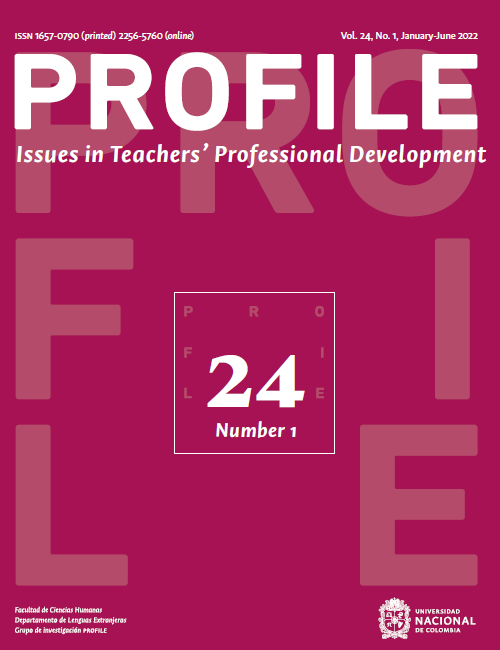
Triggering Factors that Reinforce or Change EFL Preservice Teachers’ Beliefs during the Practicum
Factores que refuerzan o cambian creencias en futuros maestros practicantes de inglés
DOI:
https://doi.org/10.15446/profile.v24n1.90342Keywords:
English teaching, preservice teachers, teachers’ beliefs, teaching practicum (en)creencias de maestros, docentes en formación, enseñanza de inglés, práctica docente (es)
This exploratory case study seeks to examine the role that specific factors exert on the evolution of beliefs in preservice English teachers during their final teaching practicum. Data were collected through reflections, interviews, focus groups, and observations. The findings revealed that three groups of factors affect belief evolution during the practicum: participant subjectivity, contextual circumstances, and university support community. Subjectivities encompassed preservice teachers’ fears, reactions to real-life teaching challenges, and enthusiasm to become teachers. Contextual circumstances incorporated classroom circumstances and cooperating teachers. The university support community concerned their peers and the university tutor. Implications discuss the relevance of curricular and reflective agendas that enrich the education of future teachers through beliefs exploration.
Este estudio exploratorio examina el papel de factores específicos en la evolución de las creencias de futuros maestros de inglés sobre su práctica pedagógica. Los datos se recolectaron mediante observaciones, entrevistas, grupos focales y reflexiones. Los hallazgos develaron tres grupos de factores que afectaron la evolución de las creencias: la subjetividad involucró el temor de los estudiantes para desarrollar su práctica, reacciones a los retos y entusiasmo por convertirse en profesores. Los aspectos contextuales implicaron las circunstancias en las aulas y relaciones con profesores titulares. La comunidad de apoyo en la universidad incluyó a compañeros y tutor. Las implicaciones discuten la relevancia de agendas curriculares, reflexivas y colaborativas que enriquezcan la educación de futuros maestros a partir de la exploración de sus creencias en la práctica pedagógica.
References
Abelson, R. P. (1979). Differences between belief and knowledge systems. Cognitive Science, 3(4), 355–366. https://doi.org/10.1207/s15516709cog0304_4
Aguirre-Sánchez, I. (2014). Exploring pre-service EFL teachers’ beliefs about their roles in an elementary school classroom in regard to pedagogical and emotional aspects of students. HOW, 21(1), 26–41. https://doi.org/10.19183/how.21.1.13
Anderson, N. A., Barksdale, M. A., & Hite, C. E. (2005). Preservice teachers’ observations of cooperating teachers and peers while participating in an early field experience. Teacher Education Quarterly, 32(4), 97–117. https://www.jstor.org/stable/23478748
Barahona, M. (2014). Pre-service teachers’ beliefs in the activity of learning to teach English in the Chilean context. Cultural-Historical Psychology, 10(2), 116–122.
Barcelos, A. M. F., & Ruohotie-Lyhty, M. (2018). Teachers’ emotions and beliefs in second language teaching: Implications for teacher education. In J. Martínez (Ed.), Emotions in second language teaching (pp. 109–124). Springer. https://doi.org/10.1007/978-3-319-75438-3_7
Biesta, G., Priestley, M., & Robinson, S. (2015). The role of beliefs in teacher agency. Teachers and Teaching, 21(6), 624–640. https://doi.org/10.1080/13540602.2015.1044325
Borg, M. (2001). Teachers’ beliefs. ELT Journal, 55(2), 186–188. https://doi.org/10.1093/elt/55.2.186
Borg, S. (2003). Teacher cognition in language teaching: A review of research on what language teachers think, know, believe, and do. Language Teaching, 36(2), 81–109. https://doi.org/10.1017/S0261444803001903
Calderhead, J., & Robson, M. (1991). Images of teaching: Student teachers’ early conceptions of classroom practice. Teaching and Teacher Education, 7(1), 1–8. https://doi.org/10.1016/0742-051X(91)90053-R
Çapan, S. A. (2014). Pre-service English as a foreign language teachers’ belief development about grammar instruction. Australian Journal of Teacher Education, 39(12), 132–152. https://doi.org/10.14221/ajte.2014v39n12.9
Castellanos-Jaimes, J. (2013). The role of English pre-service teachers’ beliefs about teaching in teacher education programs. Profile: Issues in Teachers’ Professional Development, 15(1), 195–206. https://revistas.unal.edu.co/index.php/profile/article/view/37878
Clarke, A., Triggs, V., & Nielsen, W. (2014). Cooperating teacher participation in teacher education: A review of the literature. Review of Educational Research, 84(2), 163–202. https://doi.org/10.3102/0034654313499618
Cota-Grijalva, S. D., & Ruiz-Esparza-Barajas, E. (2013). Pre-service teachers’ beliefs about language teaching and learning: A longitudinal study. Profile: Issues in Teachers’ Professional Development, 15(1), 81–95. https://revistas.unal.edu.co/index.php/profile/article/view/37866
Creswell, J. W. (2012). Educational research: Planning, conducting, and evaluating quantitative and qualitative research (4th ed.). Pearson.
Danielewicz, J. (2001). Teaching selves: Identity, pedagogy and teacher education. State University New York Press.
Debreli, E. (2016a). Pre-service teachers’ belief change and practical knowledge development during the course of practicum. Journal of Education and Training Studies, 4(7), 37–46. https://doi.org/10.11114/jets.v4i7.1513
Debreli, E. (2016b). Pre-service teachers’ belief sources about learning and teaching: An exploration with the consideration of the educational programme Nature. Higher Education Studies, 6(1), 116–127. https://doi.org/10.5539/hes.v6n1p116
Durán-Narváez, N. C., Lastra-Ramírez, S. P., & Morales-Vasco, A. M. (2013). Autobiographies: A way to explore student-teachers’ beliefs in a teacher education program. Profile: Issues in Teachers’ Professional Development, 15(2), 35–47. https://revistas.unal.edu.co/index.php/profile/article/view/36319
Durán-Narváez, N. C., Lastra-Ramírez, S. P., & Morales-Vasco, A. M. (2017). Beliefs of pre-service teachers about English language teaching: Reflection and practice. Folios, 45(1), 177–193. https://doi.org/10.17227/01234870.45folios177.193
Fajardo, A. (2013). Stated vs. enacted beliefs: Looking at pre-service teachers’ pedagogical beliefs through classroom interaction. Íkala, Revista de Lenguaje y Cultura, 18(2), 37–57. https://revistas.udea.edu.co/index.php/ikala/article/view/15013
Farrell, T. S. C. (2017). Research on reflective practice in TESOL. Routledge. https://doi.org/10.4324/9781315206332
Green, T. F. (1971). The activities of teaching. McGraw-Hill.
Gutiérrez, C. (2015). Beliefs, attitudes, and reflections of EFL pre-service teachers while exploring critical literacy theories to prepare and implement critical lessons. Colombian Applied Linguistics Journal, 17(2), 179–192. https://doi.org/10.14483/udistrital.jour.calj.2015.2.a01
Hatch, J. A. (2002). Doing qualitative research in education settings. SUNY Press.
John, P. D. (2006). Lesson planning and the student teacher: Re‐thinking the dominant model. Journal of Curriculum Studies, 38(4), 483–498. https://doi.org/10.1080/00220270500363620
Kalaja, P., Barcelos, A. M., Aro, M., & Ruohotie-Lyhty, M. (2015). Beliefs, agency and identity in foreign language learning and teaching. Palgrave Macmillan. https://doi.org/10.1057/9781137425959
Kramsch, C. (2012). Subjectivity. In C. A. Chapelle (Ed.), The encyclopedia of applied linguistics (pp. 1–6). Blackwell/Wiley. https://doi.org/10.1002/9781405198431.wbeal1122
Kumar, R. (2011). Research methodology: A step-by-step guide for beginners. Sage Publications.
Kumaravadivelu, B. (2012). Language teacher education for a global society: A modular model for knowing, analyzing, recognizing, doing, and seeing. Routledge.
Kwok, A. (2020). Pre-service teachers’ classroom management beliefs and associated teacher characteristics. Educational Studies, 46(1), 1–19. https://doi.org/10.1080/03055698.2020.1717932
Lortie, D. C. (1975). Schoolteacher: A sociological study (1st ed.). University of Chicago Press.
Macías, D. F., & Sánchez, J. A. (2015). Classroom management: A persistent challenge for preservice foreign language teachers. Profile: Issues in Teachers’ Professional Development, 17(2), 81–99. https://doi.org/10.15446/profile.v17n2.43641
Mattheoudakis, M. (2007). Tracking changes in pre-service EFL teacher beliefs in Greece: A longitudinal study. Teaching and teacher education, 23(8), 1272–1288. https://doi.org/10.1016/j.tate.2006.06.001
Merriam, S. B. (2009). Qualitative research: A guide to design and implementation (1st ed.). Jossey-Bass.
Nespor, J. (1987). The role of beliefs in the practice of teaching. Journal of Curriculum Studies, 19(4), 317–328. https://doi.org/10.1080/0022027870190403
Özmen, K. S. (2012). Exploring student teachers’ beliefs about language learning and teaching: A longitudinal study. Current Issues in Education, 15(1), 1–15. https://cie.asu.edu/ojs/index.php/cieatasu/article/view/819
Pajares, M. F. (1992). Teachers’ beliefs and educational research: Cleaning up a messy construct. Review of Educational Research, 62(3), 307–332. https://doi.org/10.3102/00346543062003307
Prilop, C. N., Weber, K. E., & Kleinknecht, M. (2019). How digital reflection and feedback environments contribute to pre-service teachers’ beliefs during a teaching practicum. Studies in Educational Evaluation, 62, 158–170. https://doi.org/10.1016/j.stueduc.2019.06.005
Richardson, V. (2003). Preservice teachers’ beliefs. In J. Raths & A. C. McAninch (Eds.), Teachers’ beliefs and classroom performance: The impact of teacher education (pp. 1–22). Information Age Publishing.
Sánchez-Solarte, A. C., & Obando-Guerrero, G. V. (2008). Is Colombia ready for “bilingualism”? Profile: Issues in Teachers’ Professional Development, 9(1), 181–195. https://revistas.unal.edu.co/index.php/profile/article/view/10715
Sheridan, L. (2016). Examining changes in pre-service teachers’ beliefs of pedagogy. Australian Journal of Teacher Education, 41(3), 1–20. https://doi.org/10.14221/ajte.2016v41n3.1
Shooshtari, Z., Razavipur, K., & Takrimi, A. (2017). Pre-service language teachers’ cognitions about language learning/teaching and cognition refinements through a reflection-oriented practicum. Iranian Journal of Applied Linguistics, 20(1), 185–217. https://doi.org/10.29252/ijal.20.1.185
Suárez-Flórez, S. A., & Basto-Basto, E. A. (2017). Identifying pre-service teachers’ beliefs about teaching EFL and their potential changes. Profile: Issues in Teachers Professional Development, 19(2), 167–184. https://doi.org/10.15446/profile.v19n2.59675
Vacilotto, S., & Cummings, R. (2007). Peer coaching in TEFL/TESL programmes. ELT Journal, 61(2), 153–160. https://doi.org/10.1093/elt/ccm008
Yalcin-Arslan, F. (2019). Reflection in pre-service teacher education: exploring the nature of four EFL pre-service teachers’ reflections. Reflective Practice, 20(1), 111–124. https://doi.org/10.1080/14623943.2018.1564652
Yuan, R., & Lee, I. (2014). Pre-service teachers’ changing beliefs in the teaching practicum: Three cases in an EFL context. System, 44, 1–12. https://doi.org/10.1016/j.system.2014.02.002
Zeichner, K. (1996). Designing educative practicum experiences for prospective teachers. In K. Zeichner, S. Melnick, & M. L. Gomez (Eds.), Currents of reform in preservice teacher education (pp. 123–144). Teachers College Press.
Zheng, H. (2009). A review of research on EFL pre-service teachers’ beliefs and practices. Journal of Cambridge Studies, 4(1). https://doi.org/10.17863/CAM.1579
Zheng, H. (2015). Teacher beliefs as a complex system: English language teachers in China. Springer International Publishing. https://doi.org/10.1007/978-3-319-23009-2
Dimensions
PlumX
Article abstract page views
Downloads
How to Cite
License
Copyright (c) 2022 Abel Andrés Periñán-Morales, John Jairo Viáfara-González, José Alexander Arcila-Valencia

This work is licensed under a Creative Commons Attribution-NonCommercial-NoDerivatives 4.0 International License.
You are authorized to copy and redistribute the material in any medium or format as long as you give appropriate credit to the authors of the articles and to Profile: Issues in Teachers' Professional Development as original source of publication. The use of the material for commercial purposes is not allowed. If you remix, transform, or build upon the material, you may not distribute the modified material.
Authors retain the intellectual property of their manuscripts with the following restriction: first publication is granted to Profile: Issues in Teachers' Professional Development.