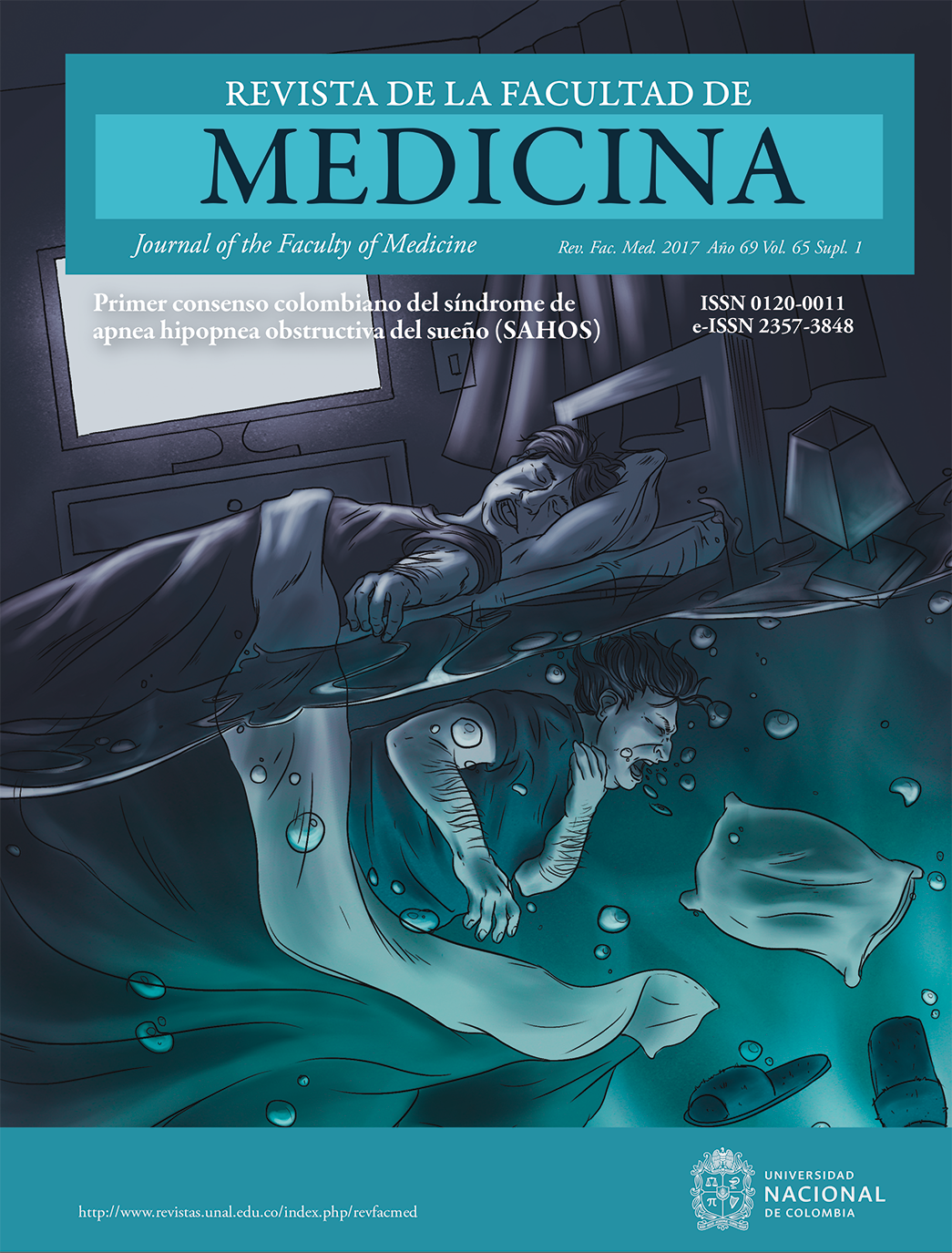
Publicado
Repercusiones psiquiátricas del síndrome de apnea-hipopnea obstructiva del sueño (SAHOS)
Psychiatric implications of obstructive sleep apnea-hypopnea syndrome (OSAHS)
DOI:
https://doi.org/10.15446/revfacmed.v65n1Sup.59542Palabras clave:
Síndromes de la apnea del sueño, Enfermedad, Diagnóstico, Terapéutica (es)Sleep Apnea Syndromes, Disease, Diagnosis, Therapeutics (en)
Referencias
Sutton EL. Psychiatric disorders and sleep issues. Med Clin North Am. 2014;98(5):1123-43. http://doi.org/bnmq.
Gałecki P, Florkowski A, Zboralski K, Pietras T, Szemraj J, Talarowska M. Psychiatric and psychological complications in obstructive sleep apnea syndrome. Pneumonol Alergol Pol. 2011;79(1):26-31.
Hızlı Ö, Özcan M, Ünal A. Evaluation of comorbidities in patients with OSAS and simple snoring. The Scientific World Journal. 2013;2013:709292. http://doi.org/bnmr.
Uyar M, Vrt O, Bayram N, Elbek O, Savaş E, Altindağ A, et al. Gender differences with respect to psychiatric comorbidity in obstructive sleep apnea syndrome. South Med J. 2011;104(7):495-8. http://doi.org/brpmxb.
Sharafkhaneh A, Giray N, Richardson P, Young T, Hirshkowitz M. Association of psychiatric disorders and sleep apnea in a large cohort. Sleep. 2005;28(11):1405-11. http://doi.org/bnms.
Einvik G, Hrubos-Strøm H, Randby A, Nordhus IH, Somers VK, Omland T, et al. Major depressive disorder, anxiety disorders, and cardiac biomarkers in subjects at high risk of obstructive sleep apnea. Psychosom Med. 2011;73(5):378-84. http://doi.org/c7z4j2.
Dai Y, Li X, Zhang X, Wang S, Sang J, Sun P, et al. Research on risk factors of depression symptoms in 1 327 patients with obstructive sleep apnea-hypopnea syndrome. Zhonghua Er Bi Yan Hou Tou Jing Wai Ke Za Zhi. 2015;50(2):110-7.
Hrubos-Strøm H, Einvik G, Nordhus IH, Randby A, Pallesen S, Moum T, et al. Sleep apnoea, anxiety, depression and somatoform pain: a community-based high-risk sample. Eur Respir J. 2012;40(2):400-7. http://doi.org/bnmt.
Naqvi HA, Wang D, Glozier N, Grunstein RR. Sleep-disordered breathing and psychiatric disorders. Curr Psychiatry Rep. 2014;16(12):519. http://doi.org/bnks.
Macey PM, Woo MA, Kumar R, Cross RL, Harper RM. Relationship between obstructive sleep apnea severity and sleep, depression and anxiety symptoms in newly-diagnosed patients. PLoS One. 2010;5(4):e10211. http://doi.org/bt2239.
Shapiro AL. Anxiety in middle-aged men with obstructive sleep apnea: state of the science. J Am Assoc Nurse Pract. 2014;26(12):689-95. http://doi.org/bnmv.
Escobar-Córdoba F, Folino O, Eslava-Schmalbach J. Sleep disorders and posttraumatic stress in raped victims. Rev Fac Med. 2012;60(4):317-24.
Krakow BJ, Ulibarri VA, Moore BA, McIver ND. Posttraumatic stress disorder and sleep-disordered breathing: a review of comorbidity research. Sleep Med Rev. 2014;24:37-45. http://doi.org/bnmx.
Lin WC, Winkelman JW. Obstructive sleep apnea and severe mental illness: evolution and consequences. Curr Psychiatry Rep. 2012;14(5):503-10. http://doi.org/bnmz.
El-Sherbini AM, Bediwy AS, El-Mitwalli A. Association between obstructive sleep apnea (OSA) and depression and the effect of continuous positive airway pressure (CPAP) treatment. Neuropsychiatr Dis Treat. 2011;7:715-21. http://doi.org/bnp6sc.
Anderson KN, Bradley AJ. Sleep disturbance in mental health problems and neurodegenerative disease. Nat Sci Sleep. 2013;5:61-75. http://doi.org/bnm2.
Bawden FC, Oliveira CA, Caramelli P. Impact of obstructive sleep apnea on cognitive performance. Arq Neuropsiquiatr. 2011;69(4):585-9. http://doi.org/bwhf2b.
Buratti L, Viticchi G, Falsetti L, Cagnetti C, Luzzi S, Bartolini M, et al. Vascular impairment in Alzheimer’s disease: the role of obstructive sleep apnea. J Alzheimers Dis. 2014;38(2):445-53. http://doi.org/bnm3.
Daurat A, Huet N, Tiberge M. Memory monitoring and memory control in patients suffering from obstructive sleep apnoea syndrome. Memory. 2014;22(6):710-21. http://doi.org/bnm4.
Wallace A, Bucks RS. Memory and obstructive sleep apnea: a meta-analysis. Sleep. 2013;36(2):203-20. http://doi.org/bnm5.
American Academy of Sleep Medicine. The international classification of sleep disorders. 3rd ed. Darien, Ill.: American Academy of Sleep Medicine; 2014.
Björnsdóttir E, Janson C, Gíslason T, Sigurdsson JF, Pack AI, Gehrman P, et al. Insomnia in untreated sleep apnea patients compared to controls. J Sleep Res. 2012;21(2):131-8. http://doi.org/dnrzfv.
Bjorvatn B, Pallesen S, Grønli J, Sivertsen B, Lehmann S. Prevalence and correlates of insomnia and excessive sleepiness in adults with obstructive sleep apnea symptoms. Percept Mot Skills. 2014;118(2):571-86. http://doi.org/bnm6.
Corcho-Mejía DC, Velásquez-Suárez JM, Escobar-Córdoba F. Apnea obstructiva del sueño y trastornos psiquiátricos. Rev Chi Neuro-psiquiatr. 2012;50(4):265-72. http://doi.org/bnm7.
Shirani A, Paradiso S, Dyken ME. The impact of atypical antipsychotic use on obstructive sleep apnea: a pilot study and literature review. Sleep Med. 2011;12(6):591-7. http://doi.org/fwrwbt.
Dimensions
PlumX
Visitas a la página del resumen del artículo
Descargas
Cómo citar
Licencia
Derechos de autor 2017 Revista de la Facultad de Medicina

Esta obra está bajo una licencia Creative Commons Reconocimiento 3.0 Unported.
-