Publicado
Historia del síndrome de apnea-hipopnea obstructiva del sueño (SAHOS)
History of obstructive sleep apnea-hypopnea syndrome (OSAHS)
DOI:
https://doi.org/10.15446/revfacmed.v65n1Sup.59725Palabras clave:
Apnea del sueño obstructiva, Síndromes de la apnea del sueño, Trastornos respiratorios. (es)Sleep Apnea, Obstructive, Sleep Apnea Syndromes, History. (en)
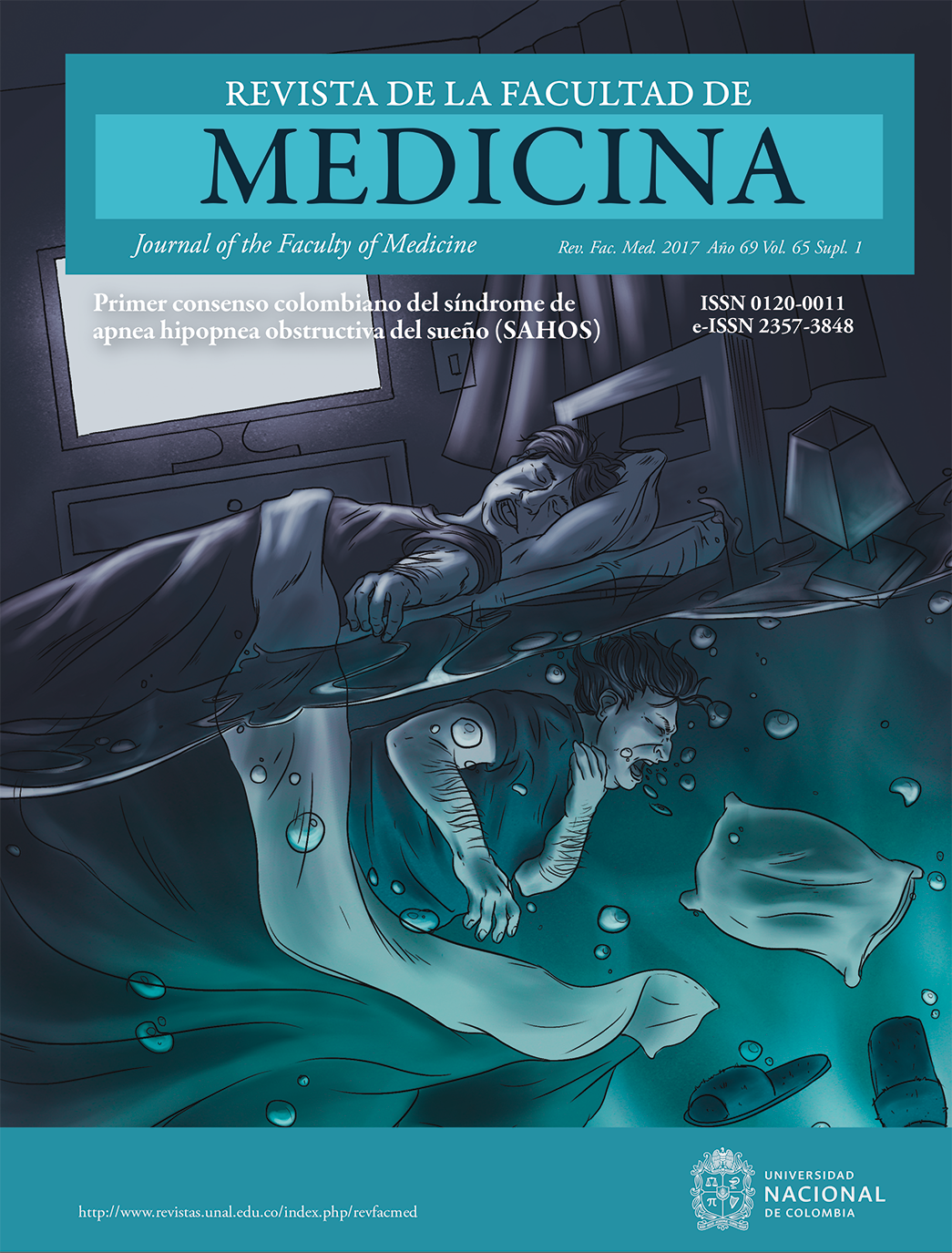
La historia de la apnea obstructiva del sueño es larga y complicada desde sus primeras descripciones en el siglo XIX con el relato de Pickwick en la primera novela de Charles Dickens. La definición de este término por parte de diferentes investigadores resalta la importancia de comprender las entidades asociadas al síndrome, como la hipoventilación alveolar y la somnolencia diurna excesiva. De esta forma, los estudios neurofisiológicos adelantados desde entonces, el desarrollo de la conferencia de la sociedad europea de neurología de 1964, la descripción del síndrome en pacientes pediátricos, la confirmación de la comorbilidad cardiovascular asociada a la enfermedad, la traqueostomía como tratamiento y la creación de implantes de estimuladores del nervio hipogloso —pasando por el descubrimiento de Sullivan de la presión positiva como tratamiento en casa— han sido esenciales para la comprensión de este síndrome.
The history of obstructive sleep apnea is long and complicated, and some descriptions can be traced back to the early nineteenth century in The Posthumous Papers of the Pickwick Club, the first novel written by Charles Dickens. The definition of this term by different researchers highlights the importance of understanding the entities associated with the syndrome, such as alveolar hypoventilation and excessive daytime sleepiness.
Thus, the neurophysiological studies carried out since then, as well as the European Society of Neurology conference held in 1964, the description of the syndrome in pediatric patients, the confirmation of cardiovascular co-morbidity associated with the disease, tracheostomy as treatment and the creation of hypoglossal nerve stimulus implants —including Sullivan’s discovery of positive pressure as a home treatment— have been essential for the understanding of this syndromeReferencias
Dickens C. The Posthumous Papers of the Pickwick club. London: Chapman and Hall; 1837.
Burwell CS, Robin ED, Whaley RD, Biskelmann AG. Extreme obesity associated with alveolar hypoventilation. A Pickwickian Syndrome. Amer. J Med. 1956;21:811-8. http://doi.org/bnhj.
Gelineau JB. De la narcolepsie. Gazette des hôpitaux. 1880;53:626-8.
Gerardy W, Herberg D, Kuhn HM. Vergleichende untersuchungen der lungfunktion und der elektroencephalogramms bei zwei patienten mit Pickwickian Syndrom. Zeitschrift für Klinische Medizin. 1960;156:362-80.
Drachman DB, Gumnit RJ. Periodic alteration of consciousness in the “Pickwickian” Syndrome. Arch Neurol. 1962;6(6):471-7. http://doi.org/bp6km4.
Jung R, Kuhlo W. Neurophysiology studies of abnormal night sleep in the Pickwickian Syndrome. In: Akert K, Bally C, Shade JP, editors. Progress in Brain Research: Sleep Mechanisms. Amsterdam: Elsevier; 1965. p. 14-159.
Kuhlo W. Neurophysiologische und klinische untersuchungen beim Pickwick-Syndrom. Arch Psychiatr Nervenkr. 1968;211(2):170-92. http://doi.org/czdsqq.
Kuhlo W, Doll E, Franc MC. Exfolgreiche behandlung eines Pickwick Syndrom durch eine dauertracheal kanule. Dtsch Med Wochenschr. 1969;94:1286-90. http://doi.org/fv4cp9.
Gastaut H, Tassinari CA, Duron B. Polygraphic study of the episodic diurnal and nocturnal manifestations of the Pickwickian syndrome. Brain Res. 1966;1(2):167-86. http://doi.org/fnvbwm.
Duron B, Quichaud J, Fullana N. Nouvelles recherches sur le mecanisme des apnees du syndrome de Pickwick. Bull Physiopathol Respir (Nancy). 1972;8(5):1277-88.
Lugaresi E, Coccagna G, Petrella A, Berti-Ceroni G, Pazzaglia P. Il disturbi del sonno e del respire nella syndrome di Pickwick. Sist Nerv. 1968;20(1):38-50.
Tassinari CA, Dalla Bernardina D, Cirignota F. Apneic periods and the respiratory related arousal patterns during sleep in the Pickwickian syndrome; a polygraphic study. Bull Physiopathol Respir. 1972;8(5):1087-102.
Kurtz D, Meunier-Carus J, Baptst-Reiter J, Landsdorfer J, Micheletti G, Benignus E, et al. Problèmes nosologiques posés par certaines formes d’hypersomnie. Rev Electroencephalogr Neurophysiol Clin (French). 1971;1:227-30. http://doi.org/btgr5t.
Krieger J. Les sequences hypno-apneic chez les sujets Pickwickiens: leur sémiologie et leur repartition. [Tesis]. Stasbourg: Facultad de Medicina de Strasbourg; 1975.
Coccagna G, Mantovani M, Brignani F, Parchi C, Lugaresi E. Continuous recording of pulmonary and systemic arterial pressure during sleep in syndromes of hypersomnia with periodic breathing. Bull Physiopathol Respir. 1972;8(5):1159-72.
Carroll D. Nosology of the Pickwickian syndrome. Bull Physiopathol Respir. 1972;8(5):1241-8.
Tammeling GJ, Blokzijl EJ, Boonstra S, Sluiter HJ. Micrognathia, hypersomnia and periodic breathing. Bull Physiopatol Respir. 1972;8(5):1229-38.
Guilleminault C, Eldridge FL, Dement WC. Insomnia, narcolepsy and sleep apneas. Bull Physiopathol Respir. 1972;8(5):1127-38.
Guilleminault C, Dement WC, Monod N. Syndrome “mort subite du nourrisson”: apnées au cours du sommeil. Nouvelle hypothèse. Nouv Presse Med. 1973;2(20):1355-8.
Guilleminault C, Eldridge FL, Dement WC. Insomnia with sleep apnea: a new syndrome. Science. 1973;181(4102):856-8. http://doi.org/b2678z.
Guilleminault C, Tilkian A, Dement WC. The sleep apnea syndromes. Annu Rev Med. 1976;27:465-84. http://doi.org/b4ctdq.
Guilleminault C, Eldridge F, Simmons FB, Dement WC. Sleep apnea syndrome: can it induce hemodynamic changes? West J Med. 1975;123(1):7-16.
Tilkian AG, Guilleminault C, Schroeder JS, Lehrman KL, Simmons FB, Dement WC. Hemodynamics in sleep induced apnea: studies during wakefulness and sleep. Ann Intern Med. 1976;85(6):714-9. http://doi.org/bnhn.
Tilkian AG, Guilleminault C, Schroeder JS, Lehrman KL, Simmons FB, Dement WC. Sleep induced apnea syndrome: prevalence of cardiac arrhythmias and their reversal after tracheostomy. Am J Med. 1977;63:348-58. http://doi.org/cnvbnw.
Weitzman ED, Pollack CP, Borrowieski B, Burack B, Shprintzem R, Rakauf S. The hypersomnia sleep apnea syndrome: site and mechanism of upper airway obstruction. In: Guilleminault C, Dement WC, editors. Sleep Apnea Syndrome. New York: Alan R Liss; 1988. p. 235-48.
Guilleminault C, Hill MW, Simmons FB, Dement WC. Obstructive sleep apnea: electromyographic and fiberoptic studies. Exp Neurol. 1978;62:48-67. http://doi.org/bg2zqw.
Guilleminault C, Eldridge F, Simmons F, Dement WC. Sleep apnea in eight children. Pediatrics. 1976;58(1):23-30.
Guilleminault C, Korobkin R, Winkle R. A review of 50 children with obstructive sleep apnea syndrome. Lung. 1981;159(5):275-87. http://doi.org/dxbcm3.
Sauerland EK, Harper RM. The human tongue during sleep: Electromyographic activity of the genioglossus muscle. Exp Neurol. 1976;51(1):160-70. http://doi.org/dtg58j.
Guilleminault C, Dement WC, editors. Sleep Apnea Syndrome. New York: AR Liss; 1978.
Remmers JE, de Groot WJ, Sauerland EK, Anch AM. Pathogenesis of upper airway occlusion during sleep. J Appl Physiol Respir Environ Exerc Physiol. 1978;44(6):931-8.
Lugaresi E, Coccagna G, Cirignotta F. Snoring and its clinical implications. In: Guilleminault C, Dement WC, editors. Sleep Apnea Syndrome. New York: AR Liss; 1978. p. 13-21.
Guilleminault C, Cummiskey J, Motta J. Chronic obstructive airflow disease and sleep studies. Am Rev Respir Dis. 1980;122(3):397-406.
Guilleminault C, Cummiskey J. Progressive improvement of apnea and ventilatory response to CO2 following tracheostomy in obstructive apnea syndrome. Am Rev Resp Dis. 1982;126(1):14-20.
Shapiro CM, Catteral JR, Oswald I, Flenley DC. Where are the british Sleep Apnoea patients? Lancet. 1981;2(8245):523. http://doi.org/cncjgk.
Flenley DC. Sleep in chronic obstructive lung disease. Clin Chest Med. 1985;6(4):651-61.
Sullivan CE, Berthon-Jones M, Issac FC, Eves L. Reversal of obstructive sleep apnea by continuous positive airway pressure applied through the nares. Lancet. 1981;1(8225):862-5. http://doi.org/frc3jj.
Fujita S, Conway WA, Zorick R, Roth T. Evaluation of the effectiveness of uvulo-palato-pharyngo-plasty. Laryngoscope. 1985;95(1):70-4.
Riley R, Powell N, Guilleminault C, Nino-Murcia G. Maxillary, mandibular, and hyoid advancement: an alternative to tracheostomy in obstructive sleep apnea syndrome. Otolaryngol Head Neck Surg. 1986;94(5):589-93. http://doi.org/cs73hp.
Andrews JM, Guilleminault C, Holdaway RA. Use of a mandibular positioning device in obstructive sleep apnea: a case report. Bull Eur Physiopath Resp (Clin Resp Physiol). 1983;19:611.
Nino-Murcia G, McCann CC, Bliwise DL, Guilleminault C, Dement WC. Compliance and side effects in sleep apnea patients treated with nasal continuous positive airway pressure. West J Med. 1989;150(2):165-9.
Schwartz AR, Bennett ML, Smith PL, De Backer W, Hedner J, Boudewyns A, et al. Therapeutic electrical stimulation of the hypoglossal nerve in obstructive sleep apnea. Arch Otolaryngol Head Neck Surg. 2001;127(10):1216-23. http://doi.org/bnjb.
Guilleminault C, Korobkin R, Winkle R. A review of 50 children with obstructive sleep apnea syndrome. Lung. 1981;159(5):275-87. http://doi.org/dxbcm3.
Kravath R, Pollak C, Borowiecki B. Hypoventilation during sleep in children who lymphoid airway obstruction treated by a nasopharyngeal tube and tonsillectomy and adenoidectomy. Pediatrics. 1977;59(6):865-71.
Mondini S, Zucconi M, Cirignotta F, Aguglia U, Lenzi PL, Zauli C, et al. Snoring as a risk factor for cardiac and circulatory problems: an epidemiologicoal study. In: Guilleminault C, Lugaresi E, editors. Sleep-wake disorders:epidemiology and long term follow-up. New York: Raven Press; 1983. p. 99-105.
Young T, Palta M, Dempsey J, Skatrud J, Weber S, Badr S. The occurrence of sleep-disordered-breathing among middle age adults. N Engl J Med. 1993;328(17):1230-5. http://doi.org/d3tqz2.
Puvamendram K, Goh KL. From snoring to sleep apnea in the Singapore population. Sleep Res Online. 1999;2(1):11-4.
Friberg D, Ansved T, Borg K, Carlsson-Nordlander B, Larsson H, Svanborg E. Histological indications of a progressive snorers disease in an upper airway muscle. Am J Respir Crit Care Med. 1998;157(2):586-93. http://doi.org/bnjc.
Schwab RJ, Pasirstein M, Pierson R, Mackley A, Hachadoorian R, Arens R, et al. Identification of upper airway anatomic risk factors for obstructive sleep apnea with volumetric MRI. Am J Respir Crit Care Med. 2003;168(5):522-30. http://doi.org/fhgn2r
Dimensions
PlumX
Visitas a la página del resumen del artículo
Descargas
Cómo citar
Licencia
Derechos de autor 2017 Revista de la Facultad de Medicina

Esta obra está bajo una licencia Creative Commons Reconocimiento 3.0 Unported.
-