Publicado
Cuadro clínico del síndrome de apnea-hipopnea obstructiva del sueño (SAHOS)
Clinical picture of obstructive sleep apnea-hypopnea syndrome (OSAHS)
DOI:
https://doi.org/10.15446/revfacmed.v65n1Sup.59726Palabras clave:
Signos y síntomas, Examen físico, Diagnóstico. (es)Signs and Symptoms, Physical Examination, Diagnosis. (en)
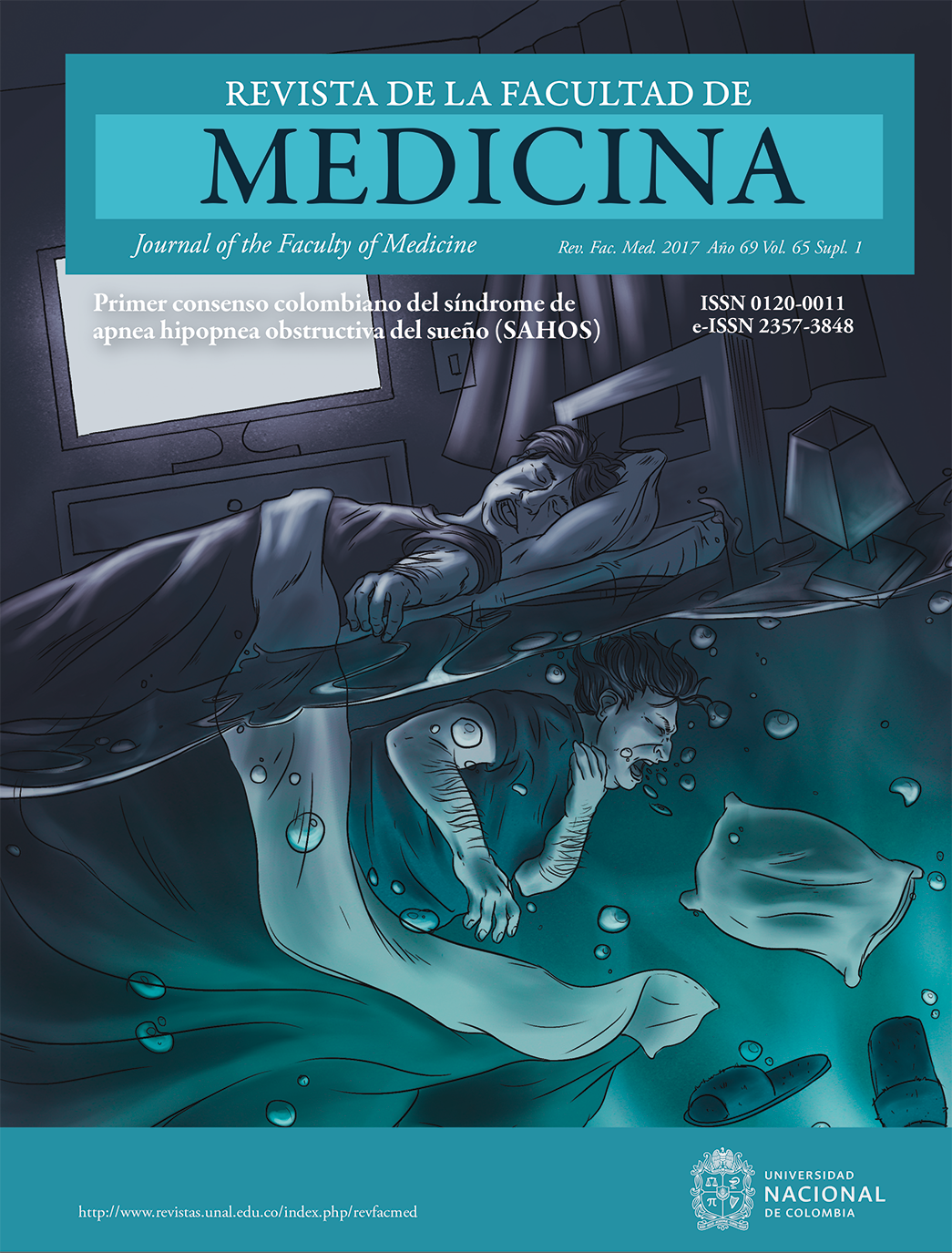
El pilar para el diagnóstico del síndrome de apnea-hipopnea obstructiva del sueño (SAHOS) es el cuadro clínico obtenido mediante una historia clínica detallada. Los síntomas son referidos por el paciente o su compañero de cama y se pueden dar durante el sueño o la vigilia; estos últimos se presentan como consecuencia del trastorno del sueño. Los síntomas son consecuencia de la obstrucción de la vía aérea superior, de la hipoxia intermitente o de la fragmentación repetida del sueño.
Para el diagnóstico de SAHOS, se deben tener en cuenta los factores agravantes, las comorbilidades, los antecedentes familiares, el examen físico, la obtención de medidas antropométricas, los signos vitales y los hallazgos anatómicos estructurales asociados con este síndrome o con alteraciones congénitas que lo predispongan. Tener conocimiento de estos aspectos clínicos es fundamental para alcanzar una buena aproximación a su diagnóstico.
The baseline for the diagnosis of obstructive sleep apnea-hypopnea syndrome (OSAHS) is the clinical picture obtained through a detailed clinical history. The symptoms are referred by the patients or their bed partners, can occur during sleep or wakefulness, and are a consequence of sleep disorders. Upper airway obstruction, intermittent hypoxia, or repeated sleep fragmentation are the cause of the symptoms.
For the diagnosis of OSAHS, aggravating factors, comorbidities, family history, physical examination, anthropometric measurements, vital signs and structural anatomical findings associated with this syndrome or with predisposing congenital abnormalities should be taken into account. Knowing these clinical aspects is fundamental to reach a good approximation to diagnosis.
Referencias
Cales A, Kadieux J, Bixler EU, Soldatos CR, Vela-Bueno A, Misoul CA, Locke TW. Severe obstructive sleep apnea. Onset, clinical course and characteristics. J Chron Dis. 1985;38(5):419-25. http://doi.org/cz723s.
Grupo español de sueño. Definición y concepto, fisiopatología, clínica y exploración del SAHOS. Arch Bronconeumol. 2005;41(Suppl 4):12-29. http://doi.org/cwdf6z.
Lugaresi E, Cirignotta F, Montagna P. Snoring: pathologenic, clinical and therapeutic aspects. In: Kryger MH, Roth T, Dement W-C, editors. Principles and practice of sleep medicine. Philadelphia: Saunders WB; 1989. p. 494-500.
Powell NB, Riley RW. A surgical protocol for sleep disordered breathing. Oral Maxillofac Surg Clin North Am. 1995;7:345-56.
Fenton ME, Heathcote K, Bryce R, Skomro R, Reid JK, Gjevre J, Cotton D. The utility of the elbow sign in the diagnosis of OSA. Chest. 2014;145(3):518-24. http://doi.org/bnkk.
Cruz IA, Drummond M, Winck JC. Obstructive sleep apnea symptoms beyond sleepiness and snoring: effects of nasal APAP therapy. Sleep Breath. 2012;16(2):361-6. http://doi.org/dbkmrq.
Hajduk IA, Strollo PJ, Jasani RR, Atwood CW Jr, Houck PR, Sanders MH. Prevalence and prediction of nocturia in obstructive sleep apnea hyopnea syndrome, a prospective study. Sleep. 2003;26(1):61-4.
Kuribayashi S, Kusano M, Kawamura O, Shimoyama Y, Maeda M, Hisada T, et al. Mechanism of gastroesophageal reflux in patients with obstructive sleep apnea syndrome. Neurogastroenterol Motil. 2010;22(6):611-17. http://doi.org/czqksm.
Ohayon MM, Li KK, Gulleminault C. Risk factors for sleep bruxism in the general population. Chest. 2001;119(1):53-61. http://doi.org/dxt7cg.
Johns MW. A new method for measuring daytime sleepiness: The Epworth Sleepiness Scale. Sleep. 1991;14(6):540-5.
Chica H, Escobar F, Eslava J. Validación de la Escala de Somnolencia de Epworth. Rev Salud Pública (Bogotá). 2007;9(4):558-67. http://doi.org/cpnqpz.
Strohl KP, Redline S. Recognition of obstructive sleep apnea. Am J Respir Crit Care Med. 1996;154(2 Pt 1):279-89. http://doi.org/bnkm.
Dement WC, Mitler MM, Roth T, Westbrook PR, Keenan S. Guidelines for the Multiple Sleep Latency Test: a standard measure of sleepiness. Sleep. 1986;9(4):519-24.
Doghramji K, Mitler M, Sangal R, Shapiro C, Taylor S, Walsleben J, et al. A normative stydy of the maintenance of wakefulness test [MWT]. Electroencephalogr Clin Neurophysiol. 1997;103(5):554-62. http://doi.org/b9228v.
Hirskowitz M, De La Cueva L, Hernan JH. The multiple vigilance test. Behav Res Meth Instr Comp. 1993;25:272-5. http://doi.org/dckbjm.
Puertas FJ, Seguret F, Dauvilliers Y, Carlander B, Billiard M. Reliability of Clinical impression in the differential diagnosis of disorders of Excessive Daytime Sleepiness (EDS). Sleep. 2003;26(Suppl):A365.
Phillip P, Sagaspe P, Taillard J, Chaumet G, Bayon V, Coste O, et al. Maintenance of wakefullnes test, obstructive sleep apnea síndrome and driving risk. Ann Neurol. 2008;64(4):410-16. http://doi.org/bbzck7.
Ward KL, Hillman DR, James A, Bremner AP, Simpson L, Cooper MN, et al. Excessive daytime sleepiness increases the risk of motor vehicle crash in obstructive sleep apnea. J Clin Sleep Med. 2013;9(10):1013-21. http://doi.org/bnkn.
Hoth KF, Zimmerman ME, Meschede KA, Arnedt JT, Aloia MS. Obstructive sleep apnea: impact of hypoxemia on memory. Sleep Breath. 2013;17(2):811-7. http://doi.org/bnkp.
Grigg-Damberger M, Ralls F. Cognitive dysfunction and obstructive sleep apnea: from cradle to tomb. Curr Opin Pulm Med. 2012;18(6):580-7. http://doi.org/bnkq.
Canessa N, Castronovo V, Cappa SF, Aloia MS, Marelli S, Falini A, et al. Obstructive sleep apnea: brain structural changes and neurocognitive function before and after treatment. Am J Respir Crit Care Med. 2011;183(10):1419-26. http://doi.org/b7ctrb.
Kadotani H, Kadotani T, Ypung T, Peppard PE, Finn L, Colrain IM, et al. Association between apolipoprotein E epsilon4 and sleep disordered breathing in adults. JAMA. 2001;285(22):2888-90. http://doi.org/cwchjq.
Naqvi HA, Wang D, Glozier N, Grunstein RR. Sleep disordered breathing and psychiatric disorders. Curr Psychiatry Rep. 2014;16(12):519-23. http://doi.org/bnks.
Schenck CH, Arnulf I, Mahowald MW. Sleep and sex: what can go wrong? A review of the literature on sleep related disorders and abnormal sexual behaviors and experiences. Sleep. 2007;30(6):683-702.
Goncalves MA, Guilleminault C, Ramos E, Palha A, Paiva T. Erectile dysfunction, obstructive sleep apnea, and nasal CPAP treatment. Sleep Med. 2005;6(4):333-9. http://doi.org/dfzqmx.
Obayon MM. Prevalence and risk factors of morning headaches in the general population. Arc Intern Med. 2004;164(1):97-102. http://doi.org/bnvvx2.
Lacasse Y, Godbout C, Sériès F. Independent validation of sleep apnea quality of life index. Thorax. 2002;57(6):483-8. http://doi.org/bpvr9h.
Flemons WW, Tsai W. Quality of life consequences of sleep-disordered breathing. J Allergy Clin Immunology. 1997;99(2):750-9. http://doi.org/fh8fz9.
Gall R, Isaac L, Kryger M. Quality of life in mild obstructive sleep apnea. Sleep. 1993;16(8 Suppl):S59-61.
D’Ambrosio c, Bowman T, Mohsenin V. Quality of life in patients with obstructive sleep apnea. Effect of nasal continuous positive airway pressure- a prospective study. Chest. 1999;115(1):123-9.
Guilleminault C, Poyares D, Rosa A, Kirisoglu C, Almeida T, Lopes MC. Chronic fatigue, unrefrshing sleep and nocturnal polysomnography. Sleep Med. 2006;7(6):513-20. http://doi.org/dgrg9f.
Gold AR, DiPalo AF, Gold MS, O’Hearn D. Symptoms and signs of upper airway resistance síndrome a link to the functional somatic síndromes. Chest. 2003;123:87-95. http://doi.org/c4zrt4.
Shepertycky MR, Bano K, Kryger MH. Difference between men and womenin the clinical prsentation of patients diagnosed with obstructive sleep apnea syndrome. Sleep. 2005;28(3):309-14.
Gulleminault C, Stoohs R, Kim YD, Chervin R, Black J, Clerk A. Upper airway sleep disordered breathing in women. Ann Intern Med. 1995;122(7):493-501. http://doi.org/bnkx.
The sixth report of the Joint National Committee on Prevention, Detection, Evaluation and Treatment of High Blood Pressure. Arch Intern Med. 1997;157(21):2413-46. http://doi.org/bptg8f.
Chobanian AV, Bakris GL, Black HR, Cushman WC, Green LA, Izzo JL Jr, et al, National Heart, Lung and Blood Institute Joint National Committee on Prevention, Detection, Evaluation and Treatment of High Blood Pressure; National High Blood Pressure Education Program Coordinating Committee. The Seventh Report of the Joint National Committee on Prevention, Detection, Evaluation, and Treatment of High Blood Pressure: the JNC 7 report. JAMA. 2003;289(19):2560-72. http://doi.org/b67bsv.
Wolk R, Somers VK. Cardiovascular consequences of obstructive sleep apnea. Clin Chest Med. 2003;24(2):195-205. http://doi.org/fjqc2t.
Hoffstein V, Szalai JP. Predictive value of clinical features in diagnosing obstructive sleep apnea. Sleep. 1993;16(2):118-22.
Durán J, Esnaola S, Rubio R, Iztueta A. Obstructive sleep apnea-hypopnea and related clinical features in a popilation-based sample of subjects aged 30 to 70 years. Am J Respir Crit Care Med. 2001;163(3 Pt 1):685-9. http://doi.org/bnjs.
Viner S, Szalai JP, Hoffstein V. Are history and physical examination a good screening test for sleep apnea? Ann Intern Med. 1991;115(5):356-69. http://doi.org/bnkz.
Chan A, Kushida CA. Sleep disordered breathing. Continuum Lifelong Learning Neurology. 2007;13(3):131-52.
Kyzer S, Charuzi I. Obstructive sleep apnea in the obese. World J Surg. 1998;22(9):998-1001. http://doi.org/b59jch.
Schwartz AR, Patil SP, Laffan AM, Polotsky V, Schneider H, Smith PL. Obesity and obstructive sleep apnea: pathogenic mechanisms and therapeutic approaches. Proc Am Thorac Soc. 2008;5(2):185-92. http://doi.org/cvzpjd.
Rosenow F, McCarthy V, Caruso AC. Sleep apnoea in endocrine diseases. J Sleep Res. 1998;7(1):3-11. http://doi.org/b95kjp.
Gutiérrez-Alaclá R. Crece la obesidad mórbida o grado 3 en México. México, D.F.: Alianza por la alud alimentaria; 2013 [cited 2017 Feb 7]. Available from: https://goo.gl/PzA5Tj.
Zonato AI, Martinho FL, Bittencourt LR, de Oliveira Camponês Brasil O, Gregório LC, Tufik S. Head and neck physical examination: comparison between nonapneic and obstructive sleep apnea patients. Laryngoscope. 2005;115(6):1030-4. http://doi.org/fpwx4w.
Kushida CA, Efron B, Guilleminault C. Apredictive morphometric model for the obstructive sleep apnea syndrome. Ann Intern Med. 1997;127(8):581-7. http://doi.org/bnk3.
Salud: Síndrome de Pierre Robin. Discapnet; 2012 [cited 2017 Feb 7]. Available from: https://goo.gl/ed8xre.
Pesqueira T. Malformaciones Cráneofaciales Congénitas y del Desarrollo. In: Manual de patología quirúrgica de cabeza y cuello. Santiago de Chile: Pontificia Universidad Católica de Chile; 2002 [cited 2017 Feb 7]. Available from: https://goo.gl/g2pS2D.
Katz ES, D’Ambrosio CM. Pediatric obstructive sleep apnea syndrome. Clin Chest Med. 2010;31(2):221-234. http://doi.org/dtrr8c.
Desvío de tabique (desvio septal, tabique desviado). Buenos Aires: Centro de Otorrinolaringología Dr. Chinski; 2014 [cited 2017 Feb 7]. Available from: https://goo.gl/9OGtdO.
Mallampati SR, Gatt SP, Gugino LD, Desai SP, Waraksa B, Freiberger D, Liu PL. A clinical sign to predict difficult tracheal intubation: a prospective study. Can Anaesth Soc J. 1985;32(4):429-34. http://doi.org/d57v2f.
Muzaffar A, Flood J. Craniofacial Anomalies I: Cephalometrics and Orthognathic Surgery. Selected Readings in Plastic Surgery. 2002;9(24):50.
Friedman M, Ibrahim H, Bass L. Clinical staging for sleep-disordered breathing. Otolaryngol Head Neck Surg. 2002;127(1):13-21. http://doi.org/b6p47g.
Angle EH. Classification of malocclusion. Dental Cosmos. 1899;41:248-64.
Lam B, Ooi CG, Peh WC, Lauder I, Tsang KW, Lam WK, Ip MS. Computed tomographic evaluation of the role of craniofacial and upper airway morphology in obstructive sleep apnea in Chinese. Respir Med. 2004;98(4):301-7. http://doi.org/fn2gpt.
Ishiguro K, Kobayashi T, Kitamura N, Saito C. Relationship between severity of sleep-disordered breathing and craniofacial morphology in Japanese male patients. Oral Surg Oral Med Oral Pathol Oral Radiol Endod. 2009;107(3):343-9. http://doi.org/b4qf2m.
Shelgikar A, Chervin R. Approach to and Evaluation of Sleep Disorders. Continuum (Minneap Minn). 2013;19(1):32-49. http://doi.org/bnk4.
Avidan A, Malow B. Physical examination in sleep medicine. In Kryger, Meir H, Roth T, Dement WC, editors. Principles and Practice of Sleep Medicine. Quinta edición. St. Louis, Missouri: Elsevier; 2012. p. 658-65.
Galería de imágenes. Murcia: Sociedad Murciana de Otorrinolaringología y Patología Cervicofacial; 2015 [cited 2017 Feb 7]. Available from: https://goo.gl/xPlMPE.
Scarone S. Bocio, una patología tiroidea. emn; 2015 [cited 2017 Feb 7]. Available from: https://goo.gl/MYIUAd.
Dimensions
PlumX
Visitas a la página del resumen del artículo
Descargas
Cómo citar
Licencia
Derechos de autor 2017 Revista de la Facultad de Medicina

Esta obra está bajo una licencia Creative Commons Reconocimiento 3.0 Unported.
-