Correo Electrónico
 DNINFOA - SIA
 Bibliotecas
 Convocatorias
 Identidad U.N.


Publicado
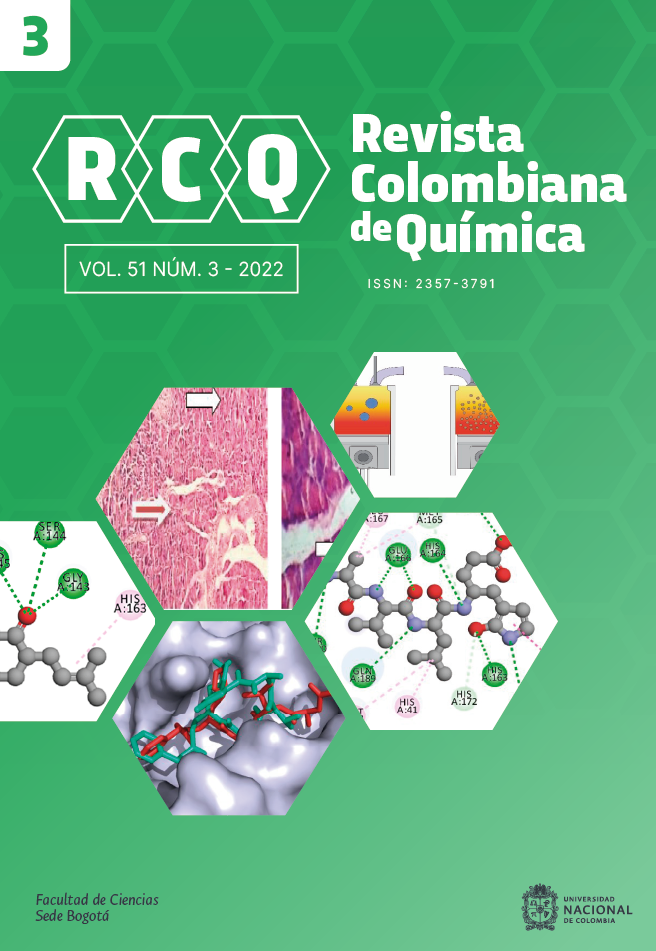
Síntesis y actividad antifúngica in vitro frente a Fusarium oxysporum de amidas N-alquilsustituidas derivadas de 2-aminoácidos
Synthesis and in vitro antifungal activity against Fusarium oxysporum of N-alkyl-substituted amides derived from 2-amino acids
Síntese e atividade antifúngica in vitro contra Fusarium oxysporum de amidas N-alquil-substituídas derivadas de 2-aminoácidos
DOI:
https://doi.org/10.15446/rev.colomb.quim.v51n3.107148Palabras clave:
amidas N-alquilsustituidas, derivados de 2-aminoácidos, Fusarium oxysporum (es)N-alkyl-substituted amides, 2-amino acid derivatives, Fusarium oxysporum (en)
amidas N-alquilsubstituídas, Derivados de 2 aminoácidos, Fusarium oxysporum (pt)
Una serie de amidas N-alquilsustituidas 1-16 fueron sintetizadas a partir de malonato de dietilo y ésteres de alquilo derivados de los aminoácidos ʟ-triptófano, ʟ-alanina, ʟ-fenilalanina y ʟ-tirosina. Los métodos de síntesis empleados involucraron calentamiento por irradiación de microondas empleando tanto un ácido de Lewis (AlCl3) o 4-dimetilaminopiridina (DMAP) como catalizador y auxiliar nucleofílico, respectivamente. Los resultados sugieren que el uso de irradiación de microondas y de DMAP conlleva mejores rendimientos en un tiempo de reacción más corto. Para ilustrar las diferencias observadas, se presentan las propuestas mecanísticas de cada método de reacción para la formación de amidas N-alquilsustituidas. Finalmente, las amidas sintetizadas se evaluaron en condiciones in vitro frente a Fusarium oxysporum; mostraron actividad antifúngica a diferentes niveles (0,40 mM < IC50 < 29,1 mM), lo cual indicó que las variaciones de la actividad observada de este grupo de compuestos pueden deberse al efecto de la amida acíclica como bioisóstero no clásico de algunas fitoalexinas heterocíclicas.
N-alkyl substituted amides 1-16 were synthesized from diethyl malonate and alkyl esters derived from the amino acids ʟ-tryptophan, ʟ-alanine, ʟ-phenylalanine, and ʟ-tyrosine. In addition, a microwave-assisted protocol was employed using a Lewis acid (AlCl3) or dimethylaminopyridine (DMAP) as a catalyst and nucleophilic auxiliary, respectively, affording the desired compounds. The results suggest that DMAP-catalyzed reactions under microwave irradiation yield higher during short reaction times. Each reaction method's mechanistic proposals for forming N-alkyl-substituted amides are presented to illustrate the observed differences. The synthesized amides were evaluated under in vitro conditions against Fusarium oxysporum. The compounds exhibited antifungal activity at different levels (0.40 mM < IC50 < 29.1 mM). These results indicated that the observed activity variations of this compound group might be due to the effect of acyclic amide as a non-classical bioisostere of some heterocyclic phytoalexins.
Uma série de amidas N-alquil substituídas foram sintetizadas a partir de malonato de dietila e ésteres alquílicos derivados dos aminoácidos ʟ-triptofano, ʟ-alanina, ʟ-fenilalanina e ʟ-tirosina. Os métodos de síntese empregados foram realizados usando aquecimento por irradiação de micro-ondas empregando um ácido de Lewis (AlCl3) ou dimetilaminopiridina (DMAP) como catalisador. Os resultados sugerem que a irradiação de micro-ondas usando DMAP leva a melhores rendimentos em um tempo de reação mais curto. Para ilustrar as diferenças observadas, são apresentadas as propostas mecanísticas de cada método de reação para a formação de amidas N-alquilsubstituídas. Finalmente, as amidas sintetizadas foram avaliadas in vitro contra Fusarium oxysporum, mostrando atividade antifúngica em diferentes níveis (0.40 mM < IC50 < 29.1 mM), o que indica que as variações observadas na atividade desse grupo de compostos podem ser devidas ao efeito de amida acíclica como um bioisóstero não clássico de algumas fitoalexinas heterocíclicas.
Referencias
M. S. C. Pedras, Q. Zheng, and V. Sarma-Mamillapalle, “The Phytoalexins from Brassicaceae: Structure, Biological Activity, Synthesis and Biosynthesis”, Nat. Prod. Commun., vol. 2, no. 3, pp. 319-330, 2007. DOI: https://doi.org/10.1177/1934578X0700200315.
M. S. C. Pedras and Z. Minic, “The Phytoalexins Brassilexin and Camalexin Inhibit Cyclobrassinin Hydrolase, a Unique Enzyme from the Fungal Pathogen Alternaria Brassicicola” Bioorganic Med. Chem., vol. 22, no. 1, pp. 459-467, 2014. DOI: https://doi.org/10.1016/j.bmc.2013.11.005.
M. S. C. Pedras and A. Abdoli, “Pathogen Inactivation of Cruciferous Phytoalexins: Detoxification Reactions, Enzymes and Inhibitors”, RSC Adv., vol. 7, no. 3, pp. 23633-23646, 2017. DOI: https://doi.org/10.1039/C7RA01574G.
M. Chripkova, D. Drutovic, M. Pilatova, J. Mikes, M. Budovska, J. Vaskova, M. Broggini, L. Mirossay, and J. Mojzis, “Brassinin and Its Derivatives as Potential Anticancer Agents”, Toxicol. Vitr., vol. 28, no. 5, pp. 909-915, 2014. DOI: https://doi.org/10.1016/j.tiv.2014.04.002.
D. Quiroga, L. D. Becerra, J. Sadat-Bernal, N. Vargas, and E. Coy-Barrera, “Synthesis and Antifungal Activity against Fusarium Oxysporum of Some Brassinin Analogs Derived from L-Tryptophan: A DFT/B3LYP Study on the Reaction Mechanism”, Molecules, vol. 21, pp. 1-8, 2016. DOI: https://doi.org/10.3390/molecules21101349.
D. Quiroga, L. D. Becerra, and E. Coy-Barrera, “Ultrasound-Assisted Synthesis, Antifungal Activity against Fusarium oxysporum, and Three-Dimensional Quantitative Structure-Activity Relationship of N,S-Dialkyl Dithiocarbamates Derived from 2-Amino Acids”, ACS Omega, vol. 4, no. 9, pp. 13710-13720, 2019. DOI: https://doi.org/10.1021/acsomega.9b01098.
P. Borrego-Muñoz, L. D. Becerra, F. Ospina, E. Coy-Barrera, and D. Quiroga, “Synthesis (Z) vs (E) Selectivity, Antifungal Activity against Fusarium oxysporum, and Structure-Based Virtual Screening of Novel Schiff Bases Derived from l-Tryptophan”, ACS Omega, vol. 7, no. 28, pp. 24714-24726, 2022. DOI: https://doi.org/10.1021/acsomega.2c02614.
P. Borrego-Muñoz, D. Cardenas, F. Ospina, E. Coy-Barrera, and D. Quiroga, “Second-Generation Enamine-Type Schiff Bases as 2-Amino Acid-Derived Antifungals against Fusarium oxysporum: Microwave-Assisted Synthesis, In Vitro Activity, 3D-QSAR, and In Vivo Effect”, J. Fungi, vol. 9, 113, 2023. DOI: https://doi.org/10.3390/jof9010113.
M. Kamal, T. Jawaid, U. A. Dar, and S. A. Shah, “Amide as a Potential Pharmacophore for Drug Designing of Novel Anticonvulsant Compounds”, Chem. Biol. Potent Nat. Prod. Synth. Compd., pp. 319-342, 2021. DOI: https://doi.org/10.1002/9781119640929.ch11.
S. Mahesh, K.-C. Tang, and M. Raj, “Amide Bond Activation of Biological Molecules”, Molecules, vol. 23, no. 10, pp. 2615, 2018. DOI: https://doi.org/10.3390/molecules23102615.
A. V. Krivoshein, “Antiepileptic Drugs Based on the -Substituted Amide Group Pharmacophore: From Chemical Crystallography to Molecular Pharmaceutics”, Curr. Pharm. Des., vol. 22, no. 32, pp. 5029-5040, 2016. DOI: https://doi.org/10.2174/1381612822666160722095748.
V. O. Kozminykh, “Synthesis and Biological Activity of Substituted Amides and Hydrazides of 1,4-Dicarboxylic Acids (a Review)”, Pharm. Chem. J., vol. 6, no. 40 (1), pp. 8-17, 2006. DOI: https://doi.org/10.1007/s11094-006-0048-0.
X. Wang, “Challenges and Outlook for Catalytic Direct Amidation Reactions”, Nat. Catal., vol. 2, pp. 98-102, 2019. DOI: https://doi.org/10.1038/s41929-018-0215-1.
B. L. Bray, “Large-Scale Manufacture of Peptide Therapeutics by Chemical Synthesis”, Nat. Rev. Drug Discov., vol. 2, pp. 587-593, 2003. DOI: https://doi.org/10.1038/nrd1133.
B. S. Chhikara, N. St. Jean, D. Mandal, A. Kumar, and K. Parang, “Fatty Acyl Amide Derivatives of Doxorubicin: Synthesis and in Vitro Anticancer Activities”, Eur. J. Med. Chem., vol. 46, pp. 2037-2042, 2011. DOI: https://doi.org/10.1016/j.ejmech.2011.02.056.
J. Wu, S. Kang, B. Song, D. Hu, M. He, L. Jin, and S. Yang, “Synthesis and Antibacterial Activity against Ralstonia Solanacearum for Novel Hydrazone Derivatives Containing a Pyridine Moiety”, Chem. Cent. J., vol. 6, pp. 1-5, 2012. DOI: https://doi.org/10.1186/1752-153X-6-28.
Z. Özdemir and Z. Wimmer, “Selected Plant Triterpenoids and Their Amide Derivatives in Cancer Treatment: A Review”, Phytochemistry, vol. 203, p. 113340, 2022. DOI: https://doi.org/10.1016/j.phytochem.2022.113340.
A. Ahmadi, M. Khalili, Z. Olama, S. Karami, and B. Nahri-Niknafs, “Synthesis and Study of Analgesic and Anti-Inflammatory Activities of Amide Derivatives of Ibuprofen”, Mini-Reviews Med. Chem., vol. 17, pp. 799-804, 2017. DOI: https://doi.org/10.2174/1389557516666161226155951.
B. J. Kim, J. Kim, Y. K. Kim, S. Y. Choi, and H. Y. P. Choo, “Synthesis of Benzoxazole Amides as Novel Antifungal Agents against Malassezia Furfur”, Bull. Korean Chem. Soc., vol. 31, no. 5, 1270-1274, 2010. DOI: https://doi.org/10.5012/bkcs.2010.31.5.1270.
J. Fu, K. Cheng, Z. Zhang, R. Fang, and H. Zhu, “Synthesis, Structure and Structure-Activity Relationship Analysis of Caffeic Acid Amides as Potential Antimicrobials”, Eur. J. Med. Chem., vol. 45, pp. 2638-2643, 2010. DOI: https://doi.org/10.1016/j.ejmech.2010.01.066.
M. Gumbo, R. Beteck, T. Mandizvo, R. Seldon, D. Warner, H. Hoppe, M. Isaacs, D. Laming, C. Tam, L. Cheng, N. Liu, K. Land, and S. Khanye, “Cinnamoyl-Oxaborole Amides: Synthesis and Their in Vitro Biological Activity”, Molecules, vol. 23, no. 8, p. 2038, 2018. DOI: https://doi.org/10.3390/molecules23082038.
E. Massolo, M. Pirola, and M. Benaglia, “Amide Bond Formation Strategies: Latest Advances on a Dateless Transformation: Amide Bond Formation Strategies: Latest Advances on a Dateless Transformation”, Eur. J. Org. Chem., vol. 2020, no. 30, pp. 4641-4651, 2020. DOI: https://doi.org/10.1002/ejoc.202000080.
J. R. Dunetz, J. Magano, and G. A. Weisenburger, “Large-Scale Applications of Amide Coupling Reagents for the Synthesis of Pharmaceuticals”, Org. Process Res. Dev., vol. 20, pp. 140-177, 2016. DOI: https://doi.org/10.1021/op500305s.
A. Ojeda-Porras and D. Gamba-Sánchez, “Recent Developments in Amide Synthesis Using Nonactivated Starting Materials”, J. Org. Chem., vol. 81, pp. 11548-11555, 2016. DOI: https://doi.org/10.1021/acs.joc.6b02358.
M. T. Sabatini, L. T. Boulton, H. F. Sneddon, and T. D. Sheppard, “A Green Chemistry Perspective on Catalytic Amide Bond Formation”, Nat. Catal., vol. 2, pp. 10-17, 2019. DOI: https://doi.org/10.1038/s41929-018-0211-5.
S. Ghosh, A. Bhaumik, J. Mondal, A. Mallik, S. Sengupta, and C. Mukhopadhyay, “Direct Amide Bond Formation from Carboxylic Acids and Amines Using Activated Alumina Balls as a New, Convenient, Clean, Reusable and Low Cost Heterogeneous Catalyst”. Green Chem., vol. 14, pp. 3220-3229, 2012. DOI: https://doi.org/10.1039/c2gc35880h.
C. L. Allen, A. R. Chhatwal, and J. M. J. Williams, “Direct Amide Formation from Unactivated Carboxylic Acids and Amines”, Chem. Commun., vol. 48, no. 5, pp. 666-668, 2012. DOI: https://doi.org/10.1039/c1cc15210f.
C. O. Kappe, B. Pieber, and D. Dallinger, “Microwave Effects in Organic Synthesis: Myth or Reality?”, Angew. Chemie - Int. Ed., vol. 52, pp. 1088-1094, 2013. DOI: https://doi.org/10.1002/anie.201204103.
C. O. Kappe, D. Dallinger, and S. S. Murphree, “Practical Microwave Synthesis for Organic Chemists: Strategies, Instruments, and Protocols”, 2009. DOI: https://doi.org/10.1002/9783527623907.
W. C. Chou, C. W. Tan, S. F. Chen, and H. Ku, “One-Pot Neat Reactions of Carboxylic Esters and Alkylenediamines for Efficient Preparation of N-Acylalkylenediamines”, J. Org. Chem., vol. 63, pp. 10015-10017, 1998. DOI: https://doi.org/10.1021/jo980830j.
F. Z. Zradni, J. Hamelin, and A. Derdour, “Synthesis of Amides from Esters and Amines under Microwave Irradiation”, Synth. Commun., vol. 32, no. 22, pp. 3525-3531, 2002. DOI: https://doi.org/10.1081/SCC-120014792.
X. J. Wang, Q. Yang, F. Liu, and Q. D. You, “Microwave-Assisted Synthesis of Amide under Solvent-Free Conditions”, Synth. Commun., vol. 38, no. 7, pp. 1028-1035, 2008. DOI: https://doi.org/10.1080/00397910701860372.
P. Kaur, S. Sharma, and J. Gaba, “Conventional vs Microwave Assisted Synthesis of Different Substituted Heterocyclic Amides”, J. Indian Chem. Soc., vol. 96, pp. 401-405, 2019.
Basavaprabhu, K. Muniyappa, N. R. Panguluri, P. Veladi, and V. V. Sureshbabu, “A Simple and Greener Approach for the Amide Bond Formation Employing FeCl3 as a Catalyst”, New J. Chem., vol. 39, no. 10, pp. 7746-7749, 2015. DOI: https://doi.org/10.1039/c5nj01047k.
R. Marentes-Culma, L. Orduz-Díaz, and E. Coy-Barrera, “Targeted Metabolite Profiling-Based Identification of Antifungal 5-n-Alkylresorcinols Occurring in Different Cereals against Fusarium oxysporum”, Molecules, vol. 24, p. 770, 2019. DOI: https://doi.org/10.3390/molecules24040770.
B. D. Mkhonazi, M. Shandu, R. Tshinavhe, S. B. Simelane, and P. T. Moshapo, “Solvent-Free Iron[III] Chloride-Catalyzed Direct Amidation of Esters Blessing”, Molecules, vol. 25, p. 1040, 2020. DOI: https://doi.org/10.3390/molecules25051040.
M. Khashi, A. Davoodnia, and J. Chamani, “Dmap-Catalyzed Synthesis of Novel Pyrrolo[2,3-D]Pyrimidine Derivatives Bearing an Aromatic Sulfonamide Moiety”, Phosphorus, Sulfur Silicon Relat. Elem., vol. 189, pp. 839-848, 2014. DOI: https://doi.org/10.1080/10426507.2013.858253.
J. Cossy and A. Thellend, “A 4-Dimethylaminopyridine-Catalyzed Aminolysis of β-Ketoesters. Formation of β-Ketoamides”, Synthesis [Stuttg], vol. 10, pp. 753-755, 1989. DOI: https://doi.org/10.1055/s-1989-27383
W. Ziemkowska, E. Jaśkowska, I. D. Madura, J. Zachara, and E. Zygadło-Monikowska, “Synthesis and Structure of Diethylaluminum Malonate: An Unusual Hexanuclear Aluminum Complex with Malonate Trianion Ligands”, Journal of Organometallic Chemistry, vol. 713, pp. 178-181, 2012. DOI: https://doi.org/10.1016/j.jorganchem.2012.05.008.
R. Lichtenberger, S. O. Baumann, M. Bendova, M. Puchberger, and U. Schubert, “Modification of Aluminium Alkoxides with Dialkylmalonates”, Monatsh. Chem., vol. 141, no. 7, pp. 717-727, 2010. DOI: https://doi.org/10.1007/s00706-010-0317-1.
I. Dhimitruka and J. SantaLucia, “Investigation of the Yamaguchi Esterification Mechanism. Synthesis of a Lux-S Enzyme Inhibitor Using an Improved Esterification Method”, Org. Lett., vol. 8, no. 1, pp. 47-50, 2006. DOI: https://doi.org/10.1021/ol0524048.
L. Hao, X. Chen, S. Chen, K. Jiang, J. Torres, and Y. R. Chi, “Access to Pyridines via DMAP-Catalyzed Activation of α-Chloro Acetic Ester to React with Unsaturated Imines”, Org. Chem. Front., vol. 1, no. 2, pp. 148-150, 2014. DOI: https://doi.org/10.1039/C3QO00045A.
R. O. McCourt and E. M. Scanlan, “A Sequential Acyl Thiol-Ene and Thiolactonization Approach for the Synthesis of δ-Thiolactones”, Org. Lett., vol. 21, no. 9, pp. 3460-3464, 2019. DOI: https://doi.org/10.1021/acs.orglett.9b01271.
T. Okuhara, “Water-Tolerant Solid Acid Catalysts”, Chem. Rev., vol. 102, pp. 3641-3666, 2002. DOI: https://doi.org/10.1021/cr0103569.
S. C. M. Pedras, M. Jha, and W. K. P. Ahiahonu, “The Synthesis and Biosynthesis of Phytoalexins Produced by Cruciferous Plants”, Curr. Org. Chem., vol. 7, no. 16, pp. 1635-1647, 2003. DOI: https://dx.doi.org/10.2174/1385272033486242.
S. Kumari, A. V. Carmona, A. K. Tiwari, and P. C. Trippier, “Amide Bond Bioisosteres: Strategies, Synthesis, and Successes”, J. Med. Chem., vol. 63, no. 21, pp. 12290-12358, 2020. DOI: https://doi.org/10.1021/acs.jmedchem.0c00530.
R. Wu, C. Zhu, X. J. Du, L. X. Xiong, S. J. Yu, X. H. Liu, Z. M. Li, and W. G. Zhao, “Synthesis, Crystal Structure and Larvicidal Activity of Novel Diamide Derivatives against Culex Pipiens”, Chem. Cent. J., vol. 6, pp. 1-5, 2012. DOI: https://doi.org/10.1186/1752-153X-6-99.
J. Wu, S. Kang, B. Song, D. Hu, M. He, L. Jin, and S. Yang, “Synthesis and Antibacterial Activity against Ralstonia Solanacearum for Novel Hydrazone Derivatives Containing a Pyridine Moiety”, Chem. Cent. J., vol. 6, pp. 1-5, 2012. DOI: https://doi.org/10.1186/1752-153X-6-28.
J. Wu, J. Wang, D. Hu, M. He, L. Jin, and B. Song, “Synthesis and Antifungal Activity of Novel Pyrazolecarboxamide Derivatives Containing a Hydrazone Moiety”, Chem. Cent. J., vol. 6, pp. 1-5, 2012. DOI: https://doi.org/10.1186/1752-153X-6-51.
A. Zhang, J. Zhou, K. Tao, T. Hou, and H. Jin, “Design, Synthesis and Antifungal Evaluation of Novel Pyrazole Carboxamides with Diarylamines Scaffold as Potent Succinate Dehydrogenase Inhibitors”, Bioorganic Med. Chem. Lett., vol. 28, no. 18, pp. 3042-3045, 2018. DOI: https://doi.org/10.1016/j.bmcl.2018.08.001.
Cómo citar
IEEE
ACM
ACS
APA
ABNT
Chicago
Harvard
MLA
Turabian
Vancouver
Descargar cita
Licencia
Derechos de autor 2023 Paola Borrego-Muñoz, Diego Enrique Quiroga, Ericsson Coy-Barrera

Esta obra está bajo una licencia internacional Creative Commons Atribución 4.0.
Los autores/as conservarán sus derechos de autor y garantizarán a la revista el derecho de primera publicación de su obra, el cuál estará simultáneamente sujeto a la Licencia de reconocimiento de Creative Commons (CC. Atribución 4.0) que permite a terceros compartir la obra siempre que se indique su autor y su primera publicación en esta revista.
Los autores/as podrán adoptar otros acuerdos de licencia no exclusiva de distribución de la versión de la obra publicada (p. ej.: depositarla en un archivo telemático institucional o publicarla en un volumen monográfico) siempre que se indique la publicación inicial en esta revista.
Se permite y recomienda a los autores/as difundir su obra a través de Internet (p. ej.: en archivos telemáticos institucionales o en su página web) antes y durante el proceso de envío, lo cual puede producir intercambios interesantes y aumentar las citas de la obra publicada. (Véase El efecto del acceso abierto).