Correo Electrónico
 DNINFOA - SIA
 Bibliotecas
 Convocatorias
 Identidad U.N.


Publicado
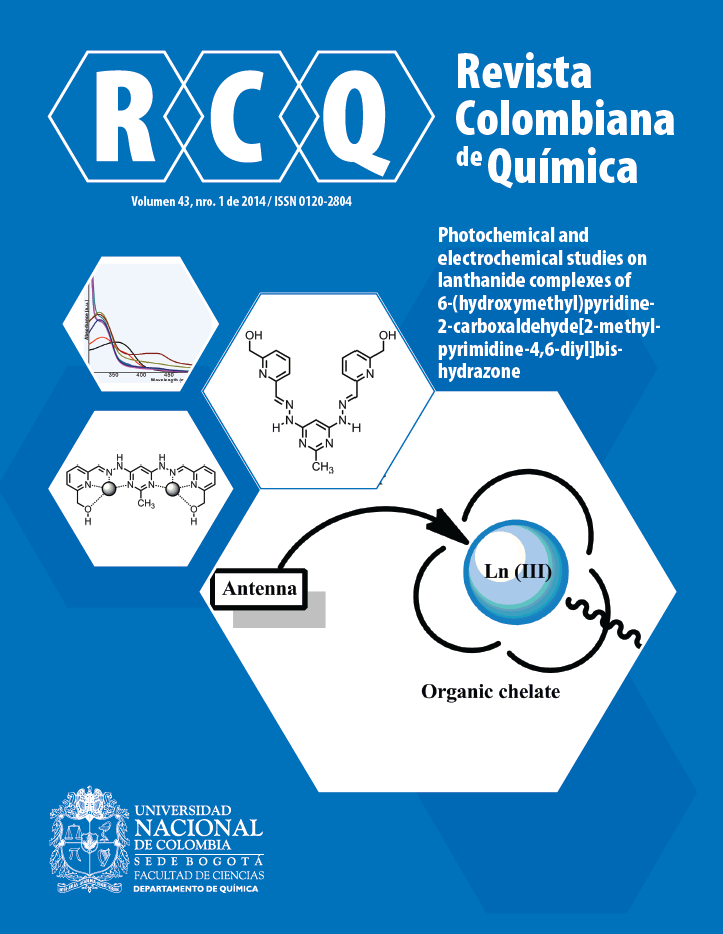
Photochemical and electrochemical studies on lanthanide complexes of 6-(hydroxymethyl)pyridine- 2-carboxaldehyde[2- methyl-pyrimidine-4,6-diyl] bis-hydrazone
Estudios fotoquímicos y electroquímicos de complejos lantánidos de 6-(hidroximetil)piridin- 2-carboxaldehído[2- metilpirimidina-4,6-diil] bishidrazona
DOI:
https://doi.org/10.15446/rev.colomb.quim.v43n1.50540Palabras clave:
Lanthanide complexes, photochemistry, bis-hidrazones, isomerization, UV-Vis/Fluorescence, electrochemistry. (es)
Descargas
Se reporta la síntesis de la 6-(hidroximetil)
piridin-2-carboxaldehído[2-metilpirimidina-
4,6-diil]bishidrazona mediante la reacción
de condensación entre el 6-(hidroximetil)
piconaldehído con la 4,6-(bishidracino)-2-
metilpirimidina. Esta bishidrazona puede ser
visualizada como un sistema de dos brazos
los cuales exhiben isomerizaciones [E,E]/
[E,Z]/[Z,Z’] fotoquímicamente inducidas
y coordinación a centros metálicos. Los
cambios configuracionales, después de
irradiación UV, fueron seguidos en el tiempo
mediante RMN 1H estableciendo que la
isomerización, en ambos brazos del sistema,
corresponde a una reacción consecutiva
que sigue una cinética de primer orden (k1=
4,06 x 10⁻⁴ s-1 y k2= 2,80 x 10⁻⁴ s-1). Además se
prepararon complejos metálicos de La (III)
y Sm(III), seguidamente, las propiedades de
absorción y emisión de dichos complejos
fueron estudiadas calculando rendimientos
cuánticos de fluorescencia de 𝟇La= 0,2024 y
𝟇Sm= 0,1413. Estudios electroquímicos de
los complejos se llevaron a cabo a través de
voltametría de onda cuadrada indicando
que los compuestos preparados poseen
potenciales redox dentro del rango de trabajo
del solvente.
Herein we report the synthesis of the 6-(hydroxymethyl)pyridine-2- carboxaldehyde[2-methyl-pyrimidine- 4,6-diyl]bis-hydrazone by a condensation reaction between 6-(hydroxymethyl) picolinaldehyde with 4,6-(bis-hydrazino)-2- methylpyrimidine. This bis-hydrazone can be visualized as a two-arm system which exhibits photochemical induced [E,E]/[E,Z]/[Z,Z’] isomerizations and double coordination to metal centers. Configurational changes, upon UV light irradiation, were followed over time by 1 H NMR, establishing that isomerization, in both arms, is a consecutive reaction that follows first-order kinetics (k1 = 4.06 x 10⁻⁴ s-1 and k2 = 2.80 x 10⁻⁴ s-1). Furthermore, the synthesis of bis-hydrazone metal complexes with La (III) and Sm (III) ions was achieved; subsequently, the absorption and emission properties of these complexes were studied, determining the fluorescence quantum yields, 𝟇La= 0.2024 and 𝟇Sm= 0.1413. Electrochemical studies of the complexes were conducted by square wave voltammetry, demonstrating that the bis-hydrazone and its complexes are electroactive species between +1.5 and -2.5 V.
Descargas
Citas
Schiff, H. Mittheilungen aus dem Universitätslaboratorium in Pisa:
eine neue Reihe organischer Basen. Justus Liebigs Annalen der Chemie.
131: 118–119.
Rollas, S.; Güniz-Küçükgüzel, Ş. Biological Activities of Hydrazone
Derivatives. Molecules. 2007. 12: 1910–1939.
Hutchinson, D. J.; Cameron, S. A.; Hanton, L. R.; Moratti, S. Sensitivity
of silver (I) complexes of a pyrimidine–hydrazone ligand
to solvent, counteranion, and metal-to-ligand ratio changes. Inorg.
Chem. 2012. 51: 5070–5081.
Tamboura, F. B.; Diouf, O.; Barry, A. H.; Gayea, M.; Sall, A. Dinuclear
lanthanide(III) complexes with large-bite Schiff bases derived
from 2,6-diformyl-4-chlorophenol and hydrazides: Synthesis, structural
characterization and spectroscopic studies. Polyhedron. 2012.
: 97–103.
Volpi, N. Springer Science Business Media, Inc.: New York, 2011.
Dugave, C.; Demange, L. Cis−Trans Isomerization of Organic Molecules
and Biomolecules: Implications and Applications. Chemical
reviews. 2003. 103: 2475–532.
Chaur, M. N.; Collado, D.; Lehn, J. M. Configurational and Constitutional
Information Storage: Multiple Dynamics in Systems Based
on Pyridyl and Acyl Hydrazones. Chem. Eur. J. 2011. 17: 248–258.
Bren, V.; Minkin, V.; Shepelenko, E.; Dobonosov, A.; Bushkov, A.
Photoisomerization of Hydrazones of 2-Acetyl-3-hydroxy-benzo[b]
furan and -benzo[b]thiophene. Mendeleev. Comm. 1991. 1: 72–73.
Bunzli, J.; Chauvin, A.; Kim, H.; Deiters, E. Lanthanide luminescence
efficiency in eight- and nine-coordinate complexes: Role of
the radiative lifetime. Coord. Chem. Rev. 2010. 254: 2623–2633.
Moreno-Fuquen. R.; Chaur, M. N.; Romero, E. L.; Zuluaga, F.; Ellena,
J. 6-Bromopyridine-2-carbaldehyde phenylhydrazone.J. Acta Crystallogr.Sect. B-Struct. Sci. 2012. 68: o2131.
Chaur, M. N. Dichlorido{(E)-4-dimethylamino-N═[(pyridin-
-yl)methylidene-κN] benzohydrazide-κO}zinc. Acta Crystallogr. Sect.
E.-Struct 2013. 69: 27.
Bünzli, J. C. G.; Eliseeva, S. V. J. Lanthanide NIR luminescence
for telecommunications, bioanalyses and solar energy conversion.
J Rare Earths. 2010. 28: 824–842.
Moeller, T. In MTP International Review of Science, Inorganic
Chemitry, Series I, Vol.VII. Ed. Bagnall K. W., London: Butterworths.
pp. 275. 1972.
Binnemans, K. Lanthanide-Based Luminescent Hybrid Materials.
Chem. Rev. 2009. 109: 4283–4374.
Armelao, L.; Quici, S.; Barigelletti, F.; Accorsi, G.; Bottaro, G.;
Cavazzini, M.; Tondello, E. Design of luminescent lanthanide complexes:
From molecules to highly efficient photo-emitting materials.
Coord. Chem. Rev. 2010. 254: 487–505.
Williams, A. T. R.; Winfield, S. A.; Miller, J. N. Relative fluorescence
quantum yields using a computer controlled luminescence spectrometer.
Analyst. 1983. 108: 1067.
Scaiano, J. C. Handbook of Organic Photochemistry. CRC Press. pp.
1989.
Pearson, R. G. Hard and Soft Acids and Bases. J. Am. Chem. Soc.
85: 3533–3539.
Chandrasekhar, V.; Azhakar, R.; Murugesapandian, B.; Senapati,
T.; Bag, P.; Pandey, M. D.; Maurya, S. K.; Goswami, D. Synthesis,
Structure, and Two-Photon Absorption Studies of a Phosphorus-
Based Tris Hydrazone Ligand (S)P[N(Me)N═CH-C6H3-2-OH-
-N(CH2CH3)2]3 and Its Metal Complexes. Inorg. Chem. 2010. 49:
–4016.
Licencia
Los autores/as conservarán sus derechos de autor y garantizarán a la revista el derecho de primera publicación de su obra, el cuál estará simultáneamente sujeto a la Licencia de reconocimiento de Creative Commons (CC. Atribución 4.0) que permite a terceros compartir la obra siempre que se indique su autor y su primera publicación en esta revista.
Los autores/as podrán adoptar otros acuerdos de licencia no exclusiva de distribución de la versión de la obra publicada (p. ej.: depositarla en un archivo telemático institucional o publicarla en un volumen monográfico) siempre que se indique la publicación inicial en esta revista.
Se permite y recomienda a los autores/as difundir su obra a través de Internet (p. ej.: en archivos telemáticos institucionales o en su página web) antes y durante el proceso de envío, lo cual puede producir intercambios interesantes y aumentar las citas de la obra publicada. (Véase El efecto del acceso abierto).