Correo Electrónico
 DNINFOA - SIA
 Bibliotecas
 Convocatorias
 Identidad U.N.


Publicado
Implementación y evaluación de una nariz electrónica para la detección de alcoholes lineales
Implementation and evaluation of an electronic nose for the alcohols detection
DOI:
https://doi.org/10.15446/rev.colomb.quim.v45n2.60393Palabras clave:
nariz electrónica, clasificación de alcoholes, arreglo de sensores preparado, PCA, sensores de gas, óxido de estaño (es)electronic nose, alcohols classification, array of prepared sensors, PCA, gas sensors, tin oxide (en)
Se desarrolló una nariz electrónica que permite la detección de alcoholes de manera sencilla y económica en comparación con las narices electrónicas tradicionales. Está basada en cuatro sensores de gas de SnO2 (dos comerciales y dos fabricados en el laboratorio), un sistema neumático irregular, un hardware y software para adquisición de datos y un software de reconocimiento de patrones. Se evaluó el comportamiento de la nariz y las condiciones de trabajo con muestras de vapor de alcoholes (metanol, etanol, n-butanol y 1-octanol) y se determinó que los alcoholes se pueden detectar con el arreglo de sensores preparado y pueden diferenciarse entre sí haciendo uso del análisis estadístico de componentes principales (PCA). El orden de detección encontrado para los alcoholes lineales fue el siguiente: metanol > etanol > n-butanol > 1-octanol. Se encontró también que haciendo uso del análisis de componentes principales (PCA) y realizando una normalización de los datos en el software de reconocimiento de patrones, la varianza total de las muestras también aumenta del 76% al 85%. Esto demuestra que una nariz simple y económica puede clasificar bien las muestras evaluadas.
An electronic nose that allows the detection of alcohols, easy to use and inexpensive as compared to traditional electronic noses, was developed. This nose is based on four gas sensors SnO2 (two commercial and two home-made), an irregular pneumatic system, hardware and software for data acquisition and software for pattern recognition. The nose behavior and working conditions with vapor samples of alcohols (methanol, ethanol, n-butanol and 1-octanol) were evaluated. Alcohols could be detected with the array of prepared sensors and also could be differentiated from each other by using principal component analysis (PCA). The detection order for linear alcohols followed the order: methanol > ethanol > n-butanol > 1-octanol. It was also found that by using principal component analysis (PCA) and performing a standardization of data in software pattern recognition the total variance of such information increases from 76% to 85%. This result confirms that a simple and inexpensive nose can rank well the tested samples.
Doi: https://doi.org/10.15446/rev.colomb.quim.v45n2.60393.
Implementation y evaluación de una nariz electrónica para la detección de alcoholes lineales
Implementation and evaluation of an electronic nose for the alcohols detection
Implementação e avaliação de um nariz eletrônico para detectar álcoois lineares
Ana Lucía Paredes-Doig1,*, María del Rosario Sun Kou2, Gino Picasso-Escobar1, Elizabeth Doig-Camino3, Germán Comina1
1 Facultad de Ciencias. Universidad Nacional de Ingeniería. Av. Túpac Amaru 210- Lima 25- Perú.
2 Sección Química. Departamento de Ciencias. Pontificia Universidad Católica del Perú, Av. Universitaria 1801, Lima 32, Perú.
3 Sección Matemáticas. Departamento de Ciencias. Pontificia Universidad Católica del Perú, Av. Universitaria 1801, Lima 32, Perú.
* Autor para correspondencia: anludoig@gmail.com
Article citation:
Paredes-Doig, A. L.; Sun-Kou, M. R.; Picasso-Escobar, G.; Doig-Camino, E.; Comina, G. Implementación y evaluación de una nariz electrónica para la detección de alcoholes lineales. Rev. Colomb. Quim. 2016, 45 (2), 12-18. DOI: https://doi.org/10.15446/rev.colomb.quim.v45n2.60393.
Recibido: 19 de Mayo de 2016. Aceptado: 15 de Junio de 2016.
Resumen
Se desarrolló una nariz electrónica que permite la detección de alcoholes de manera sencilla y económica en comparación con las narices electrónicas tradicionales. Estábasada en cuatro sensores de gas de SnO2 (dos comerciales y dos fabricados en el laboratorio), un sistema neumático irregular, un hardware y software para adquisición de datos y un software de reconocimiento de patrones. Se evaluó el comportamiento de la nariz y las condiciones de trabajo con muestras de vapor de alcoholes (metanol, etanol, n-butanol y 1-2 octanol) y se determinó que los alcoholes se pueden detectar con el arreglo de sensores preparado y pueden diferenciarse entre sí haciendo uso del análisis estadístico de componentes principales (PCA). El orden de detección encontrado para los alcoholes lineales fue el siguiente: metanol > etanol > n-butanol > 1-octanol. Se encontró también que haciendo uso del análisis de componentes principales (PCA) y realizando una normalización de los datos en el software de reconocimiento de patrones, la varianza total de las muestras también aumenta del 76% al 85%. Esto demuestra que una nariz simple y económica puede clasificar bien las muestras evaluadas.
Palabras clave: Nariz electrónica, clasificación de alcoholes, arreglo de sensores, PCA, sensores de gas, óxido de estaño.
Abstract
An electronic nose for the detection of alcohols, easy to use and inexpensive as compared to traditional electronic noses, was developed. This nose is based on four SnO2 gas sensors (two commercial and two homemade), an irregular pneumatic system, hardware and a software for data acquisition and a software for pattern recognition. The nose behavior and the working conditions with vapor samples of alcohols (methanol, ethanol, n-butanol and 1-octanol) were evaluated. Alcohols could be detected with the array of prepared sensors and could be also differentiated from each other by using principal component analysis (PCA). The detection order for linear alcohols followed the order: methanol > ethanol > n-butanol > 1-octanol. It was also found that by using PCA and performing a standardization of data in software pattern recognition so, the total variance of such information increases from 76% up to 85%. This result confirms that a simple and inexpensive nose can rank well the tested samples.
Keywords: Electronic nose, alcohol classification, array of sensors, PCA, gas sensors, tin oxide.
Resumo
Foi feito um nariz eletrônico que permitiu a detecção de álcoois de jeito simplis e económico em comparacao com os narices electrónicos tradicionais. Estábaseado em quatro sensores de gás SnO2 (dois comerciais e dois feitos no laboratório), um sistema pneumático irregular, hardware e software para aquisição de dados e software de reconhecimento de padrões. Foi avaliado o comportamento do nariz e as condições de trabalho com amostras de vapor de álcoois (metanol, etanol, n-butanol e 1-octanol) determinou-se que os álcoois podem ser detectados com o arranjo de sensores preparado e pode diferenciar-se entre sim usando análise de componentes principais (PCA). A ordem de detecção para os álcoois lineares encontrados foi os seguinte: metanol> etanol> n-butanol> 1-octanol. Verificou-se que, usando análise de componentes principais (PCA) e a execução de uma normalização dos dados no software de reconhecimento de padrões, a variância das amostras também aumenta de 76% para 85%. Esto demostra que um nariz simples e barato pode classificar bem as amostras avaliadas.
Palavras-Chave: Nariz eletrônico, classificação de álcoois, arranjo de sensores, PCA, sensores de gas, óxido de estanho.
Introducción
Los sensores de gas basados en óxidos semiconductores son dispositivos que presentan un cambio en la resistencia cuando son expuestos a ciertos gases, principalmente los denominados compuestos orgánicos volátiles (VOCs). En estos, la conductividad cambia de acuerdo a los cambios de concentración, debido a la adsorción/desorción de oxígeno y la reacción entre el oxígeno superficial y los gases. Hoy en día, los sensores de gas son muy requeridos debido a su aplicación en diversas áreas como el monitoreo ambiental, la seguridad pública y doméstica, entre otras. Sin embargo, para la aplicación de estos sensores, es necesario encontrar alternativas cada vez más económicas, confiables y que no consuman tanta energía (1).
Entre estos óxidos metálicos semiconductores (MOS) (2-4), se encuentra el óxido de estaño. En los últimos años, los estudios en sensores han mostrado que existen factores que influencian las propiedades sensoras de los óxidos metálicos: el tamaño de grano de las partículas (5, 6), la microestructura del material sensor y la modificación química de la superficie de las partículas, por ejemplo, adicionando metales nobles como el paladio o el platino (7-13).
Los metales nobles (entre ellos el paladio, utilizado en este estudio) contribuyen en dos formas: creando sitios para la adsorción molecular del gas y disminuyendo la energía de activación para la reacción de sensado. En el estudio de sensado de muestras gaseosas, estas son detectadas por un cambio en la resistencia eléctrica del óxido semiconductor. Esta resistencia varía debido a las reacciones que se llevan a cabo en la superficie del sensor con las especies de oxígeno quimioadsorbidas (14).
Ahora bien, una de las aplicaciones de los sensores de gas es la construcción de narices electrónicas. Estas son una simulación del aparato olfativo del ser humano y son dispositivos no destructivos que entregan como resultado de medición una huella digital de los datos detectados (15).
Estos dispositivos empezaron a desarrollarse desde 1980 (2, 3) y hasta la actualidad han contribuido a analizar y diferenciar una variedad de muestras en distintos campos de la ciencia (16). Hasta la fecha se han realizado trabajos de este tipo especialmente en Europa (2, 14), aunque también se conocen investigaciones en América Latina, por ejemplo en Perú (17).
Las narices electrónicas se emplean en el monitoreo del etanol, por ejemplo, en el control de procesos de fermentación, en el control ambiental, en alarmas de escape de gases, en la detección de alcohol en aliento, etc. (18). Sin embargo, usar estas narices electrónicas supone cantidades considerables de sensores para diferenciar las muestras, además de emplear controladores másicos de flujo. La presente investigación tuvo como objetivo probar mediante mediciones repetidas en sistemas dinámico y estático, haciendo uso del Análisis de Componentes Principales (PCA) que una nariz electrónica simple (con solo cuatro sensores y sin controladores másicos de flujo) puede distinguir muestras diferentes de compuestos volátiles.
Materiales y métodos
Sistema dinámico y sistema estático
Con el objetivo de construir una nariz electrónica sin controladores másicos de flujo, se procedió a comparar dos sistemas de medición: estático y dinámico. El método dinámico consiste en registrar las mediciones desde que se empieza a hacer fluir el vapor de la muestra. Por otro lado, para el sistema estático primero se almacena la muestra en una cámara de gas, donde se satura y después se empieza a medir. De este modo, empleando el método estático, se espera que la clasificación de las muestras se incremente significativamente.
Para estudiar la cantidad de datos obtenida se empleó la técnica de análisis multivariado y análisis de componentes principales (PCA), con la finalidad de reducir la dimensionalidad de los datos y obtener una representación gráfica del proceso experimental (19).
Preparación del SnO2 dopado con Pd
Los óxidos de estaño se prepararon usando el método de impregnación húmeda que consiste en mezclar 2 g de SnO2 en polvo con 100 mL de una disolución acuosa de PdCl2 (Sigma Aldrich) a una concentración previamente fijada de Pd y HCl (20). La mezcla se agitó durante 15 min a 30 °C hasta alcanzar el equilibrio térmico y obtener una suspensión sólida. Posteriormente, se adicionaron 20 mL de una solución de SnCl2 (empleando 0,3793 g) a la misma temperatura y en agitación constante por 50 min. La mezcla se filtró y el sólido resultante se lavó, primero con una solución ácida (HCl 0,005 M), y luego con abundante agua. El secado se realizó a 80 °C durante 24 h y la calcinación a 400 °C durante 1 h. Al final se obtuvo Pd-SnO2 en polvo al 5% p/p.
Preparación de los sensores
Se combinó Pd-SnO2 en polvo (0,10 g) con terpineol (32 μL) y etil celulosa (0,02 g) para formar una pasta. Luego, usando el método de impresión llamado screen printing (21-23), se preparó una película gruesa de Pd-SnO2 sobre un sustrato de alúmina en el que previamente se colocaron electrodos de oro y un calentador de Pt (Figura 1). Los electrodos de oro fueron donados por la Universidad de Oulu de Finlandia y se utilizaron para el debido funcionamiento del sensor, dado que es de tipo electroquímico.

El procedimiento para preparar los sensores constó de los siguientes pasos:
1) Se preparó una máscara con cinta adhesiva para definir el área que cubriría la película.
2) Se esparció la pasta con una espátula teniendo cuidado de esparcirla uniformemente.
3) Se retiró la cinta adhesiva del sustrato.
4) Se llevó el sustrato con la película a un horno donde se aplicó un tratamiento térmico a 800 °C por 8 h, con una velocidad de calentamiento de 2 °C/min.
Construcción de las partes que constituyen la nariz electrónica
Arreglo de sensores
Consiste en un arreglo de cuatro sensores (Tabla 1), todos ellos basados en SnO2 con diferentes contenidos de Pd (0 y 5%). En el caso de los sensores comerciales, estos se eligieron por tener sensibilidades diferentes: uno al etanol (MQ-3) y el otro al gas licuado de petróleo GLP (MQ-2). Este último se eligió porque se buscó que la nariz no fuera específica a una sola especie química (sensores de gases ideales) sino que respondiera a una amplia gama de olores, constituyéndose en un sistema de reconocimiento del patrón apropiado. De modo que la información de reconocimiento de la calidad del olor está asegurada por todo el patrón de respuestas a través de la matriz de sensores en lugar de la respuesta de un solo sensor en particular (24).
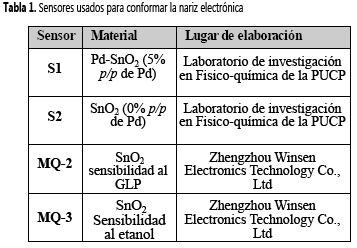
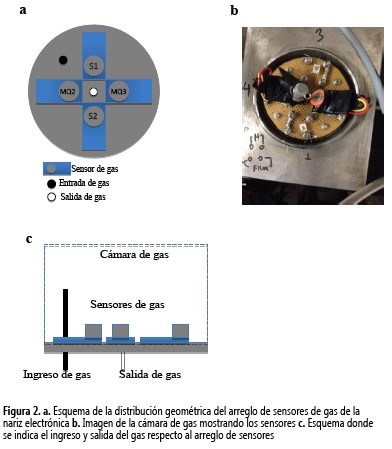
Los sensores fueron ubicados en forma circular respecto a las tomas de entrada y de salida de la cámara de gas, como se muestra en la Figura 2. El volumen de la cámara era de 788 cm3 y poseía una tapa hermética de rosca, la cual se retiraba para instalar los sensores y permanecía puesta durante las mediciones.
Para los sensores preparados en el laboratorio, se alimentó el calentador con un voltaje VH = 6 V que permite que la película esté a la temperatura de trabajo. Se conectaron los electrodos sobre los que se depositó la película de SnO2 al circuito de carga tal como se muestra en la Figura 3.
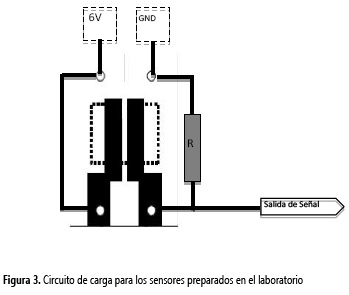
La corriente consumida por todos los sensores fue de 0,9 A. La salida de la señal de cada sensor fue conectada a las entradas analógicas de la tarjeta de adquisición (National Instruments (USB 6213)), para obtener las señales a través del sistema de adquisición de datos (software LabviewTM).
Sistema hidráulico
Estáconformado por tres válvulas de paso de dos vías (V1, V2, V3) con un solenoide de 24 V y una mini-bomba de vacío (B1) de 24 V. Las válvulas V1 y V2 se conectan a la cámara y la válvula V3 a la bomba B1 como se muestra en la Figura 4.

Los terminales de cada válvula y los de la bomba se conectan a la salida digital de la tarjeta de adquisición a través de un circuito de potencia, a fin de poder abrir y cerrar las válvulas y activar la bomba usando un sistema para la adquisición y control de datos.
Sistema de adquisición y control de datos
La parte principal de este sistema es la tarjeta de adquisición de datos marca National Instruments (USB 6213), la cual posee un conversor analógico digital (ADC) con una resolución de 16 bits. Adicionalmente, se desarrollaron circuitos de potencia para poder controlar las válvulas de paso y la bomba de vacío. La salida digital de la tarjeta se conectó a la entrada del sistema de potencia, de manera que a través del software se podía controlar la apertura o cierre de las válvulas por las cuales pasaba la muestra en fase gas y el gas de referencia (aire); también se podía controlar el tiempo de encendido y apagado de la bomba.
El programa de adquisición y control de datos fue desarrollado en el lenguaje de programación LabVIEW 2010. El panel de control del programa desarrollado se muestra en la Figura 5.
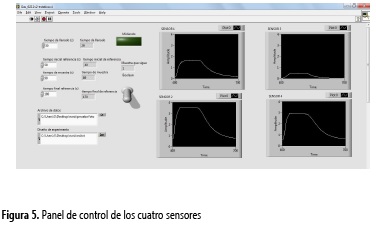
En el panel de control se configuraron los siguientes parámetros: Tiempo inicial de referencia, Tiempo de llenado, Tiempo de análisis de la muestra. Tiempo final de referencia, Archivo de datos, Diseño de experimentos, Midiendo, Muestra siguiente, Interruptor (Boolean).
Procedimiento de calibración y medición
Antes de iniciar la medición de las muestras, se realizó un procedimiento de calibración para determinar los tiempos óptimos requeridos en el programa.
Procedimiento de calibración
Se seleccionó un volumen de muestra entre 20 y 40 mL que fue depositado en una trampa líquida a temperatura ambiente. Luego se conectó la trampa líquida a la entrada de la válvula V1; la válvula V2 siempre se mantuvo conectada a una entrada de aire. Se determinaron para los cuatro sensores a la vez, el Tiempo inicial de referencia, Tiempo de llenado, Tiempo de análisis de la muestra y Tiempo final de referencia, en ese orden.
Procedimiento de medición
La forma de medición implica exponer al arreglo de sensores a los vapores de las muestras. Este arreglo de sensores se puso dentro de la cámara de gas, la cual posee una entrada y una salida. Previo a la medición, se dejó pasar un flujo de aire a través del sistema y el valor que se obtuvo en los sensores definió el valor base de la señal. Luego, con la bomba, se extrajo el aire saturado con el vapor de la muestra durante el Tiempo de llenado. En este instante la señal de los sensores incrementó su valor. Posteriormente, se cerró la entrada y la salida de la cámara, y se midió la señal de los sensores durante el tiempo de muestra. Posteriormente se abrieron las válvulas de entrada y la salida y se introdujo un flujo de aire por un determinado tiempo, o Tiempo final de referencia, con el objetivo de purgar la cámara. La señal que se obtiene se muestra en la Figura 6.
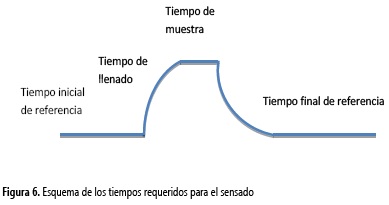
Se registran mediciones de vapor de alcohol en un determinado tiempo t en función del cambio de la resistividad del sensor. Estas mediciones se representaron por medio de vectores, denominados rks, que se definen de la siguiente manera: r = (m1, m2,..., mt). Estos vectores muestran las mediciones correspondientes al sensor s (se emplearon cuatro sensores) en el ensayo k (se realizaron 5 ensayos).
Luego, se construye la matriz Mkts = [[WK]i,j]txs que corresponde a las mediciones realizadas en el k-ésimo ensayo durante el tiempo t y con los cuatro sensores. De este modo, cada entrada indica la medición registrada por el j-ésimo sensor en el tiempo i (con i < t). Las variables que se usaron en el reconocimiento de patrones por el PCA son las mediciones obtenidas por el sensor j en el tiempo i. Finalmente, se utilizó el PCA para clasificar de forma analítica los alcoholes.
Sofware para el tratamiento de datos
Se desarrolló un software en Matlab para conformar la matriz de objetos y variables necesarias para el análisis PCA. Se usaron los programas Scirius®, Matllab® y Origin® para evaluar los resultados.
Resultados y discusión
Evaluación de la nariz electrónica
Sistema Dinámico versus Estático
Usando el sistema de detección dinámico, y siguiendo el procedimiento descrito anteriormente, se obtuvo el PCA que se muestra en la Figura 7. Allí se observa que para una misma muestra, en donde mij representa a las mediciones del j-ésimo ensayo para la muestra i, de todas las mediciones (m12, m13, m14) dos correlaciones son positivas y una es negativa. En cambio en la Figura 8, donde se muestra el PCA de un sistema estático para una misma muestra, o todas las mediciones son positivas, o todas son negativas, o todas están alrededor del cero.

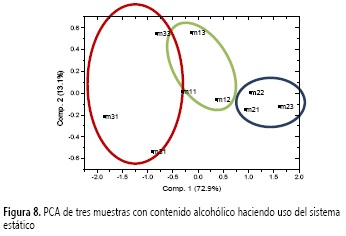
Esto permitió concluir que el mejor sistema era el estático, por diferenciar mejor las muestras y presentar una varianza de mayor magnitud. Por esta razón, todas las pruebas siguientes se realizaron con dicho sistema. En estudios anteriores también se ha llegado a esta conclusión (25), en donde se demuestra que con el sistema estático se logran distinguir componentes orgánicos volátiles que se encuentran en menores concentraciones (del rango de ppm).
Por lo anterior, se puede observar claramente que los alcoholes se diferencian mejor en un sistema estático. La varianza total para un sistema estático fue mayor, alcanzando el 86 %, mientras que con el sistema dinámico se alcanzó el 75,92% de la varianza. Este resultado es coherente, porque en un sistema estático se tiene una concentración fija de alcohol, lo que permite tener una respuesta más uniforme del sensor.
Detección de alcoholes
Se procedió a comparar la sensibilidad de los cuatro sensores a la detección de los cuatro alcoholes a una concentración del 100% logrando obtener el siguiente orden: metanol > etanol >n-butanol > 1-octanol.
Utilizando los resultados obtenidos con este último arreglo de sensores, se realizó un PCA a las medidas de detección de los alcoholes puros para poder establecer una diferenciación en los alcoholes. Para ello se consideraron la Componente 1 (73,2 %), la Componente 2 (12,8 %) y la Componente 3 (8,2 %).
Los alcoholes estudiados tienen una estructura similar, se diferencian en el tamaño de la cadena. Sin embargo, esta particularidad hace que algunos difundan más rápido que los otros hasta la superficie del óxido semiconductor, por lo que con un análisis multivariado de datos se les puede diferenciar. Se escogió para el análisis del PCA la Primera y Tercera componente, dado que ambas sumaban la mayor varianza total para un PCA bidimensional.
En la Figura 9 se han agrupado los valores obtenidos para cada alcohol, obteniéndose un arrastre vertical para el etanol y n-butanol y una dispersión diagonal para el metanol y el octanol. Otra característica de esta distribución de los alcoholes es que en el PCA aparecen en el orden de longitud de la cadena del alcohol. El de cadena más corta (metanol) aparece a la derecha y el de cadena más larga (l-octanol), a la izquierda. La varianza total fue de 81,4%. Esto significa que hay una buena diferenciación de los alcoholes y que el orden de detección de los alcoholes se da de derecha a izquierda.
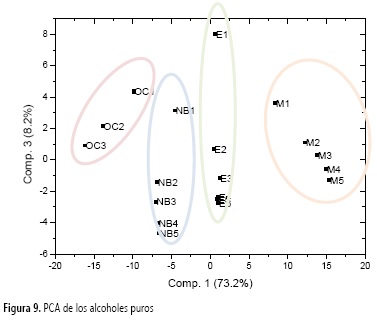
Usando el programa Scirius® se estableció que las correlaciones para el metanol y el etanol son positivas, por lo que se puede interpretar que la detección o sensibilidad es alta para estas moléculas, identificando que una correlación positiva se reconoce por una señal eléctrica que presenta un voltaje más elevado. En cambio, para el n-butanol y el 1-octanol, son correlaciones negativas, Esto indicaría que la sensibilidad disminuye o la detección empeora con estos alcoholes.
Además de la detección y clasificación de alcoholes, se realizaron pruebas de detección de los alcoholes a diferentes concentraciones a una temperatura de 200 °C (la temperatura fue seleccionada en estudios anteriores) (26). Se obtuvieron curvas que permitieron observar el aumento de voltaje medido, al incrementarse la concentración del alcohol hasta cierto punto. El comportamiento de los alcoholes a concentraciones elevadas era prácticamente el mismo, por lo que en la curva se evidenció una meseta. No se logró superar la sensibilidad de los sensores comerciales con los sensores preparados en el laboratorio. Sin embargo, los sensores comerciales tendían a saturarse y a tener un límite en la detección, mientras que los fabricados en el laboratorio seguían aumentando su detección a altas concentraciones (por ejemplo, concentraciones mayores a 500 ppm).
Se determinó otro resultado importante diluyendo las muestras para ver si la nariz detectaba mejor y no se saturaba como las narices electrónicas comunes. Se encontró que la nariz preparada en el laboratorio no requería preparación de las muestras, es decir, no era necesario diluir antes de medir para obtener mejores resultados. Por tanto, se considera que esta nariz podría ser aplicada a procesos industriales, durante o después de la producción, sin necesidad de hacer modificaciones en las muestras.
En la Figura 10, para el etanol por ejemplo, se puede observar una interacción relativamente fuerte entre especie adsorbida-sensor a bajas concentraciones. La interacción química se produce cuando las moléculas a adsorberse (alcoholes) reaccionan con las especies oxigenadas presentes. Esto libera electrones hacia la superficie, disminuyendo la resistencia del sensor (La barrera de Schottky) y aumentando la sensibilidad del mismo (1).

También se observa en la Figura 10 que el sensor preparado en el laboratorio con agente dopante (paladio) muestra una sensibilidad más elevada al etanol que el sensor sin dopar. Entonces, se puede notar una mejora en la detección de los alcoholes cuando se incorpora al óxido de estaño una cantidad de metal noble. Este metal noble aumenta el número de sitios activos y disminuye la energía de activación del proceso de adsorción de los alcoholes debido a su carácter de catalizador (1).
Conclusiones
Los sensores de gas preparados en el laboratorio, basados en óxidos de estaño, uno sin dopar y el otro dopado con paladio al 5 % p/p, presentaron una buena detección en contacto con alcoholes lineales en el siguiente orden: metanol > etanol > n-butanol > 1-octanol. La variación de voltaje (la señal medida) se incrementa con el aumento en la concentración del vapor de alcohol. Además, estos sensores preparados en el laboratorio no tienden a saturarse a altas concentraciones de alcohol por lo que no se requiere la dilución de las muestras para realizar las mediciones.
Por otro lado, se construyó una nariz electrónica sin controladores másicos de flujo y de solo cuatro sensores, capaz de detectar y diferenciar alcoholes lineales. Se encontró que el sistema de medida más apropiado para dicha nariz fue el estático. Esta nariz podría emplearse para diferentes fines como el monitoreo de alcohol en aliento o el contenido de alcohol en licores.
Agradecimientos
Los autores agradecen a Ciencia Activa-CONCYTEC (Proyecto 159-2015), a la Pontificia Universidad Católica del Perú, y a la Universidad Nacional de Ingeniería por el soporte financiero para el desarrollo de esta investigación.
Referencias
1. Choudhary, M.; Mishra, V.N.; Dwivedi, R.. Pd-Doped Tin-Oxide-Based Thick-Film Sensor Array for Detection of H2, CH4 and CO. J. Electron. Mater. 2013, 42 (9), 2793-2802. DOI: https://doi.org/10.1007/s11664-013-2663-3.
2. Ragazzo-Sanchez, J.A.; Chalier, P.; Ghommidh, C. Coupling gas chromatography and electronic nose for dehydration and desalcoholization of alcoholized beverages. Application to off flavour detection in wine. Sens. Actuators, B 2005, 106, 253-257. DOI: https://doi.org/10.1016/j.snb.2004.08.006.
3. Persaud, K.; Dodd, G.H. Analysis of discrimination mechanisms in the mammalian olfactory system using a model nose. Nature 1982, 299, 352-355. DOI: https://doi.org/10.1038/299352a0.
4. Papadopoulos, C.A.; Vlachos, D.; Avaritsiotis, J.N. Comparative study of various metal-oxide based gas-sensor architectures. Sens. Actuators, B 1996, 32, 61-69. DOI: https://doi.org/10.1016/0925-4005(96)80110-9.
5. Xu, C.; Tamaki, J.; Miura, N.; Yamazoe, N. Grain size effects on gas sensitivity of porous SnO2-based elements. Sens. Actuators, B 1991, 3 (2), 147-155. DOI: https://doi.org/10.1016/0925-4005(91)80207-z.
6. Yoshida, K.; Shimanoe, K.; Yamazoe, N. Preparation of SnO2 cluster by hydrothermal treatment for highly sensitive thin film sensor. Proceedings of the Technical Digest of the 6th East Asian Conference on Chemical Sensor, November 6-9, 2005, pp. 515-516. Guilin, China.
7. Yamazoe, N.; Kurokawa, Y; Seiyama, T. Effects of additives on semiconductor gas sensors. Sens. Actuators 1983, 4, 283-289. DOI: https://doi.org/10.1016/0250-6874(83)85034-3.
8. Matsushima, S.; Maekawa, T.; Tamaki, J.; Miura, N.; Yamazoe, N. Role of additives on alcohol sensing by semiconductor gas sensor. Chem. Lett. 1989, 5, 845-848. DOI: https://doi.org/10.1246/cl.1989.845.
9. Maekawa, T.; Tamaki, J.; Miura, N.; Yamazoe, N. Sensing behavior of CuO loaded SnO2 element for H2S detection. Chem. Lett. 1991, 4, 575-578. DOI: https://doi.org/10.1246/cl.1991.575.
10. Duh, J.G.; Jou, J.W. Catalytic and gas sensing characteristics in Pd-doped SnO2. J. Electrochem. Soc. 1989, 136, 2740-2747. DOI: https://doi.org/10.1149/1.2097581.
11. Kappler, J.; Barsan, N.; Weimar, U.; Dieguez, A.; Alay, J.L.; Romano-Rodriguez, A. et al. Correlation between XPS, Raman and TEM measurements and the gas sensitivity of Pt and Pd doped SnO2 based gas sensors. Fresenius' J. Anal. Chem. 1998, 361, 110-114. DOI: https://doi.org/10.1007/s002160050844.
12. Cha, K.H.; Park, H.C.; Kim, K.H. Effect of palladium doping and film thickness on the H2 gas sensing characteristics of SnO2. Sens Actuators B 1994, 21, 91-96. DOI: https://doi.org/10.1016/0925-4005(94)80009-x.
13. Bagal, L.K.; Patil, J.Y.; Mulla, I.S.; Suryavanshi, S.S. Influence of Pd-loading on gas sensing characteristics of SnO2 thick films Ceram. Int. 2012, 38 (6), 4835-4844. DOI: https://doi.org/10.1016/j.ceramint.2012.02.073.
14. Russo, M.; Serra, D.; Suraci, E; Di Snzo, R. Fuda, S.; Postorino, S. The potential of e-nose aroma profiling for identifying the geographical origin of licorice (Glycyrrhiza glabra L.) roots. Food Chem. 2014, 165, 467-474. DOI: https://doi.org/10.1016/j.foodchem.2014.05.142.
15. Qiu, S.; Gao, L.; Wang, J. Classification and regression of ELM, LVQ and SVM for E-nose data of strawberry juice. J. Food Eng. 2015, 144, 77-85. DOI: https://doi.org/10.1016/j.jfoodeng 2014.07.015.
16. Loutfi, A.; Coradeschi, S.; Mani, G. K.; Shankar, P.; Rayappan, J. B. B. Electronic noses for food quality: A review. J. Food Eng. 2015, 144, 103-111. DOI: https://doi.org/10.1016/j.jfoodeng.2014.07.019.
17. Calzado, J.; Comina, G.; Solís, J. Desarrollo de un sistema integrado de sensores para la caracterización organoléptica de pisco. Revista Investigación de Física 13, 2010.
18. Quiñones, J.; NG, Y; Zambrano, A. Películas gruesas de La1-xSrxFeO3 como sensores de etanol, RLMM2007, 27 (1) 52-58.
19. Hong, X; Wang, J; Qi, G E-nose combined ith chemometrics to trace tomato-juice quality. J. Food Eng. 2015, 149, 38-43. DOI: https://doi.org/10T016/jjfoodeng.2014T0.003.
20. Delgado, R D Sensores de gases basados en óxidos de estaño: una aproximación electroquímica 2002 http://tdxcat/bitstream/handle/10803/2743/Tol1226.pdf?sequence=6.(fecha de acceso Mayo,2016).
21. Cadahia, E.; Muñoz, L.; Fernández de Simón, B.; García-Vallejo, C. Changes in lo molecular eight phenolic compounds in Spanish, French, and American oak Woods during natural seasoning and toasting. J. Agric. Food Chem. 2001, 49, 1790-1798. DOI: https://doi.org/10.1021/jf0006168.
22. Chatonnet, P; Boidron, J N; Pons, M Maturation of red ines in oak barrels: evolution of some volatile compounds and their aromatic impact. Sci. Aliments 1990, 10, 565-587.
23. Garde-Cerdán, T.; Rodriguez-Mozaz, S.; Ancín-Azpilicueta, C. Volatile composition of aged wine in used barrels of French oak and of American oak. Food Res. Int. 2002, 35, 603-610. DOI: https://doi.org/10.1016/s0963-9969(01)00151-x.
24. Korotcenkov, G. Metal oxides for solid-state gas sensors: what determines our choice. J. Mater. Sci. Eng. B 2007,139, 1-23.
25. García, M.; Aleixandre, M.; Gutiérrez, J.; Horrillo, M.C. Electronic nose for wine discrimination. Sens. Actuators B 2006, 113, 911-916. DOI: https://doi.org/10.1016/j.snb.2005.03.078.
26. Paredes-Doig, A.L.; Sun-Kou, M.R.. ; Comina, G. Alcohols detection based on Pd-doped SnO2 sensors. En Sensors (IBERSENSOR), 2014 IEEE 9th Ibero-American, Universidad de los Andes, Bogotá, Colombia, 2014, 1-3.
Referencias
Choudhary, M.; Mishra, V.N.; Dwivedi, R.. Pd-Doped Tin-Oxide-Based Thick-Film Sensor Array for Detection of H2, CH4 and CO. J. Electron. Mater.2013, 42 (9), 2793-2802. DOI: http://dx.doi.org/10.1007/s11664-013-2663-3
Ragazzo-Sanchez, J.A.; Chalier, P.; Ghommidh, C. Coupling gas chromatography and electronic nose for dehydration and desalcoholization of alcoholized beverages. Application to off-flavour detection in wine. Sens. Actuators, B 2005, 106, 253-257. DOI: http://dx.doi.org/10.1016/j.snb.2004.08.006
Persaud, K.; Dodd, G.H. Analysis of discrimination mechanisms in the mammalian olfactory system using a model nose, Nature 1982, 299, 352-355. DOI: http://dx.doi.org/10.1038/299352a0
Papadopoulos, C.A.; Vlachos, D.; Avaritsiotis, J.N. Comparative study of various metal-oxide based gas-sensor architectures. Sens. Actuators, B 1996, 32, 61-69. DOI: http://dx.doi.org/10.1016/0925-4005(96)80110-9
Xu, C.; Tamaki, J.; Miura, N.; Yamazoe, N. Grain size effects on gas sensitivity of porous SnO2-based elements. Sens. Actuators, B 1991, 3 (2), 147-155. DOI: http://dx.doi.org/10.1016/0925-4005(91)80207-z
Yoshida, K.; Shimanoe, K.; Yamazoe, N. Preparation of SnO2 cluster by hydrothermal treatment for highly sensitive thin film sensor, Proceedings of the Technical Digest of the 6th East Asian Conference on Chemical Sensor, November 6-9, 2005, pp. 515–516. Guilin, China.
Yamazoe, N.; Kurokawa, Y.; Seiyama, T. Effects of additives on semiconductor gas sensors. Sens. Actuators 1983, 4, 283-289. DOI: http://dx.doi.org/10.1016/0250-6874(83)85034-3
Matsushima, S.; Maekawa, T.; Tamaki, J.; Miura, N.; Yamazoe, N. Role of additives on alcohol sensing by semiconductor gas sensor. Chem. Lett. 1989, 5, 845-848. DOI: http://dx.doi.org/10.1246/cl.1989.845
Maekawa, T.; Tamaki, J.; Miura, N.; Yamazoe, N. Sensing behavior of CuO loaded SnO2 element for H2S detection. Chem. Lett. 1991, 4, 575–578. DOI: http://dx.doi.org/10.1246/cl.1991.575
Duh, J.G.; Jou, J.W. Catalytic and gas sensing characteristics in Pd-doped SnO2. J. Electrochem. Soc. 1989, 136, 2740-2747. DOI: http://dx.doi.org/10.1149/1.2097581
Kappler, J.; Barsan, N.; Weimar, U.; Dieguez, A.; Alay, J.L.; Romano-Rodriguez, A. et al. Correlation between XPS, Raman and TEM measurements and the gas sensitivity of Pt and Pd doped SnO2 based gas sensors. Fresenius' J. Anal. Chem. 1998, 361, 110-114. DOI: http://dx.doi.org/10.1007/s002160050844
Cha, K.H.; Park, H.C.; Kim, K.H. Effect of palladium doping and film thickness on the H2 gas sensing characteristics of SnO2. Sens. Actuators B 1994, 21, 91-96. DOI: http://dx.doi.org/10.1016/0925-4005(94)80009-x
Bagal, L.K.; Patil, J.Y.; Mulla, I.S.; Suryavanshi, S.S. Influence of Pd-loading on gas sensing characteristics of SnO2 thick films. Ceram. Int. 2012, 38 (6), 4835-4844. DOI: http://dx.doi.org/10.1016/j.ceramint.2012.02.073
Russo, M.; Serra, D.; Suraci, F.; Di Snzo, R. Fuda, S.; Postorino, S. The potential of e-nose aroma profiling for identifying the geographical origin of licorice (Glycyrrhiza glabra L.) roots. Food Chem. 2014, 165, 467-474. DOI: http://dx.doi.org/10.1016/j.foodchem.2014.05.142
Qiu, S.; Gao, L.; Wang, J. Classification and regression of ELM, LVQ and SVM for E-nose data of strawberry juice. J. Food Eng. 2015, 144, 77-85. DOI: http://dx.doi.org/10.1016/j.jfoodeng.2014.07.015
Loutfi, A.; Coradeschi, S.; Mani, G. K.; Shankar, P.; Rayappan, J. B. B. Electronic noses for food quality: A review. J. Food Eng. 2015, 144, 103-111. DOI: http://dx.doi.org/10.1016/j.jfoodeng.2014.07.019
Calzado, J.; Comina, G.; Solís, J. Desarrollo de un sistema integrado de sensores para la caracterización organoléptica de pisco. Revista de Investigación de Física 13, (2010).
Quiñones, J.; NG, Y.; Zambrano, A. Películas gruesas de La1-xSrxFeO3 como sensores de etanol, RLMM 2007, 27 (1) 52-58.
Hong, X.; Wang, J.; Qi, G. E-nose combined with chemometrics to trace tomato-juice quality. J. Food Eng. 2015, 149, 38-43. DOI: http://dx.doi.org/10.1016/j.jfoodeng.2014.10.003
Delgado, R. D. Sensores de gases basados en óxidos de estaño: una aproximación electroquímica. 2002. http://www.tdx.cat/bitstream/handle/10803/2743/Tol1226.pdf?sequence=6. (fecha de acceso Mayo,2015).
Cadahía, E.; Muñoz, L.; Fernández de Simón, B.; García-Vallejo, C. Changes in low molecular weight phenolic compounds in Spanish, French, and American oak Woods during natural seasoning and toasting. J. Agric. Food Chem. 2001, 49, 1790-1798. DOI: http://dx.doi.org/10.1021/jf0006168
Chatonnet, P.; Boidron, J.N.; Pons, M. Maturation of red wines in oak barrels: evolution of some volatile compounds and their aromatic impact. Sci. Aliments 1990, 10, 565-587.
Garde-Cerdán, T.; Rodriguez-Mozaz, S.; Ancín-Azpilicueta, C. Volatile composition of aged wine in used barrels of French oak and of American oak. Food Res. Int. 2002, 35, 603-610. DOI: http://dx.doi.org/10.1016/s0963-9969(01)00151-x
Korotcenkov, G. (2007). Metal oxides for solid-state gas sensors: what determines our choice. Materials Science and Engineering B., 139, 1-23.
García, M.; Aleixandre, M.; Gutiérrez, J.; Horrillo, M.C. Electronic nose for wine discrimination. Sens. Actuators B 2006, 113, 911-916. DOI: http://dx.doi.org/10.1016/j.snb.2005.03.078
Paredes-Doig, A.L.; Sun-Kou, M.R..; Comina, G. Alcohols detection based on Pd-doped SnO2 sensors. En Sensors (IBERSENSOR), 2014 IEEE 9th Ibero-American, Universidad de los Andes, Bogotá, Colombia, 2014, pp.1-3
Cómo citar
IEEE
ACM
ACS
APA
ABNT
Chicago
Harvard
MLA
Turabian
Vancouver
Descargar cita
CrossRef Cited-by
1. Emili Catherine Trujillo Barajas, Oscar Eduardo Gualdrón Guerrero, Diego Alfonso Peláez Carrillo. (2023). Desarrollo de un sistema multisensorial embebido para detección de fallas incipientes en transformadores eléctricos. REVISTA COLOMBIANA DE TECNOLOGIAS DE AVANZADA (RCTA), 1(41), p.50. https://doi.org/10.24054/rcta.v1i41.2417.
2. A. L. Paredes-Doig, H. Cárcamo, M. Hurtado Cotillo, R. Sun-Kou, E. Doig-Camino, G. Picasso, G. Comina, A. La Rosa-Toro Gómez. (2019). Gas Sensors Modified with Zeolite Y for Assessing Wine Aroma Compounds. Journal of Chemistry, 2019, p.1. https://doi.org/10.1155/2019/5283208.
Dimensions
PlumX
Visitas a la página del resumen del artículo
Descargas
Licencia
Los autores/as conservarán sus derechos de autor y garantizarán a la revista el derecho de primera publicación de su obra, el cuál estará simultáneamente sujeto a la Licencia de reconocimiento de Creative Commons (CC. Atribución 4.0) que permite a terceros compartir la obra siempre que se indique su autor y su primera publicación en esta revista.
Los autores/as podrán adoptar otros acuerdos de licencia no exclusiva de distribución de la versión de la obra publicada (p. ej.: depositarla en un archivo telemático institucional o publicarla en un volumen monográfico) siempre que se indique la publicación inicial en esta revista.
Se permite y recomienda a los autores/as difundir su obra a través de Internet (p. ej.: en archivos telemáticos institucionales o en su página web) antes y durante el proceso de envío, lo cual puede producir intercambios interesantes y aumentar las citas de la obra publicada. (Véase El efecto del acceso abierto).