Correo Electrónico
 DNINFOA - SIA
 Bibliotecas
 Convocatorias
 Identidad U.N.


Publicado
Caracterización de los compuestos del aroma en rones colombianos por HS-SPME-GC-MS-O
Characterization of aroma compounds in Colombian rums by HS-SPME-GC-MS-O
DOI:
https://doi.org/10.15446/rev.colomb.quim.v45n2.60406Palabras clave:
ron, compuestos volátiles, identificación, aroma, HS-SPME, GC-MS-O (es)volatile compounds, identification, aroma, HS-SPME, GC-MS-O (en)
Se identificaron por primera vez 46 compuestos volátiles olfativamente activos con actividad aromática significativa presentes en rones comerciales de Colombia. Lo anterior, mediante microextracción en fase sólida en modo espacio de cabeza (HS-SPME), acoplada a cromatografía de gases con detectores de espectrometría de masas y olfatometría (GC-MS-O). Dentro de los compuestos identificados se encuentran ésteres, compuestos aromáticos, alcoholes, acetales, lactonas y furfural. De esos 46 compuestos, nueve están presentes en todos los rones estudiados y algunos otros son característicos solo de la marca.
Doi: https://doi.org/10.15446/rev.colomb.quim.v45n2.60406.
Caracterización de los compuestos del aroma en rones colombianos por HS-SPME-GC-MS-O
Characterization of aroma compounds in Colombian rums by HS-SPME-GC-MS-O
Caracterização de compostos de aroma em rum colombiano por HS-SPME-GC-MS-O
Jazmín Osorio Monsalve1; Carlos López1; Julián Zapata1,*
1 Laboratorio de Análisis de Residuos, Instituto de Química, Facultad de Ciencias Exactas y Naturales. Universidad de Antioquia, Calle 67 N° 53-108, Medellín, Colombia.
* Autor para correspondencia: julian.zapatao@udea.edu.co
Article citation:
Osorio-Monsalve, J.; López, C.; Zapata, J. Caracterización de los compuestos del aroma en rones colombianos por HS-SPMEGC-MS-O. Rev. Colomb. Quim. 2016, 45 (2), 48-54. DOI: https://doi.org/10.15446/rev.colomb.quim.v45n2.60406.
Recibido: 24 de Mayo de 2016. Aceptado: 16 de Julio de 2016.
Resumen
Se identificaron por primera vez 46 compuestos volátiles olfativamente activos con actividad aromática significativa presentes en rones comerciales de Colombia. Lo anterior, mediante microextracción en fase sólida en modo espacio de cabeza (HS-SPME), acoplada a cromatografía de gases con detectores de espectrometría de masas y olfatometría (GC-MS-O). Dentro de los compuestos identificados se encuentran ésteres, compuestos aromáticos, alcoholes, acetales, lactonas y furfural. De esos 46 compuestos, nueve están presentes en todos los rones estudiados y algunos otros son característicos solo de la marca.
Palabras clave: Ron, compuestos volátiles, identificación, aroma, HS-SPME, GC-MS-O.
Abstract
For the first time, 46 odor-active volatile compounds present in commercial rums from Colombia were identified. This was performed through a head space-solid phase microextraction (HS-SPME) methodology, coupled to gas chromatography and mass spectrometry and olfactometry detection (GC-MS-O). Compounds included esters, aromatic compounds, alcohols, acetals, lactones and furfural. Of these 46 compounds, nine are present in all rums studied and others are brand characteristic.
Keywords: Rum, volatile compounds, identification, aroma, HS-SPME, GC-MS-O.
Resumo
Foram identificados por primeira vez 46 compostos voláteis olfativamente ativos com atividade aromática significativa presentes nos runs comerciais da Colômbia. O anterior, mediante o desenvolvimento duma metodologia Head Space - Solid Phase Microextraction (HS-SPME) acoplada à cromatografia gasosa com detectores de espectrometria de massa e olfatometria (GC-MS-O). Entre os compostos identificados estão ésteres, compostos aromáticos, alcoóis, acetais, lactonas e furfural. Destes 46 compostos, nove estão presentes em todos os runs estudados e alguns outros são característicos das marcas.
Palavras-Chave: Rum, compostos voláteis, identificação, aroma, HS-SPME, GC-MS-O.
Introducción
El ron es una bebida alcohólica procedente del jugo de la caña o de la melaza. Esta bebida pasa por un proceso de fermentación corta (entre 12 horas y 12 días), seguido de una destilación, ya sea en columnas fraccionadas o en alambiques de cobre y, finalmente, es envejecido en barricas de roble o tanques de acero. Sin embargo, el proceso de fabricación del ron puede cambiar de acuerdo a su lugar de origen, debido a la variación de las materias primas y a las diferencias culturales, por tanto, cada ron puede tener características únicas frente a los demás. Estas diferencias pueden estar dadas por: la variedad de la caña, la materia prima utilizada (melaza o jugo de caña), fermentación corta o larga, destilación en columna o en alambique, envejecimiento en barricas o en tanques de acero y el tiempo de envejecimiento.
Ahora bien, una de las propiedades más importantes para definir la calidad de un ron es su aroma, resultado de su composición volátil. Se han presentado varios trabajos que han estudiado la composición volátil de los rones procedentes de Jamaica (1), Puerto Rico (2) y Cuba (3, 4). Recientemente, se presentó la caracterización de los compuestos responsables del aroma de rones fabricados bajo el sistema de solera, sin indicar la procedencia de los rones estudiados (5). A la fecha no se ha reportado ningún estudio sobre los rones colombianos comerciales y, por tanto, no se tiene información sobre la composición volátil que los caracteriza.
Los métodos empleados para el análisis de compuestos volátiles en bebidas alcohólicas como el ron incluyen el fraccionamiento en columnas empacadas (6), la extracción líquido-líquido (2), evaporación del aroma asistida con disolvente (SAFE) (5) y la microextracción en fase sólida (SPME) (3); todos ellos seguidos de análisis por cromatografía de gases con detectores de masas y olfatométrico. La SPME presenta ciertas ventajas para análisis de compuestos volátiles en bebidas alcohólicas debido a su fácil implementación, además de que no requiere el uso de solventes orgánicos, evitando la interferencia de los mismos (7, 8).
El objetivo de este estudio fue elaborar un perfil de moléculas volátiles (odorantes) de los principales rones comerciales colombianos de diferentes calidades, mediante la optimización de un método de SPME en modo de espacio de cabeza (HS-SPME), seguido de análisis por cromatografía de gases acoplado a espectrometría de masas y detector olfatométrico (GC-MS-O).
Materiales y métodos
Reactivos
La mezcla de alcanos (desde C6 hasta C25) fue suministrada por Supelco (Bellefonte, PA, USA). El agua de calidad analítica se obtuvo de un sistema de purificación Milli-Q® de Millipore (Bedford, USA).
Muestras
Los rones empleados en el estudio se compraron en una tienda especializada de la zona. En total fueron nueve rones colombianos de tres marcas diferentes y con envejecimiento entre tres y 12 años, con porcentaje alcohólico de 35% (v/v) (referencia comercial). Dichos rones son: Ron Medellín Añejo 3 años, 8 años y 12 años; Ron Santa Fe 4 años, 8 años y 12 años; y Ron Viejo de Caldas 3 años, 5 años y 8 años.
Entrenamiento del panel sensorial
Para la obtención del perfil aromático de las diferentes muestras se entrenó un panel sensorial olfativo conformado por diez personas (cinco hombres y cinco mujeres), con edades entre los 18 y 35 años. El entrenamiento se llevó a cabo durante seis meses en sesiones de 2 h a la semana. La metodología utilizada fue la propuesta por Steinhaus y Schieberle (1). Los catadores se entrenaron con muestras de productos con diferentes descriptores sensoriales olfativos: frutales, maderas, tostados, dulces, nueces, cítricos, florales y lácteos. Las muestras fueron puestas en recipientes oscuros marcados con un código de tres dígitos para evitar el sesgo (9).
Al finalizar el periodo de entrenamiento, los panelistas fueron sometidos a una evaluación de clasificación, que consistió en reconocer y clasificar según el olor las diferentes muestras. De esta prueba se seleccionaron seis panelistas que recibieron entrenamiento en olfatometría con una disolución de prueba preparada en el laboratorio y que, posteriormente, realizaron los análisis.
Optimización de la HS-SPME
Para asegurar la eficiencia en el proceso de extracción, la evaluación de los parámetros de extracción incluyó el estudio de cinco parámetros que afectan el proceso de HS-SPME: la naturaleza química del recubrimiento de la fibra, tiempo de extracción, volumen de muestra a extraer, dilución de la muestra y efecto salino.
En el proceso de extracción se evaluaron tres fibras con diferentes polaridades: PDMS (100 μm), PDMS/DVB (65 μm) y DVB/PDMS/CAR (50/30 μm) que fueron suministradas por Supelco (Bellefonte, PA, USA). La inyección se realizó en modo manual empleando un holder de SPME de Supelco (Bellefonte, PA, USA). Se utilizaron las siguientes condiciones de partida: 5 mL de una muestra de Ron Medellín Añejo 3 Años, diluida al 50% (v/v) con una solución 6 M de NaCl, en un vial de 20 mL para HS-SPME con agitación magnética de 1000 rpm y un tiempo de exposición de 60 min a 25 °C. Una vez realizada la extracción, la fibra fue llevada al puerto de inyección del GC-MS a 250 °C durante 3 min para la desorción térmica de los analitos extraídos. En este estudio se evaluó la eficiencia de la extracción en función de la cantidad e intensidad de analitos volátiles extraídos. Todas las fibras fueron acondicionadas según la recomendación del fabricante.
Posteriormente, para optimizar el tiempo de extracción de los analitos se estudiaron tiempos de extracción de 5, 15, 30 y 60 min y volúmenes de muestra de 5; 2,5 y 1,3 mL. Dado que el proceso de extracción también es sensible a factores que modifiquen la matriz (10), se optimizó la dilución de la muestra (sin diluir, al 50%, 25% y al 12,5% v/v) y, adicionalmente, el efecto salino a concentraciones de NaCl de 1, 3 y 6 M. En todos los casos, solo se modificó el parámetro en estudio, manteniendo las demás condiciones constantes. Todos los experimentos se realizaron por duplicado, fijando la temperatura a 25 °C en un baño termostático.
La temperatura es un factor crítico en el análisis por HS-SPME, puesto que favorece la transferencia de compuestos al espacio de cabeza (11, 12). Sin embargo, en este estudio se optó por fijar la extracción a 25 °C, simulando las condiciones de cata de un ron y evitando que la composición del aroma se viera afectada por el incremento de la temperatura.
Todos los análisis se realizaron en un Saturn® 2000 GC/MS Varian (Walnut Creek, CA, USA), detección de espectrometría de masas con analizador de trampa de iones con un inyector un split/ splittless estándar y un liner para SPME de 0,75 mm de diámetro interno. El modo de inyección usado fue splittless a una temperatura de 250 °C, con un pulso de presión de 131 kPa durante 2,9 min. Durante el análisis, se utilizó helio como gas transportador a un flujo constante de 1 mL/min. La columna cromatográfica utilizada fue una Agilent J&W DB-WAX, de 30 m, 0,25 mm de diámetro interno y 0,25 μm de espesor de película.
El horno cromatográfico inicialmente fue puesto a 40 °C durante 5 min, se incrementó a una razón de 4 °C/min hasta 100 °C, luego a una velocidad de 6 °C/min hasta 220 °C y se mantuvo durante 20 min. La temperatura de la trampa de iones se mantuvo a 200 °C y la línea de transferencia a 270 °C. El rango de masas seleccionado, como relación masa/carga, fue de 40 a 350.
Análisis de las muestras por GC-MS-O
Las muestras de ron se diluyeron al 50% con una solución 6 M de NaCl; de esta solución se tomaron 5 mL y se llevaron a un vial estándar de 20 mL para HS-SPME. Posteriormente, la fibra de PDMS/DVB fue puesta en el espacio de cabeza de la muestra por 60 min a 25 °C con agitación constante (1000 rpm). Al terminar el proceso de extracción, se retiró la fibra del vial y fue llevada al puerto de inyección del GC-MS-O para la desorción térmica de los analitos a una temperatura de 250 °C durante 3 min.
Los análisis se realizaron en un cromatógrafo de gases Agilent 7890 (Santa Clara, CA, USA), acoplado simultáneamente a un puerto de olfacción de temperatura programable Gerstel ODP (Mülheim an der Ruhr, Alemania), con sistema de detección olfatométrico y un detector de espectrometría de masas 5973 Network con analizador tipo cuádruplo. El cromatógrafo contó con un inyector de tipo split/splittless estándar y se utilizó un liner para SPME de 0,75 mm de diámetro interno. El modo de inyección usado fue splittless a una temperatura de 250 °C, con un pulso de presión de 62 kPa durante 1 min. Se usó helio (grado 5,0 analítico) como gas portador, a flujo constante de 1 mL/min durante todo el análisis.
La columna cromatográfica utilizada fue una DB-WAX de 60 m; 0,25 mm de diámetro interno y 0,25 μm de espesor de película (Agilent J&W Scientific). La temperatura inicial del horno cromatográfico fue de 50 °C durante 3 min, luego se incrementó a una velocidad de 3 °C/min hasta 160 °C, finalmente se llevó a 250 ° C a una velocidad de 25 °C/min y se mantuvo durante 22 min (tiempo final de análisis 60 min).
La temperatura del detector se mantuvo a 250 °C y la línea de transferencia a 250 °C. El rango de masas seleccionado, como relación masa/carga, fue de 40 a 400. La temperatura del puerto de olfacción fue programada a través de una rampa lineal de calentamiento que inició en 80 °C y subió hasta 250 °C a una velocidad de 4 °C/min.
Durante cada análisis, los jueces evaluaron los olores efluentes. Cada vez que se reconocía un olor, se registraba el tiempo de retención y la descripción del olor. Cada inyección fue realizada por dos jueces entrenados, cada uno durante un tiempo de 30 min. Las muestras de ron fueron evaluadas por seis jueces y cada uno realizó el análisis completo de cada muestra en dos sesiones diferentes.
Cálculo de los Índices de Retención (LRI)
Para realizar el cálculo de los índices de retención experimentales, se analizó un estándar que contenía una serie de alcanos lineales desde C6 hasta C25 bajo las mismas condiciones cromatográficas que las muestras analizadas. Se calculó el LRI a cada compuesto que presentó una respuesta sensorial (15).
Identificación de los compuestos
La identificación de los compuestos sensorialmente activos se realizó con tres criterios: comparación con un espectro de masas de referencia de la base de datos NIST Mass Spectral Library 2014; comparación con los índices de retención lineales reportados en la literatura (2-6) en una fase polar y por olfatometría, comparando la descripción de la percepción olfativa realizada por los jueces respecto a la descripción olfativa de referencia de cada compuesto.
El criterio para aceptar la identificación de un compuesto fue la correcta correspondencia del espectro de masas, el índice de retención y la descripción olfativa con los datos de referencia reportados para cada compuesto.
Resultados y discusión
Parámetros de optimización de la HS-SPME
Para seleccionar la fase extractora del proceso HS-SPME se evaluó la cantidad de compuestos volátiles extraídos y la señal cromatográfica de estos con tres fibras de polaridades diferentes como se muestra en la Figura 1. La Fibra de PDMS tuvo el más bajo rendimiento en la extracción, debido a que la extracción de compuestos polares volátiles presentes en el ron se ve afectada por la naturaleza apolar de la fase. El rendimiento de las fibras de PDMS/ DVB y CAR/DVB/PDMS fue similar en cuanto al número de compuestos extraídos. Sin embargo, con la fibra de PDMS/DVB se obtuvo una mayor eficiencia en la extracción de los compuestos volátiles odorantes y, por tanto, fue la fase seleccionada para el análisis. Estos resultados difieren de la fase seleccionada (PDMS) por Pino (3, 4, 14) para el estudio de compuestos volátiles en rones cubanos, sin embargo, el autor no presenta resultados que justifiquen la selección de esa fase extractora.

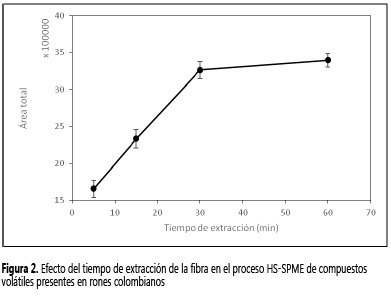
Después de elegir el tipo de fibra, se evaluó el efecto del tiempo de exposición de la fibra de SPME al espacio de cabeza de las muestras (5, 15, 30 y 60 min) (Figura 2). Se encontró que, al aumentar el tiempo de extracción, se aumenta también la cantidad de compuestos volátiles extraídos (representado por la suma total de las áreas de todos los picos en el cromatrográma). Se evidenció que, a 60 min, el sistema llegó prácticamente al equilibrio de los analitos en los procesos de partición líquido-HS y HS-fibra, por tanto, se eligió continuar el estudio con un tiempo de extracción de 60 min, que coincide con el tiempo del análisis cromatográfico.
Se evaluó también el efecto de la dilución de la muestra: en la mayoría de los licores se presentan problemas para la extracción de los analitos volátiles, debido al alto contenido de etanol. Este produce la saturación del espacio de cabeza y de los sitios activos de la fibra de SPME por la elevada presión de vapor a temperatura ambiente.
En todos los rones estudiados el contenido de etanol fue de 35% (v/ v). A esta concentración, el alcohol compite con los demás analitos por el espacio de cabeza y por los sitios activos de la fibra, disminuyendo la eficiencia del proceso de extracción (3, 10). Así, cuando se diluyó la muestra y el contenido de etanol era del 17,5%, la extracción de los demás analitos volátiles fue favorable, porque el etanol se encontraba en menor proporción en el espacio de cabeza. Sin embargo, cuando el contenido de etanol era del 12% y 7,5%, los analitos también se diluyeron en una proporción considerable, disminuyendo su concentración en el espacio de cabeza y, consecuentemente, la extracción de estos se vio afectada (Figura 3). Estos resultados coinciden con los previamente reportados (3, 15). Por lo anterior, se eligió una dilución de la muestra con contenido de etanol del 17,5% como parámetro óptimo para los análisis.

Del mismo modo, se evaluó el efecto del volumen de la muestra en el proceso de extracción. Para ilustrar la evaluación de este parámetro se realizó el seguimiento de tres compuestos presentes en las muestras de ron: acetato de etilo, 2-feniletanol y lactona de roble, que eluyen al inicio y al final del análisis cromatográfico (Figura 4). Al aumentar el volumen de la muestra (disminución del volumen del espacio de cabeza), aumentaron las áreas de los compuestos volátiles extraídos. Los compuestos más volátiles, como es el caso del acetato de etilo, tuvieron un mayor aumento, razón por la cual se decidió seguir el estudio con 5 mL de muestra.
Finalmente, se estudió el efecto salino, dado que la adición de una sal a la muestra puede afectar los coeficientes de partición de los analitos. Se observó un aumento significativo de la intensidad de los compuestos volátiles extraídos, conforme se aumentó la fuerza iónica (datos no mostrados). Por ello, la dilución de las muestras se realizó con una solución de NaCl 6 M. Al evaluar el efecto salino, mediante una prueba triangular con el panel sensorial se verificó que el perfil aromático de las muestras no cambiaría al modificar la fuerza iónica del sistema.
Compuestos aromáticos activos identificados por GC-O
En este estudio se identificaron 46 compuestos volátiles sensorialmente activos presentes en los diferentes rones estudiados. Dentro de los compuestos identificados se encuentran 26 ésteres, seis compuestos aromáticos, seis alcoholes, dos acetales, la trans-lactona de roble, furfural, salicilato de metilo, (E)-anetol, 2-metilbutanoato de etilo y vainillina (Tabla 1). Los descriptores odorantes más representativos fueron frutales, dulces, maderas, vinagres y florales.
Así, el aroma de los rones estudiados está constituido principalmente por ésteres, alcoholes e hidrocarburos aromáticos que son generados en el proceso de fermentación (16). Los ácidos también son compuestos característicos en el aroma de rones, que se generan por oxidación de lípidos saturados constituyentes de la caña, cuya producción se incrementa con el tratamiento térmico de la materia prima (2). Entre los más abundantes que se han reportado se encuentran el ácido acético, ácido hexanoico, ácido octanoico y ácido decanoico (17). Sin embargo, en las muestras de rones colombianos estudiados no se encontró ningún ácido, pero sí los ésteres derivados de los ácidos enunciados anteriormente. Se infiere que estos ácidos pueden ser esterificados probablemente por condiciones propias del proceso y del añejamiento.
Por su parte, los hidrocarburos aromáticos son compuestos que generalmente se producen en un proceso de combustión y que, a concentraciones altas, pueden llegar a tener un impacto negativo en la calidad olfativa. Es probable que estos se formen en el proceso de tostado de la barrica, y posteriormente sean transferidos al ron en el proceso de envejecimiento (18).
De los compuestos volátiles olfativos identificados, se distinguen nueve compuestos que están presentes en todos los rones estudiados: acetato de etilo, etanol, hexanoato de etilo, heptanoato de etilo, octanoato de etilo, furfural, caproato de etilo, laureato de etilo y vainillina. Estos compuestos podrían hacer parte de la base del aroma del ron, puesto que se producen en etapas básicas del proceso, por lo cual es normal que se encuentren presentes en todas las muestras. Por ejemplo, el etanol se produce en la etapa de fermentación alcohólica, los ésteres en el añejamiento y el furfural en la deshidratación del jugo de caña.
Además de lo anterior, en el Ron Santa Fe 12 años se encontró el p-xileno, un compuesto que no ha sido reportado en ningún tipo de ron. La presencia de este compuesto podría deberse al proceso de añejamiento, donde posiblemente se formó tras el tostado de la barrica (dependiendo del tipo de roble empleado) (19).
Se evaluó también el efecto de la dilución de la muestra: en la mayoría de los licores se presentan problemas para la extracción de los analitos volátiles, debido al alto contenido de etanol. Este produce la saturación del espacio de cabeza y de los sitios activos de la fibra de SPME por la elevada presión de vapor a temperatura ambiente.
Analizando los compuestos identificados por marca (Ron Medellín Añejo, Ron Santa Fe y Ron Viejo de Caldas), se observa que Ron Medellín Añejo presenta un compuesto característico: el 1,1-dietoxi-3-metilbutano, que tiene un descriptor aromático dulce-frutal. Este compuesto de la familia de los acetales se forma por reacción de los aldehídos con etanol (4). En Santa Fe se identificó el succinato de dietilo, con descriptor aromático vinoso-fruta, este compuesto se produce por acción de las levaduras en el proceso de fermentación (4). Por el contrario, en el caso de Ron Viejo de Caldas no se encontró ningún compuesto característico.
Conclusiones
Se establecieron las condiciones óptimas para realizar el proceso de extracción por HS-SPME de los compuestos volátiles presentes en el ron, evaluando el tipo de fibra, el tiempo de extracción, la dilución de la muestra, el volumen de la muestra y el efecto salino.
Aplicando el método desarrollado, se identificaron por primera vez 46 compuestos volátiles odorantes presentes en nueve rones colombianos comerciales, resaltando las notas odorantes a madera, dulce, floral, frutales y vinagrosas. Además, se estableció una lista de compuestos volátiles odorantes que se encuentran presentes en todos los rones estudiados. Esta lista de compuestos permitirá realizar estudios posteriores de cuantificación de los odorantes involucrados en la formación del aroma, que, acompañado de estudios de reconstitución de aromas, pueden dar lugar al desarrollo del papel de cada uno de estos compuestos en el aroma de los rones colombianos.
Agradecimientos
Este trabajo fue financiado por el Comité para el Desarrollo de la Investigación (CODI), Fondo de apoyo al primer proyecto (proyecto IN654CE) de la Universidad de Antioquia.
Referencias
1. Steinhaus, P.; Schieberle, P. Characterization of the key aroma compounds in soy sauce using approaches of molecular sensory science. J. Agric. Food Chem. 2007, 55 (15), 6262-6269. DOI: http:// dx.doi.org/10.1021/jf3709092.
2. de Souza, M.; Vásquez, P.; del Mastro, N. L.; Acree,T. E.; Lavin, E. H. Characterization of Cachaça and Rum Aroma. J. Agric. Food Chem. 2006, 54 (2), 485-488. DOI: https://doi.org/10.1021/jf0511190.
3. Pino, J. A. Characterization of rum using solid-phase microextraction with gas chromatography-mass spectrometry. Food Chem. 2007, 104 (1), 421-428. DOI: https://doi.org/10.1016/j.foodchem.2006.09.031.
4. Pino, J. A.; Tolle, S.; Gök, R.; Winterhalter, P. Characterisation of odour-active compounds in aged rum. Food Chem. 2012, 132 (3), 1436-1441. DOI: https://doi.org/10.1016/j.foodchem.2011.1L133.
5. Franitza, L.; Granvogl, M.; Schieberle, P. Characterization of the key aroma compounds in two commercial rums by means of the sensomics approach. J. Agric. Food Chem. 2016, 64 (3), 637-645. DOI: https://doi.org/10.1021/acs.jafc.5b05426.
6. Maarse, H.; de Brauw, N. M. C. The analysis of volatile components of jamaica rum. J. Food Sci. 1966, 31 (6), 951-955. DOI: https://doi.org/10.1111/j.1365-2621.1966.tb03275.x.
7. Ferreira, V.; Herrero, P.; Zapata, J.; Escudero, A. Coping with matrix effects in headspace solid phase microextraction gas chromatography using multivariate calibration strategies. J. Chromatogr. A. 2015, 1407, 30-41. DOI: https://doi.org/10.1016/j.chroma.2015.06.058.
8. Zapata, J.; Mateo-Vivaracho, L.; Cacho, J.; Ferreira, V. Comparison of extraction techniques and mass spectrometric ionization modes in the analysis of wine volatile carbonyls. Anal. Chim. Acta. 2010, 660 (1-2), 197-205. DOI: https://doi.org/10.1016/j.aca.2009.09.041.
9. Feng, Y.; Cai, Y.; Su, G.; Zhao, H.; Wang, C.; Zhao, M. Evaluation of aroma differences between high-salt liquid-state fermentation and low-salt solid-state fermentation soy sauces from China. Food Chem. 2014, 145, 126-134. DOI: http://www.sciencedirect.com/science/article/pii/S0308814613010017.
10. Mestres, M.; Sala, C.; Martí, M. P.; Busto, O.; Guasch, J. Headspace solid-phase microextraction of sulphides and disulphides using Carboxen-polydimethylsiloxane fibers in the analysis of wine aroma J. Chromatogr. A. 1999, 835 (1-2), 137-144. DOI: https://doi.org/10.1016/S0021-9673(98)01050-4.
11. Bogusz, S.; de Marchi Tavares de Melo, A.; Zini, C. A.; Godoy, H. T. Optimization of the extraction conditions of the volatile compounds from chili peppers by headspace solid phase micro-extraction. J. Chromatogr. A. 2011, 1218 (21), 3345-3350. DOI: https://doi.org/10.1016/j.chroma.2010.12.060.
12. Pizarro, C.; Pérez-del-Notario, N.; González-Sáiz, J. M. Optimisation of a simple and reliable method based on headspace solid-phase microextraction for the determination of volatile phenols in beer. J. Chromatogr. A. 2010, 1217 (39), 6013-6021. DOI: https://doi.org/10.1016/j.chroma.2010.07.021.
13. van Den Dool, H.; Kratz, P. A generalization of the retention index system including linear temperature programmed gas-liquid partition chromatography. J. Chromatogr. A. 1963, 11, 463-471. DOI: 10.1016/S0021-9673(01)80947-X.
14. Queris, O.; Pino, J.; Martí, P.; Rodríguez, I. Packed bed techniques for accelerated aging of rum. Revista CENIC Ciencias Química. 2007, 38 (2). 319-324.
15. Pino, J.; Martí, M. P.; Mestres, M.; Pérez, J.; Busto, O.; Guasch, J. Headspace solidphase microextraction of higher fatty acid ethyl esters in white rum aroma. J. Chromatogr. A. 2002, 954 (1-2), 51-57. DOI: https://doi.org/10.1016/S0021-9673(02)00167-X.
16. Singleton, V. L. Maturation of wines and spirits: comparisons, facts, and hypotheses. Am. J. Enol. Vitic. 1995, 46 (1), 98-115.
17. Sampaio, O. M.; Reche, R. V.; Franco, D. W. Chemical profile ofrums as a function of their origin. the use of chemometric techniques for their identification. J. Agric. Food Chem. 2008, 56 (5), 1661-1668. DOI: https://doi.org/10.1021/jf0726841.
18. Maza Gomez, S. Rum aroma descriptive analysis. Tesis de Maestria, Louisiana State University, 2001.
19. Regalado, E. L.; Tolle, S.; Pino, J. A.; Winterhalter, P.; Menendez, R.; Morales, A. R. et al. Isolation and identification of phenolic compounds from rum aged in oak barrels by high-speed countercurrent chromatography/high-performance liquid chromatography-diode array detection-electrospray ionization mass spectrometry and screening for antioxidant activity. J. Chromatogr. A. 2011, 1218 (41), 7358-7364. DOI: https://doi.org/10.1016/j.chroma.2011.08.068.
Referencias
Steinhaus, P.; Schieberle, P. Characterization of the key aroma compounds in soy sauce using approaches of molecular sensory science. J. Agric. Food Chem. 2007, 55 (15), 6262-6269. DOI: http://dx.doi.org/10.1021/jf0709092.
de Souza, M.; Vásquez, P.; del Mastro, N. L.; Acree,T. E.; Lavin, E. H. Characterization of Cachaça and Rum Aroma. J. Agric. Food Chem. 2006, 54(2), 485-488. DOI: http://dx.doi.org/10.1021/jf0511190
Pino, J. A. Characterization of rum using solid-phase microextraction with gas chromatography–mass spectrometry. Food Chem. 2007, 104(1), 421-428. DOI: http://dx.doi.org/10.1016/j.foodchem.2006.09.031
Pino, J. A.; Tolle, S.; Gök, R.; Winterhalter, P. Characterisation of odour-active compounds in aged rum. Food Chem. 2012, 132(3), 1436-1441. DOI: http://dx.doi.org/10.1016/j.foodchem.2011.11.133
Franitza, L.; Granvogl, M.; Schieberle, P. Characterization of the key aroma compounds in two commercial rums by means of the sensomics approach. J. Agric. Food Chem. 2016, 64(3), 637-645. DOI: http://dx.doi.org/10.1021/acs.jafc.5b05426
Maarse, H.; de Brauw, N. M. C. The analysis of volatile components of jamaica rum. J. Food Sci. 1966, 31(6), 951-955. DOI: http://dx.doi.org/10.1111/j.1365-2621.1966.tb03275.x
Ferreira, V.; Herrero, P.; Zapata, J.; Escudero, A. Coping with matrix effects in headspace solid phase microextraction gas chromatography using multivariate calibration strategies. J. Chromatogr. A. 2015, 1407, 30-41. DOI: http://dx.doi.org/10.1016/j.chroma.2015.06.058
Zapata, J.; Mateo-Vivaracho, L.; Cacho, J.; Ferreira, V. Comparison of extraction techniques and mass spectrometric ionization modes in the analysis of wine volatile carbonyls. Anal. Chim. Acta. 2010, 660(1–2), 197-205. DOI: http://dx.doi.org/10.1016/j.aca.2009.09.041
Feng, Y.; Cai, Y.; Su, G.; Zhao, H.; Wang, C.; Zhao, M. Evaluation of aroma differences between high-salt liquid-state fermentation and low-salt solid-state fermentation soy sauces from China. Food Chem. 2014, 145, 126-134. DOI: http://www.sciencedirect.com/science/article/pii/S0308814613010017
Mestres, M.; Sala, C.; Martı́, M. P.; Busto, O.; Guasch, J. Headspace solid-phase microextraction of sulphides and disulphides using Carboxen–polydimethylsiloxane fibers in the analysis of wine aroma. J. Chromatogr. A. 1999, 835(1–2), 137-144. DOI: http://dx.doi.org/10.1016/S0021-9673(98)01050-4
Bogusz, S.; de Marchi Tavares de Melo, A.; Zini, C. A.; Godoy, H. T. Optimization of the extraction conditions of the volatile compounds from chili peppers by headspace solid phase micro-extraction. J. Chromatogr. A. 2011, 1218(21), 3345-3350. DOI: http://dx.doi.org/10.1016/j.chroma.2010.12.060
Pizarro, C.; Pérez-del-Notario, N.; González-Sáiz, J. M. Optimisation of a simple and reliable method based on headspace solid-phase microextraction for the determination of volatile phenols in beer. J. Chromatogr. A. 2010, 1217(39), 6013-6021. DOI: http://dx.doi.org/10.1016/j.chroma.2010.07.021
van Den Dool, H.; Kratz, P. A generalization of the retention index system including linear temperature programmed gas—liquid partition chromatography. J. Chromatogr. A. 1963, 11, 463-471. DOI: 10.1016/S0021-9673(01)80947-X
Queris, O.; Pino, J.; Martí, P.; Rodríguez, I. Packed bed techniques for accelerated aging of rum. Revista CENIC Ciencias Química. 2007, 3/8(2).
Pino, J.; Martı́, M. P.; Mestres, M.; Pérez, J.; Busto, O.; Guasch, J. Headspace solid-phase microextraction of higher fatty acid ethyl esters in white rum aroma. J. Chromatogr. A. 2002, 954(1–2), 51-57. DOI: http://dx.doi.org/10.1016/S0021-9673(02)00167-X
Singleton, V. L. Maturation of wines and spirits: comparisons, facts, and hypotheses. Am. J. Enol. Vitic. 1995, 46(1), 98-115.
Sampaio, O. M.; Reche, R. V.; Franco, D. W. Chemical profile of rums as a function of their origin. the use of chemometric techniques for their identification. J. Agric. Food Chem. 2008, 56(5), 1661-1668. DOI: http://dx.doi.org/10.1021/jf0726841
Maza Gomez, S. Rum aroma descriptive analysis. Tesis de Maestria, Louisiana State University, 2001.
Regalado, E. L.; Tolle, S.; Pino, J. A.; Winterhalter, P.; Menendez, R.; Morales, A. R. et al. Isolation and identification of phenolic compounds from rum aged in oak barrels by high-speed countercurrent chromatography/high-performance liquid chromatography-diode array detection-electrospray ionization mass spectrometry and screening for antioxidant activity. J. Chromatogr. A. 2011, 1218(41), 7358-7364. DOI: http://dx.doi.org/10.1016/j.chroma.2011.08.068
Cómo citar
IEEE
ACM
ACS
APA
ABNT
Chicago
Harvard
MLA
Turabian
Vancouver
Descargar cita
CrossRef Cited-by
1. Juliana Rincón-López, Juanita Castro Chica, Victoria Eugenia Recalde Rojas, Liliana Moncayo Martínez, Ángela María Arango Gartner, Milton Rosero-Moreano, Gonzalo Taborda-Ocampo. (2024). Regulatory-based classification of rums: a chemometric and machine learning analysis. International Journal of Food Science and Technology, 59(12), p.9072. https://doi.org/10.1111/ijfs.17464.
2. Ming-jun Zhang, Yu Chen, Ji-dong Liu, Kai Li, Jian-bin Li. (2022). Comparison of LLE and SPME Methods for Screening the Aroma Compounds in Rum. Journal of the American Society of Brewing Chemists, 80(2), p.136. https://doi.org/10.1080/03610470.2021.1937472.
3. Lina Monroy, Carlos López Córdoba, Pedronel Araque Marín, Sandra Torijano Gutiérrez, Julián Andrés Zapata Ochoa. (2019). Caracterización de los compuestos de aroma del aceite de sacha inchi (Plukenetia volubilis L.) por HS-SPME-GC-MS-O. Revista Colombiana de Química, 48(3), p.45. https://doi.org/10.15446/rev.colomb.quim.v48n3.78979.
4. Daniel Hinojosa-Nogueira, Sergio Pérez-Burillo, José Ángel Rufián-Henares, Silvia Pastoriza de la Cueva. (2020). Characterization of rums sold in Spain through their absorption spectra, furans, phenolic compounds and total antioxidant capacity. Food Chemistry, 323, p.126829. https://doi.org/10.1016/j.foodchem.2020.126829.
5. Esteban Narváez, Esteban Zapata, Juan David Dereix, Carlos Lopez, Sandra Torijano-Gutiérrez, Julián Zapata. (2024). A Comparative Analysis of Cold Brew Coffee Aroma Using the Gas Chromatography–Olfactometry–Mass Spectrometry Technique: Headspace–Solid-Phase Extraction and Headspace Solid-Phase Microextraction Methods for the Extraction of Sensory-Active Compounds. Molecules, 29(16), p.3791. https://doi.org/10.3390/molecules29163791.
Dimensions
PlumX
Visitas a la página del resumen del artículo
Descargas
Licencia
Los autores/as conservarán sus derechos de autor y garantizarán a la revista el derecho de primera publicación de su obra, el cuál estará simultáneamente sujeto a la Licencia de reconocimiento de Creative Commons (CC. Atribución 4.0) que permite a terceros compartir la obra siempre que se indique su autor y su primera publicación en esta revista.
Los autores/as podrán adoptar otros acuerdos de licencia no exclusiva de distribución de la versión de la obra publicada (p. ej.: depositarla en un archivo telemático institucional o publicarla en un volumen monográfico) siempre que se indique la publicación inicial en esta revista.
Se permite y recomienda a los autores/as difundir su obra a través de Internet (p. ej.: en archivos telemáticos institucionales o en su página web) antes y durante el proceso de envío, lo cual puede producir intercambios interesantes y aumentar las citas de la obra publicada. (Véase El efecto del acceso abierto).