 Correo Electrónico
 DNINFOA - SIA
 Bibliotecas
 Convocatorias
 Identidad U.N.


Publicado
Ácido L-poliláctico (PLA) y nanotubos de carbono de pared múltiple (NTCPM) con potenciales aplicaciones industriales
L-polylactic acid (PLA) and multi-walled carbon nanotubes (CNTMW) with potential industrial applications
Ácido L-polilático (PLA) e nanotubos de carbono de paredes múltiplas (NTCPM) com possíveis aplicações industriais
DOI:
https://doi.org/10.15446/rev.colomb.quim.v50n1.89838Palabras clave:
ácido poliláctico, nanotubos de carbono, nanomateriales compuestos, nanomateriales, polímeros biodegradables (es)polylactic acid, carbon nanotubes, nanocomposites, nanomaterials, biodegradable polymers. (en)
ácido polilático, nanotubos de carbono, nanocompósitos, nanomateriais, polímeros biodegradáveis. (pt)
En términos generales, es bien conocida la cualidad que poseen algunos polímeros de cambiar sus propiedades físicas y químicas finales mediante la adición de nanopartículas a la matriz polimérica para producir un material compuesto (MC). Esta investigación está basada en la obtención de un MC a partir de ácido poliláctico (PLA) y nanotubos de carbono de pared múltiple (NTCPM), muy empleado en la industria del envasado y dispositivos biomédicos, con el fin de ampliar su perfil industrial.
Se desarrollaron cuatro mezclas de PLA y NTCPM, y se empleó polietilenglicol (PEG) como plastificante. Se evaluaron sus propiedades morfológicas, térmicas, mecánicas, termo-mecánicas, espectroscópicas, ángulo de contacto y cristalográficas. Se observó que los MCs presentaron degradación térmica a temperaturas inferiores a la matriz sin NTCPM, así como un aumento en el módulo de flexión y tensión en algunas de las muestras. Así mismo, se observó que los NTCPM pueden aumentar la cristalinidad del material y que, en algunos casos, se incrementa su rigidez, actuando como un aditivo útil para aplicaciones de mayor esfuerzo mecánico que la matriz.
Del efecto de agregar PEG en los MC, se determinó que los NTCPM no restringen la movilidad de las cadenas poliméricas y se da un efecto plastificante, lo que permite mayor movilidad de la zona amorfa de las cadenas de polímero, como indica la literatura consultada. Finalmente, se concluyó que a mayores contenidos de NTCPM, se generan mejores valores en el módulo de flexión, esfuerzo máximo de flexión, módulo de elongación, esfuerzo de carga máxima y esfuerzo de ruptura, entre otras propiedades evaluadas.
The quality of some polymers to change their final physical and chemical properties by adding nanoparticles to the polymer matrix to produce a composite material (MC) is well known. This research is based on obtaining a MC from polylactic acid (PLA) and multi-walled carbon nanotubes (CNTMW), widely used in the packaging industry and biomedical devices, in order to expand its industrial profile.
Four mixtures of PLA and CNTMW were developed, and polyethylene glycol (PEG) was used as a plasticizer. Their morphological, thermal, mechanical, thermo-mechanical, spectroscopic, contact angle, and crystallographic properties were evaluated. It was observed that the composites showed thermal degradation at temperatures below the matrix without CNTMW, as well as an increase in the modulus of flexion and tension in some of the samples. Likewise, it was observed that the CNTMW can increase the crystallinity of the material and that, in some cases, its rigidity is increased, acting as a useful additive for applications of greater mechanical stress than the matrix.
From the effect of adding PEG in the composites, the CNTMW do not restrict the mobility of the polymer chains and a plasticizing effect occurs, which allows greater mobility of the amorphous zone of the polymer chains. In general terms, it was concluded that at higher CNTMW contents, better values were generated in the flexural modulus, maximum flexural stress, elongation modulus, maximum load stress and rupture stress, among other evaluated properties.
Alguns polímeros têm a propriedade de alterar suas propriedades físicas e químicas finais, adicionando nanopartículas à matriz polimérica para produzir um composto. Esta pesquisa baseia-se na obtenção de composto partir de ácido polilático (PLA) e nanotubos de carbono de paredes múltiplas (MWCNT), amplamente utilizado na indústria de embalagens e dispositivos biomédicos, a fim de expandir seu perfil industrial.
Foram desenvolvidas quatro misturas de PLA e MWCNT e o polietilenoglicol (PEG) foi usado como plastificante. Foram avaliadas suas propriedades morfológicas, térmicas, mecânicas, termo-mecânicas, espectroscópicas, ângulo de contato e cristalográficas. Observou-se que os compostos apresentaram degradação térmica em temperaturas abaixo da matriz sem MWCNT, além de aumento no módulo de flexão e tensão em algumas das amostras. Da mesma forma, observou-se que o MWCNT pode aumentar a cristalinidade do material e que, em alguns casos, sua rigidez é aumentada, atuando como um aditivo útil para aplicações de maior tensão mecânica que a matriz.
A partir do efeito da adição de PEG nos compostos, determinou-se que o MWCNT não restringe a mobilidade das cadeias poliméricas e ocorre um efeito plastificante, que permite maior mobilidade da zona amorfa das cadeias poliméricas. Em termos gerais, concluiu-se que, com maiores teores de MWCNT, melhores valores foram gerados no módulo de flexão, tensão máxima de flexão, módulo de alongamento, tensão de carga máxima e tensão de ruptura, entre outras propriedades avaliadas.
Orgánica y Bioquímica
Ácido L-poliláctico (PLA) y nanotubos de carbono de pared múltiple (NTCPM) con potenciales aplicaciones industriales
L-polylactic acid (PLA) and multi-walled carbon nanotubes (CNTMW) with potential industrial applications
Ácido L-polilático (PLA) e nanotubos de carbono de paredes múltiplas (NTCPM) com possíveis aplicações industriais
Ácido L-poliláctico (PLA) y nanotubos de carbono de pared múltiple (NTCPM) con potenciales aplicaciones industriales
Revista Colombiana de Química, vol. 50, núm. 1, pp. 20-39, 2021
Universidad Nacional de Colombia
Recepción: 09 Agosto 2020
Revisado: 21 Septiembre 2020
Aprobación: 07 Diciembre 2020
Resumen:
En términos generales, es bien conocida la cualidad que poseen algunos polímeros de cambiar sus propiedades físicas y químicas finales mediante la adición de nanopartículas a la matriz polimérica para producir un material compuesto (MC). Esta investigación está basada en la obtención de un MC a partir de ácido poliláctico (PLA) y nanotubos de carbono de pared múltiple (NTCPM), muy empleado en la industria del envasado y dispositivos biomédicos, con el fin de ampliar su perfil industrial. Se desarrollaron cuatro mezclas de PLA y NTCPM, y se empleó polietilenglicol (PEG) como plastificante. Se evaluaron sus propiedades morfológicas, térmicas, mecánicas, termo-mecánicas, espectroscópicas, ángulo de contacto y cristalográficas. Se observó que los MCs presentaron degradación térmica a temperaturas inferiores a la matriz sin NTCPM, así como un aumento en el módulo de flexión y tensión en algunas de las muestras. Así mismo, se observó que los NTCPM pueden aumentar la cristalinidad del material y que, en algunos casos, se incrementa su rigidez, actuando como un aditivo útil para aplicaciones de mayor esfuerzo mecánico que la matriz. Del efecto de agregar PEG en los MC, se determinó que los NTCPM no restringen la movilidad de las cadenas poliméricas y se da un efecto plastificante, lo que permite mayor movilidad de la zona amorfa de las cadenas de polímero, como indica la literatura consultada. Finalmente, se concluyó que a mayores contenidos de NTCPM, se generan mejores valores en el módulo de flexión, esfuerzo máximo de flexión, módulo de elongación, esfuerzo de carga máxima y esfuerzo de ruptura, entre otras propiedades evaluadas.
Palabras clave: ácido poliláctico, nanotubos de carbono, nanomateriales compuestos, nanomateriales, polímeros biodegradables.
Abstract:
The quality of some polymers to change their final physical and chemical properties by adding nanoparticles to the polymer matrix to produce a composite material (MC) is well known. This research is based on obtaining a MC from polylactic acid (PLA) and multi-walled carbon nanotubes (CNTMW), widely used in the packaging industry and biomedical devices, in order to expand its industrial profile. Four mixtures of PLA and CNTMW were developed, and polyethylene glycol (PEG) was used as a plasticizer. Their morphological, thermal, mechanical, thermo-mechanical, spectroscopic, contact angle, and crystallographic properties were evaluated. It was observed that the composites showed thermal degradation at temperatures below the matrix without CNTMW, as well as an increase in the modulus of flexion and tension in some of the samples. Likewise, it was observed that the CNTMW can increase the crystallinity of the material and that, in some cases, its rigidity is increased, acting as a useful additive for applications of greater mechanical stress than the matrix. From the effect of adding PEG in the composites, the CNTMW do not restrict the mobility of the polymer chains and a plasticizing effect occurs, which allows greater mobility of the amorphous zone of the polymer chains. In general terms, it was concluded that at higher CNTMW contents, better values were generated in the flexural modulus, maximum flexural stress, elongation modulus, maximum load stress and rupture stress, among other evaluated properties.
Keywords: polylactic acid, carbon nanotubes, nanocomposites, nanomaterials, biodegradable polymers.
Resumo:
Alguns polímeros têm a propriedade de alterar suas propriedades físicas e químicas finais, adicionando nanopartículas à matriz polimérica para produzir um composto. Esta pesquisa baseia-se na obtenção de composto partir de ácido polilático (PLA) e nanotubos de carbono de paredes múltiplas (MWCNT), amplamente utilizado na indústria de embalagens e dispositivos biomédicos, a fim de expandir seu perfil industrial. Foram desenvolvidas quatro misturas de PLA e MWCNT e o polietilenoglicol (PEG) foi usado como plastificante. Foram avaliadas suas propriedades morfológicas, térmicas, mecânicas, termo-mecânicas, espectroscópicas, ângulo de contato e cristalográficas. Observou-se que os compostos apresentaram degradação térmica em temperaturas abaixo da matriz sem MWCNT, além de aumento no módulo de flexão e tensão em algumas das amostras. Da mesma forma, observou-se que o MWCNT pode aumentar a cristalinidade do material e que, em alguns casos, sua rigidez é aumentada, atuando como um aditivo útil para aplicações de maior tensão mecânica que a matriz. A partir do efeito da adição de PEG nos compostos, determinou-se que o MWCNT não restringe a mobilidade das cadeias poliméricas e ocorre um efeito plastificante, que permite maior mobilidade da zona amorfa das cadeias poliméricas. Em termos gerais, concluiu-se que, com maiores teores de MWCNT, melhores valores foram gerados no módulo de flexão, tensão máxima de flexão, módulo de alongamento, tensão de carga máxima e tensão de ruptura, entre outras propriedades avaliadas.
Palavras-chave: ácido polilático, nanotubos de carbono, nanocompósitos, nanomateriais, polímeros biodegradáveis.
Introducción
Ácido L-poliláctico (PLA) y nanotubos de carbono de pared múltiple (NTCPM) con potenciales aplicaciones industriales
Los materiales que se emplean para el envasado de alimentos y otros productos consisten en una variedad de polímeros a base de petroquímicos, metales, vidrio, papel y madera o combinaciones de estos. La durabilidad y tiempos de biodegradación de los materiales de embalaje son temas contradictorios. Por un lado, la durabilidad es deseable para el envasado y la protección de su contenido durante la vida útil de los productos, pero por otro lado, el tiempo de biodegradación es importante para su rápida desintegración en el medioambiente. Sin embargo, los polímeros usados comúnmente como material de embalaje, a pesar de que brindan estabilidad y protección, tienen tiempos de biodegradación de varios cientos de años [1]. Debido a lo anterior, empresas como NatureWorks y Cargill, a partir de la década de los ochenta, han buscado usos innovadores de los productos provenientes de fuentes naturales para la obtención de plásticos innovadores y más sostenibles como el ácido poliláctico (PLA) a partir de ácido láctico o el polibutilensuccinato (PBS) proveniente del etilénglicol y el ácido succínico. De esta manera, se introdujo una familia de biopolímeros comercialmente disponibles derivados de recursos renovables, con un rendimiento que compite con los materiales de embalaje y fibras a base de petróleo [2].
En la actualidad, la aplicación principal del PLA es en envases (casi el 70%); una estimación para el 2020 muestra el aumento de otras aplicaciones, especialmente como fibras y tejidos [3]. En empaque, dos áreas específicas han recibido mucha atención, las películas de alto valor y envases rígidos termoformados. El PLA aporta una nueva combinación de atributos a los envases, incluyendo rigidez, claridad, retención de torcimiento, capacidad de sellado térmico a baja temperatura, así como una interesante combinación de propiedades de barrera que incluyen el mantenimiento del sabor y conservación del aroma [1]. El PLA también se utiliza en aplicaciones biomédicas, con diversos usos como componentes internos del cuerpo, por ejemplo, tornillos de interferencia en el tobillo, la rodilla, la mano; chinchetas y alfileres para la fijación del ligamento, barras y agujas en los huesos, placas y tornillos de fijación ósea craneomaxilofacial [4] y también para suturas quirúrgicas, implantes y sistemas de administración de fármacos [5].
Por otro lado, casi todos los plásticos convencionales, como polietileno (PE), polipropileno (PP), poliestireno (PS) y policloruro de vinilo (PVC) son resistentes al ataque microbiano; contrariamente, en los poliésteres alifáticos como PLA hay una fácil degradación por los microorganismos presentes en el medioambiente. La degradación de PLA se ha estudiado en los seres vivos para aplicaciones médicas, como implantes, suturas quirúrgicas y liberación de drogas. En estos entornos, el PLA se degrada inicialmente por la hidrólisis y los oligómeros solubles formados son metabolizados por las células [6]. La degradación de PLA en el medioambiente es más difícil que en entornos controlados porque el PLA es resistente al ataque de microorganismos en el suelo o las aguas residuales en condiciones normales. El polímero primero se debe hidrolizar (figura 1) a temperaturas elevadas (aproximadamente 58 ºC) para reducir el peso molecular antes de que la biodegradación pueda comenzar [7].
Las degradaciones microbiana y enzimática del PLA han sido recientemente estudiadas por muchos investigadores, debido a que estos tipos de degradaciones por lo general no necesitan de altas temperaturas. Se reportó primero la degradación de PLA por proteinasa K de Tritirachium album. Después se realizaron muchos estudios para encontrar diferentes enzimas que permitan la degradación del PLA [8]. Así mismo, se ha determinado que hay enzimas que degradan el PLA a diferentes escalas, entre las cuales se incluyen: proteasa alcalina, las proteasas de serina como subtilisina, tripsina, elastasa y α-quimotripsina, enzima cutinasa [9-11].
Por otra parte, además de poseer una lenta biodegradación bajo condiciones especiales, el PLA es muy frágil, con menos de 10% de alargamiento al punto de ruptura, por lo que no es adecuado para aplicaciones que requieran un alto rendimiento mecánico, a menos que esté adecuadamente modificado. Así mismo, el PLA es muy hidrófobo, tiene limitadas propiedades de barrera de gas (permeabilidad de gases), que impiden su acceso pleno a los sectores industriales, como envasadores. También tiene baja resistencia mecánica en condiciones de mucho calor y humedad, baja temperatura de distorsión por calor, poca flexibilidad y largo tiempo de ciclo de moldeo [12-14].
![Figura 1. Degradación hidrolítica del PLA [7].](https://revistas.unal.edu.co/index.php/rcolquim/article/download/89838/version/72042/79392/526986/309066297003_gf2.png)
Figura 1. Degradación hidrolítica del PLA [7].
Debido a los inconvenientes antes mencionados —y como indica la literatura—, el PLA se ha mezclado con una gran cantidad de materiales para obtener materiales compuestos, con el fin de mejorar sus propiedades y conferir una mayor aplicabilidad industrial. Sin embargo, muchos de los resultados obtenidos —según la literatura— no son los esperados [1, 15]. Otros autores han preparado nanocompuestos de PLA con nanotubos de carbono de pared múltiple, a través de métodos de fundición y mezclado, observando mejoras en las propiedades mecánicas y de resistencia a la tracción en comparación con el PLA puro [16].
En un estudio reciente, para la obtención de nanocompuestos de grafeno y PLA, se empleó PEG como agente dispersante. El PEG es un polímero que se usa para la plastificación del PLA. Se han determinado mejoras durante el proceso de alargamiento a la ruptura y la ductilidad, así como reducción de la temperatura de transición vítrea [17].
En esta investigación, se realizó un reforzamiento mecánico de PLA con nanotubos de carbono de pared múltiple (NTCPM). Los NTCPM, con ya reconocidas propiedades mecánicas, poseen 500 veces más área superficial por gramo que la fracción de volumen equivalente de fibra típica de carbono y relaciones de aspecto de alrededor de 103, lo que lo hace un material de gran interés en el refuerzo de matrices poliméricas [18]. Se empleó PEG como plastificante del PLA.
Este estudio pretende ofrecer una alternativa al sector industrial con información sobre el cambio de la propiedades mecánicas, térmicas y morfológicas del ácido poliláctico, al ser mezclado con distintos porcentajes de PEG y nanotubos de carbono de pared múltiple. Estas mezclas pueden ser empleadas como materiales semiconductores de electricidad, debido al efecto de salto electrónico que se puede observar por la presencia de los nanotubos de carbono de pared múltiple; también se podrían utilizar en dispositivos médicos debido a la citocompatibilidad demostrada en otros estudios; así mismo, como sensor integrado de la degradación del ácido poliláctico o para el área de seguridad en sistemas de sensores de vapores de cloroformo, metanol, tolueno y agua [19-22].
Materiales y métodos
Materiales
Los reactivos empleados en la preparación de los materiales compuestos fueron: NTCPM (Cheaptubes. Inc), ácido poliláctico PLA (Chembiotec) y polietilenglicol 300 calidad reactivo (Sigma-Aldrich CAS Number 25322-68-3).
Caracterización de los nanotubos de carbono de pared múltiple
Análisis termogravimétrico (TGA)
Se empleó un analizador termogravimétrico TGA marca TA Instruments®, modelo TGA500. Se utilizó la metodología según ASTM E-1131-3. Se realizó un barrido desde temperatura ambiente hasta 900 °C, con una rampa de calentamiento de 10 °C/min en una atmósfera inerte de nitrógeno [23, 24].
Microscopía de fuerza atómica (AFM)
La morfología de los NTCPM se determinó utilizando un microscopio de fuerza atómica marca Asylum Research®, modelo MFP-3D, mediante un método previamente descrito en la literatura [25, 26].
Microscopía electrónica de transmisión (TEM)
El material se analizó en un microscopio electrónico de transmisión (TEM) marca JEOL®, modelo 2011. Además, se realizó un análisis elemental por espectroscopía de energía dispersiva (EDS) [27].
Espectroscopía de infrarrojo (FTIR-ATR) y RAMAN
Se utilizó un equipo marca Thermo Scientific®, modelo Nicolet 6700 empleando un atenuador de reflectancia. Se realizó un barrido en un intervalo de onda de 400 a 4000 cm-1 [28]. Para RAMAN, se usó un microscopio RAMAN marca Witec®, modelo Alpha300 AR; el experimento se llevó a cabo con una longitud de onda de 514 nm desde un láser sintonizable de argón centrado en la muestra por medio de un objetivo 100x de 0,9 de apertura numérica. La intensidad del haz usada fue de 1 mW [29].
Difracción de rayos X
Se utilizó un difractómetro de rayos X marca PANanlytical® modelo Empyrean con radiación Cu Kα 1,54060 Å, con un escaneo de °2θ desde 5 a 50 [30].
Preparación de las mezclas PLA + PEG y PLA + PEG + NTCPM
Preparación de las mezclas PLA+PEG
Se prepararon cinco muestras en un mezclador marca Brabender®, modelo ATR Plasticorder (tabla 1) a 40 rpm durante 10 min y 20 °C por encima de la temperatura de fusión de la matriz polimérica (170 °C). Con el material se prepararon placas empleando una prensa hidráulica marca Carver® de 12 ton modelo A122 (180 °C, 10 min, a 110 kg/cm2).
| Mezcla | 1 | 2 | 3 | 4 | 5 |
| % de PLA | 100,0 | 97,4 | 94,9 | 93,6 | 90,1 |
| % de PEG | 0,0 | 2,6 | 5,1 | 6,4 | 9,9 |
Tabla 1. Composición en masa de las mezclas PLA-PEG efectuadas en un mezclador interno de materiales.
Preparación de los materiales compuestos PLA+PEG+NTCPM
Se prepararon cuatro muestras en un mezclador interno marca Brabender®, modelo ATR Plasticorder (tabla 2) agitadas a 40 rpm durante 10 min y 20 °C por encima de la temperatura de fusión de la matriz de polímero (170 °C). Con el material se prepararon placas empleando una prensa hidráulica marca Carver® modelo A122, a 180 °C, por 10 min a 110 kg/cm2 [17, 32].
| Mezcla | 1 | 2 | 3 | 4 |
| % PLA | 87,98 | 90,14 | 87,56 | 86,91 |
| % de PEG | 11,90 | 9,62 | 11,78 | 11,93 |
| % de NTCPM | 0,12 | 0,24 | 0,66 | 1,16 |
Tabla 2. Composición porcentual en masa de las mezclas PLA-PEG-NTCPM.
Caracterización de los materiales compuestos
Microscopía electrónica de barrido (SEM)
Se cortaron piezas de 4 x 4 mm de cada muestra y se fijaron sobre una cinta de doble cara carbón/aluminio. Se realizó un recubrimiento de 5 nm de espesor de Au en un cobertor iónico modelo EMS 550 X. Las placas se analizaron en un microscopio electrónico de barrido (SEM) marca Jeol®, modelo JSM-6390LV.
Calorimetría diferencial de barrido (DSC)
utilizó un calorímetro marca TA Instruments®, modelo DSCQ200, con una muestra de 5 mg aproximadamente, a una rampa de 10 °C/min desde temperatura ambiente hasta 200 °C [33, 34]. El porcentaje de cristalinidad se determinó mediante la siguiente ecuación:
Se utilizó un calorímetro marca TA Instruments®, modelo DSCQ200, con una muestra de 5 mg aproximadamente, a una rampa de 10 °C/min desde temperatura ambiente hasta 200 °C [33, 34]. El porcentaje de cristalinidad se determinó mediante la siguiente ecuación:

Donde ΔHm es la entalpía de fusión, ΔHcc es la entalpía de cristalización en frío, ΦPLA es el contenido de PLA en la mezcla y ΔH0 es la entalpía de fusión del PLA 100% cristalino (93,6 J/g).
Análisis termogravimétrico (TGA)
Se empleó un equipo marca TA Instruments® (modelo TGAQ500), según la metodología ASTM E-1131-3, en la que se colocan muestras con peso entre 5-10 mg en una cápsula abierta metálica. Se hizo un barrido de temperaturas hasta 900 °C con una rampa de calentamiento del horno de 10 °C/min en una atmósfera inerte utilizando nitrógeno [24].
Propiedades mecánicas
El ensayo de flexión se realizó considerando la norma ASTM D-790-3 con un equipo marca Instron®, modelo 3365 [31]. Para el experimento, se prepararon muestras rectangulares de 11 x 1,7 mm. Los soportes se colocaron a 4 cm de distancia media y la velocidad de flexión se efectuó a 1,3 mm/min. El ensayo de elongación se llevó a cabo en el mismo equipo (ASTM D-638). Se prepararon 5 placas rectangulares, con un ancho aproximado de 110 mm y un grosor medio de 17 mm. La velocidad del análisis fue de 1 mm/min [35, 36].
Análisis dinámico mecánico
El análisis dinámico mecánico se realizó de acuerdo con la norma ASTM D-7028 en un equipo marca Perkin Elmer®, modelo DMA8000, en donde se colocó una placa rectangular de 50 mm de largo, 7 mm de ancho y 1,7 mm de grosor aproximadamente, se aplicó una rampa de calentamiento de 2 °C/min desde temperatura ambiente a 100 °C, el modo de deformación utilizado fue de doble viga, con una frecuencia de 1 Hz y desplazamiento de 0,1 mm [37, 38].
Espectroscopía infrarroja (FTIR-ATR) y RAMAN
Los espectros infrarrojos de las muestras se realizaron con un espectrofotómetro marca Thermo Scientific®, modelo Nicolet 6700 empleando un atenuador de reflectancia, en un intervalo de 400-4000 cm-1. Para RAMAN se utilizó un equipo marca Thermo Scientific®, modelo DXR2 Raman Microscope, en el que los espectros se registraron en geometría de retrodispersión. Se empleó una longitud de onda de excitación de 633 nm, procedente de un láser sintonizable de argón centrado en la muestra por medio de un objetivo 100x de 0,9 de apertura numérica. La intensidad del haz fue de 0,2 mW para las muestras PLA, PLA-PEG 9,9, PLA-NTCPM 0,1, 0,24, 0,66 con 60 exposiciones y de 1 mW para la muestra PLA-NTCPM 1,16% con 30 exposiciones [29, 39].
Análisis de goniometría
Se usó un goniómetro marca Ramé-hart Instruments®, modelo 100-25-M para realizar las mediciones de ángulo de contacto de agua estática. Los ángulos de contacto de agua se determinan utilizando el método de la gota sésil y son un promedio de 3 lecturas con una confianza del 95% según el método descrito por Rasal et al. [40, 41].
Difracción de rayos X
Para el análisis de dispersión de los nanotubos en la matriz de polímero se utilizó un difractómetro marca PANanlytical® modelo Empyrean. Se empleó el equipo a 40 mV y 45 mA con radiación CuKα (1,54060 Ǻ). Se realizó un escaneo de °2θ de 5 a 50 a cada muestra, según Denaul et al. [42, 43].
Se utilizó el área bajo la curva para determinar la cristalinidad de las mezclas según el método del grado de cristalinidad, que es un método directo y se basa en la estimación de que la intensidad o el área total contribuyen al patrón de difracción en general de cada componente del análisis. Se empleó la Ecuación (2).

Resultados y discusión
Caracterización de nanotubos de carbono de pared múltiple
Análisis termogravimétrico
A través del análisis termogravimétrico (figura 2), se determinó que la temperatura de degradación (Td) media de los NTCPM fue de 706 °C. Se observó en el tramo I, que va desde temperatura ambiente hasta 621 °C, una meseta donde la pérdida de masa es mínima (1,79%). En este rango de temperatura se da la pérdida de masa debido a la sublimación de carbono amorfo, que posiblemente es una impureza que queda luego del proceso de síntesis de los nanotubos de carbono de pared múltiple.
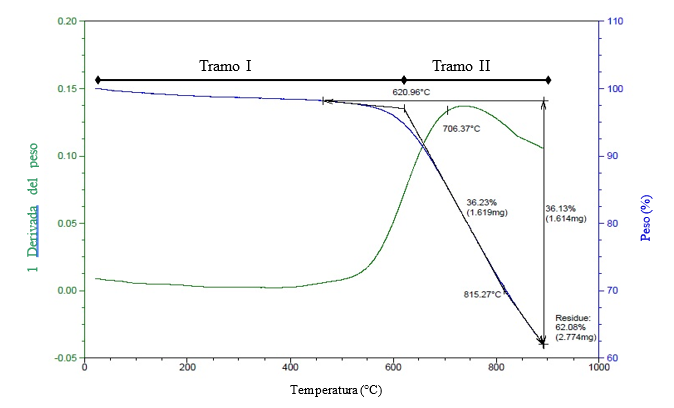
Figura 2. Análisis termogravimétrico de los nanotubos de carbono de pared múltiple.
Al ser la temperatura inicial de degradación de los NTCPM de 621 °C es posible mezclar los NTCPM con PLA a una temperatura de mezclado de 180 °C, sin generar la degradación oxidativa del material de refuerzo. Por lo tanto, los NTCPM no serán limitantes para el uso del material resultante en alguna aplicación que se realice a una temperatura superior a la temperatura ambiente y hasta los 621 °C, la temperatura de degradación de la matriz será la limitante antes de los 621 °C.
El tramo II del termograma representa la degradación de los nanotubos de carbono, la cual va desde los 621 a los 900 °C. Las variaciones en la degradación pueden deberse a que los nanotubos de carbono contienen diferentes defectos en su estructura hexahedral. De modo que se induce la ruptura de los enlaces de las estructuras carbonadas principalmente en los extremos de los tubos, donde hay una mayor cantidad de carbonos con hibridación tipo sp3, la pérdida de masa se da por sublimación de las estructuras carbonadas [44]. La degradación térmica de los nanotubos de carbono queda incompleta, ya que en este último tramo queda un residuo de 62,06%, esto indica que no se pudo realizar la desintegración completa del material debido a las condiciones del análisis aplicadas [45-47].
Espectroscopía Raman y de infrarrojo - FTIR
En la figura 3(A) se observa el espectro Raman de los nanotubos de carbono. Los NTCPM generan dos bandas características del grafito, una de estas aparece aproximadamente a los 1590 cm-1. Esta banda es también conocida como la banda G y se asigna a la vibración en el plano de los enlaces carbono-carbono (C-C) de los carbonos sp2.
Otra banda característica del grafito se observa a los 1295 cm-1 y se conoce como la banda D o banda inducida al desorden por fotón, la cual se atribuye a la presencia de desorden en los alótropos del carbono. Esta banda está más asociada a enlaces de carbonos tipo sp3 que sirven como sitios de nucleación de hidrógenos. El espectro Raman también exhibe una banda a los 2440 cm-1 que se llama banda Gꞌ y se atribuye a un sobretono de la banda G [49]. Para determinar la cristalinidad de los nanotubos de carbono se utilizó la relación entre la intensidad de la banda G y la intensidad de la banda D, como se muestra en la Ec. (3).
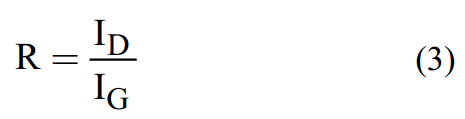
Mediante esta técnica se obtuvo una razón de cristalinidad de 1,14, lo que demuestra que estos nanotubos tienen poca cristalinidad [50, 51].
Una manera de identificar si la muestra es grafeno 2D o NTCPM es mediante la banda G, ya que en esta las estructuras del grafeno pueden observarse como un pico bien definido, pero para nanotubos de carbono se presenta como un multipico [48].
En el espectro infrarrojo de los NTCPM (figura 3(B)), se observó un pico a los 1650 cm-1, esta señal se conoce como banda G, la cual se aprecia mejor mediante espectroscopía RAMAN. La banda G es un pico originado por la vibración longitudinal de los carbonos con hibridación sp2. El pico observado a los 1280 cm-1 es una banda de absorbancia de un fotón inducida por el desorden.
La presencia de regiones desordenadas en los nanotubos implica una posible unión de carbonos con hibridación sp3 que sirven de sitios de nucleación para el hidrógeno. Estos grupos CHx pueden relacionarse con los picos en 2900 y 2830 cm-1 originados por vibraciones longitudinales C-H. De acuerdo con el espectro, la banda a 895 cm-1 se genera por vibraciones de flexión por balanceo entre enlaces C-H de carbonos sp3. Las bandas observadas entre los 2000 y 2400 cm-1 podrían deberse a vibraciones longitudinales de distintos carbonos con hibridación sp formados en las zonas desordenadas [51].
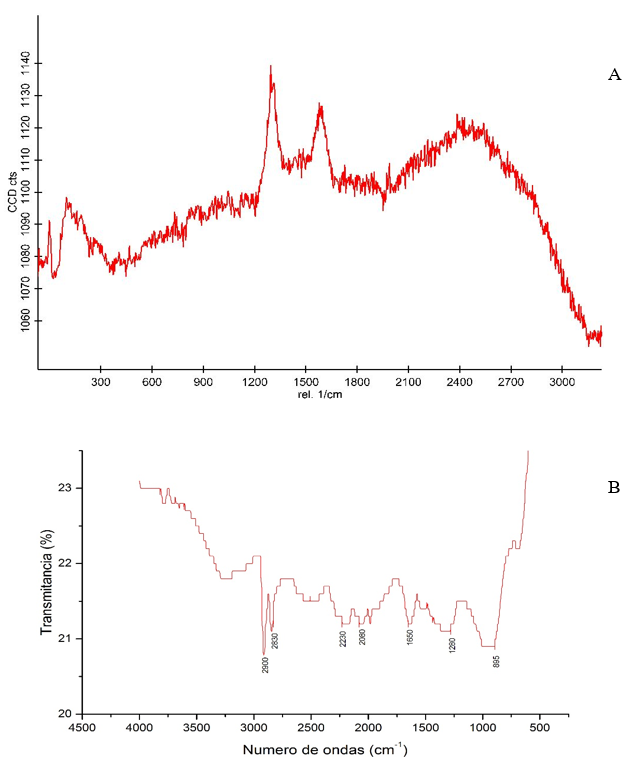
Figura 3. Espectro Raman (A) y de FTIR (B) para una muestra de nanotubos de carbono multipared.
Difracción de rayos X de nanotubos de carbono
En la figura 4 se observa el patrón de difracción de rayos X para los NTCPM. La banda ancha a 26 °2θ puede atribuirse a la reflexión (002) de las estructuras carbonadas de la red hexagonal de los NTCPM, la cual corresponde al espacio interplanar de las paredes del tubo.
La forma en que se detecta este pico se debe a que mientras la muestra rota θ grados y el haz disperso gira 2θ grados con respecto a la luz incidente, el eje simétrico se mantiene normal, así que la difracción de Bragg de las caras paralelas cristalinas a la superficie de la muestra (techo de red) que es normal al eje simétrico puede ser detectado por el colector. Por lo tanto, si las caras a lo largo del eje del tubo están alineadas de forma perpendicular al techo de red del tubo, el rayo incidente se dispersa hacia abajo y no llega al colector, pero si las muestras consisten en bloques de nanotubos desordenados, habrá nanotubos cuyo eje es perpendicular al eje simétrico [53, 54].

Figura 4. Patrón de difracción de rayos X para la muestra en polvo de NTCPM bajo condiciones ambientales.
Microscopía de fuerza atómica
En la figura 5 se puede observar una imagen de AFM de la muestra de NTCPM. Debido a la afinidad consigo mismo, se observan algunas aglomeraciones de los NTCPM. Además, se pueden detallar algunas impurezas como carbono amorfo y restos de material catalítico [45]. Las microscopías se utilizaron para realizar el estudio del espesor de los NTCPM. En este estudio se utiliza la distancia de la punta del cantiléver con respecto a la distancia entre la superficie de mica y la superficie de la muestra para determinar la altura de esta. Suponiendo que los NTCPM tienen secciones transversales circulares, se determina con precisión el diámetro del tubo. El promedio de altura observado fue de (13,75 ± 0,75) nm. La medición se realiza con un contacto intermitente entre la punta del cantiléver y la muestra, las fuerzas laterales que actúan sobre los NTCPM son despreciables.
Estudios donde se incorporan NTCPM a matrices de polipropileno han demostrado que los NTCPM con diámetros de alrededor de 10 nm presentan un efecto nucleante mayor que aquellos con tamaños mayores (40 a 60 nm), esto se ha verificado por análisis RAMAN. Los NTCPM presentan un efecto nucleante al aumentar la cinética de cristalización sobre la matriz polimérica de PLA. En estos estudios los cambios se ven reflejados mediante el aumento en la Tg de la mezcla PLA-NTCPM con respecto a la Tg del PLA y la reducción de la Tcc de la mezcla PLA-NTCPM con respecto a la Tcc del PLA que indica que la velocidad de cristalización se acelera con el incremento de contenido NTCPM en la matriz debido a este efecto nucleante [55, 56].
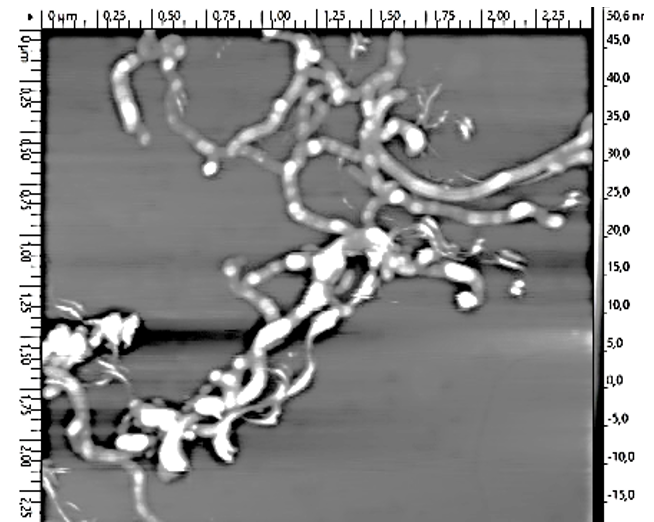
Figura 5. Microscopía de fuerza atómica de nanotubos de carbono multipared NTCPM.
Microscopía de transmisión electrónica (TEM)
En la figura 6 se muestran cuatro micrografías de los nanotubos de carbono obtenidas mediante TEM. Se observa que el largo de los nanotubos es variable, con un valor promedio de 1604 nm en un rango de mediciones de 673 a 2540 nm. En estas mediciones también se pueden observar estructuras que podrían clasificarse como carbono amorfo. En estudios del efecto de relación de aspecto sobre la capacidad de reforzamiento del polipropileno (propiedades de tensión como módulo de elasticidad, esfuerzo, tensión, elongación a la ruptura) se demostró que, sin importar si los tubos son delgados o gruesos, los mejores resultados de refuerzo se obtienen con NTCPM con razones de aspecto superiores a 40. Los NTCPM con valores de relación de aspecto superiores a 300 no presentan diferencias significativas en cuanto a su comportamiento como refuerzo. Estudios usando matrices de PLA demuestran que con relaciones de aspecto bajas se presentan reforzamientos menores a los observados con relaciones de aspecto mayores. La relación de aspecto L/D de los NTCPM en este estudio fue de 117 [55, 57].
Los resultados obtenidos por EDS (tabla 3) indican la presencia de cuatro elementos (C, O, Cu y Na). El carbono se encuentra en mayor proporción y proviene de la estructura de los NTCPM, mientras que la señal del sodio posiblemente se debe a trazas del material catalítico utilizado en la elaboración de los NTCPM. El cobre observado proviene de la malla portamuestras, y el oxígeno de la oxidación del cobre.
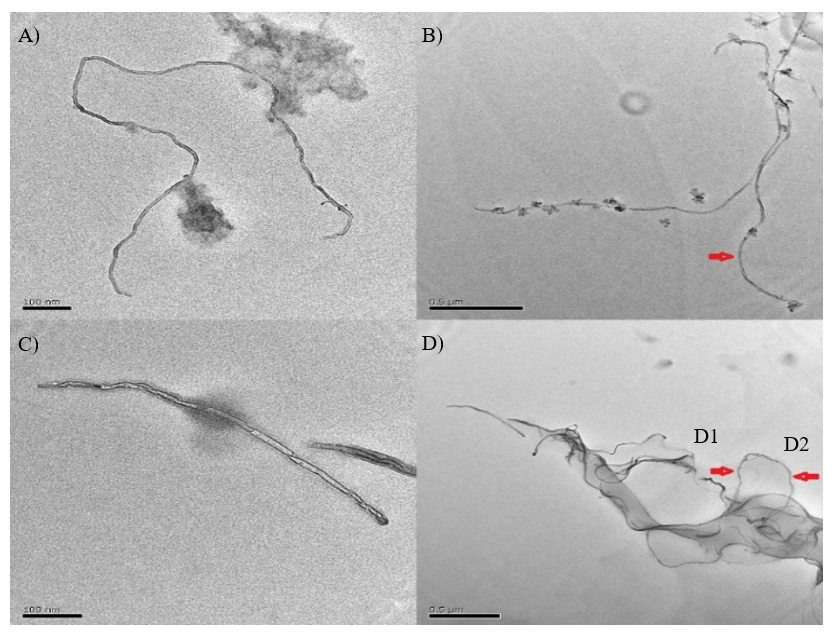
Figura 6. Microscopías TEM de los NTCPM. Cinco NTCPM fueron medidos en estas cuatro mocrografías. En rojo se señala el nanotubo que fue medido en las micrografías donde hay más de un NTCPM.
Como se observó por medio del análisis FTIR no hay presencia detectable de grupos alcohol o ácido carboxílico en los nanotubos de carbono. Con este resultado, junto con los resultados obtenidos por espectroscopía infrarroja, se puede determinar que la composición de NTCPM es en su mayoría carbono y no han sido modificados con grupos funcionales [58-60].
| Composición porcentual | ||||
| Espectro (figura 6) | C | O | Na | Cu |
| A | 89,84 | 9,01 | 1,01 | 0,14 |
| B | 86,45 | 12,21 | 1,07 | 0,27 |
| C | 85,96 | 12,75 | 1,08 | 0,22 |
| D | 85,39 | 13,24 | 1,09 | 0,28 |
Tabla 3. Obtención del porcentaje elemental por EDS de los NTCPM.
En la figura 7 se muestran imágenes de microscopía electrónica de transmisión de alta reolución (HR-TEM). Por medio de estas se pudo determinar que los nanotubos tienen de 16 a 26 paredes, con un promedio de diámetro externo en figura 7a de 23,95 nm y diámetro interno de 9,08 nm; en la figura 7b se presenta un promedio de diámetro externo de 23, nm y diámetro interno de 10,07 nm. En la figura 7b se realizó un estudio de la distancia entre paredes, en los puntos donde hay 16 paredes se obtuvo un total de 0,78 nm y en la zona en la que hay 26 paredes se apreció una distancia de 0,61 nm. También puede observarse cómo las paredes de grafeno internas se puentean periódicamente, lo que indica que poco a poco se va cerrando el tubo hasta que se interconecta la pared más externa. Estas zonas analizadas son rectas, por lo que se descartan irregularidades en la estructura del tubo como zonas con pentágonos, heptágonos u octágonos. Tampoco se observan residuos carbonosos dentro de la estructura, lo que sugiere que la estructura no ha sido rasgada en esta zona [61-63].

Figura 7. Microscopía electrónica de transmisión de nanotubos de carbono de pared múltiple. a) y b) muestran micrografías HR-TEM y c) una la micrografía TEM detallando en un círculo la zona donde se hizo la imagen por HR-TEM.
Análisis de las mezclas PLA-PEG
Análisis de flexión
En la tabla 4 se resumen los datos obtenidos para el experimento de flexión de placas compuestas por PLA-PEG. Como se observa, el módulo de flexión es una propiedad que disminuye al aumentar el porcentaje de PEG. El PLA presenta un esfuerzo máximo de 74 MPa, lo que demuestra una deformación plástica limitada; al aumentar el porcentaje de PEG el esfuerzo máximo disminuye y como consecuencia el material presenta una habilidad menor a la deformación con respecto al PLA. La fragilidad de los materiales puede compararse mediante el módulo de flexión, que es un parámetro para definir que tan rígido es un material. El PLA presenta un módulo de flexión de 2685 MPa, lo que significa que presenta alta rigidez. Al aumentar el porcentaje de PEG, el módulo de flexión desciende hasta 1459 MPa en la mezcla al 9,9%. Se reduce el módulo de flexión de esta mezcla, pero se mantiene rígida, ya que el módulo de flexión supera los 700 MPa, que es el límite en que los materiales se clasifican como no rígidos [64, 65]. Los valores de esfuerzo de flexión al 5% muestran cómo al aumentar el porcentaje de PEG, el esfuerzo es menor, por lo tanto, se requiere una menor energía para flexionar el material a un 5% del desplazamiento del punto inicial, este parámetro demuestra cómo el PEG genera una reducción en la rigidez del material.
| Mezcla | Módulo de flexión | Esfuerzo máximo | Esfuerzo de flexión al 5% de deformación | |||
| MPa | % RRP | MPa | % RRPS | MPa | % RRPS | |
| PLA | 2700 ± 200 | 0 | 74 ± 3 | 0 | 60 ± 30 | 0 |
| PLA+PEG 2,6% | 2300 ± 200 | -14 | 56 ± 7 | -24 | 0 | -100 |
| PLA+PEG 5,1% | 1800 ± 200 | -31 | 44 ± 4 | -41 | 42 ± 4 | -30 |
| PLA+PEG 6,4% | 1500 ± 100 | -44 | 35 ± 3 | -52 | 34 ± 3 | -44 |
| PLA+PEG 9,9% | 1500 ± 200 | -46 | 36 ± 4 | -51 | 21 ± 3 | -43 |
Tabla 4. Resumen de datos obtenidos por el método de flexión de plástico
*RRP: relación respecto al PLACalorimetría diferencial de barrido de las mezclas
Los resultados obtenidos mediante calorimetría diferencial de barrido de las muestras se señalan en el tabla 5. El PLA muestra una temperatura de transición vítrea (Tg) de 57 °C, una exoterma correspondiente a la temperatura de cristalización en frío (Tcc) a los 117 °C y una endoterma correspondiente a la temperatura de fusión (Tm) a los 149 °C. Se observa que al aumentar la concentración de PEG hay variaciones en la temperatura de transición vítrea y en la temperatura de cristalización. Esto indica una afinidad con la matriz de PLA. El PEG promueve una disminución en la estabilidad térmica del PLA debido a que se intercala en las cadenas poliméricas y rompe la interacción polímero-polímero [64].
Como se puede ver, los datos de fusión (Tm) no se ven afectados con la adición de distintos porcentajes de PEG, por lo tanto, el PEG no altera la cinética entre las partículas que lleva al estado líquido al PLA. El valor de la temperatura de transición vítrea cambia ligeramente en función de la concentración de PEG, su valor disminuye gradualmente al aumentar la concentración de PEG. La disminución de la Tg se debe a que el PEG, al tener un alto grado de miscibilidad con el PLA, permite una mayor movilidad de las cadenas aumentando el volumen libre entre estas [64].
Se observa una disminución en la temperatura de cristalización en frío al aumentar la concentración de PEG. Esto sugiere que, al aumentar la movilidad de las cadenas ubicadas en zonas amorfas, se aumenta también la velocidad de cristalización, esto le permite al polímero cristalizar más fácilmente. No se observan señales relacionadas con la temperatura de cristalización (Tc) durante el enfriamiento del PLA y de las mezclas de este con PEG, por lo tanto, el PLA y sus mezclas con PEG no cristalizan durante el enfriamiento [64, 66]. Al disminuir la temperatura de cristalización, la cantidad de zonas cristalinas debería incrementarse, lo cual se puede apreciar en la tabla 5. También se observa que la cristalinidad tiende a aumentar, de esta forma, el PEG sirve como agente de nucleación para las estructuras cristalinas al dar más libertad de movimiento a las cadenas [64, 67].
| Mezcla | Transición vítrea | T de Cristalización en frío | Fusión | % cristalinidad | |||
| T (°C) | Q (J/g) | T (°C) | Q (J/g) | T (°C) | Q (J/g) | ||
| PLA | 57,0 | 1,27 | 116,7 | 21,21 | 149,4 | 24,65 | 3,675 |
| PLA+PEG 2,6% | 49,2 | 1,29 | 103,5 | 26,56 | 152,6 | 31,26 | 5,153 |
| PLA+PEG 5,1% | 37,0 | 1,32 | 90,8 | 30,03 | 151,2 | 35,01 | 5,605 |
| PLA+PEG 6,4% | 36,3 | 1,05 | 91,1 | 37,99 | 150,8 | 47,31 | 10,63 |
| PLA+PEG 9,9% | 32,8 | 0,50 | 86,2 | 26,08 | 150,4 | 35,42 | 11,08 |
Tabla 5. Resumen de datos obtenidos por DSC de las mezclas PLA-PEG.
Análisis dinámico mecánico (DMA)
En la figura 8 se observa la tendencia de las mezclas con respecto al valor tan δ, que es un valor utilizado para determinar por DMA la temperatura de transición vítrea. La matriz virgen exhibe una Tg de 65,1 °C y al aumentar el valor de PEG en la mezcla se observa cómo esta disminuye de forma drástica (de manera similar a los resultados obtenidos por DSC). Se puede justificar esta tendencia por la libertad de las cadenas al aumentar el volumen libre. El cambio en la Tg muestra que hay un efecto del PEG sobre el PLA que indica cierta miscibilidad entre los componentes. Se observa, además, un ensanchamiento de las bandas y una reducción de la altura del pico de tan δ, que podría estar relacionada con la movilidad de la región amorfa del polímero. Cuando el pico es agudo el polímero suele ser amorfo, esto se debe a que no hay restricción de movimiento de la cadena principal. En el caso de los polímeros semicristalinos, las regiones cristalinas dispersas dificultan la movilidad de la cadena en las regiones amorfas, lo cual se observa por reducción de nitidez y altura del pico del valor tan δ. El grado de cristalización del PLA depende de cuatro factores que son: la fracción de isómero D y L en la matriz, el peso molecular de PLA, el tiempo de enfriamiento luego de ser procesado hasta llegar a la Tg y la presencia o ausencia de agentes nucleantes.
En este estudio se utilizó el mismo PLA por lo que la fracción de isómeros y peso molecular se mantienen como una constante para todas las muestras, además, todas las muestras se trataron de la misma manera por lo que la incorporación de PEG funciona como agente nucleante al reducir la Tg de la matriz, lo que indica que hay una interacción entre estos componentes. En la tabla 6 se observa un resumen de los valores obtenidos mediante esta técnica [68, 69].
En la figura 9 se observa la relación del módulo dinámico de almacenamiento (Eꞌ) en función de la temperatura de las mezclas. Con la incorporación del PEG el módulo dinámico disminuye en algunas de las muestras y, por lo tanto, se reducen las propiedades elásticas del PLA, ya que la muestra pierde su rigidez a temperaturas por encima de la Tg. En este proyecto se desea aumentar el medio de dispersión de los NTCPM utilizando PEG y reducir la rigidez del material para que se requiera menor energía de procesamiento [68].
| Mezcla | Transición vítrea (tan δ) (±0,1 °C) |
| PLA | 65,1 |
| PLA+PEG 2,5% | 58,7 |
| PLA+PEG 5,0% | 53,4 |
| PLA+PEG 7,5% | 50,3 |
| PLA+PEG 10,0% | 43,5 |
Tabla 6. Tan δ de las mezclas PLA-PEG para ver la tendencia de la transición vítrea.
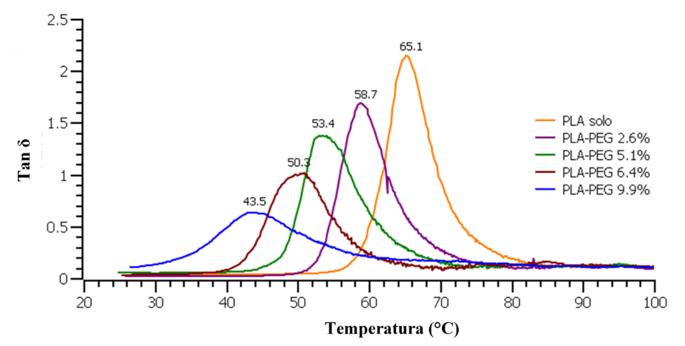
Figura 8. Comparación de tan δ vs temperatura de las mezclas PLA-PEG.
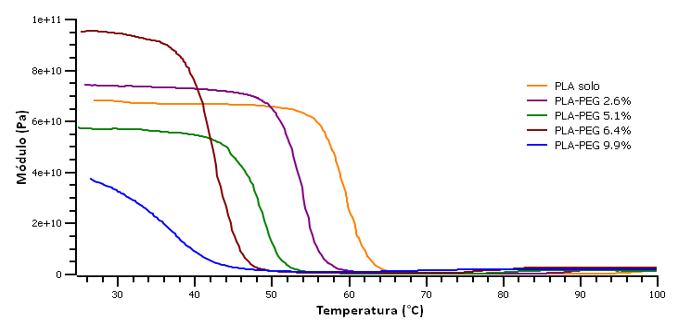
Figura 9. Comparativa de gráficas módulo dinámico vs. temperatura de mezclas PLA-PEG.
Selección de la mezcla PLA+PEG a utilizar como base para la dispersión de nanotubos de carbono
Como se mencionó, la adición de PEG puede generar la disminución de la rigidez del material final. En la figura 10 se observa la disminución del módulo de flexión, que es un parámetro que está relacionado con la rigidez de un material, con el aumento del contenido de PEG. Un material menos rígido es más fácil de procesar, se ahorra energía y como ninguna mezcla llega a valores de módulo de flexión menores a los 700 MPa (donde ya el material pierde su rigidez), se considera que es más conveniente utilizar el valor de 9,9%.

Figura 10. Módulo de flexión vs. temperatura de transición vítrea de las mezclas PLA+PEG.
Análisis de mezclas PLA-PEG-NTCPM
Espectroscopía infrarroja de las mezclas
En el espectro infrarrojo del PLA (figura 11), se detallan bandas a 2945 y 3000 cm-1, correspondiente a la vibración longitudinal en los enlaces C-H presentes en los grupos metilo y en los carbonos terciarios que se encuentran en la estructura del PLA. La banda a los 1748 cm-1 es debida a la vibración longitudinal del grupo carbonilo (C=O) presente en el PLA, además puede observarse que esta banda se encuentra a una longitud de onda mayor a la que presentaría un grupo carbonilo unido a cadenas de hidrocarburos (~1710 cm-1), esto se debe a que el PLA presenta grupos éster donde un oxígeno donador electrónico unido al grupo carbonilo hace el enlace C=O más fuerte y más rígido.
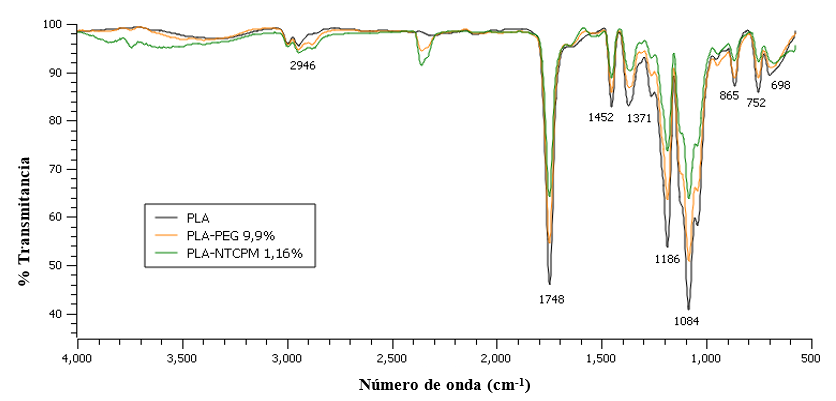
Figura 11. Espectroscopía infrarroja del PLA y las mezclas PLA-PEG 9,9% y PLA-PEG-NTCPM 1,16%.
La banda que se observa a los 1452 cm-1 es debida a las vibraciones de flexión entre enlaces C-H. Las bandas presentes a 1084 y 1371 cm-1 son debidas a vibraciones longitudinales de los enlaces C-C y la banda a 1186 cm-1 es una banda característica de todos los ésteres que representa las vibraciones longitudinales de los enlaces C-O. En la zona de huella digital las bandas a 698, 752 y 865 cm-1 se deben a vibraciones de flexión por balanceo de los enlaces C-H [72]. Así mismo, en dicha figura se observa el espectro infrarrojo de una mezcla PLA+PEG 9,9%. En esta se pueden observar algunas bandas iguales a aquellas que presenta el PLA como una banda a 2945 cm-1 producto de las vibraciones longitudinales entre los enlaces C-H, donde hay un aporte de los enlaces C—H presentes en el PEG. A los 1749 cm-1 de igual forma puede observarse la banda por vibración longitudinal del grupo carbonilo presente en éster, la banda presente a 1185 cm-1 es debida a las vibraciones longitudinales en los enlaces C-O presentes en los grupos éster del PLA y grupos éter del PEG. Las demás bandas también se observan en el espectro del PLA y pueden de igual forma atribuirse a este espectro [72].
Finalmente, se observa el espectro infrarrojo de la mezcla al 1,16%. Se ha escogido esta mezcla para representar todas las demás mezclas porque presenta una mayor presencia de nanotubos de carbono. Como se observa la banda a 2942 cm-1 representa las vibraciones longitudinales entre los enlaces C-H presentes tanto en el PLA como en el PEG. Otras bandas, como la banda G a los 1650 cm-1 de los nanotubos de carbono, no pueden apreciarse a frecuencias tan altas, por lo que es más preciso utilizar espectroscopia RAMAN para observar la presencia de nanotubos de carbono en las muestras [72].
Análisis por goniometría
En la tabla 7 se muestra el ángulo de contacto de una gota de agua colocada sobre cada material. Se observa un ángulo de contacto similar en todos los casos. El de PLA presenta un valor 71 ± 2° relacionado con su carácter hidrofóbico. La adición de PEG 9,9% reporta un valor de 71 ± 5°, similar al reportado para el PLA, por lo tanto, el carácter hidrófobo se mantiene y la adición de PEG no representa una alteración superficial significativa. Con la adición de NTCPM se obtiene en todos los casos valores similares de ángulo de contacto. Las energías de humectabilidad no se ven modificadas y no varía significativamente el carácter hidrofóbico del PLA con la presencia del nanomaterial [73].
| Porcentaje de PEG (%) | Porcentaje de NTCPM (%) | Ángulo de contacto |
| 0,00 | 0,00 | 71 ± 2 |
| 9,92 | 0,00 | 71 ± 5 |
| 11,90 | 0,12 | 55 ± 2 |
| 9,62 | 0,27 | 69 ± 3 |
| 11,78 | 0,67 | 66 ± 6 |
| 11,93 | 1,16 | 69 ± 3 |
Análisis termogravimétrico
La figura 12 compara el contenido (%) de NTCPM en la mezcla contra la temperatura inicial y al 50% de degradación térmica. Como se observa, el PLA presenta una degradación térmica de 341 °C y está por encima de la temperatura de degradación del resto de muestras. La muestra con PEG presenta una reducción de la temperatura inicial de degradación térmica considerable. El PEG promueve una disminución en la estabilidad térmica debido a que penetra la matriz polimérica, entre las cadenas de polímero, y rompe la interacción polímero-polímero que se predice en la teoría de lubricación y en la teoría de geles de plastificación [64].
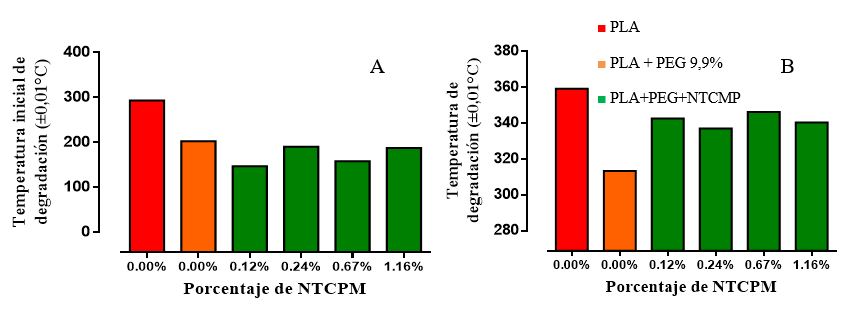
Figura 12. Temperatura degradación inicial (A) y al 50% vs. porcentaje de NTCPM (B).
Al comparar ambos materiales con los de las mezclas PLA–PEG–NTCPM, la muestra de solo PLA sigue presentando el mayor valor, seguida por la de PLA-PEG. Todas las muestras con NTCPM presentan menores valores en ese parámetro. La diferencia entre la mezcla PLA–PEG respecto a la mezcla PLA–PEG–NTCPM demuestra que la adición de NTCPM no mejora la estabilidad térmica de la matriz, pues se degradan a temperaturas ligeramente menores, incrementando el efecto del PEG.
En la comparativa al 50% de degradación versus el porcentaje de NTCPM agregados, el valor de la mezcla PLA–PEG disminuye de igual forma con respecto al PLA por el efecto plastificante del PEG sobre la matriz polimérica, sin embargo, al añadir nanotubos de carbono se incrementa considerablemente la temperatura al 50% del total de degradación térmica, probablemente como respuesta a una separación de fases que reduce la compatibilidad de las mezclas, como se indica en la literatura [74].
Calorimetría diferencial de barrido
En la tabla 8 se resumen los valores obtenidos por DSC de las mezclas a una velocidad de análisis de 10 °C/min.
| % NTCPM | % de PEG | T. transición vítrea (°C) | T. cristalización en frío (± 0,01 °C) | T. Fusión (± 0,01 °C) | % Cristalinidad |
| 0,00 | 0,000 | 61,23 | 116,95 | 149,28 | 5,69 |
| 0,00 | 9,920 | 31,83 | 86,24 | 150,48 | 5,26 |
| 0,12 | 11,89 | 29,34 | 82,83 | 148,37 | 0,000 |
| 0,24 | 9,59 | 31,77 | 94,16 | 151,49 | 2,68 |
| 0,67 | 11,78 | 26,41 | 80,44 | 149,53 | 5,35 |
| 1,16 | 11,93 | 27,10 | 77,57 | 150,91 | 23,30 |
Tabla 8. Resumen de datos obtenidos por DSC de las mezclas PLA–PEG–NTCPM.
Puede observarse que en cuanto a Tg y Tcc hay variaciones, por lo que se presenta un efecto en la matriz polimérica producido por la presencia de los nanotubos de carbono en ella. La temperatura de transición vítrea desciende significativamente desde la muestra de PLA hasta la mezcla de PLA–PEG 9,9 % por el efecto plastificante del PEG. Al comparar los valores de Tg entre las muestras PLA–PEG 9,9 % y las mezclas PLA–PEG–NTCPM se observa que la mayor diferencia que se presenta es de 5,42 °C y que al aumentar la concentración de NTCPM sus valores descienden, sin embargo, el grado de disminución es insignificante tomando en cuenta el error asociado con este tipo de mediciones [75].
La temperatura de cristalización posee la tendencia de reducirse y es claro que, conforme aumenta la concentración de NTCPM, la temperatura de cristalización se reduce a excepción de la mezcla PLA–PEG–NTCPM 0,24 %, en la cual es posible que la reducción no se haya generado porque se adicionó una menor cantidad de PEG, siendo este el que produce una reducción considerable de la temperatura de cristalización (30,77 °C). Al aumentar la cantidad de nanotubos de carbono en la mezcla se genera una mayor cantidad de sitios de nucleación y, por esto, es que la temperatura de cristalización se reduce, al generar cristales a menores temperaturas [75].
El porcentaje de cristalinidad se espera que aumente, sin embargo, se mantiene en valores cercanos al PLA excepto en la mezcla al 1,16%. Al aumentar la cantidad de NTCPM no se presenta un crecimiento de las zonas cristalinas, en la mezcla al 1,16% sí se presenta un crecimiento significativo de cristales producto de una separación de fases orgánica e inorgánica mayor, por lo tanto, al reducir el volumen libre hace que los NTCPM se aglomeren y no se entremezclen en las zonas amorfas del polímero, lo que le da inestabilidad a la mezcla [19].
Análisis dinámico mecánico
En la figura 13 y en la tabla 9, se presentan los resultados de temperatura de tan δ que nos permiten obtener el valor de la transición vítrea de las mezclas analizadas. Se observa que hay una disminución en los valores de Tg, debido al efecto plastificante causado por el PEG.
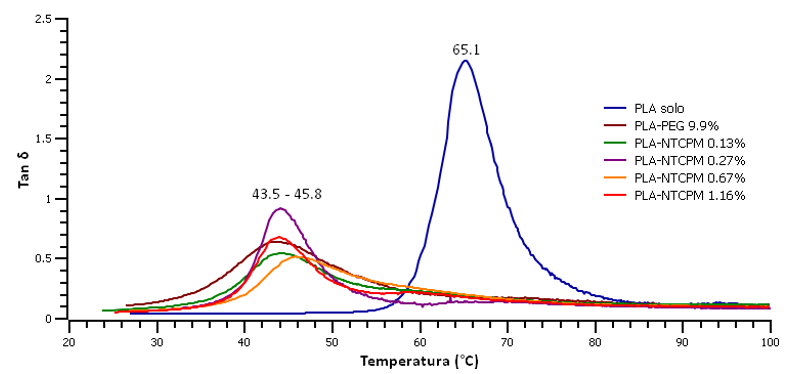
Figura 13. Comparación de tan δ vs temperatura de las mezclas PLA–PEG 9,9% y PLA–PEG–NTCPM.
Se observa cómo los valores de tan δ se ensanchan y disminuye la intensidad con respecto a la curva de PLA de todas las mezclas restantes, esto es un indicativo de que los NTCPM no tienen un efecto sobre la transición vítrea, los valores son muy similares al variar la concentración. Por lo tanto, los NTCPM no le dan mayor rigidez a la estructura, los nanotubos no restringen la movilidad de las cadenas de polímero y es mayor el efecto plastificante del PEG, que les da mayor movilidad a las cadenas de la zona amorfa del polímero [74].
En la figura 14 se muestran las gráficas de módulo dinámico de almacenamiento (Eꞌ) al variar la temperatura de las mezclas. Como se ha explicado, el PEG funciona como plastificante y provoca el aumento de propiedades viscosas del PLA. Las mezclas con PEG pierden su rigidez a temperaturas por debajo de la Tg.
| Porcentaje de PEG (%) | Porcentaje de NTCPM (%) | Transición vítrea (tan δ) (±0,1 °C) |
| 0,00 | 0,00 | 65,1 |
| 9,92 | 0,00 | 43,5 |
| 11,90 | 0,12 | 44,0 |
| 9,62 | 0,27 | 43,9 |
| 11,78 | 0,67 | 45,8 |
| 11,93 | 1,16 | 43,7 |
Tabla 9. Temperatura de Tan δ de las mezclas PLA–PEG y PLA–PEG–NTCPM.
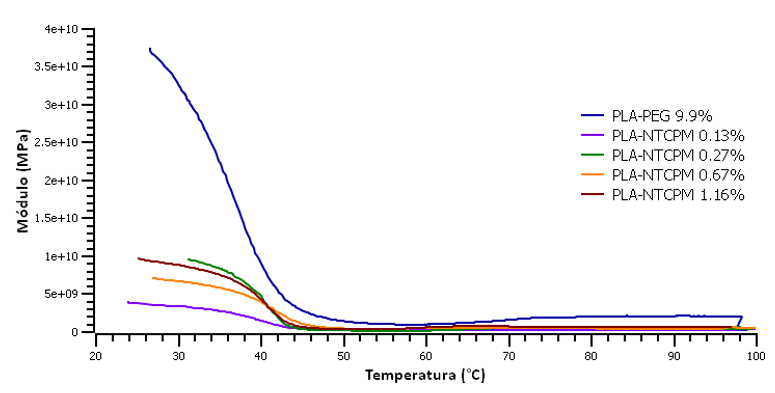
Figura 14. Módulo dinámico de almacenamiento al variar la temperatura de las mezclas PLA-PEG-NTCPM.
En la mezcla PLA–PEG 9,9% hay una reducción del módulo dinámico, lo que indica que los nanotubos de carbono no le dan rigidez a la estructura amorfa, sino que más bien la hacen más flexible y es posible que haya una incompatibilidad y una separación de fases entre la fase orgánica compuesta por PLA y PEG con alta miscibilidad y otra fase inorgánica compuesta por los NTCPM distribuida por la fase orgánica y ligada a la fase orgánica únicamente por interacciones dipolo-dipolo inducido. Esta incompatibilidad reduce el módulo dinámico del material [76].
Análisis de flexión y tensión
La figura 15 muestra el comportamiento del módulo de flexión y el esfuerzo máximo de flexión al aumentar el porcentaje de NTCPM en las mezclas con 10% de PEG. Se observa inicialmente un decaimiento en el módulo de flexión del material con PEG respecto a la muestra sin PEG. Posteriormente hay un aumento del módulo de flexión para la mezcla al 0,24% de NTCPM, la cual presenta el mayor módulo de flexión. Finalmente, se observa una disminución del módulo de elasticidad. Esto indica que los NTCPM refuerzan al material plastificado con PEG, debido al aumento en el módulo de elasticidad y algunas zonas del polímero han sido inmovilizadas por la presencia de NTCPM. Sin embargo, como la concentración es mayor, se presenta una mayor separación de fases orgánica-inorgánica que enriquece algunas zonas con NTCPM y otras con polímero que evita que se refuercen mayormente algunas zonas de la matriz polimérica, como sí lo logra la mezcla al 0,24% [74, 76-78].
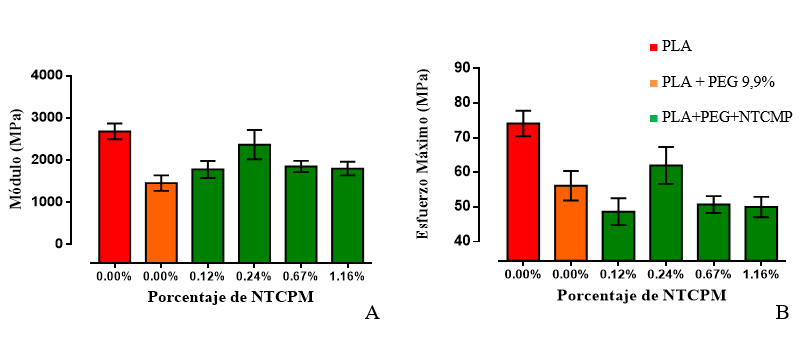
Figura 15. (A) Tendencia del módulo y (B) tendencia del esfuerzo máximo de flexión al aumentar el porcentaje de NTCPM con aproximadamente 10% de PEG.
El esfuerzo máximo de flexión muestra una tendencia similar a la presentada en el módulo de flexión como se observa en la figura 16. La disminución desde el PLA hasta la mezcla al 0,12% es indicadora de que se aumenta la deformación plástica limitada que presenta el PLA. Para las mezclas al 0,67 y 1,16% se ha presentado una disminución del esfuerzo máximo, que es posible que se genere por la separación de fases orgánica-inorgánica [76].
En la figura 16 puede observarse la comparación entre el módulo de flexión con respecto a la transición vítrea (DMTA) de las muestras. Como se aprecia, el valor de transición vítrea es de 61,23 °C para el PLA y se reduce a 43,5 °C cuando se le añade 9,9% de PEG.
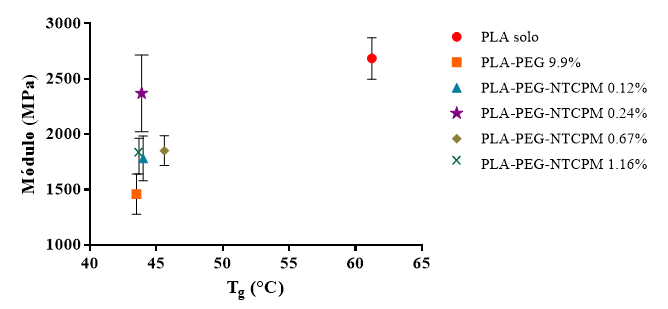
Figura 16. Comparativa entre el módulo de flexión con respecto a la transición vítrea de las muestras.
Al añadir NTCPM, la transición vítrea es un valor que se mantiene relativamente constante, ya que este nanomaterial solo inmoviliza ciertas zonas amorfas del polímero, las cuales, al tener menor movilidad, necesitan mayor energía para vencer la temperatura de transición vítrea. La tendencia del módulo de elongación y la deformación de tensión a carga máxima al variar el porcentaje de NTCPM puede observarse en la figura 17.
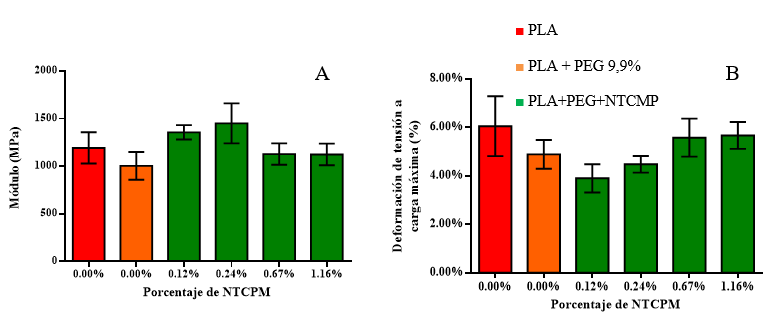
Figura 17. Tendencia del módulo de elongación (A) y la deformación de tensión a carga máxima al variar el porcentaje de NTCPM (B).
El gráfico puede seccionarse en 3 zonas, la primera cuando al PLA se le añade PEG, la segunda cuando se añade NTCPM hasta el punto de mayor módulo de tensión y la tercera zona es aquella en la que hay presencia de NTCPM, pero el módulo de tensión se va reduciendo. En la primera zona el PLA presenta un módulo de tensión de 1193 MPa y cuando se le añade PEG al 9,9% se reduce a 1003 MPa. Esta tendencia se explica por el efecto plastificante que tiene el PEG sobre el PLA.
En la segunda zona, el módulo de tensión se incrementa, lo que demuestra que, con los NTCPM, se genera un material más rígido. Así mismo, al añadir NTCPM hasta el 0,24%, se alcanza el módulo de tensión más alto, indicando que es el adecuado para aumentar la rigidez del material. En la tercera etapa se puede ver que al agregar NTCPM el módulo de tensión se reduce, lo que demuestra que al añadir una cantidad mayor al 0,24%, los NTCPM se convierten en una carga para el material y ya no lo refuerzan. Se incrementa la separación de las fases orgánica del polímero e inorgánica de los NTCPM, por lo que la confinación de zonas de matriz y zonas de NTCPM no llevan a una buena interacción de ambas fases y el material se hace más flexible.
En la figura 18 se observa la curva de esfuerzo de carga máxima, la deformación a la ruptura y el esfuerzo de ruptura al variar el porcentaje de NTCPM. Para el esfuerzo de carga máxima, el PLA presenta el valor más alto, lo que indica que este material requiere bajo un esfuerzo aplicado, una mayor energía para deformarla.

Figura 18. Esfuerzo de carga máxima (A), la deformación a la ruptura (B) y el esfuerzo de ruptura al variar el porcentaje de NTCPM (C).
Al añadir PEG a la mezcla el esfuerzo de carga máximo se ve reducido considerablemente, el PEG 300 es un material líquido y su función es la de hacer flexible a la matriz polimérica, por lo que se requiere menos energía para elongar esta mezcla. Al agregar NTCPM se observa un incremento en el esfuerzo de carga máxima en el caso de las mezclas al 0,12% y 0,24%, donde el incremento ya es considerable. La razón por la que se requiere mayor energía para elongar estos materiales es que los NTCPM se han dispersado bien en la matriz polimérica y, por lo tanto, han reforzado el material, las cadenas de polímero son más rígidas gracias a esta interacción y se requiere mayor energía para elongar estas mezclas. Como se mencionó anteriormente, las mezclas con NTCPM a 0,67 y 1,16% contienen una cantidad de NTCPM que producen una separación de fases y la interacción no es efectiva cuando los materiales se confinan entre sí, evitando una interacción efectiva de las mezclas.
La deformación a la ruptura es una propiedad que puede estar relacionada con la flexibilidad y fragilidad de un material, lo mismo que la variación de esfuerzo de ruptura de las distintas mezclas. Como puede observarse en la figura 18, para ambas propiedades el PLA presenta una mayor deformación a la ruptura que la mezcla PLA─PEG 9,9%. Se requiere un menor esfuerzo para la ruptura de la mezcla PLA-PEG 9,9% con respecto al PLA, la estructura del PLA plastificada se ha modificado, la presencia de PEG como plastificante reduce la rigidez del material, como se observa en los datos de módulo de tensión. El PEG al actuar como plastificante provoca la reducción de los esfuerzos necesarios para elongar, pero también propicia el aumento del grado de deformación, por lo que se habría esperado que, en lugar de bajar el porcentaje de deformación al agregar PEG 9,9%, hubiera subido la deformación.
Cuando se agrega NTCPM, se observa un incremento en el porcentaje de deformación a la ruptura similar entre las mezclas al 0,12 y 0,24%, con una diferencia poco significativa respecto al PLA y la de 0,67%, que se considera la óptima. El incremento en la mezcla al 1,16% es mínimo, no sigue la tendencia y se ve reducida. Finalmente, los resultados obtenidos en los estudios del efecto del refuerzo indican una tendencia al incremento. En las mezclas al agregar NTCPM el esfuerzo aumenta, pero la deformación disminuye, esto ocurre porque los NTCPM actúan como retículos físicos y restringen el movimiento de las cadenas de polímero, por lo que el PLA se hace más fuerte, pero más quebradizo [79].
Difracción de rayos X
En la figura 19 se observa el patrón de difracción de rayos X del PLA. La curva de PLA exhibe una reflexión débil a °2θ = 16,9 correspondiente al plano de lactida (110)/(200) de la forma α de los cristales del PLA. La amorficidad podría ocultar una señal, posiblemente a los 19 °2θ correspondiente al plano de lactida (203) de la forma α de los cristales de PLA [80]. Para las mezclas PLA-PEG 9,9%, se observa que los dos picos ya vistos y anticipados en el espectro del PLA se hacen más fuertes (las reflexiones presentes a 16,6 y a 18,4 °2θ, correspondientes al plano de la lactida (110)/(200) y (203) de la forma α de los cristales de PLA). Las señales también son más agudas e intensas, lo que indica que la presencia de PEG induce a un incremento de los cristales de la forma α. La razón de este incremento es porque el PEG 300 incrementa la movilidad de las cadenas de PLA, que es termodinámicamente beneficioso para el cristal de forma α.
El difractograma de rayos X de la mezcla PLA con PEG 11,90% y NTCPM al 0,12% muestra las reflexiones que se han visto en los anteriores difractogramas. Las señales no presentan mayor intensidad que las observadas en el difractograma de la mezcla PLA-PEG 9,9%, por lo tanto, la adición de NTCPM en esta proporción no induce un incremento de cristales de la forma α, lo cual implica que en esta proporción el responsable del incremento de cristales con respecto al PLA es el favorecimiento termodinámico que ofrece la libertad de movimiento de las cadenas por el PEG y no por sitios de nucleación que ofrecen las nanopartículas de NTCPM a esta concentración.
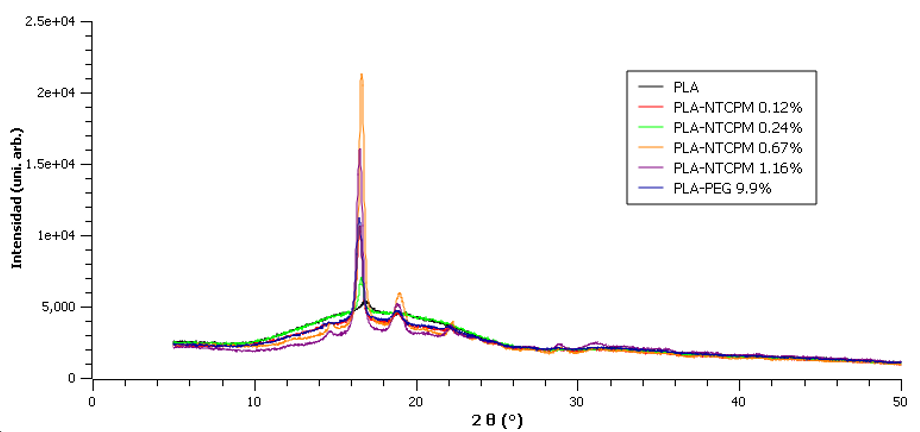
Figura 19. Difractograma de rayos X de las mezclas de PLA, PEG y nanotubos de carbono de pared múltiple.
De la mezcla PLA-PEG 9,62% con 0,24% de NTCPM, el difractograma muestra una banda ancha de polímero amorfo, donde surge un pico a 16,6 °2θ correspondiente al plano de la lactida (110)/(200) de la forma α de los cristales de PLA. La señal que se espera alrededor de los 18,5° 2θ posiblemente se encuentra debajo de la señal de material amorfo. A este porcentaje, el incremento de cristales de la forma α no crece en gran medida con respecto al PLA, por lo tanto, la presencia de NTCPM a esta concentración no ofrece puntos de nucleación y su forma rígida disminuye el favorecimiento termodinámico que ofrece la libertad de movimiento de las cadenas por el PEG, por lo tanto, la presencia de cristales de la forma α se ve disminuida con respecto a la mezcla PLA-PEG 9,9%.
Finalmente, en los difractogramas de las mezclas PLA-PEG al 11,78 y 11,93% con NTCPM a 0,67% y 1,16% respectivamente, se observan las reflexiones más agudas e intensas ubicadas en los ángulos 16,5 y 18,8 °2θ con respecto a las demás mezclas. Esto indica que a partir de esta concentración los NTCPM inducen a un incremento de los cristales de la forma α. Esta cristalinidad incrementa debido a que a la concentración utilizada de NTCPM se presentan sitios de nucleación que permiten el crecimiento de una mayor cantidad de estructuras cristalinas y el incremento de la movilidad de las cadenas gracias al favorecimiento termodinámico que brinda el PEG a la matriz ayuda a que se produzca una cristalización mucho mayor [80].
Para el cálculo de la cristalinidad se empleó la Ecuación 2 y el software GraphPad Prism 6 para realizar la integración del área bajo la curva de las señales de los difractogramas [81]. Se observa un incremento en la cristalinidad al agregar PEG al 9,9%, esta se mantiene muy similar cuando se agregan NTCPM al 0,12%, por lo tanto, añadir NTCPM a esta concentración no genera una nucleación considerable en la matriz polimérica. Se observa que al añadir NTCPM al 0,24% se presenta una reducción de la cristalinidad en peso, lo cual podría deberse a que esta configuración lleva el sistema hacia el desorden. La adición de NTCPM a 0,67 y 1,16% genera un incremento considerable en la cristalinidad de la matriz, de forma que a esta concentración los NTCPM funcionan como agentes nucleantes de la estructura de PLA. En la tabla 10 se observan los valores obtenidos de área de fase amorfa y cristalina.
| Porcentaje de PEG (%) | Porcentaje de NTCPM (%) | Área cristalina (Ac) | Área amorfa (Aa) | Grado cristalinidad (%wc) |
| 0,00 | 0,00 | 359,1 | 21009,9 | 1,68 |
| 9,92 | 0,00 | 3397,0 | 15913,0 | 17,59 |
| 11,90 | 0,12 | 2870,5 | 17109,5 | 16,91 |
| 9,62 | 0,24 | 948,6 | 21318,4 | 4,26 |
| 11,78 | 0,67 | 8979,8 | 12812,2 | 41,21 |
| 11,93 | 1,16 | 7724,4 | 9812,5 | 44,05 |
Tabla 10. Datos de cristalinidad obtenidos por el método de integración del área bajo la curva.
Espectroscopía Raman
En la figura 20 se presentan los espectros de RAMAN del PLA (a) procesado, se observan bandas entre 2900 y 3500 cm-1, que se asignan a grupos vCH3 y vCH, ambos presentes en la cadena del ácido poliláctico. A 1777 cm-1 se observa una frecuencia vibracional del grupo vC=O. A 1450 cm-1 puede observarse un pico relacionado con frecuencias vibracionales asignadas a los grupos δCH3. A 875 cm-1 puede observarse una banda asignada a las frecuencias vibracionales de grupos vCester-Cα y vC-Cα. Las bandas ubicadas entre 300 y 700 cm-1 se deben a frecuencias vibracionales de los enlaces τC–OE, δO=COE [82]. Con la adicción de PEG 300 al 9,9% se observa la presencia, además de las bandas ya mencionadas en (a), de algunas otras bandas en (b). Las bandas que se pueden observar entre los 1000 y 1300 cm-1 se atribuyen a varias frecuencias vibracionales como v(CO)i, r(CH2) i a 1042 cm-1, v(C-C), ω(CH2) a 1124 cm-1.
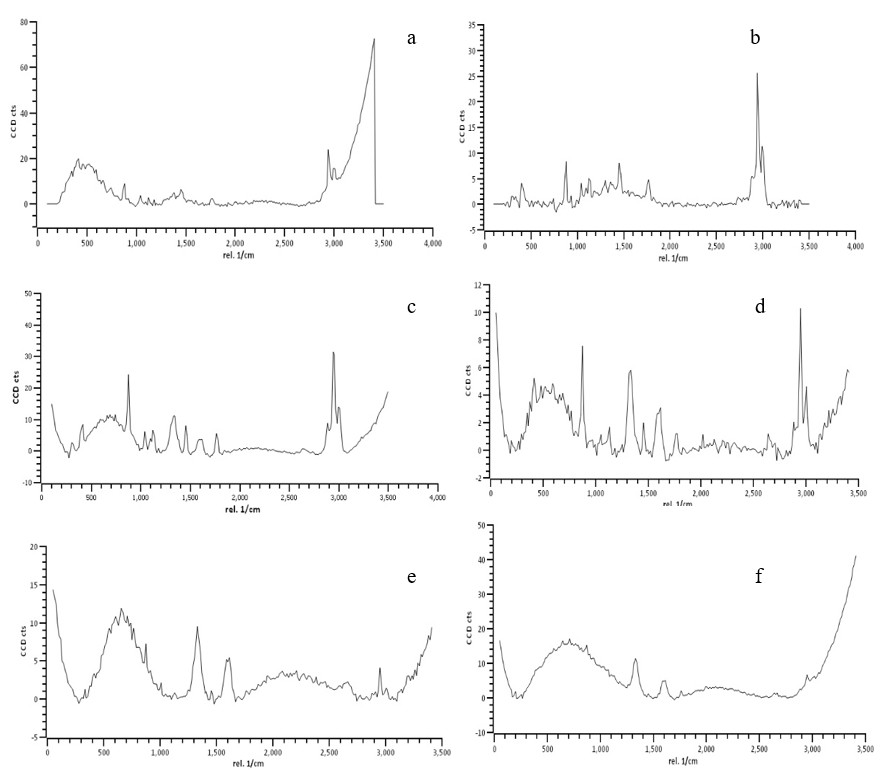
Figura 20. (a)Espectroscopía Raman de PLA procesado, (b) PLA-PEG al 9,9%, (c) PLA-PEG-NTCPM al 0,12%, (d) PLA-PEG-NTCPM al 0,24%, (e) PLA-PEG-NTCPM al 0,67%, (f) PLA-PEG-NTCPM al 1,16%.
La banda a 880 cm-1 es aportada por dos frecuencias vibracionales, los enlaces vCester-Cα y vC-Cα de la cadena de PLA y los enlaces r(CH2)i y v(CO)i de la estructura de PEG [83]. En los RAMAN (c), (d), (e), (f) de las mezclas PLA-CNT-PEG se observa, además, un pico bien definido, entre 1330 y 1445 cm-1 y otro pico alrededor de 1590 cm-1. Los picos entre 1330 y 1445 cm-1 corresponden a la banda D y los picos ubicados alrededor de los 1590 cm-1 a la banda G.
Microscopía electrónica de barrido (SEM)
En las figuras 21 a 26, se muestran las micrografías SEM de PLA luego de ser fracturado; se observan tanto superficies homogéneas y lisas, así como zonas irregulares con porosidad, y algunas grietas y fracturas. La superficie mostró ductilidad que se evidencia en forma de blanqueamiento por esfuerzo o deformación permanente y en la imagen por SEM se confirma por medio de estas fibrillas estiradas [84].
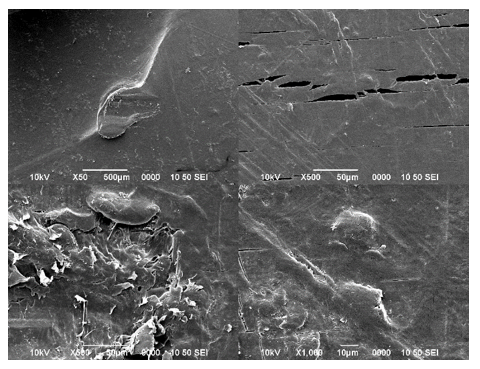
Figura 21. Micrografías SEM de PLA procesado.
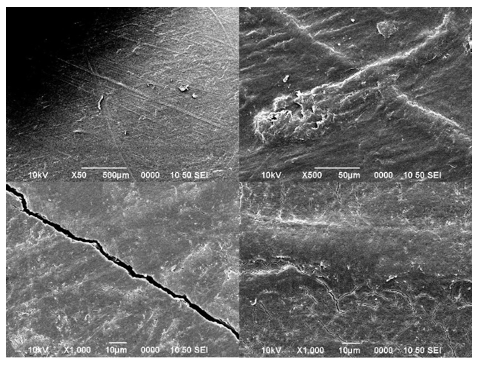
Figura 22. Micrografías SEM de PLA procesado PLA-PEG al 9,9%.
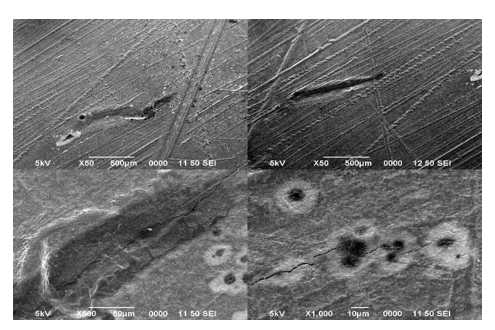
Figura 23. Micrografías SEM de PLA-PEG-NTCPM al 0,12%.

Figura 24. Micrografías SEM de PLA-PEG-NTCPM al 0,24%.
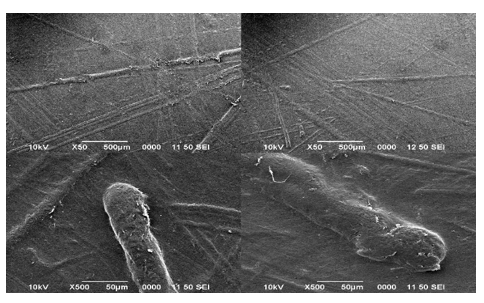
Figura 25. Micrografías SEM de PLA-PEG-NTCPM al 0,67%.
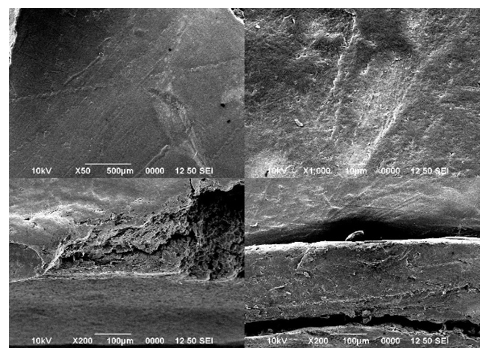
Figura 26. Micrografías SEM de PLA-PEG-NTCPM al 1,16%.
En las micrografías SEM de la mezcla 9,9% pueden observarse estructuras uniformes y homogéneas, y la presencia de fracturas y rupturas en la estructura. Se presenta ductilidad en la muestra evidenciado en el blanqueamiento de la placa y en las fibrillas estiradas. También se observa bifurcación de la grieta, lo cual evidencia que estuvo sometida a un gran esfuerzo producto de los ensayos de elongación [84, 85]. En la mezcla 0,12% se pueden observar puntos negros a lo largo de la matriz, estos pueden ser un efecto visual o zonas expuestas por un mayor tiempo al haz de electrones. Se observa que el material uniforme presenta líneas de orientación hacia una misma dirección. Hay fisuras sin bifurcación, que indican que la estructura presenta fallos en una sola dirección [84, 85, 75]. En las micrografías de las placas al 0,24%, se pueden observar estructuras homogéneas y uniformes, algunas fisuras poseen poca bifurcación y las rupturas se dan en la misma dirección [84-86]. En las placas al 0,67%, no se observan rupturas, es homogénea y presenta algunos relieves producto de aglomeraciones de fibras de PLA [84-86]. Finalmente, en las placas al 1,16%, se observan zonas homogéneas de fibras de polímero, además de una fractura en forma de corte, que se propaga en distintas direcciones, se observa que este corte genera una fractura en la parte superior, no se logra observar bifurcación [84-86].
Conclusiones
De los resultados obtenidos en esta investigación, se determinó que los nanotubos de carbono presentan una temperatura de degradación adecuada para hacer mezclas con la matriz de PLA. Así mismo, se obtuvieron los resultados esperados en su caracterización física, química y morfológica.
Respeto al uso del plastificante PEG, se observó una disminución en los módulos de flexión y tensión, así como en el esfuerzo máximo al aumentar el porcentaje de PEG en el PLA, convirtiéndolo en un material fácil de procesar, útil para el ahorro energético industrial y con mayor deformación plástica para aplicaciones donde el PLA necesita mayor flexibilidad.
Para realizar las mezclas con NTCPM se escogió la mezcla con PEG menos rígida, que permitiría un procesamiento más beneficioso a nivel industrial y que, además, es la que presentó mayor elasticidad.
Los NTCPM permitieron una matriz polimérica más flexible al disminuir el módulo dinámico, el módulo de flexión y de tensión presenta incrementos, por lo tanto, podrían ser útiles en la industria para aumentar la rigidez en aplicaciones de esfuerzo mecánico.
Referencias
[1] M. Jamshidian, E. Tehrany, M. Imran, M. Jacquot & S. Desobry, “Poly-Lactic Acid: Production, Applications, Nanocomposites, and Release Studies”, Comprehensive Reviews in Food Science and Food Safety, n.. 9, pp. 552-571, 2010. DOI: https://doi.org/10.1111/j.1541-4337.2010.00126.x
[2] Natureworksllc.com. 2020. Natureworks | About Natureworks. [Online] Available: https://www.natureworksllc.com/About-NatureWorks [Accessed: 8-Aug-2020].
[3] O. Wolf, Techno-economic feasibility of large-scale production of bio-based polymers in Europe. Institute for Prospective Technological Studies, Madrid: European Communities, 2005, pp. 50-64.
[4] J. Lim, S. Kim, S. Lim & Y. Kim, “Improvement of flexural strengths of poly(L-lactic acid) by solid-state extrusión, 2: extrusión through rectangular die”, Macromolecular Materials and Engineering, n.. 288, pp. 50-57, 2003. DOI: https://doi.org/10.1002/mame.200290033
[5] T. Furukawa, H. Sato, R. Murakami, J. Zhang, Y. Duan, I. Noda, S. Ochiai & Y. Ozaki, “Structure, dispersibility, and crystallinity of poly(hydroxybutyrate)/poly(L-lactic acid) blends studied by FT-IR microspectroscopy and differential scanning calorimetry”, Macromolecules, n.. 38, pp. 6445-6454, 2005. DOI: https://doi.org/10.1021/ma0504668
[6] S. Vainionpaa, P. Rokkanen & P. Tormall, “Surgical application of biodegradable polymers in human tissues”, Prog Polym Sci., n.. 14, pp. 679-716, 1989. DOI: https://doi.org/10.1023/B:BILE.0000004398.38799.29
[7] T. Ohkita & S. Lee S., “Thermal degradation and biodegradability of poly(lacticacid)/cornstarch biocomposites”, Journal of Applied Polymer Science, n.. 100, pp. 3009-3017, 2006. DOI: https://doi.org/10.1002/app.23425
[8] D. Williams, “Enzymatic hydrolysis of polylactic acid”, Engineering in Medicine, n.. 10, pp. 5-7, 1981. DOI: https://doi.org/10.1243/EMED_JOUR_1981_010_004_02
[9] Y. Oda, A. Yonetsu, T. Urakami & K. Tonomura, “Degradation of polylactide by commercial proteases”, Journal of Polymers and the Environment, n.. 8, pp. 29-32, 2000. DOI: https://doi.org/10.1023/A:1010120128048
[10] H. Lim, T. Raku & Y. Tokiwa, “Hydrolysis of polyesters by serine proteases”, Biotechnology Letters, n.. 27, pp. 459-64, 2005. DOI: https://doi.org/10.1007/s10529-005-2217-8
[11] K. Masaki, N. Kamini, H. Ikeda & H. Iefuji, “Cutinase-like enzyme from the yeast Cryptococcus sp. strain. S-2 hydrolyses polylactic acid and other biodegradable plastics”, Applied Environmental Microbiology, n.. 7, pp. 7548-7550, 2005. DOI: https://dx.doi.org/10.1128%2FAEM.71.11.7548-7550.2005
[12] P. Jiménez, M. Sibaja & J. Vega-Baudrit, “Síntesis y caracterización de poli (ácido L-láctico) por Policondensación Directa Obtenido del Fermento de Desechos Agroindustriales de Banano (Musa Acuminata Aaa Variedad Cavendish Cultivar Gran Naine) en Costa Rica”, Revista Iberoamericana de Polímeros, n.. 13, pp. 52-59, 2013.
[13] Cdn.intechopen.com, 2020. [Online]. Available: http://cdn.intechopen.com/pdfs-wm/26368.pdf. [Accessed: 08-Aug-2020].
[14] YTC America Inc 2020. [Online]. Available: http://www.ytca.com/biodegradable_plastics_and_composites. [Accessed: 08-Aug-2020].
[15] S. Ramaswamy, “Study of Morphological, Mechanical and Electrical properties of Electrospun Poly(lactic acid) Nanofibers incorporated with Multiwalled Carbon Nanotubes as a Function of Thermal Bonding”, Repository.lib.ncsu.edu, 2020. [Online]. Available: http://repository.lib.ncsu.edu/ir/bitstream/1840.16/656/1/etd.pdf. [Accessed: 08-Aug-2020].
[16] A. Abdal-hay, S. Park, G. Abdel-Jaber & J. Lim, “Biodegradable Poly(Lactic Acid)/Multiwalled Carbon Nanotube Nanocomposites Fabrication Using Casting And Hot Press Techniques”, International Journal of Innovative Research in Science, Engineering and Technology, n.. 2, pp. 7976-7981, 2013. ISSN: 2319-8753.
[17] B. Chieng, N. Ibrahim, W. Yunus & M. Hussein, “Poly(lactic acid)/Poly(ethylene glycol) Polymer Nanocomposites: Effects of Graphene Nanoplatelets”, Polymers, vol. 6, n.. 1, pp. 93-104, 2014. https://doi.org/10.3390/polym6010093
[18] R. Khare & S. Bose, “Carbon Nanotube Based Composites- A Review”, Journal of Minerals & Materials Characterization & Engineering, n.. 4, pp. 31-46, 2005. DOI: https://doi.org/10.4236/jmmce.2005.41004
[19] B. Kumar, M. Castro, J. Feller, “ Poly (lactic acid)-multi-wall carbon nanotube conductive biopolymer nanocomposite vapour sensors”, Sensors and Actuators B: Chemical, n.. 161, pp. 621-628, 2012. DOI: https://www.researchgate.net/deref/http%3A%2F%2Fdx.doi.org%2F10.1016%2Fj.snb.2011.10.077
[20] R. Moradian & A. Fathalian, “Effects of inter wall hopping on the electronic properties of double-wall carbon nanotubes”, Solid State Communications, n.. 149, pp. 491-495, 2009. DOI: https://www.researchgate.net/deref/http%3A%2F%2Fdx.doi.org%2F10.1016%2Fj.ssc.2008.12.028
[21] M. Obarzanek-Fojt, Y. Elbs-Glatz, E. Lizundia, L. Diener, S. Sarasua, A. Bruinink, “From implantation to degradation — are poly (L-lactide)/multiwall carbon nanotube composite materials really cytocompatible?”, Nanomedicine: Nanotechnology, Biology, and Medicine, n.. 10, pp. 1041-1051, 2014. DOI: https://doi.org/10.1016/j.nano.2013.12.012
[22] F. Mai, Y. Habibi, J. Raquez, P. Dubois, J. Feller, T. Peijs & E. Bilotti, “Poly(lactic acid)/carbon nanotube nanocomposites with integrated degradation sensing”, Polymer, n.. 54, pp. 6818-6823, 2013. DOI: https://doi.org/10.1016/j.polymer.2013.10.035
[23] A. Coats & J. Redfern, “Thermogravimetric Analysis: A review”, The Analyst (Royal Society of Chemistry), n.. 88, pp. 906-924, 1963. DOI: https://doi.org/10.1016/j.polymer.2013.10.035
[24] “ASTM E1131 - 20 Standard Test Method for Compositional Analysis by Thermogravimetry”, Astm.org, 2020. [Online]. Available: http://www.astm.org/Standards/E1131.htm. [Accessed: 08-Aug-2020].
[25] T. DeBorde, J. Joiner, M. Leyden & E. Minot, “Identifying Individual Single-Walled and Double-Walled Carbon Nanotubes by Atomic Force Microscopy”, Nanoletters, n.. 8, pp. 3568-3571, 2008. DOI: https://doi.org/10.1021/nl801106p
[26] M. Zdrojekl, W. Gebicki1, C. Jastrzebski1, C. Melin & A. Huczko, “Studies of multiwall carbon nanotubes using Raman spectroscopy and atomic force microscopy”, Solide State Phenomena, n.. 99, pp. 265-269, 2004. DOI: https://doi.org/10.4028/www.scientific.net/SSP.99-100.265
[27] G. Maurin, I. Stepanek, P. Bernier, J. Colomer, J. Nagy & F. Henn, “Segmented and opened multi-walled carbon nanotubes”, Carbon, n.. 39, pp. 1273-1278, 2000. DOI: https://doi.org/10.1016/S0008-6223(00)00250-5
[28] D. Leclere, Fourier Transform Infrared Spectroscopy in the Pulp and Paper Industry, 1st ed. R.A. Myers, 2000, pp. 8361-8388.
[29] L. Bokobza & J. Zhang, “Raman spectroscopic characterization of multiwall carbon nanotubes and of composites”, Express Polymer Letters, n.. 6, pp. 601-608, 2012. DOI: https://10.3144/expresspolymlett.2012.63
[30] G. Maurin, I. Stepanek, P. Bernier, J. Colomer, J. Nagy & F. Henn, “Segmented and opened multi-walled carbon nanotubes”, Carbon, n.. 39, pp. 1273-1278, 2000. DOI: https://www.researchgate.net/deref/http%3A%2F%2Fdx.doi.org%2F10.1016%2FS0008-6223(00)00250-5
[31] “ASTM D790 - 17 Standard Test Methods for Flexural Properties of Unreinforced and Reinforced Plastics and Electrical Insulating Materials”, Astm.org, 2020. [Online]. Available: http://www.astm.org/Standards/D790.htm. [Accessed: 8-Aug-2020].
[32] Z. Antar, J. Feller, H. Noël, P. Glouannec & P. Elleuch, “Thermoelectric behaviour of melt processed carbon nanotube/graphite/poly (lactic acid) conductive biopolymer nanocomposites (CPC)”, Materials Letters, n.. 67, pp. 210-214, 2012. DOI: https://10.1016/j.matlet.2011.09.060
[33] M. Chiu & E. Prenner, “Differential scanning calorimetry: An invaluable tool for a detailed thermodynamic characterization of macromolecules and their interactions”, Journal of Pharmacy and Bioallied Sciences, n.. 3, pp. 39-59, 2011. DOI: https://10.4103/0975-7406.76463
[34] X. Cao, A. Mohamed, S. Gordon, J. Willett & D. Sessa, “DSC study of biodegradable poly (lactic acid) and poly(hydroxy ester ether) blends”, Thermochimica Acta, n.. 406, pp. 115-127, 2003. DOI: https://10.1016/S0040-6031(03)00252-1
[35] B. Stuart, Polymer Analysis, 1st ed. London: John Wiley and sons, 2002, p. 227.
[36] “ASTM D638 - 14 Standard Test Method for Tensile Properties of Plastics”, Astm.org, 2020. [Online]. Available: http://www.astm.org/Standards/D638.htm. [Accessed: 8-Aug-2020].
[37] [Online]. Available: http://scholar.lib.vt.edu/theses/available/etd-71498-94026/unrestricted/etd_Chapt_6.pdf. [Accessed: 08-Aug-2020].
[38] “ASTM D7028 - 07(2015) Standard Test Method for Glass Transition Temperature (DMA Tg) of Polymer Matrix Composites by Dynamic Mechanical Analysis (DMA)”, Astm.org, 2020. [Online]. Available: http://www.astm.org/Standards/D7028.htm. [Accessed: 8-Aug-2020].
[39] U. Kim, C. Furtado, X. Liu, G. Chen & P. Eklund, “Raman and IR Spectroscopy of Chemically Processed Single-Walled Carbon Nanotubes”, Journal of the American Chemical Society, 2005, n.. 127, pp. 15437-15445. DOI: https://doi.org/10.1021/ja052951o
[40] Pubs.acs.org, 2020. [Online]. Available: http://pubs.acs.org/doi/pdf/10.1021/ba-1964-0043.ch001. [Accessed: 8-Aug-2020].
[41] R. Rasal, R. Bradley, G. Bohannon & D. Hirt, “Effect of the Photoreaction Solvent on surface and Bulk Properties of Poly (lactic acid) and Poly(hydroxyalkanoate) Films”, Wiley InterScience, n.. 85, pp. 564-572, 2007. DOI: https://doi.org/10.1002/jbm.b.30980
[42] “Earth & Planetary Sciences | The University of New Mexico”, Epsunm.edu, 2020. [Online]. Available: http://epswww.unm.edu/xrd/xrdbasics.pdf. [Accessed: 08-Aug-2020].
[43] Industrial Materials Institute: http://www.speautomotive.com/SPEA_CD/SPEA2006/PDF/c/c2.pdf [Accesed: 23-Jun-2014].
[44] C. Damian, S. Garea, E. Vasile, H. Iovu, “Covalent and non-covalent functionalized MWCNTs for improved thermo-mechanical properties of epoxy composites”, Composites Part B: Engineering., n.. 43, pp. 3507-3515, 2012. DOI: https://doi.org/10.1016/j.compositesb.2011.11.052
[45] B. Scheibe, E. Borowiak-Palen & R. Kalenczuk, “Oxidation and reduction of multiwalled carbon nanotubes — preparation and characterization”, Materials Caracterization, n.. 61, pp. 185-191, 2010. DOI: https://doi.org/10.1016/j.matchar.2009.11.008
[46] H. Yu, C. Lu, T. Xi1, L. Luo, J. Ning & C. Xiang, “Thermal decomposition of the carbon nanotube/SiO2”, Journal of Thermal Analysis and Calorimetry, n.. 82, pp. 97-101, 2005. DOI: https://doi.org/10.1007/s10973-005-0847-7
[47] A. Mahajan, A. Kingon, A. Kukovecz, A. Konya & P. Vilarinho, “Studies on the thermal decomposition of multiwall carbon nanotubes under different atmospheres”, Materials Letters, n.. 90, pp. 165-168, 2013. DOI: https://doi.org/10.1016/j.matlet.2012.08.120
[48] M. Dresselhaus, A. Jorio, M. Hofmann, G. Dresselhaus & R. Saito, “Perspectives on Carbon Nanotubes and Graphene Raman Spectroscopy”, Nanoletters, n.. 10, pp. 751-758, 2010. DOI: https://doi.org/10.1021/nl904286r
[49] L. Bokobza & J. Zhang, “Raman spectroscopic characterization of multiwall carbon nanotubes and of composites”, eXPRESS Polymer Letters, n.. 6, pp. 601-608, 2012. DOI: https://10.3144/expresspolymlett.2012.63
[50] C. Singh, M. Shaffer, K. Koziol, I. Kinlock & A. Windle, “Towards the production of large-scale aligned carbon nanotubes”, Chemical Physics Letters, n.. 372, pp. 860-865, 2003. DOI: https://doi.org/10.1016/S0009-2614(03)00531-1
[51] P. Tan, S. Zhang, K. Yue, F. Huang, Z. Shi, X. Zhou & Z. Gu, “Comparative Raman Study of Carbon Nanotubes Prepared by D.C. Arc Discharge and Catalytic Methods”, Journal of Raman Spectroscopy, n.. 28, pp. 369-372, 1997. DOI: https://doi.org/10.1002/(SICI)1097-4555(199705)28:5%3C369::AID-JRS107%3E3.0.CO;2-X
[52] N. Kouklin, M. Tzolov, D. Straus, A. Yin & J. Xu, “Infrared absorption properties of carbon nanotubes synthesized by chemical vapor”, Applied Physics Letters, n.. 85, pp. 4463-4465, 2004. DOI: https://doi.org.10.1063/1.1812837
[53] A. Cao, C. Xu, J. Liang, D. Wu & B. Wei, “X-ray diffraction characterization on the alignment degree of carbon nanotubes”, Chemical Physics Letters, n.. 344, pp. 13-17, 2001. DOI: https://doi.org/10.1016/S0009-2614(01)00671-6
[54] B. Dunlap, “Relating carbon tubules”, Physical Review B., n.. 49, pp. 5943-5650, 1994. DOI: https://doi.org/10.1103/PhysRevB.49.5643
[55] I. Dubnikova, E. Kuvardina, V. Krasheninnikov, S. Lomakin, I. Tchmutin & S. Kuznetsov, “The Effect of Multiwalled Carbon Nanotube Dimensions on the Morphology, Mechanical, and Electrical Properties of Melt Mixed Polypropylene-Based Composites”, Journal of Applied Polymer Science, n.. 117, pp. 259-272, 2010. DOI: https://doi.org/10.1002/app.31979
[56] J. Yoon, Y. Jeong, S. Lee & B. Min, “Influences of poly (lactic acid)-grafted carbon nanotube on thermal, mechanical, and electrical properties of poly (lactic acid)”, Polymers Advanced Technologies, n.. 20, pp. 631-638, 2008. DOI: https://doi.org/10.1002/pat.1312
[57] D. Wu, L. Wu, W. Zhou, Y. Sun & M. Zhang, “Relations Between the Aspect Ratio of Carbon Nanotubes and the Formation of Percolation Networks in Biodegradable Polylactide/Carbon Nanotube Composites”, Journal of Polymer Science: Part B: Polymer Physics, n.. 48, pp. 479-489, 2010. DOI: https://doi.org/10.1002/polb.21909
[58] D. Zhou, E. Anoshkina, L. Chow & G. Chai, “Synthesis of carbon nanotubes by electrochemical deposition at room temperature”, Carbon., n.. 44, pp. 1013-1016, 2006. DOI: https://doi.org/10.1016/j.carbon.2005.11.006
[59] A. Osikoya, D. Wankasi, R. Vala, A. Afolabi & E. Dikio, Synthesis, characterization and adsorption studies of fluorine–doped carbon nanotubes”, Digest Journal of Nanomaterials and Biostructures, pp. 1187-1197, 2014. DOI: https://www.researchgate.net/profile/Adeniyi_Osikoya/publication/266201742_Synthesis_Characterization_and_adsorption_studies_of_fluorine-doped_carbon_nanotubes/links/54298f800cf27e39fa8e6263.pdf
[60] S. Rahman, M. Islam & K. Shorowordí, “Electrodeposition and Characterization of Cooper Oxide Thin Films for Solar Cell Applications”, Procedia Engineering, n.. 105, pp. 679-685, 2015. DOI: https://doi.org/10.1016/j.proeng.2015.05.048
[61] M. Gaillard, C. Kübel, C. Boulmer-Leborgne, D. Wang, N. Semmar, A. Petit & E. Millon, “High-resolution transmission electron microscope observations of multiwalled carbon nanotube microstructures grown by plasma enhanced chemical vapor deposition”, Journal of Vacuum Science & Technology B., n.. 31, pp. 031805, 2013. DOI: https://doi.org/10.1116/1.4804543
[62] M. Terrones & H. Terrones, “The carbon nanocosmos: novel materials for the twenty-first century”, Philosophical Transactions of the Royal Society of London A., n.. 361, pp. 2789-2806, 2003. DOI: https://doi.org/10.1098/rsta.2003.1262
[63] P. Ajayan, T. Ebbesen, T. Ichihashi, S. Iijima, K. Tanigaki & H. Hiura, “Opening carbon nanotubes with oxygen and implications for filling”, Letters of Nature, n.. 362, pp. 522-525, 1993. DOI: https://doi.org/10.1038/362522a0
[64] B. Chieng, N. Ibrahim, V. Yunus & M. Hussein, “Plasticized Poly (lactic acid) with Low Molecular Weight Poly (ethylene glycol): Mechanical, Thermal, and Morphology Properties”, Journal of Applied Polymer Science, n.. 130, pp. 4576-4580. 2013. DOI: https://doi.org/10.1002/app.39742
[65] ASTM D883. [Online]. Available: https://www.astm.org/Standards/D883.htm [Accesed: 25-april-16].
[66] D. Battegazzore, S. Bocchini & A. Frache, “Crystallization kinetics of poly (lactic acid)-talc composites”, eXPRESS Polymer Letters., n.. 5, pp. 849-858, 2010. DOI: https://doi.org/10.3144/expresspolymlett.2011.84
[67] K. Sungsanit, N. Kao & S. Bhattacharya, “Properties of Linear Poly (Lactic Acid)/Polyethylene Glycol Blends”, Polymer Engineering and Science, n.. 52, pp. 108-116, 2016. DOI: https://doi.org/10.1002/pen.22052
[68] A. Mohapatra, S. Mohanty & S. Nayak, “Effect of PEG on PLA/PEG Blend and Its Nanocomposites: A Study of Thermo-Mechanical and Morphological Characterization”, Polymer Composites, n.. 35, pp. 283-293. 2014. DOI: https://doi.org/10.1002/pc.22660
[69] X. Liu, M. Dever, N. Fair & R. Benson, “Thermal and Mechanical Properties of Poly (lactic Acid) and Poly(ethylene/butylene Succinate) Blends”, Journal of Environmental Polymer Degradation, n.. 5, pp. 225-235, 1997. DOI: https://doi.org/10.1007/BF02763666
[70] http://www.ptonline.com/articles/tips-and-techniques-boosting-extrusión-productivitypart-iii-of-iii-trim-your-material-energy-costs [Accesed: 30-Jul-2017].
[71] I. Pillin, N. Montrelay & Y. Grohens, “Thermo-mechanical characterization of plasticized PLA: Is the miscibility the only significant factor?”, Polymer, n.. 47, pp. 4676-4682, 2006. DOI: https://doi.org/10.1016/j.polymer.2006.04.013
[72] V. Orozco, W. Brostow, W. Chonkaew & B. López, “Preparation and Characterization of Poly(Lactic Acid)-g-Maleic Anhydride + Starch Blends”, Macromolecular Symposia, n.. 277, pp. 69-80, 2009. https://doi.org/10.1002/masy.200950309
[73] Oliveira, J., Zucolotto, V., Mattoso, L. & Medeiros, E. Multi-Walled Carbon Nanotubes and Poly (lactic acid) Nanocomposite Fibrous Membranes Prepared by Solution Blow Spinning. Journal of Nanoscience and Nanotechnology, n.. 11, pp. 1-9, 2011. DOI: https://doi.org.10.1166/jnn.2012.5730
[74] C. Wu & H. Liao, “Study on the preparation and characterization of biodegradable polylactide/multi-walled carbon nanotubes nanocomposites”, Polymer, n.. 48, pp. 4449-4458, 2007. DOI: https://doi.org/10.1016/j.polymer.2007.06.004
[75] S. Kim, K. Shin, S. Lee, K. Kim, & J. Youn. “Unique Crystallization Behavior of Multi-Walled Carbon Nanotube Filled Poly (lactic acid)”, Fibers and Polymers, n.. 11, pp. 1018-1023, 2010. DOI: https://doi.org/10.1007/s12221-010-1018-4
[76] W. Lin, Y. Shih, C. Lin, C. Lee & Y. Yu, “The preparation of multi-walled carbon nanotube/poly (lactic acid) composites with excellent conductivity”, Journal of the Taiwan Institute of Chemical Engineers, n.. 44, pp. 489-496, 2013. DOI: https://doi.org/10.1016/j.jtice.2012.12.012
[77] S. Bastida, J. Eguiazábal, M. Gaztelumendí & J. Nazábal, “On the Thickness Dependence of the Modulus of Elasticity of Polymers”, Polymer Testing, n.. 17, pp. 139-145, 1998. DOI: https://doi.org/10.1016/S0142-9418(97)00042-1
[78] Rua.ua.es, 2020. [Online]. Available: https://rua.ua.es/dspace/bitstream/10045/3624/1/tema3RUA.pdf. [Accessed: 8-Aug-2020].
[79] S. Yellampalli, Carbon nanotubes. Rijeka: InTech, 2011.
[80] F. Li, S. Zhang, J. Liang & J. Wang, “Effect of polyethylene glycol on the crystallization and impact properties of polylactide-based blends”, Polymers Advanced Technologies, n.. 26, pp. 465-475, 2015. DOI: https://doi.org/10.1002/pat.3475
[81] A. Kern & I. Madsen, Quantifying Amorphous Phases. Dordrecht: Springer, 2012, pp. 219-231.
[82] T. Suzuki, K. Takahashi, H. Uehara & T. Yamanobe, “Application and analysis of a DSC-Raman spectroscopy for indium and poly (lactic acid)”, Journal of Thermal Analysis and Calorimetry, n.. 113, pp. 1543-1549, 2013. DOI: https://doi.org/10.1007%2Fs10973-013-3098-z
[83] J. Koenig & A. Angood, “Raman Spectra of Poly (ethy1ene Glycols) in Solution”, Journal of Polymer Science, n.. 8, pp. 1787-1796, 1970. DOI: https://doi.org/10.1002/pol.1970.160081013
[84] J. A. Jansen, Failure Analysis and Prevention (ASM International), volume 11; Failure Analysis and Prevention: United States, 2002, pp. 437-459.
[85] T. Ono, Fracture Analysis, a Basic Tool to Solve Breakage Issues, Corning, 2002, pp. 1-9.
[86] A. Bhattacharyya, T. Sreekumara, T. Liu, S. Kumar, L. Ericson, R. Hauge & R. Smalley, “Crystallization and orientation studies in polypropylene/single wall carbon nanotube composite”, Polymer, n.. 44, pp. 2373-2377, 2003. DOI: https://doi.org/10.1016/S0032-3861(03)00073-9
Notas de autor
jvegab@gmail.com
Recibido: 9 de agosto de 2020; Revisión solicitada: 21 de septiembre de 2020; Aceptado: 7 de diciembre de 2020
Resumen
En términos generales, es bien conocida la cualidad que poseen algunos polímeros de cambiar sus propiedades físicas y químicas finales mediante la adición de nanopartículas a la matriz polimérica para producir un material compuesto (MC). Esta investigación está basada en la obtención de un MC a partir de ácido poliláctico (PLA) y nanotubos de carbono de pared múltiple (NTCPM), muy empleado en la industria del envasado y dispositivos biomédicos, con el fin de ampliar su perfil industrial.
Se desarrollaron cuatro mezclas de PLA y NTCPM, y se empleó polietilenglicol (PEG) como plastificante. Se evaluaron sus propiedades morfológicas, térmicas, mecánicas, termo-mecánicas, espectroscópicas, ángulo de contacto y cristalográficas. Se observó que los MCs presentaron degradación térmica a temperaturas inferiores a la matriz sin NTCPM, así como un aumento en el módulo de flexión y tensión en algunas de las muestras. Así mismo, se observó que los NTCPM pueden aumentar la cristalinidad del material y que, en algunos casos, se incrementa su rigidez, actuando como un aditivo útil para aplicaciones de mayor esfuerzo mecánico que la matriz.
Del efecto de agregar PEG en los MC, se determinó que los NTCPM no restringen la movilidad de las cadenas poliméricas y se da un efecto plastificante, lo que permite mayor movilidad de la zona amorfa de las cadenas de polímero, como indica la literatura consultada. Finalmente, se concluyó que a mayores contenidos de NTCPM, se generan mejores valores en el módulo de flexión, esfuerzo máximo de flexión, módulo de elongación, esfuerzo de carga máxima y esfuerzo de ruptura, entre otras propiedades evaluadas.
Palabras clave
ácido poliláctico, nanotubos de carbono, nanomateriales compuestos, nanomateriales, polímeros biodegradables.Abstract
The quality of some polymers to change their final physical and chemical properties by adding nanoparticles to the polymer matrix to produce a composite material (MC) is well known. This research is based on obtaining a MC from polylactic acid (PLA) and multi-walled carbon nanotubes (CNTMW), widely used in the packaging industry and biomedical devices, in order to expand its industrial profile.
Four mixtures of PLA and CNTMW were developed, and polyethylene glycol (PEG) was used as a plasticizer. Their morphological, thermal, mechanical, thermo-mechanical, spectroscopic, contact angle, and crystallographic properties were evaluated. It was observed that the composites showed thermal degradation at temperatures below the matrix without CNTMW, as well as an increase in the modulus of flexion and tension in some of the samples. Likewise, it was observed that the CNTMW can increase the crystallinity of the material and that, in some cases, its rigidity is increased, acting as a useful additive for applications of greater mechanical stress than the matrix.
From the effect of adding PEG in the composites, the CNTMW do not restrict the mobility of the polymer chains and a plasticizing effect occurs, which allows greater mobility of the amorphous zone of the polymer chains. In general terms, it was concluded that at higher CNTMW contents, better values were generated in the flexural modulus, maximum flexural stress, elongation modulus, maximum load stress and rupture stress, among other evaluated properties.
Keywords
polylactic acid, carbon nanotubes, nanocomposites, nanomaterials, biodegradable polymers.Resumo
Alguns polímeros têm a propriedade de alterar suas propriedades físicas e químicas finais, adicionando nanopartículas à matriz polimérica para produzir um composto. Esta pesquisa baseia-se na obtenção de composto partir de ácido polilático (PLA) e nanotubos de carbono de paredes múltiplas (MWCNT), amplamente utilizado na indústria de embalagens e dispositivos biomédicos, a fim de expandir seu perfil industrial.
Foram desenvolvidas quatro misturas de PLA e MWCNT e o polietilenoglicol (PEG) foi usado como plastificante. Foram avaliadas suas propriedades morfológicas, térmicas, mecânicas, termo-mecânicas, espectroscópicas, ângulo de contato e cristalográficas. Observou-se que os compostos apresentaram degradação térmica em temperaturas abaixo da matriz sem MWCNT, além de aumento no módulo de flexão e tensão em algumas das amostras. Da mesma forma, observou-se que o MWCNT pode aumentar a cristalinidade do material e que, em alguns casos, sua rigidez é aumentada, atuando como um aditivo útil para aplicações de maior tensão mecânica que a matriz.
A partir do efeito da adição de PEG nos compostos, determinou-se que o MWCNT não restringe a mobilidade das cadeias poliméricas e ocorre um efeito plastificante, que permite maior mobilidade da zona amorfa das cadeias poliméricas. Em termos gerais, concluiu-se que, com maiores teores de MWCNT, melhores valores foram gerados no módulo de flexão, tensão máxima de flexão, módulo de alongamento, tensão de carga máxima e tensão de ruptura, entre outras propriedades avaliadas.
Palavras-chave
ácido polilático, nanotubos de carbono, nanocompósitos, nanomateriais, polímeros biodegradáveis.Introducción
Ácido L-poliláctico (PLA) y nanotubos de carbono de pared múltiple (NTCPM) con potenciales aplicaciones industriales
Los materiales que se emplean para el envasado de alimentos y otros productos consisten en una variedad de polímeros a base de petroquímicos, metales, vidrio, papel y madera o combinaciones de estos. La durabilidad y tiempos de biodegradación de los materiales de embalaje son temas contradictorios. Por un lado, la durabilidad es deseable para el envasado y la protección de su contenido durante la vida útil de los productos, pero por otro lado, el tiempo de biodegradación es importante para su rápida desintegración en el medioambiente. Sin embargo, los polímeros usados comúnmente como material de embalaje, a pesar de que brindan estabilidad y protección, tienen tiempos de biodegradación de varios cientos de años [1]. Debido a lo anterior, empresas como NatureWorks y Cargill, a partir de la década de los ochenta, han buscado usos innovadores de los productos provenientes de fuentes naturales para la obtención de plásticos innovadores y más sostenibles como el ácido poliláctico (PLA) a partir de ácido láctico o el polibutilensuccinato (PBS) proveniente del etilénglicol y el ácido succínico. De esta manera, se introdujo una familia de biopolímeros comercialmente disponibles derivados de recursos renovables, con un rendimiento que compite con los materiales de embalaje y fibras a base de petróleo [2].
En la actualidad, la aplicación principal del PLA es en envases (casi el 70%); una estimación para el 2020 muestra el aumento de otras aplicaciones, especialmente como fibras y tejidos [3]. En empaque, dos áreas específicas han recibido mucha atención, las películas de alto valor y envases rígidos termoformados. El PLA aporta una nueva combinación de atributos a los envases, incluyendo rigidez, claridad, retención de torcimiento, capacidad de sellado térmico a baja temperatura, así como una interesante combinación de propiedades de barrera que incluyen el mantenimiento del sabor y conservación del aroma [1]. El PLA también se utiliza en aplicaciones biomédicas, con diversos usos como componentes internos del cuerpo, por ejemplo, tornillos de interferencia en el tobillo, la rodilla, la mano; chinchetas y alfileres para la fijación del ligamento, barras y agujas en los huesos, placas y tornillos de fijación ósea craneomaxilofacial [4] y también para suturas quirúrgicas, implantes y sistemas de administración de fármacos [5].
Por otro lado, casi todos los plásticos convencionales, como polietileno (PE), polipropileno (PP), poliestireno (PS) y policloruro de vinilo (PVC) son resistentes al ataque microbiano; contrariamente, en los poliésteres alifáticos como PLA hay una fácil degradación por los microorganismos presentes en el medioambiente. La degradación de PLA se ha estudiado en los seres vivos para aplicaciones médicas, como implantes, suturas quirúrgicas y liberación de drogas. En estos entornos, el PLA se degrada inicialmente por la hidrólisis y los oligómeros solubles formados son metabolizados por las células [6]. La degradación de PLA en el medioambiente es más difícil que en entornos controlados porque el PLA es resistente al ataque de microorganismos en el suelo o las aguas residuales en condiciones normales. El polímero primero se debe hidrolizar (figura 1) a temperaturas elevadas (aproximadamente 58 ºC) para reducir el peso molecular antes de que la biodegradación pueda comenzar [7].
Las degradaciones microbiana y enzimática del PLA han sido recientemente estudiadas por muchos investigadores, debido a que estos tipos de degradaciones por lo general no necesitan de altas temperaturas. Se reportó primero la degradación de PLA por proteinasa K de Tritirachium album. Después se realizaron muchos estudios para encontrar diferentes enzimas que permitan la degradación del PLA [8]. Así mismo, se ha determinado que hay enzimas que degradan el PLA a diferentes escalas, entre las cuales se incluyen: proteasa alcalina, las proteasas de serina como subtilisina, tripsina, elastasa y α-quimotripsina, enzima cutinasa [9-11].
Por otra parte, además de poseer una lenta biodegradación bajo condiciones especiales, el PLA es muy frágil, con menos de 10% de alargamiento al punto de ruptura, por lo que no es adecuado para aplicaciones que requieran un alto rendimiento mecánico, a menos que esté adecuadamente modificado. Así mismo, el PLA es muy hidrófobo, tiene limitadas propiedades de barrera de gas (permeabilidad de gases), que impiden su acceso pleno a los sectores industriales, como envasadores. También tiene baja resistencia mecánica en condiciones de mucho calor y humedad, baja temperatura de distorsión por calor, poca flexibilidad y largo tiempo de ciclo de moldeo [12-14].
![Figura 1. Degradación hidrolítica del PLA [7].](https://revistas.unal.edu.co/index.php/rcolquim/article/download/89838/version/72042/79401/527276/309066297003_gf2.png)
Figura 1. Degradación hidrolítica del PLA [7].
Debido a los inconvenientes antes mencionados —y como indica la literatura—, el PLA se ha mezclado con una gran cantidad de materiales para obtener materiales compuestos, con el fin de mejorar sus propiedades y conferir una mayor aplicabilidad industrial. Sin embargo, muchos de los resultados obtenidos —según la literatura— no son los esperados [1, 15]. Otros autores han preparado nanocompuestos de PLA con nanotubos de carbono de pared múltiple, a través de métodos de fundición y mezclado, observando mejoras en las propiedades mecánicas y de resistencia a la tracción en comparación con el PLA puro [16].
En un estudio reciente, para la obtención de nanocompuestos de grafeno y PLA, se empleó PEG como agente dispersante. El PEG es un polímero que se usa para la plastificación del PLA. Se han determinado mejoras durante el proceso de alargamiento a la ruptura y la ductilidad, así como reducción de la temperatura de transición vítrea [17].
En esta investigación, se realizó un reforzamiento mecánico de PLA con nanotubos de carbono de pared múltiple (NTCPM). Los NTCPM, con ya reconocidas propiedades mecánicas, poseen 500 veces más área superficial por gramo que la fracción de volumen equivalente de fibra típica de carbono y relaciones de aspecto de alrededor de 103, lo que lo hace un material de gran interés en el refuerzo de matrices poliméricas [18]. Se empleó PEG como plastificante del PLA.
Este estudio pretende ofrecer una alternativa al sector industrial con información sobre el cambio de la propiedades mecánicas, térmicas y morfológicas del ácido poliláctico, al ser mezclado con distintos porcentajes de PEG y nanotubos de carbono de pared múltiple. Estas mezclas pueden ser empleadas como materiales semiconductores de electricidad, debido al efecto de salto electrónico que se puede observar por la presencia de los nanotubos de carbono de pared múltiple; también se podrían utilizar en dispositivos médicos debido a la citocompatibilidad demostrada en otros estudios; así mismo, como sensor integrado de la degradación del ácido poliláctico o para el área de seguridad en sistemas de sensores de vapores de cloroformo, metanol, tolueno y agua [19-22].
Materiales y métodos
Materiales
Los reactivos empleados en la preparación de los materiales compuestos fueron: NTCPM (Cheaptubes. Inc), ácido poliláctico PLA (Chembiotec) y polietilenglicol 300 calidad reactivo (Sigma-Aldrich CAS Number 25322-68-3).
Caracterización de los nanotubos de carbono de pared múltiple
Análisis termogravimétrico (TGA)
Se empleó un analizador termogravimétrico TGA marca TA Instruments®, modelo TGA500. Se utilizó la metodología según ASTM E-1131-3. Se realizó un barrido desde temperatura ambiente hasta 900 °C, con una rampa de calentamiento de 10 °C/min en una atmósfera inerte de nitrógeno [23, 24].
Microscopía de fuerza atómica (AFM)
La morfología de los NTCPM se determinó utilizando un microscopio de fuerza atómica marca Asylum Research®, modelo MFP-3D, mediante un método previamente descrito en la literatura [25, 26].
Microscopía electrónica de transmisión (TEM)
El material se analizó en un microscopio electrónico de transmisión (TEM) marca JEOL®, modelo 2011. Además, se realizó un análisis elemental por espectroscopía de energía dispersiva (EDS) [27].
Espectroscopía de infrarrojo (FTIR-ATR) y RAMAN
Se utilizó un equipo marca Thermo Scientific®, modelo Nicolet 6700 empleando un atenuador de reflectancia. Se realizó un barrido en un intervalo de onda de 400 a 4000 cm-1 [28]. Para RAMAN, se usó un microscopio RAMAN marca Witec®, modelo Alpha300 AR; el experimento se llevó a cabo con una longitud de onda de 514 nm desde un láser sintonizable de argón centrado en la muestra por medio de un objetivo 100x de 0,9 de apertura numérica. La intensidad del haz usada fue de 1 mW [29].
Difracción de rayos X
Se utilizó un difractómetro de rayos X marca PANanlytical® modelo Empyrean con radiación Cu Kα 1,54060 Å, con un escaneo de °2θ desde 5 a 50 [30].
Preparación de las mezclas PLA + PEG y PLA + PEG + NTCPM
Preparación de las mezclas PLA+PEG
Se prepararon cinco muestras en un mezclador marca Brabender®, modelo ATR Plasticorder (tabla 1) a 40 rpm durante 10 min y 20 °C por encima de la temperatura de fusión de la matriz polimérica (170 °C). Con el material se prepararon placas empleando una prensa hidráulica marca Carver® de 12 ton modelo A122 (180 °C, 10 min, a 110 kg/cm2).
Mezcla
1
2
3
4
5
% de PLA
100,0
97,4
94,9
93,6
90,1
% de PEG
0,0
2,6
5,1
6,4
9,9
Preparación de los materiales compuestos PLA+PEG+NTCPM
Se prepararon cuatro muestras en un mezclador interno marca Brabender®, modelo ATR Plasticorder (tabla 2) agitadas a 40 rpm durante 10 min y 20 °C por encima de la temperatura de fusión de la matriz de polímero (170 °C). Con el material se prepararon placas empleando una prensa hidráulica marca Carver® modelo A122, a 180 °C, por 10 min a 110 kg/cm2 [17, 32].
Mezcla
1
2
3
4
% PLA
87,98
90,14
87,56
86,91
% de PEG
11,90
9,62
11,78
11,93
% de NTCPM
0,12
0,24
0,66
1,16
Caracterización de los materiales compuestos
Microscopía electrónica de barrido (SEM)
Se cortaron piezas de 4 x 4 mm de cada muestra y se fijaron sobre una cinta de doble cara carbón/aluminio. Se realizó un recubrimiento de 5 nm de espesor de Au en un cobertor iónico modelo EMS 550 X. Las placas se analizaron en un microscopio electrónico de barrido (SEM) marca Jeol®, modelo JSM-6390LV.
Calorimetría diferencial de barrido (DSC)
utilizó un calorímetro marca TA Instruments®, modelo DSCQ200, con una muestra de 5 mg aproximadamente, a una rampa de 10 °C/min desde temperatura ambiente hasta 200 °C [33, 34]. El porcentaje de cristalinidad se determinó mediante la siguiente ecuación:
Se utilizó un calorímetro marca TA Instruments®, modelo DSCQ200, con una muestra de 5 mg aproximadamente, a una rampa de 10 °C/min desde temperatura ambiente hasta 200 °C [33, 34]. El porcentaje de cristalinidad se determinó mediante la siguiente ecuación:

Donde ΔHm es la entalpía de fusión, ΔHcc es la entalpía de cristalización en frío, ΦPLA es el contenido de PLA en la mezcla y ΔH0 es la entalpía de fusión del PLA 100% cristalino (93,6 J/g).
Análisis termogravimétrico (TGA)
Se empleó un equipo marca TA Instruments® (modelo TGAQ500), según la metodología ASTM E-1131-3, en la que se colocan muestras con peso entre 5-10 mg en una cápsula abierta metálica. Se hizo un barrido de temperaturas hasta 900 °C con una rampa de calentamiento del horno de 10 °C/min en una atmósfera inerte utilizando nitrógeno [24].
Propiedades mecánicas
El ensayo de flexión se realizó considerando la norma ASTM D-790-3 con un equipo marca Instron®, modelo 3365 [31]. Para el experimento, se prepararon muestras rectangulares de 11 x 1,7 mm. Los soportes se colocaron a 4 cm de distancia media y la velocidad de flexión se efectuó a 1,3 mm/min. El ensayo de elongación se llevó a cabo en el mismo equipo (ASTM D-638). Se prepararon 5 placas rectangulares, con un ancho aproximado de 110 mm y un grosor medio de 17 mm. La velocidad del análisis fue de 1 mm/min [35, 36].
Análisis dinámico mecánico
El análisis dinámico mecánico se realizó de acuerdo con la norma ASTM D-7028 en un equipo marca Perkin Elmer®, modelo DMA8000, en donde se colocó una placa rectangular de 50 mm de largo, 7 mm de ancho y 1,7 mm de grosor aproximadamente, se aplicó una rampa de calentamiento de 2 °C/min desde temperatura ambiente a 100 °C, el modo de deformación utilizado fue de doble viga, con una frecuencia de 1 Hz y desplazamiento de 0,1 mm [37, 38].
Espectroscopía infrarroja (FTIR-ATR) y RAMAN
Los espectros infrarrojos de las muestras se realizaron con un espectrofotómetro marca Thermo Scientific®, modelo Nicolet 6700 empleando un atenuador de reflectancia, en un intervalo de 400-4000 cm-1. Para RAMAN se utilizó un equipo marca Thermo Scientific®, modelo DXR2 Raman Microscope, en el que los espectros se registraron en geometría de retrodispersión. Se empleó una longitud de onda de excitación de 633 nm, procedente de un láser sintonizable de argón centrado en la muestra por medio de un objetivo 100x de 0,9 de apertura numérica. La intensidad del haz fue de 0,2 mW para las muestras PLA, PLA-PEG 9,9, PLA-NTCPM 0,1, 0,24, 0,66 con 60 exposiciones y de 1 mW para la muestra PLA-NTCPM 1,16% con 30 exposiciones [29, 39].
Análisis de goniometría
Se usó un goniómetro marca Ramé-hart Instruments®, modelo 100-25-M para realizar las mediciones de ángulo de contacto de agua estática. Los ángulos de contacto de agua se determinan utilizando el método de la gota sésil y son un promedio de 3 lecturas con una confianza del 95% según el método descrito por Rasal et al. [40, 41].
Difracción de rayos X
Para el análisis de dispersión de los nanotubos en la matriz de polímero se utilizó un difractómetro marca PANanlytical® modelo Empyrean. Se empleó el equipo a 40 mV y 45 mA con radiación CuKα (1,54060 Ǻ). Se realizó un escaneo de °2θ de 5 a 50 a cada muestra, según Denaul et al. [42, 43].
Se utilizó el área bajo la curva para determinar la cristalinidad de las mezclas según el método del grado de cristalinidad, que es un método directo y se basa en la estimación de que la intensidad o el área total contribuyen al patrón de difracción en general de cada componente del análisis. Se empleó la Ecuación (2).

Resultados y discusión
Caracterización de nanotubos de carbono de pared múltiple
Análisis termogravimétrico
A través del análisis termogravimétrico (figura 2), se determinó que la temperatura de degradación (Td) media de los NTCPM fue de 706 °C. Se observó en el tramo I, que va desde temperatura ambiente hasta 621 °C, una meseta donde la pérdida de masa es mínima (1,79%). En este rango de temperatura se da la pérdida de masa debido a la sublimación de carbono amorfo, que posiblemente es una impureza que queda luego del proceso de síntesis de los nanotubos de carbono de pared múltiple.
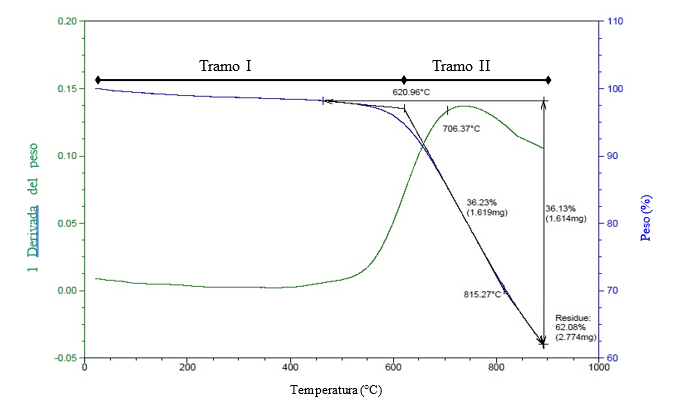
Al ser la temperatura inicial de degradación de los NTCPM de 621 °C es posible mezclar los NTCPM con PLA a una temperatura de mezclado de 180 °C, sin generar la degradación oxidativa del material de refuerzo. Por lo tanto, los NTCPM no serán limitantes para el uso del material resultante en alguna aplicación que se realice a una temperatura superior a la temperatura ambiente y hasta los 621 °C, la temperatura de degradación de la matriz será la limitante antes de los 621 °C.
El tramo II del termograma representa la degradación de los nanotubos de carbono, la cual va desde los 621 a los 900 °C. Las variaciones en la degradación pueden deberse a que los nanotubos de carbono contienen diferentes defectos en su estructura hexahedral. De modo que se induce la ruptura de los enlaces de las estructuras carbonadas principalmente en los extremos de los tubos, donde hay una mayor cantidad de carbonos con hibridación tipo sp3, la pérdida de masa se da por sublimación de las estructuras carbonadas [44]. La degradación térmica de los nanotubos de carbono queda incompleta, ya que en este último tramo queda un residuo de 62,06%, esto indica que no se pudo realizar la desintegración completa del material debido a las condiciones del análisis aplicadas [45-47].
Espectroscopía Raman y de infrarrojo - FTIR
En la figura 3(A) se observa el espectro Raman de los nanotubos de carbono. Los NTCPM generan dos bandas características del grafito, una de estas aparece aproximadamente a los 1590 cm-1. Esta banda es también conocida como la banda G y se asigna a la vibración en el plano de los enlaces carbono-carbono (C-C) de los carbonos sp2.
Otra banda característica del grafito se observa a los 1295 cm-1 y se conoce como la banda D o banda inducida al desorden por fotón, la cual se atribuye a la presencia de desorden en los alótropos del carbono. Esta banda está más asociada a enlaces de carbonos tipo sp3 que sirven como sitios de nucleación de hidrógenos. El espectro Raman también exhibe una banda a los 2440 cm-1 que se llama banda Gꞌ y se atribuye a un sobretono de la banda G [49]. Para determinar la cristalinidad de los nanotubos de carbono se utilizó la relación entre la intensidad de la banda G y la intensidad de la banda D, como se muestra en la Ec. (3).
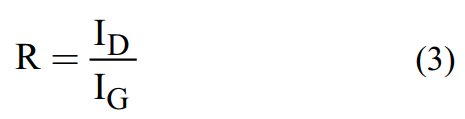
Mediante esta técnica se obtuvo una razón de cristalinidad de 1,14, lo que demuestra que estos nanotubos tienen poca cristalinidad [50, 51].
Una manera de identificar si la muestra es grafeno 2D o NTCPM es mediante la banda G, ya que en esta las estructuras del grafeno pueden observarse como un pico bien definido, pero para nanotubos de carbono se presenta como un multipico [48].
En el espectro infrarrojo de los NTCPM (figura 3(B)), se observó un pico a los 1650 cm-1, esta señal se conoce como banda G, la cual se aprecia mejor mediante espectroscopía RAMAN. La banda G es un pico originado por la vibración longitudinal de los carbonos con hibridación sp2. El pico observado a los 1280 cm-1 es una banda de absorbancia de un fotón inducida por el desorden.
La presencia de regiones desordenadas en los nanotubos implica una posible unión de carbonos con hibridación sp3 que sirven de sitios de nucleación para el hidrógeno. Estos grupos CHx pueden relacionarse con los picos en 2900 y 2830 cm-1 originados por vibraciones longitudinales C-H. De acuerdo con el espectro, la banda a 895 cm-1 se genera por vibraciones de flexión por balanceo entre enlaces C-H de carbonos sp3. Las bandas observadas entre los 2000 y 2400 cm-1 podrían deberse a vibraciones longitudinales de distintos carbonos con hibridación sp formados en las zonas desordenadas [51].
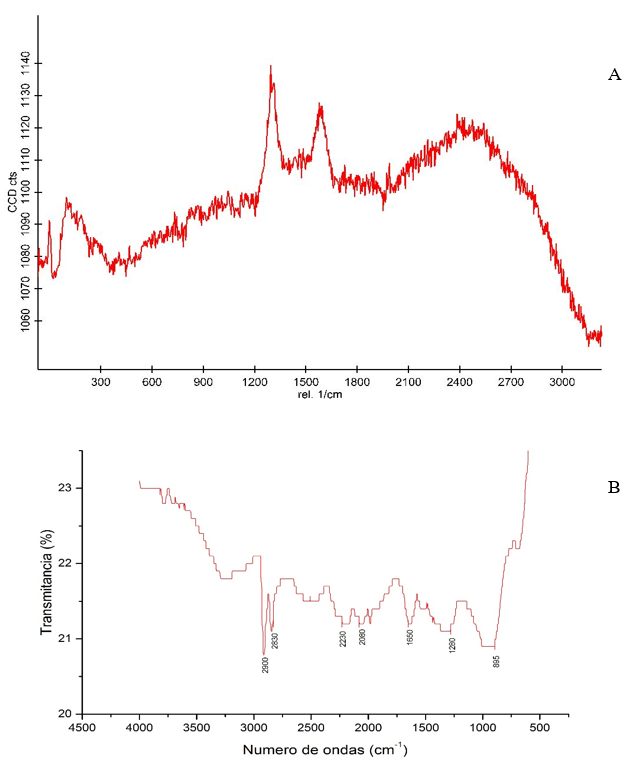
Difracción de rayos X de nanotubos de carbono
En la figura 4 se observa el patrón de difracción de rayos X para los NTCPM. La banda ancha a 26 °2θ puede atribuirse a la reflexión (002) de las estructuras carbonadas de la red hexagonal de los NTCPM, la cual corresponde al espacio interplanar de las paredes del tubo.
La forma en que se detecta este pico se debe a que mientras la muestra rota θ grados y el haz disperso gira 2θ grados con respecto a la luz incidente, el eje simétrico se mantiene normal, así que la difracción de Bragg de las caras paralelas cristalinas a la superficie de la muestra (techo de red) que es normal al eje simétrico puede ser detectado por el colector. Por lo tanto, si las caras a lo largo del eje del tubo están alineadas de forma perpendicular al techo de red del tubo, el rayo incidente se dispersa hacia abajo y no llega al colector, pero si las muestras consisten en bloques de nanotubos desordenados, habrá nanotubos cuyo eje es perpendicular al eje simétrico [53, 54].
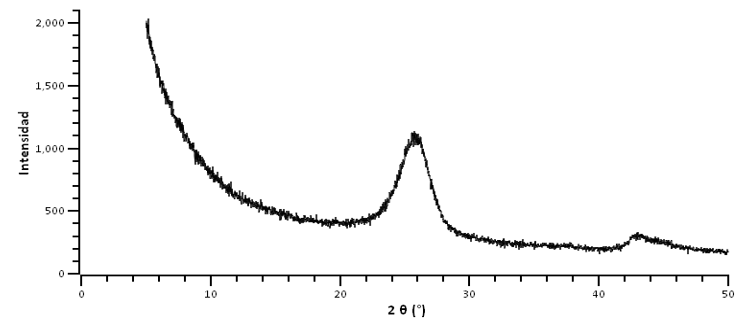
Microscopía de fuerza atómica
En la figura 5 se puede observar una imagen de AFM de la muestra de NTCPM. Debido a la afinidad consigo mismo, se observan algunas aglomeraciones de los NTCPM. Además, se pueden detallar algunas impurezas como carbono amorfo y restos de material catalítico [45]. Las microscopías se utilizaron para realizar el estudio del espesor de los NTCPM. En este estudio se utiliza la distancia de la punta del cantiléver con respecto a la distancia entre la superficie de mica y la superficie de la muestra para determinar la altura de esta. Suponiendo que los NTCPM tienen secciones transversales circulares, se determina con precisión el diámetro del tubo. El promedio de altura observado fue de (13,75 ± 0,75) nm. La medición se realiza con un contacto intermitente entre la punta del cantiléver y la muestra, las fuerzas laterales que actúan sobre los NTCPM son despreciables.
Estudios donde se incorporan NTCPM a matrices de polipropileno han demostrado que los NTCPM con diámetros de alrededor de 10 nm presentan un efecto nucleante mayor que aquellos con tamaños mayores (40 a 60 nm), esto se ha verificado por análisis RAMAN. Los NTCPM presentan un efecto nucleante al aumentar la cinética de cristalización sobre la matriz polimérica de PLA. En estos estudios los cambios se ven reflejados mediante el aumento en la Tg de la mezcla PLA-NTCPM con respecto a la Tg del PLA y la reducción de la Tcc de la mezcla PLA-NTCPM con respecto a la Tcc del PLA que indica que la velocidad de cristalización se acelera con el incremento de contenido NTCPM en la matriz debido a este efecto nucleante [55, 56].
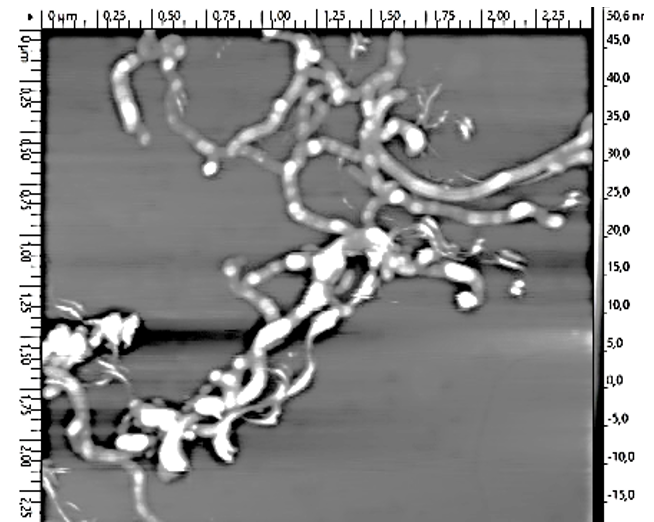
Microscopía de transmisión electrónica (TEM)
En la figura 6 se muestran cuatro micrografías de los nanotubos de carbono obtenidas mediante TEM. Se observa que el largo de los nanotubos es variable, con un valor promedio de 1604 nm en un rango de mediciones de 673 a 2540 nm. En estas mediciones también se pueden observar estructuras que podrían clasificarse como carbono amorfo. En estudios del efecto de relación de aspecto sobre la capacidad de reforzamiento del polipropileno (propiedades de tensión como módulo de elasticidad, esfuerzo, tensión, elongación a la ruptura) se demostró que, sin importar si los tubos son delgados o gruesos, los mejores resultados de refuerzo se obtienen con NTCPM con razones de aspecto superiores a 40. Los NTCPM con valores de relación de aspecto superiores a 300 no presentan diferencias significativas en cuanto a su comportamiento como refuerzo. Estudios usando matrices de PLA demuestran que con relaciones de aspecto bajas se presentan reforzamientos menores a los observados con relaciones de aspecto mayores. La relación de aspecto L/D de los NTCPM en este estudio fue de 117 [55, 57].
Los resultados obtenidos por EDS (tabla 3) indican la presencia de cuatro elementos (C, O, Cu y Na). El carbono se encuentra en mayor proporción y proviene de la estructura de los NTCPM, mientras que la señal del sodio posiblemente se debe a trazas del material catalítico utilizado en la elaboración de los NTCPM. El cobre observado proviene de la malla portamuestras, y el oxígeno de la oxidación del cobre.
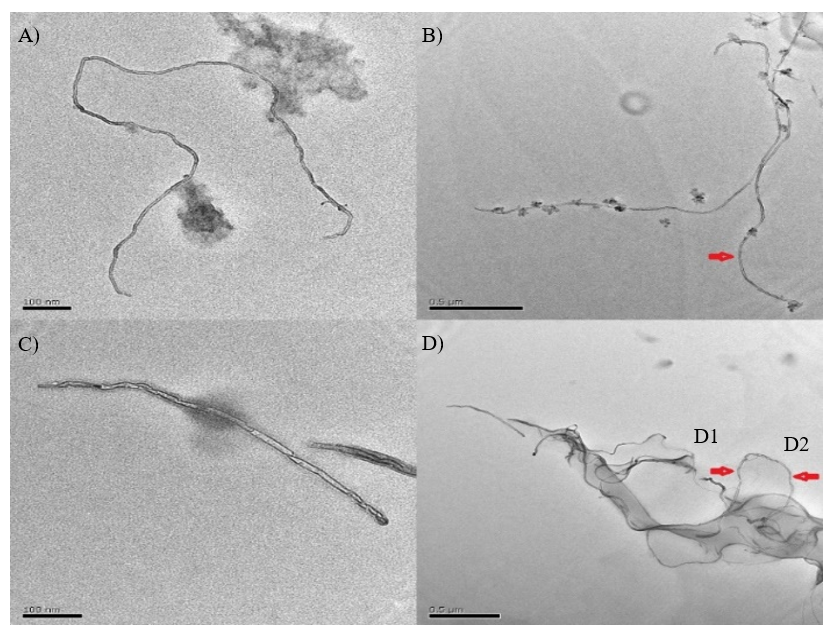
Como se observó por medio del análisis FTIR no hay presencia detectable de grupos alcohol o ácido carboxílico en los nanotubos de carbono. Con este resultado, junto con los resultados obtenidos por espectroscopía infrarroja, se puede determinar que la composición de NTCPM es en su mayoría carbono y no han sido modificados con grupos funcionales [58-60].
Composición porcentual
Espectro (figura 6)
C
O
Na
Cu
A
89,84
9,01
1,01
0,14
B
86,45
12,21
1,07
0,27
C
85,96
12,75
1,08
0,22
D
85,39
13,24
1,09
0,28
En la figura 7 se muestran imágenes de microscopía electrónica de transmisión de alta reolución (HR-TEM). Por medio de estas se pudo determinar que los nanotubos tienen de 16 a 26 paredes, con un promedio de diámetro externo en figura 7a de 23,95 nm y diámetro interno de 9,08 nm; en la figura 7b se presenta un promedio de diámetro externo de 23, nm y diámetro interno de 10,07 nm. En la figura 7b se realizó un estudio de la distancia entre paredes, en los puntos donde hay 16 paredes se obtuvo un total de 0,78 nm y en la zona en la que hay 26 paredes se apreció una distancia de 0,61 nm. También puede observarse cómo las paredes de grafeno internas se puentean periódicamente, lo que indica que poco a poco se va cerrando el tubo hasta que se interconecta la pared más externa. Estas zonas analizadas son rectas, por lo que se descartan irregularidades en la estructura del tubo como zonas con pentágonos, heptágonos u octágonos. Tampoco se observan residuos carbonosos dentro de la estructura, lo que sugiere que la estructura no ha sido rasgada en esta zona [61-63].
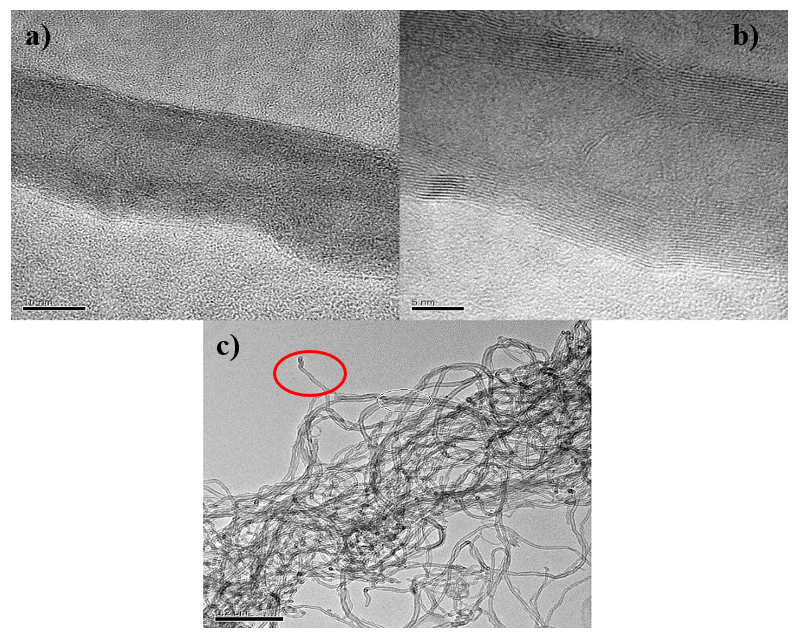
Análisis de las mezclas PLA-PEG
Análisis de flexión
En la tabla 4 se resumen los datos obtenidos para el experimento de flexión de placas compuestas por PLA-PEG. Como se observa, el módulo de flexión es una propiedad que disminuye al aumentar el porcentaje de PEG. El PLA presenta un esfuerzo máximo de 74 MPa, lo que demuestra una deformación plástica limitada; al aumentar el porcentaje de PEG el esfuerzo máximo disminuye y como consecuencia el material presenta una habilidad menor a la deformación con respecto al PLA. La fragilidad de los materiales puede compararse mediante el módulo de flexión, que es un parámetro para definir que tan rígido es un material. El PLA presenta un módulo de flexión de 2685 MPa, lo que significa que presenta alta rigidez. Al aumentar el porcentaje de PEG, el módulo de flexión desciende hasta 1459 MPa en la mezcla al 9,9%. Se reduce el módulo de flexión de esta mezcla, pero se mantiene rígida, ya que el módulo de flexión supera los 700 MPa, que es el límite en que los materiales se clasifican como no rígidos [64, 65]. Los valores de esfuerzo de flexión al 5% muestran cómo al aumentar el porcentaje de PEG, el esfuerzo es menor, por lo tanto, se requiere una menor energía para flexionar el material a un 5% del desplazamiento del punto inicial, este parámetro demuestra cómo el PEG genera una reducción en la rigidez del material.
*RRP: relación respecto al PLA
Mezcla
Módulo de flexión
Esfuerzo máximo
Esfuerzo de flexión al 5% de deformación
MPa
% RRP
MPa
% RRPS
MPa
% RRPS
PLA
2700 ± 200
0
74 ± 3
0
60 ± 30
0
PLA+PEG 2,6%
2300 ± 200
-14
56 ± 7
-24
0
-100
PLA+PEG 5,1%
1800 ± 200
-31
44 ± 4
-41
42 ± 4
-30
PLA+PEG 6,4%
1500 ± 100
-44
35 ± 3
-52
34 ± 3
-44
PLA+PEG 9,9%
1500 ± 200
-46
36 ± 4
-51
21 ± 3
-43
Calorimetría diferencial de barrido de las mezclas
Los resultados obtenidos mediante calorimetría diferencial de barrido de las muestras se señalan en el tabla 5. El PLA muestra una temperatura de transición vítrea (Tg) de 57 °C, una exoterma correspondiente a la temperatura de cristalización en frío (Tcc) a los 117 °C y una endoterma correspondiente a la temperatura de fusión (Tm) a los 149 °C. Se observa que al aumentar la concentración de PEG hay variaciones en la temperatura de transición vítrea y en la temperatura de cristalización. Esto indica una afinidad con la matriz de PLA. El PEG promueve una disminución en la estabilidad térmica del PLA debido a que se intercala en las cadenas poliméricas y rompe la interacción polímero-polímero [64].
Como se puede ver, los datos de fusión (Tm) no se ven afectados con la adición de distintos porcentajes de PEG, por lo tanto, el PEG no altera la cinética entre las partículas que lleva al estado líquido al PLA. El valor de la temperatura de transición vítrea cambia ligeramente en función de la concentración de PEG, su valor disminuye gradualmente al aumentar la concentración de PEG. La disminución de la Tg se debe a que el PEG, al tener un alto grado de miscibilidad con el PLA, permite una mayor movilidad de las cadenas aumentando el volumen libre entre estas [64].
Se observa una disminución en la temperatura de cristalización en frío al aumentar la concentración de PEG. Esto sugiere que, al aumentar la movilidad de las cadenas ubicadas en zonas amorfas, se aumenta también la velocidad de cristalización, esto le permite al polímero cristalizar más fácilmente. No se observan señales relacionadas con la temperatura de cristalización (Tc) durante el enfriamiento del PLA y de las mezclas de este con PEG, por lo tanto, el PLA y sus mezclas con PEG no cristalizan durante el enfriamiento [64, 66]. Al disminuir la temperatura de cristalización, la cantidad de zonas cristalinas debería incrementarse, lo cual se puede apreciar en la tabla 5. También se observa que la cristalinidad tiende a aumentar, de esta forma, el PEG sirve como agente de nucleación para las estructuras cristalinas al dar más libertad de movimiento a las cadenas [64, 67].
Mezcla
Transición vítrea
T de Cristalización en frío
Fusión
% cristalinidad
T (°C)
Q (J/g)
T (°C)
Q (J/g)
T (°C)
Q (J/g)
PLA
57,0
1,27
116,7
21,21
149,4
24,65
3,675
PLA+PEG 2,6%
49,2
1,29
103,5
26,56
152,6
31,26
5,153
PLA+PEG 5,1%
37,0
1,32
90,8
30,03
151,2
35,01
5,605
PLA+PEG 6,4%
36,3
1,05
91,1
37,99
150,8
47,31
10,63
PLA+PEG 9,9%
32,8
0,50
86,2
26,08
150,4
35,42
11,08
Análisis dinámico mecánico (DMA)
En la figura 8 se observa la tendencia de las mezclas con respecto al valor tan δ, que es un valor utilizado para determinar por DMA la temperatura de transición vítrea. La matriz virgen exhibe una Tg de 65,1 °C y al aumentar el valor de PEG en la mezcla se observa cómo esta disminuye de forma drástica (de manera similar a los resultados obtenidos por DSC). Se puede justificar esta tendencia por la libertad de las cadenas al aumentar el volumen libre. El cambio en la Tg muestra que hay un efecto del PEG sobre el PLA que indica cierta miscibilidad entre los componentes. Se observa, además, un ensanchamiento de las bandas y una reducción de la altura del pico de tan δ, que podría estar relacionada con la movilidad de la región amorfa del polímero. Cuando el pico es agudo el polímero suele ser amorfo, esto se debe a que no hay restricción de movimiento de la cadena principal. En el caso de los polímeros semicristalinos, las regiones cristalinas dispersas dificultan la movilidad de la cadena en las regiones amorfas, lo cual se observa por reducción de nitidez y altura del pico del valor tan δ. El grado de cristalización del PLA depende de cuatro factores que son: la fracción de isómero D y L en la matriz, el peso molecular de PLA, el tiempo de enfriamiento luego de ser procesado hasta llegar a la Tg y la presencia o ausencia de agentes nucleantes.
En este estudio se utilizó el mismo PLA por lo que la fracción de isómeros y peso molecular se mantienen como una constante para todas las muestras, además, todas las muestras se trataron de la misma manera por lo que la incorporación de PEG funciona como agente nucleante al reducir la Tg de la matriz, lo que indica que hay una interacción entre estos componentes. En la tabla 6 se observa un resumen de los valores obtenidos mediante esta técnica [68, 69].
En la figura 9 se observa la relación del módulo dinámico de almacenamiento (Eꞌ) en función de la temperatura de las mezclas. Con la incorporación del PEG el módulo dinámico disminuye en algunas de las muestras y, por lo tanto, se reducen las propiedades elásticas del PLA, ya que la muestra pierde su rigidez a temperaturas por encima de la Tg. En este proyecto se desea aumentar el medio de dispersión de los NTCPM utilizando PEG y reducir la rigidez del material para que se requiera menor energía de procesamiento [68].
Mezcla
Transición vítrea (tan δ) (±0,1 °C)
PLA
65,1
PLA+PEG 2,5%
58,7
PLA+PEG 5,0%
53,4
PLA+PEG 7,5%
50,3
PLA+PEG 10,0%
43,5
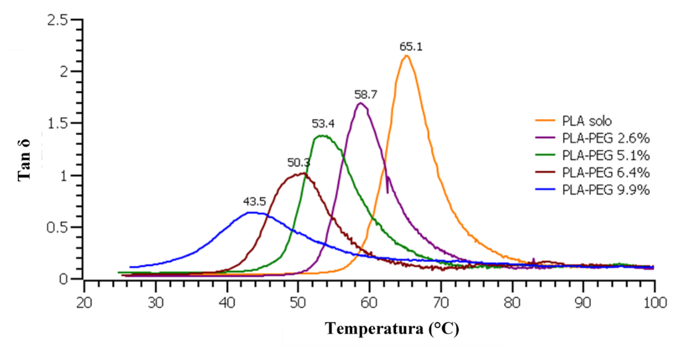
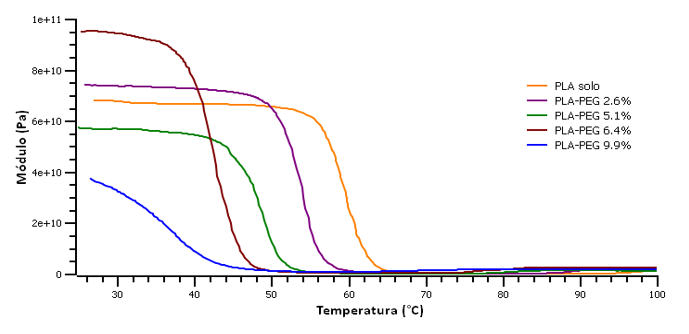
Selección de la mezcla PLA+PEG a utilizar como base para la dispersión de nanotubos de carbono
Como se mencionó, la adición de PEG puede generar la disminución de la rigidez del material final. En la figura 10 se observa la disminución del módulo de flexión, que es un parámetro que está relacionado con la rigidez de un material, con el aumento del contenido de PEG. Un material menos rígido es más fácil de procesar, se ahorra energía y como ninguna mezcla llega a valores de módulo de flexión menores a los 700 MPa (donde ya el material pierde su rigidez), se considera que es más conveniente utilizar el valor de 9,9%.

Análisis de mezclas PLA-PEG-NTCPM
Espectroscopía infrarroja de las mezclas
En el espectro infrarrojo del PLA (figura 11), se detallan bandas a 2945 y 3000 cm-1, correspondiente a la vibración longitudinal en los enlaces C-H presentes en los grupos metilo y en los carbonos terciarios que se encuentran en la estructura del PLA. La banda a los 1748 cm-1 es debida a la vibración longitudinal del grupo carbonilo (C=O) presente en el PLA, además puede observarse que esta banda se encuentra a una longitud de onda mayor a la que presentaría un grupo carbonilo unido a cadenas de hidrocarburos (~1710 cm-1), esto se debe a que el PLA presenta grupos éster donde un oxígeno donador electrónico unido al grupo carbonilo hace el enlace C=O más fuerte y más rígido.
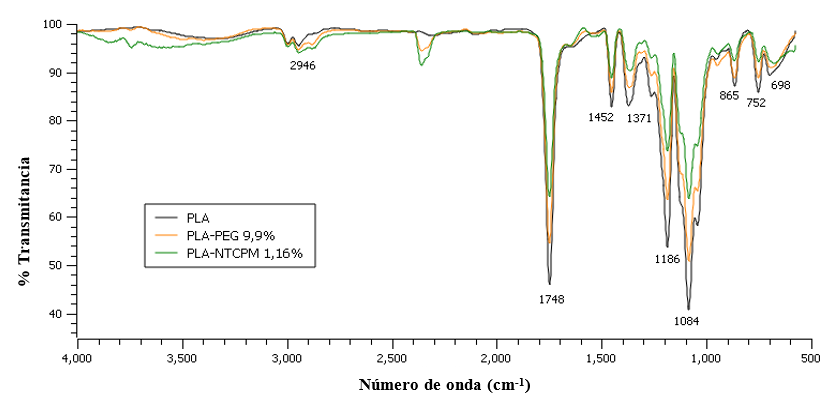
La banda que se observa a los 1452 cm-1 es debida a las vibraciones de flexión entre enlaces C-H. Las bandas presentes a 1084 y 1371 cm-1 son debidas a vibraciones longitudinales de los enlaces C-C y la banda a 1186 cm-1 es una banda característica de todos los ésteres que representa las vibraciones longitudinales de los enlaces C-O. En la zona de huella digital las bandas a 698, 752 y 865 cm-1 se deben a vibraciones de flexión por balanceo de los enlaces C-H [72]. Así mismo, en dicha figura se observa el espectro infrarrojo de una mezcla PLA+PEG 9,9%. En esta se pueden observar algunas bandas iguales a aquellas que presenta el PLA como una banda a 2945 cm-1 producto de las vibraciones longitudinales entre los enlaces C-H, donde hay un aporte de los enlaces C—H presentes en el PEG. A los 1749 cm-1 de igual forma puede observarse la banda por vibración longitudinal del grupo carbonilo presente en éster, la banda presente a 1185 cm-1 es debida a las vibraciones longitudinales en los enlaces C-O presentes en los grupos éster del PLA y grupos éter del PEG. Las demás bandas también se observan en el espectro del PLA y pueden de igual forma atribuirse a este espectro [72].
Finalmente, se observa el espectro infrarrojo de la mezcla al 1,16%. Se ha escogido esta mezcla para representar todas las demás mezclas porque presenta una mayor presencia de nanotubos de carbono. Como se observa la banda a 2942 cm-1 representa las vibraciones longitudinales entre los enlaces C-H presentes tanto en el PLA como en el PEG. Otras bandas, como la banda G a los 1650 cm-1 de los nanotubos de carbono, no pueden apreciarse a frecuencias tan altas, por lo que es más preciso utilizar espectroscopia RAMAN para observar la presencia de nanotubos de carbono en las muestras [72].
Análisis por goniometría
En la tabla 7 se muestra el ángulo de contacto de una gota de agua colocada sobre cada material. Se observa un ángulo de contacto similar en todos los casos. El de PLA presenta un valor 71 ± 2° relacionado con su carácter hidrofóbico. La adición de PEG 9,9% reporta un valor de 71 ± 5°, similar al reportado para el PLA, por lo tanto, el carácter hidrófobo se mantiene y la adición de PEG no representa una alteración superficial significativa. Con la adición de NTCPM se obtiene en todos los casos valores similares de ángulo de contacto. Las energías de humectabilidad no se ven modificadas y no varía significativamente el carácter hidrofóbico del PLA con la presencia del nanomaterial [73].
Tabla 7. Ángulo de contacto de las placas de PLA, PLA–PEG y PLA–PEG–NTCPM con una gota de agua.
Porcentaje de PEG (%)
Porcentaje de NTCPM (%)
Ángulo de contacto
0,00
0,00
71 ± 2
9,92
0,00
71 ± 5
11,90
0,12
55 ± 2
9,62
0,27
69 ± 3
11,78
0,67
66 ± 6
11,93
1,16
69 ± 3
Análisis termogravimétrico
La figura 12 compara el contenido (%) de NTCPM en la mezcla contra la temperatura inicial y al 50% de degradación térmica. Como se observa, el PLA presenta una degradación térmica de 341 °C y está por encima de la temperatura de degradación del resto de muestras. La muestra con PEG presenta una reducción de la temperatura inicial de degradación térmica considerable. El PEG promueve una disminución en la estabilidad térmica debido a que penetra la matriz polimérica, entre las cadenas de polímero, y rompe la interacción polímero-polímero que se predice en la teoría de lubricación y en la teoría de geles de plastificación [64].
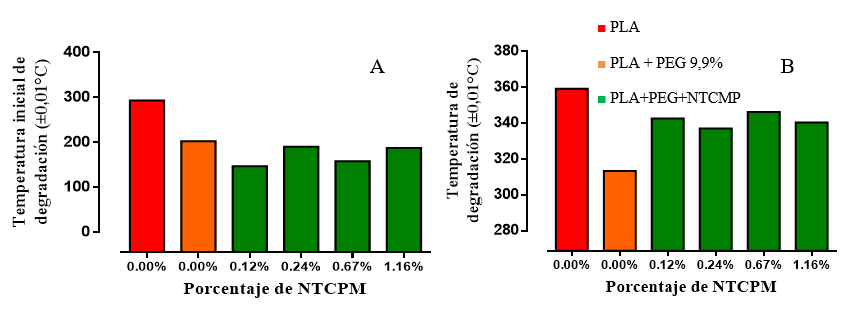
Al comparar ambos materiales con los de las mezclas PLA–PEG–NTCPM, la muestra de solo PLA sigue presentando el mayor valor, seguida por la de PLA-PEG. Todas las muestras con NTCPM presentan menores valores en ese parámetro. La diferencia entre la mezcla PLA–PEG respecto a la mezcla PLA–PEG–NTCPM demuestra que la adición de NTCPM no mejora la estabilidad térmica de la matriz, pues se degradan a temperaturas ligeramente menores, incrementando el efecto del PEG.
En la comparativa al 50% de degradación versus el porcentaje de NTCPM agregados, el valor de la mezcla PLA–PEG disminuye de igual forma con respecto al PLA por el efecto plastificante del PEG sobre la matriz polimérica, sin embargo, al añadir nanotubos de carbono se incrementa considerablemente la temperatura al 50% del total de degradación térmica, probablemente como respuesta a una separación de fases que reduce la compatibilidad de las mezclas, como se indica en la literatura [74].
Calorimetría diferencial de barrido
En la tabla 8 se resumen los valores obtenidos por DSC de las mezclas a una velocidad de análisis de 10 °C/min.
% NTCPM
% de PEG
T. transición vítrea (°C)
T. cristalización en frío (± 0,01 °C)
T. Fusión (± 0,01 °C)
% Cristalinidad
0,00
0,000
61,23
116,95
149,28
5,69
0,00
9,920
31,83
86,24
150,48
5,26
0,12
11,89
29,34
82,83
148,37
0,000
0,24
9,59
31,77
94,16
151,49
2,68
0,67
11,78
26,41
80,44
149,53
5,35
1,16
11,93
27,10
77,57
150,91
23,30
Puede observarse que en cuanto a Tg y Tcc hay variaciones, por lo que se presenta un efecto en la matriz polimérica producido por la presencia de los nanotubos de carbono en ella. La temperatura de transición vítrea desciende significativamente desde la muestra de PLA hasta la mezcla de PLA–PEG 9,9 % por el efecto plastificante del PEG. Al comparar los valores de Tg entre las muestras PLA–PEG 9,9 % y las mezclas PLA–PEG–NTCPM se observa que la mayor diferencia que se presenta es de 5,42 °C y que al aumentar la concentración de NTCPM sus valores descienden, sin embargo, el grado de disminución es insignificante tomando en cuenta el error asociado con este tipo de mediciones [75].
La temperatura de cristalización posee la tendencia de reducirse y es claro que, conforme aumenta la concentración de NTCPM, la temperatura de cristalización se reduce a excepción de la mezcla PLA–PEG–NTCPM 0,24 %, en la cual es posible que la reducción no se haya generado porque se adicionó una menor cantidad de PEG, siendo este el que produce una reducción considerable de la temperatura de cristalización (30,77 °C). Al aumentar la cantidad de nanotubos de carbono en la mezcla se genera una mayor cantidad de sitios de nucleación y, por esto, es que la temperatura de cristalización se reduce, al generar cristales a menores temperaturas [75].
El porcentaje de cristalinidad se espera que aumente, sin embargo, se mantiene en valores cercanos al PLA excepto en la mezcla al 1,16%. Al aumentar la cantidad de NTCPM no se presenta un crecimiento de las zonas cristalinas, en la mezcla al 1,16% sí se presenta un crecimiento significativo de cristales producto de una separación de fases orgánica e inorgánica mayor, por lo tanto, al reducir el volumen libre hace que los NTCPM se aglomeren y no se entremezclen en las zonas amorfas del polímero, lo que le da inestabilidad a la mezcla [19].
Análisis dinámico mecánico
En la figura 13 y en la tabla 9, se presentan los resultados de temperatura de tan δ que nos permiten obtener el valor de la transición vítrea de las mezclas analizadas. Se observa que hay una disminución en los valores de Tg, debido al efecto plastificante causado por el PEG.
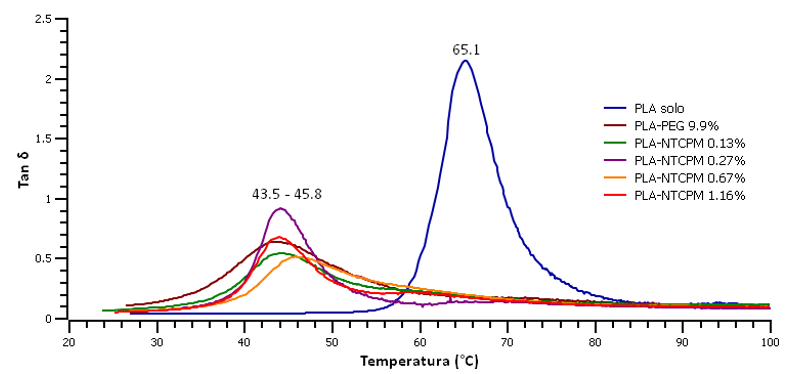
Se observa cómo los valores de tan δ se ensanchan y disminuye la intensidad con respecto a la curva de PLA de todas las mezclas restantes, esto es un indicativo de que los NTCPM no tienen un efecto sobre la transición vítrea, los valores son muy similares al variar la concentración. Por lo tanto, los NTCPM no le dan mayor rigidez a la estructura, los nanotubos no restringen la movilidad de las cadenas de polímero y es mayor el efecto plastificante del PEG, que les da mayor movilidad a las cadenas de la zona amorfa del polímero [74].
En la figura 14 se muestran las gráficas de módulo dinámico de almacenamiento (Eꞌ) al variar la temperatura de las mezclas. Como se ha explicado, el PEG funciona como plastificante y provoca el aumento de propiedades viscosas del PLA. Las mezclas con PEG pierden su rigidez a temperaturas por debajo de la Tg.
Porcentaje de PEG (%)
Porcentaje de NTCPM (%)
Transición vítrea (tan δ) (±0,1 °C)
0,00
0,00
65,1
9,92
0,00
43,5
11,90
0,12
44,0
9,62
0,27
43,9
11,78
0,67
45,8
11,93
1,16
43,7
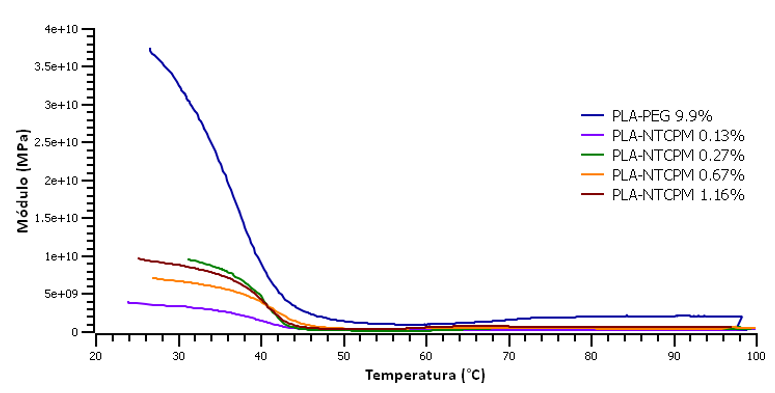
En la mezcla PLA–PEG 9,9% hay una reducción del módulo dinámico, lo que indica que los nanotubos de carbono no le dan rigidez a la estructura amorfa, sino que más bien la hacen más flexible y es posible que haya una incompatibilidad y una separación de fases entre la fase orgánica compuesta por PLA y PEG con alta miscibilidad y otra fase inorgánica compuesta por los NTCPM distribuida por la fase orgánica y ligada a la fase orgánica únicamente por interacciones dipolo-dipolo inducido. Esta incompatibilidad reduce el módulo dinámico del material [76].
Análisis de flexión y tensión
La figura 15 muestra el comportamiento del módulo de flexión y el esfuerzo máximo de flexión al aumentar el porcentaje de NTCPM en las mezclas con 10% de PEG. Se observa inicialmente un decaimiento en el módulo de flexión del material con PEG respecto a la muestra sin PEG. Posteriormente hay un aumento del módulo de flexión para la mezcla al 0,24% de NTCPM, la cual presenta el mayor módulo de flexión. Finalmente, se observa una disminución del módulo de elasticidad. Esto indica que los NTCPM refuerzan al material plastificado con PEG, debido al aumento en el módulo de elasticidad y algunas zonas del polímero han sido inmovilizadas por la presencia de NTCPM. Sin embargo, como la concentración es mayor, se presenta una mayor separación de fases orgánica-inorgánica que enriquece algunas zonas con NTCPM y otras con polímero que evita que se refuercen mayormente algunas zonas de la matriz polimérica, como sí lo logra la mezcla al 0,24% [74, 76-78].

El esfuerzo máximo de flexión muestra una tendencia similar a la presentada en el módulo de flexión como se observa en la figura 16. La disminución desde el PLA hasta la mezcla al 0,12% es indicadora de que se aumenta la deformación plástica limitada que presenta el PLA. Para las mezclas al 0,67 y 1,16% se ha presentado una disminución del esfuerzo máximo, que es posible que se genere por la separación de fases orgánica-inorgánica [76].
En la figura 16 puede observarse la comparación entre el módulo de flexión con respecto a la transición vítrea (DMTA) de las muestras. Como se aprecia, el valor de transición vítrea es de 61,23 °C para el PLA y se reduce a 43,5 °C cuando se le añade 9,9% de PEG.
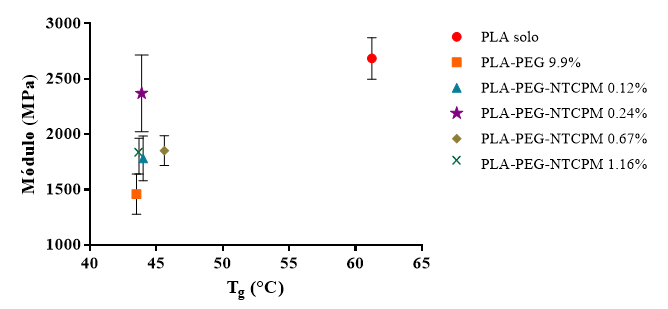
Al añadir NTCPM, la transición vítrea es un valor que se mantiene relativamente constante, ya que este nanomaterial solo inmoviliza ciertas zonas amorfas del polímero, las cuales, al tener menor movilidad, necesitan mayor energía para vencer la temperatura de transición vítrea. La tendencia del módulo de elongación y la deformación de tensión a carga máxima al variar el porcentaje de NTCPM puede observarse en la figura 17.
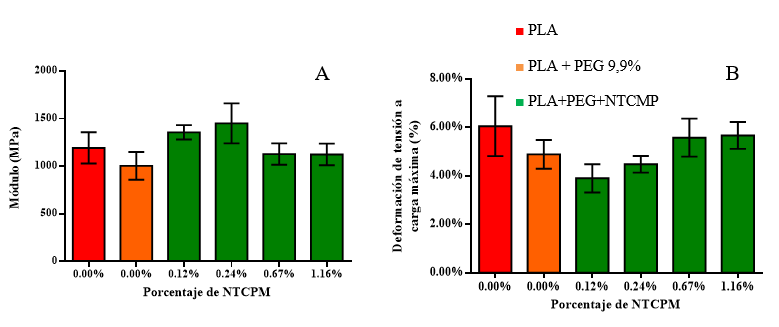
El gráfico puede seccionarse en 3 zonas, la primera cuando al PLA se le añade PEG, la segunda cuando se añade NTCPM hasta el punto de mayor módulo de tensión y la tercera zona es aquella en la que hay presencia de NTCPM, pero el módulo de tensión se va reduciendo. En la primera zona el PLA presenta un módulo de tensión de 1193 MPa y cuando se le añade PEG al 9,9% se reduce a 1003 MPa. Esta tendencia se explica por el efecto plastificante que tiene el PEG sobre el PLA.
En la segunda zona, el módulo de tensión se incrementa, lo que demuestra que, con los NTCPM, se genera un material más rígido. Así mismo, al añadir NTCPM hasta el 0,24%, se alcanza el módulo de tensión más alto, indicando que es el adecuado para aumentar la rigidez del material. En la tercera etapa se puede ver que al agregar NTCPM el módulo de tensión se reduce, lo que demuestra que al añadir una cantidad mayor al 0,24%, los NTCPM se convierten en una carga para el material y ya no lo refuerzan. Se incrementa la separación de las fases orgánica del polímero e inorgánica de los NTCPM, por lo que la confinación de zonas de matriz y zonas de NTCPM no llevan a una buena interacción de ambas fases y el material se hace más flexible.
En la figura 18 se observa la curva de esfuerzo de carga máxima, la deformación a la ruptura y el esfuerzo de ruptura al variar el porcentaje de NTCPM. Para el esfuerzo de carga máxima, el PLA presenta el valor más alto, lo que indica que este material requiere bajo un esfuerzo aplicado, una mayor energía para deformarla.

Al añadir PEG a la mezcla el esfuerzo de carga máximo se ve reducido considerablemente, el PEG 300 es un material líquido y su función es la de hacer flexible a la matriz polimérica, por lo que se requiere menos energía para elongar esta mezcla. Al agregar NTCPM se observa un incremento en el esfuerzo de carga máxima en el caso de las mezclas al 0,12% y 0,24%, donde el incremento ya es considerable. La razón por la que se requiere mayor energía para elongar estos materiales es que los NTCPM se han dispersado bien en la matriz polimérica y, por lo tanto, han reforzado el material, las cadenas de polímero son más rígidas gracias a esta interacción y se requiere mayor energía para elongar estas mezclas. Como se mencionó anteriormente, las mezclas con NTCPM a 0,67 y 1,16% contienen una cantidad de NTCPM que producen una separación de fases y la interacción no es efectiva cuando los materiales se confinan entre sí, evitando una interacción efectiva de las mezclas.
La deformación a la ruptura es una propiedad que puede estar relacionada con la flexibilidad y fragilidad de un material, lo mismo que la variación de esfuerzo de ruptura de las distintas mezclas. Como puede observarse en la figura 18, para ambas propiedades el PLA presenta una mayor deformación a la ruptura que la mezcla PLA─PEG 9,9%. Se requiere un menor esfuerzo para la ruptura de la mezcla PLA-PEG 9,9% con respecto al PLA, la estructura del PLA plastificada se ha modificado, la presencia de PEG como plastificante reduce la rigidez del material, como se observa en los datos de módulo de tensión. El PEG al actuar como plastificante provoca la reducción de los esfuerzos necesarios para elongar, pero también propicia el aumento del grado de deformación, por lo que se habría esperado que, en lugar de bajar el porcentaje de deformación al agregar PEG 9,9%, hubiera subido la deformación.
Cuando se agrega NTCPM, se observa un incremento en el porcentaje de deformación a la ruptura similar entre las mezclas al 0,12 y 0,24%, con una diferencia poco significativa respecto al PLA y la de 0,67%, que se considera la óptima. El incremento en la mezcla al 1,16% es mínimo, no sigue la tendencia y se ve reducida. Finalmente, los resultados obtenidos en los estudios del efecto del refuerzo indican una tendencia al incremento. En las mezclas al agregar NTCPM el esfuerzo aumenta, pero la deformación disminuye, esto ocurre porque los NTCPM actúan como retículos físicos y restringen el movimiento de las cadenas de polímero, por lo que el PLA se hace más fuerte, pero más quebradizo [79].
Difracción de rayos X
En la figura 19 se observa el patrón de difracción de rayos X del PLA. La curva de PLA exhibe una reflexión débil a °2θ = 16,9 correspondiente al plano de lactida (110)/(200) de la forma α de los cristales del PLA. La amorficidad podría ocultar una señal, posiblemente a los 19 °2θ correspondiente al plano de lactida (203) de la forma α de los cristales de PLA [80]. Para las mezclas PLA-PEG 9,9%, se observa que los dos picos ya vistos y anticipados en el espectro del PLA se hacen más fuertes (las reflexiones presentes a 16,6 y a 18,4 °2θ, correspondientes al plano de la lactida (110)/(200) y (203) de la forma α de los cristales de PLA). Las señales también son más agudas e intensas, lo que indica que la presencia de PEG induce a un incremento de los cristales de la forma α. La razón de este incremento es porque el PEG 300 incrementa la movilidad de las cadenas de PLA, que es termodinámicamente beneficioso para el cristal de forma α.
El difractograma de rayos X de la mezcla PLA con PEG 11,90% y NTCPM al 0,12% muestra las reflexiones que se han visto en los anteriores difractogramas. Las señales no presentan mayor intensidad que las observadas en el difractograma de la mezcla PLA-PEG 9,9%, por lo tanto, la adición de NTCPM en esta proporción no induce un incremento de cristales de la forma α, lo cual implica que en esta proporción el responsable del incremento de cristales con respecto al PLA es el favorecimiento termodinámico que ofrece la libertad de movimiento de las cadenas por el PEG y no por sitios de nucleación que ofrecen las nanopartículas de NTCPM a esta concentración.
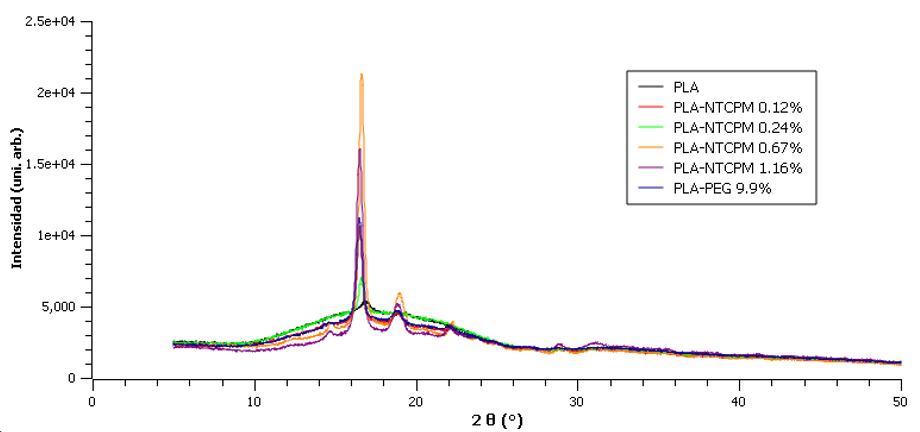
De la mezcla PLA-PEG 9,62% con 0,24% de NTCPM, el difractograma muestra una banda ancha de polímero amorfo, donde surge un pico a 16,6 °2θ correspondiente al plano de la lactida (110)/(200) de la forma α de los cristales de PLA. La señal que se espera alrededor de los 18,5° 2θ posiblemente se encuentra debajo de la señal de material amorfo. A este porcentaje, el incremento de cristales de la forma α no crece en gran medida con respecto al PLA, por lo tanto, la presencia de NTCPM a esta concentración no ofrece puntos de nucleación y su forma rígida disminuye el favorecimiento termodinámico que ofrece la libertad de movimiento de las cadenas por el PEG, por lo tanto, la presencia de cristales de la forma α se ve disminuida con respecto a la mezcla PLA-PEG 9,9%.
Finalmente, en los difractogramas de las mezclas PLA-PEG al 11,78 y 11,93% con NTCPM a 0,67% y 1,16% respectivamente, se observan las reflexiones más agudas e intensas ubicadas en los ángulos 16,5 y 18,8 °2θ con respecto a las demás mezclas. Esto indica que a partir de esta concentración los NTCPM inducen a un incremento de los cristales de la forma α. Esta cristalinidad incrementa debido a que a la concentración utilizada de NTCPM se presentan sitios de nucleación que permiten el crecimiento de una mayor cantidad de estructuras cristalinas y el incremento de la movilidad de las cadenas gracias al favorecimiento termodinámico que brinda el PEG a la matriz ayuda a que se produzca una cristalización mucho mayor [80].
Para el cálculo de la cristalinidad se empleó la Ecuación 2 y el software GraphPad Prism 6 para realizar la integración del área bajo la curva de las señales de los difractogramas [81]. Se observa un incremento en la cristalinidad al agregar PEG al 9,9%, esta se mantiene muy similar cuando se agregan NTCPM al 0,12%, por lo tanto, añadir NTCPM a esta concentración no genera una nucleación considerable en la matriz polimérica. Se observa que al añadir NTCPM al 0,24% se presenta una reducción de la cristalinidad en peso, lo cual podría deberse a que esta configuración lleva el sistema hacia el desorden. La adición de NTCPM a 0,67 y 1,16% genera un incremento considerable en la cristalinidad de la matriz, de forma que a esta concentración los NTCPM funcionan como agentes nucleantes de la estructura de PLA. En la tabla 10 se observan los valores obtenidos de área de fase amorfa y cristalina.
Porcentaje de PEG (%)
Porcentaje de NTCPM (%)
Área cristalina (Ac)
Área amorfa (Aa)
Grado cristalinidad (%wc)
0,00
0,00
359,1
21009,9
1,68
9,92
0,00
3397,0
15913,0
17,59
11,90
0,12
2870,5
17109,5
16,91
9,62
0,24
948,6
21318,4
4,26
11,78
0,67
8979,8
12812,2
41,21
11,93
1,16
7724,4
9812,5
44,05
Espectroscopía Raman
En la figura 20 se presentan los espectros de RAMAN del PLA (a) procesado, se observan bandas entre 2900 y 3500 cm-1, que se asignan a grupos vCH3 y vCH, ambos presentes en la cadena del ácido poliláctico. A 1777 cm-1 se observa una frecuencia vibracional del grupo vC=O. A 1450 cm-1 puede observarse un pico relacionado con frecuencias vibracionales asignadas a los grupos δCH3. A 875 cm-1 puede observarse una banda asignada a las frecuencias vibracionales de grupos vCester-Cα y vC-Cα. Las bandas ubicadas entre 300 y 700 cm-1 se deben a frecuencias vibracionales de los enlaces τC–OE, δO=COE [82]. Con la adicción de PEG 300 al 9,9% se observa la presencia, además de las bandas ya mencionadas en (a), de algunas otras bandas en (b). Las bandas que se pueden observar entre los 1000 y 1300 cm-1 se atribuyen a varias frecuencias vibracionales como v(CO)i, r(CH2) i a 1042 cm-1, v(C-C), ω(CH2) a 1124 cm-1.
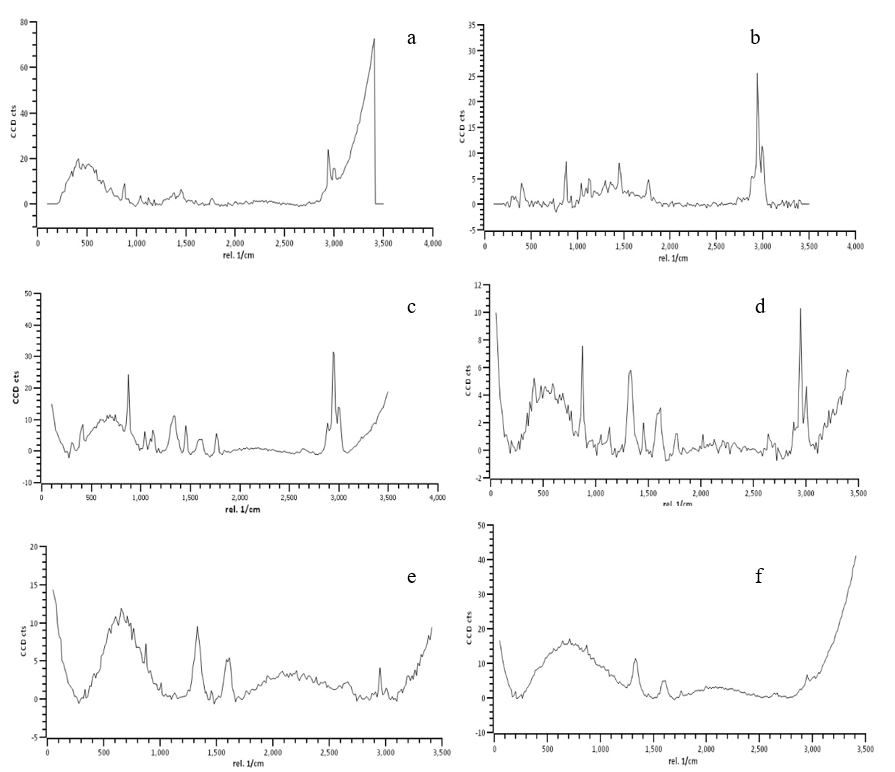
La banda a 880 cm-1 es aportada por dos frecuencias vibracionales, los enlaces vCester-Cα y vC-Cα de la cadena de PLA y los enlaces r(CH2)i y v(CO)i de la estructura de PEG [83]. En los RAMAN (c), (d), (e), (f) de las mezclas PLA-CNT-PEG se observa, además, un pico bien definido, entre 1330 y 1445 cm-1 y otro pico alrededor de 1590 cm-1. Los picos entre 1330 y 1445 cm-1 corresponden a la banda D y los picos ubicados alrededor de los 1590 cm-1 a la banda G.
Microscopía electrónica de barrido (SEM)
En las figuras 21 a 26, se muestran las micrografías SEM de PLA luego de ser fracturado; se observan tanto superficies homogéneas y lisas, así como zonas irregulares con porosidad, y algunas grietas y fracturas. La superficie mostró ductilidad que se evidencia en forma de blanqueamiento por esfuerzo o deformación permanente y en la imagen por SEM se confirma por medio de estas fibrillas estiradas [84].
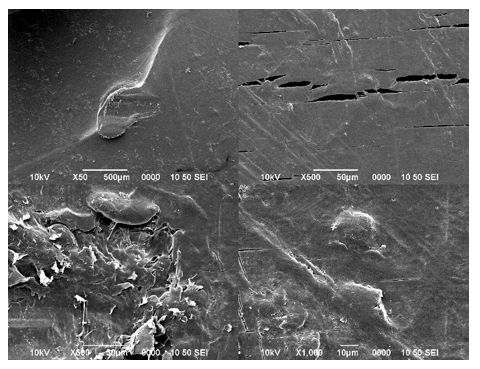
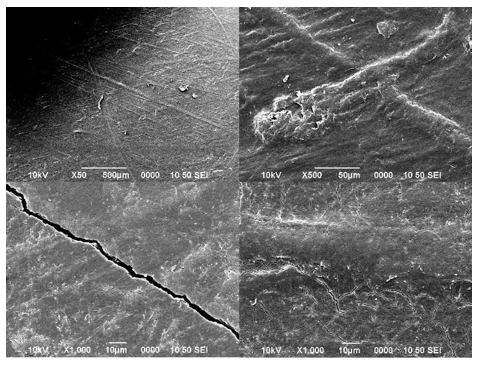
Figura 22. Micrografías SEM de PLA procesado PLA-PEG al 9,9%.
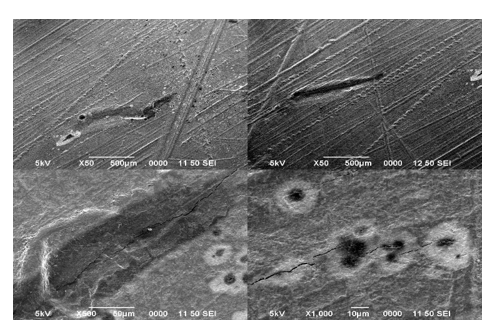
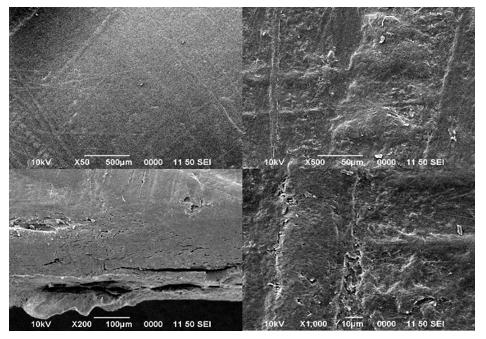
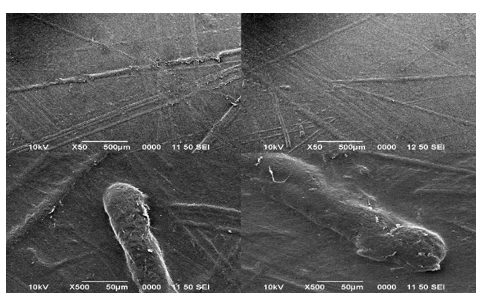
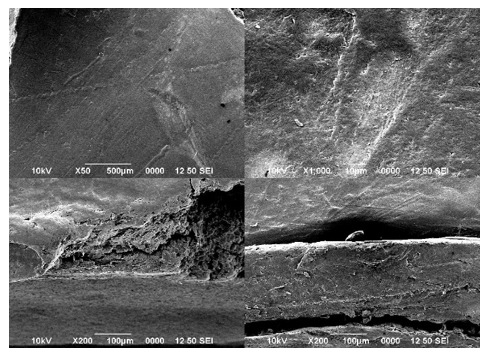
En las micrografías SEM de la mezcla 9,9% pueden observarse estructuras uniformes y homogéneas, y la presencia de fracturas y rupturas en la estructura. Se presenta ductilidad en la muestra evidenciado en el blanqueamiento de la placa y en las fibrillas estiradas. También se observa bifurcación de la grieta, lo cual evidencia que estuvo sometida a un gran esfuerzo producto de los ensayos de elongación [84, 85]. En la mezcla 0,12% se pueden observar puntos negros a lo largo de la matriz, estos pueden ser un efecto visual o zonas expuestas por un mayor tiempo al haz de electrones. Se observa que el material uniforme presenta líneas de orientación hacia una misma dirección. Hay fisuras sin bifurcación, que indican que la estructura presenta fallos en una sola dirección [84, 85, 75]. En las micrografías de las placas al 0,24%, se pueden observar estructuras homogéneas y uniformes, algunas fisuras poseen poca bifurcación y las rupturas se dan en la misma dirección [84-86]. En las placas al 0,67%, no se observan rupturas, es homogénea y presenta algunos relieves producto de aglomeraciones de fibras de PLA [84-86]. Finalmente, en las placas al 1,16%, se observan zonas homogéneas de fibras de polímero, además de una fractura en forma de corte, que se propaga en distintas direcciones, se observa que este corte genera una fractura en la parte superior, no se logra observar bifurcación [84-86].
Conclusiones
De los resultados obtenidos en esta investigación, se determinó que los nanotubos de carbono presentan una temperatura de degradación adecuada para hacer mezclas con la matriz de PLA. Así mismo, se obtuvieron los resultados esperados en su caracterización física, química y morfológica.
Respeto al uso del plastificante PEG, se observó una disminución en los módulos de flexión y tensión, así como en el esfuerzo máximo al aumentar el porcentaje de PEG en el PLA, convirtiéndolo en un material fácil de procesar, útil para el ahorro energético industrial y con mayor deformación plástica para aplicaciones donde el PLA necesita mayor flexibilidad.
Para realizar las mezclas con NTCPM se escogió la mezcla con PEG menos rígida, que permitiría un procesamiento más beneficioso a nivel industrial y que, además, es la que presentó mayor elasticidad.
Los NTCPM permitieron una matriz polimérica más flexible al disminuir el módulo dinámico, el módulo de flexión y de tensión presenta incrementos, por lo tanto, podrían ser útiles en la industria para aumentar la rigidez en aplicaciones de esfuerzo mecánico.
Referencias
Referencias
M. Jamshidian, E. Tehrany, M. Imran, M. Jacquot & S. Desobry, “Poly-Lactic Acid: Production, Applications, Nanocomposites, and Release Studies”, Comprehensive Reviews in Food Science and Food Safety, n.o 9, pp. 552-571, 2010. DOI: https://doi.org/10.1111/j.1541-4337.2010.00126.x
Natureworksllc.com. 2020. Natureworks | About Natureworks. [Online] Available: https://www.natureworksllc.com/About-NatureWorks [Accessed: 8-Aug-2020].
O. Wolf, Techno-economic feasibility of large-scale production of bio-based polymers in Europe. Institute for Prospective Technological Studies, Madrid: European Communities, 2005, pp. 50-64.
J. Lim, S. Kim, S. Lim & Y. Kim, “Improvement of flexural strengths of poly(L-lactic acid) by solid-state extrusión, 2: extrusión through rectangular die”, Macromolecular Materials and Engineering, n.o 288, pp. 50-57, 2003. DOI: https://doi.org/10.1002/mame.200290033
T. Furukawa, H. Sato, R. Murakami, J. Zhang, Y. Duan, I. Noda, S. Ochiai & Y. Ozaki, “Structure, dispersibility, and crystallinity of poly(hydroxybutyrate)/poly(L-lactic acid) blends studied by FT-IR microspectroscopy and differential scanning calorimetry”, Macromolecules, n.o 38, pp. 6445-6454, 2005. DOI: https://doi.org/10.1021/ma0504668
S. Vainionpaa, P. Rokkanen & P. Tormall, “Surgical application of biodegradable polymers in human tissues”, Prog Polym Sci., n.o 14, pp. 679-716, 1989. DOI: https://doi.org/10.1023/B:BILE.0000004398.38799.29
T. Ohkita & S. Lee S., “Thermal degradation and biodegradability of poly(lacticacid)/cornstarch biocomposites”, Journal of Applied Polymer Science, n.o 100, pp. 3009-3017, 2006. DOI: https://doi.org/10.1002/app.23425
D. Williams, “Enzymatic hydrolysis of polylactic acid”, Engineering in Medicine, n.o 10, pp. 5-7, 1981. DOI: https://doi.org/10.1243/EMED_JOUR_1981_010_004_02
Y. Oda, A. Yonetsu, T. Urakami & K. Tonomura, “Degradation of polylactide by commercial proteases”, Journal of Polymers and the Environment, n.o 8, pp. 29-32, 2000. DOI: https://doi.org/10.1023/A:1010120128048
H. Lim, T. Raku & Y. Tokiwa, “Hydrolysis of polyesters by serine proteases”, Biotechnology Letters, n.o 27, pp. 459-64, 2005. DOI: https://doi.org/10.1007/s10529-005-2217-8
K. Masaki, N. Kamini, H. Ikeda & H. Iefuji, “Cutinase-like enzyme from the yeast Cryptococcus sp. strain. S-2 hydrolyses polylactic acid and other biodegradable plastics”, Applied Environmental Microbiology, n.o 7, pp. 7548-7550, 2005. DOI: https://dx.doi.org/10.1128%2FAEM.71.11.7548-7550.2005
P. Jiménez, M. Sibaja & J. Vega-Baudrit, “Síntesis y caracterización de poli (ácido L-láctico) por Policondensación Directa Obtenido del Fermento de Desechos Agroindustriales de Banano (Musa Acuminata Aaa Variedad Cavendish Cultivar Gran Naine) en Costa Rica”, Revista Iberoamericana de Polímeros, n.o 13, pp. 52-59, 2013.
Cdn.intechopen.com, 2020. [Online]. Available: http://cdn.intechopen.com/pdfs-wm/26368.pdf. [Accessed: 08-Aug-2020].
YTC America Inc 2020. [Online]. Available: http://www.ytca.com/biodegradable_plastics_and_composites. [Accessed: 08-Aug-2020].
S. Ramaswamy, “Study of Morphological, Mechanical and Electrical properties of Electrospun Poly(lactic acid) Nanofibers incorporated with Multiwalled Carbon Nanotubes as a Function of Thermal Bonding”, Repository.lib.ncsu.edu, 2020. [Online]. Available: http://repository.lib.ncsu.edu/ir/bitstream/1840.16/656/1/etd.pdf. [Accessed: 08-Aug-2020].
A. Abdal-hay, S. Park, G. Abdel-Jaber & J. Lim, “Biodegradable Poly(Lactic Acid)/Multiwalled Carbon Nanotube Nanocomposites Fabrication Using Casting And Hot Press Techniques”, International Journal of Innovative Research in Science, Engineering and Technology, n.o 2, pp. 7976-7981, 2013. ISSN: 2319-8753.
B. Chieng, N. Ibrahim, W. Yunus & M. Hussein, “Poly(lactic acid)/Poly(ethylene glycol) Polymer Nanocomposites: Effects of Graphene Nanoplatelets”, Polymers, vol. 6, n.o 1, pp. 93-104, 2014. https://doi.org/10.3390/polym6010093
R. Khare & S. Bose, “Carbon Nanotube Based Composites- A Review”, Journal of Minerals & Materials Characterization & Engineering, n.o 4, pp. 31-46, 2005. DOI: http://dx.doi.org/10.4236/jmmce.2005.41004
B. Kumar, M. Castro, J. Feller, “ Poly (lactic acid)-multi-wall carbon nanotube conductive biopolymer nanocomposite vapour sensors”, Sensors and Actuators B: Chemical, n.o 161, pp. 621-628, 2012. DOI: https://www.researchgate.net/deref/http%3A%2F%2Fdx.doi.org%2F10.1016%2Fj.snb.2011.10.077
R. Moradian & A. Fathalian, “Effects of inter wall hopping on the electronic properties of double-wall carbon nanotubes”, Solid State Communications, n.o 149, pp. 491-495, 2009. DOI: https://www.researchgate.net/deref/http%3A%2F%2Fdx.doi.org%2F10.1016%2Fj.ssc.2008.12.028
M. Obarzanek-Fojt, Y. Elbs-Glatz, E. Lizundia, L. Diener, S. Sarasua, A. Bruinink, “From implantation to degradation — are poly (L-lactide)/multiwall carbon nanotube composite materials really cytocompatible?”, Nanomedicine: Nanotechnology, Biology, and Medicine, n.o 10, pp. 1041-1051, 2014. DOI: http://dx.doi.org/10.1016/j.nano.2013.12.012
F. Mai, Y. Habibi, J. Raquez, P. Dubois, J. Feller, T. Peijs & E. Bilotti, “Poly(lactic acid)/carbon nanotube nanocomposites with integrated degradation sensing”, Polymer, n.o 54, pp. 6818-6823, 2013. DOI: http://dx.doi.org/10.1016/j.polymer.2013.10.035
A. Coats & J. Redfern, “Thermogravimetric Analysis: A review”, The Analyst (Royal Society of Chemistry), n.o 88, pp. 906-924, 1963. DOI: http://dx.doi.org/10.1016/j.polymer.2013.10.035
“ASTM E1131 - 20 Standard Test Method for Compositional Analysis by Thermogravimetry”, Astm.org, 2020. [Online]. Available: http://www.astm.org/Standards/E1131.htm. [Accessed: 08-Aug-2020].
T. DeBorde, J. Joiner, M. Leyden & E. Minot, “Identifying Individual Single-Walled and Double-Walled Carbon Nanotubes by Atomic Force Microscopy”, Nanoletters, n.o 8, pp. 3568-3571, 2008. DOI: https://doi.org/10.1021/nl801106p
M. Zdrojekl, W. Gebicki1, C. Jastrzebski1, C. Melin & A. Huczko, “Studies of multiwall carbon nanotubes using Raman spectroscopy and atomic force microscopy”, Solide State Phenomena, n.o 99, pp. 265-269, 2004. DOI: https://doi.org/10.4028/www.scientific.net/SSP.99-100.265
G. Maurin, I. Stepanek, P. Bernier, J. Colomer, J. Nagy & F. Henn, “Segmented and opened multi-walled carbon nanotubes”, Carbon, n.o 39, pp. 1273-1278, 2000. DOI: https://doi.org/10.1016/S0008-6223(00)00250-5
D. Leclere, Fourier Transform Infrared Spectroscopy in the Pulp and Paper Industry, 1st ed. R.A. Myers, 2000, pp. 8361-8388.
L. Bokobza & J. Zhang, “Raman spectroscopic characterization of multiwall carbon nanotubes and of composites”, Express Polymer Letters, n.o 6, pp. 601-608, 2012. DOI: https://10.3144/expresspolymlett.2012.63
G. Maurin, I. Stepanek, P. Bernier, J. Colomer, J. Nagy & F. Henn, “Segmented and opened multi-walled carbon nanotubes”, Carbon, n.o 39, pp. 1273-1278, 2000. DOI: https://www.researchgate.net/deref/http%3A%2F%2Fdx.doi.org%2F10.1016%2FS0008-6223(00)00250-5
“ASTM D790 - 17 Standard Test Methods for Flexural Properties of Unreinforced and Reinforced Plastics and Electrical Insulating Materials”, Astm.org, 2020. [Online]. Available: http://www.astm.org/Standards/D790.htm. [Accessed: 8-Aug-2020].
Z. Antar, J. Feller, H. Noël, P. Glouannec & P. Elleuch, “Thermoelectric behaviour of melt processed carbon nanotube/graphite/poly (lactic acid) conductive biopolymer nanocomposites (CPC)”, Materials Letters, n.o 67, pp. 210-214, 2012. DOI: https://10.1016/j.matlet.2011.09.060
M. Chiu & E. Prenner, “Differential scanning calorimetry: An invaluable tool for a detailed thermodynamic characterization of macromolecules and their interactions”, Journal of Pharmacy and Bioallied Sciences, n.o 3, pp. 39-59, 2011. DOI: https://10.4103/0975-7406.76463
X. Cao, A. Mohamed, S. Gordon, J. Willett & D. Sessa, “DSC study of biodegradable poly (lactic acid) and poly(hydroxy ester ether) blends”, Thermochimica Acta, n.o 406, pp. 115-127, 2003. DOI: https://10.1016/S0040-6031(03)00252-1
B. Stuart, Polymer Analysis, 1st ed. London: John Wiley and sons, 2002, p. 227.
“ASTM D638 - 14 Standard Test Method for Tensile Properties of Plastics”, Astm.org, 2020. [Online]. Available: http://www.astm.org/Standards/D638.htm. [Accessed: 8-Aug-2020].
[Online]. Available: http://scholar.lib.vt.edu/theses/available/etd-71498-94026/unrestricted/etd_Chapt_6.pdf. [Accessed: 08-Aug-2020].
“ASTM D7028 - 07(2015) Standard Test Method for Glass Transition Temperature (DMA Tg) of Polymer Matrix Composites by Dynamic Mechanical Analysis (DMA)”, Astm.org, 2020. [Online]. Available: http://www.astm.org/Standards/D7028.htm. [Accessed: 8-Aug-2020].
U. Kim, C. Furtado, X. Liu, G. Chen & P. Eklund, “Raman and IR Spectroscopy of Chemically Processed Single-Walled Carbon Nanotubes”, Journal of the American Chemical Society, 2005, n.o 127, pp. 15437-15445. DOI: https://doi.org/10.1021/ja052951o
Pubs.acs.org, 2020. [Online]. Available: http://pubs.acs.org/doi/pdf/10.1021/ba-1964-0043.ch001. [Accessed: 8-Aug-2020].
R. Rasal, R. Bradley, G. Bohannon & D. Hirt, “Effect of the Photoreaction Solvent on surface and Bulk Properties of Poly (lactic acid) and Poly(hydroxyalkanoate) Films”, Wiley InterScience, n.o 85, pp. 564-572, 2007. DOI: https://doi.org/10.1002/jbm.b.30980
“Earth & Planetary Sciences | The University of New Mexico”, Epsunm.edu, 2020. [Online]. Available: http://epswww.unm.edu/xrd/xrdbasics.pdf. [Accessed: 08-Aug-2020].
Industrial Materials Institute: http://www.speautomotive.com/SPEA_CD/SPEA2006/PDF/c/c2.pdf [Accesed: 23-Jun-2014].
C. Damian, S. Garea, E. Vasile, H. Iovu, “Covalent and non-covalent functionalized MWCNTs for improved thermo-mechanical properties of epoxy composites”, Composites Part B: Engineering., n.o 43, pp. 3507-3515, 2012. DOI: https://doi.org/10.1016/j.compositesb.2011.11.052
B. Scheibe, E. Borowiak-Palen & R. Kalenczuk, “Oxidation and reduction of multiwalled carbon nanotubes — preparation and characterization”, Materials Caracterization, n.o 61, pp. 185-191, 2010. DOI: https://doi.org/10.1016/j.matchar.2009.11.008
H. Yu, C. Lu, T. Xi1, L. Luo, J. Ning & C. Xiang, “Thermal decomposition of the carbon nanotube/SiO2”, Journal of Thermal Analysis and Calorimetry, n.o 82, pp. 97-101, 2005. DOI: https://doi.org/10.1007/s10973-005-0847-7
A. Mahajan, A. Kingon, A. Kukovecz, A. Konya & P. Vilarinho, “Studies on the thermal decomposition of multiwall carbon nanotubes under different atmospheres”, Materials Letters, n.o 90, pp. 165-168, 2013. DOI: https://doi.org/10.1016/j.matlet.2012.08.120
M. Dresselhaus, A. Jorio, M. Hofmann, G. Dresselhaus & R. Saito, “Perspectives on Carbon Nanotubes and Graphene Raman Spectroscopy”, Nanoletters, n.o 10, pp. 751-758, 2010. DOI: https://doi.org/10.1021/nl904286r
L. Bokobza & J. Zhang, “Raman spectroscopic characterization of multiwall carbon nanotubes and of composites”, eXPRESS Polymer Letters, n.o 6, pp. 601-608, 2012. DOI: https://10.3144/expresspolymlett.2012.63
C. Singh, M. Shaffer, K. Koziol, I. Kinlock & A. Windle, “Towards the production of large-scale aligned carbon nanotubes”, Chemical Physics Letters, n.o 372, pp. 860-865, 2003. DOI: https://doi.org/10.1016/S0009-2614(03)00531-1
P. Tan, S. Zhang, K. Yue, F. Huang, Z. Shi, X. Zhou & Z. Gu, “Comparative Raman Study of Carbon Nanotubes Prepared by D.C. Arc Discharge and Catalytic Methods”, Journal of Raman Spectroscopy, n.o 28, pp. 369-372, 1997. DOI: https://doi.org/10.1002/(SICI)1097-4555(199705)28:5%3C369::AID-JRS107%3E3.0.CO;2-X
N. Kouklin, M. Tzolov, D. Straus, A. Yin & J. Xu, “Infrared absorption properties of carbon nanotubes synthesized by chemical vapor”, Applied Physics Letters, n.o 85, pp. 4463-4465, 2004. DOI: https://doi.org.10.1063/1.1812837
A. Cao, C. Xu, J. Liang, D. Wu & B. Wei, “X-ray diffraction characterization on the alignment degree of carbon nanotubes”, Chemical Physics Letters, n.o 344, pp. 13-17, 2001. DOI: https://doi.org/10.1016/S0009-2614(01)00671-6
B. Dunlap, “Relating carbon tubules”, Physical Review B., n.o 49, pp. 5943-5650, 1994. DOI: https://doi.org/10.1103/PhysRevB.49.5643
I. Dubnikova, E. Kuvardina, V. Krasheninnikov, S. Lomakin, I. Tchmutin & S. Kuznetsov, “The Effect of Multiwalled Carbon Nanotube Dimensions on the Morphology, Mechanical, and Electrical Properties of Melt Mixed Polypropylene-Based Composites”, Journal of Applied Polymer Science, n.o 117, pp. 259-272, 2010. DOI: https://doi.org/10.1002/app.31979
J. Yoon, Y. Jeong, S. Lee & B. Min, “Influences of poly (lactic acid)-grafted carbon nanotube on thermal, mechanical, and electrical properties of poly (lactic acid)”, Polymers Advanced Technologies, n.o 20, pp. 631-638, 2008. DOI: https://doi.org/10.1002/pat.1312
D. Wu, L. Wu, W. Zhou, Y. Sun & M. Zhang, “Relations Between the Aspect Ratio of Carbon Nanotubes and the Formation of Percolation Networks in Biodegradable Polylactide/Carbon Nanotube Composites”, Journal of Polymer Science: Part B: Polymer Physics, n.o 48, pp. 479-489, 2010. DOI: https://doi.org/10.1002/polb.21909
D. Zhou, E. Anoshkina, L. Chow & G. Chai, “Synthesis of carbon nanotubes by electrochemical deposition at room temperature”, Carbon., n.o 44, pp. 1013-1016, 2006. DOI: https://doi.org/10.1016/j.carbon.2005.11.006
A. Osikoya, D. Wankasi, R. Vala, A. Afolabi & E. Dikio, Synthesis, characterization and adsorption studies of fluorine–doped carbon nanotubes”, Digest Journal of Nanomaterials and Biostructures, pp. 1187-1197, 2014. DOI: https://www.researchgate.net/profile/Adeniyi_Osikoya/publication/266201742_Synthesis_Characterization_and_adsorption_studies_of_fluorine-doped_carbon_nanotubes/links/54298f800cf27e39fa8e6263.pdf
S. Rahman, M. Islam & K. Shorowordí, “Electrodeposition and Characterization of Cooper Oxide Thin Films for Solar Cell Applications”, Procedia Engineering, n.o 105, pp. 679-685, 2015. DOI: https://doi.org/10.1016/j.proeng.2015.05.048
M. Gaillard, C. Kübel, C. Boulmer-Leborgne, D. Wang, N. Semmar, A. Petit & E. Millon, “High-resolution transmission electron microscope observations of multiwalled carbon nanotube microstructures grown by plasma enhanced chemical vapor deposition”, Journal of Vacuum Science & Technology B., n.o 31, pp. 031805, 2013. DOI: https://doi.org/10.1116/1.4804543
M. Terrones & H. Terrones, “The carbon nanocosmos: novel materials for the twenty-first century”, Philosophical Transactions of the Royal Society of London A., n.o 361, pp. 2789-2806, 2003. DOI: https://doi.org/10.1098/rsta.2003.1262
P. Ajayan, T. Ebbesen, T. Ichihashi, S. Iijima, K. Tanigaki & H. Hiura, “Opening carbon nanotubes with oxygen and implications for filling”, Letters of Nature, n.o 362, pp. 522-525, 1993. DOI: https://doi.org/10.1038/362522a0
B. Chieng, N. Ibrahim, V. Yunus & M. Hussein, “Plasticized Poly (lactic acid) with Low Molecular Weight Poly (ethylene glycol): Mechanical, Thermal, and Morphology Properties”, Journal of Applied Polymer Science, n.o 130, pp. 4576-4580. 2013. DOI: https://doi.org/10.1002/app.39742
ASTM D883. [Online]. Available: https://www.astm.org/Standards/D883.htm [Accesed: 25-april-16].
D. Battegazzore, S. Bocchini & A. Frache, “Crystallization kinetics of poly (lactic acid)-talc composites”, eXPRESS Polymer Letters., n.o 5, pp. 849-858, 2010. DOI: https://doi.org/10.3144/expresspolymlett.2011.84
K. Sungsanit, N. Kao & S. Bhattacharya, “Properties of Linear Poly (Lactic Acid)/Polyethylene Glycol Blends”, Polymer Engineering and Science, n.o 52, pp. 108-116, 2016. DOI: https://doi.org/10.1002/pen.22052
A. Mohapatra, S. Mohanty & S. Nayak, “Effect of PEG on PLA/PEG Blend and Its Nanocomposites: A Study of Thermo-Mechanical and Morphological Characterization”, Polymer Composites, n.o 35, pp. 283-293. 2014. DOI: https://doi.org/10.1002/pc.22660
X. Liu, M. Dever, N. Fair & R. Benson, “Thermal and Mechanical Properties of Poly (lactic Acid) and Poly(ethylene/butylene Succinate) Blends”, Journal of Environmental Polymer Degradation, n.o 5, pp. 225-235, 1997. DOI: https://doi.org/10.1007/BF02763666
http://www.ptonline.com/articles/tips-and-techniques-boosting-extrusión-productivitypart-iii-of-iii-trim-your-material-energy-costs [Accesed: 30-Jul-2017].
I. Pillin, N. Montrelay & Y. Grohens, “Thermo-mechanical characterization of plasticized PLA: Is the miscibility the only significant factor?”, Polymer, n.o 47, pp. 4676-4682, 2006. DOI: https://doi.org/10.1016/j.polymer.2006.04.013
V. Orozco, W. Brostow, W. Chonkaew & B. López, “Preparation and Characterization of Poly(Lactic Acid)-g-Maleic Anhydride + Starch Blends”, Macromolecular Symposia, n.o 277, pp. 69-80, 2009. https://doi.org/10.1002/masy.200950309
Oliveira, J., Zucolotto, V., Mattoso, L. & Medeiros, E. Multi-Walled Carbon Nanotubes and Poly (lactic acid) Nanocomposite Fibrous Membranes Prepared by Solution Blow Spinning. Journal of Nanoscience and Nanotechnology, n.o 11, pp. 1-9, 2011. DOI: https://doi.org.10.1166/jnn.2012.5730
C. Wu & H. Liao, “Study on the preparation and characterization of biodegradable polylactide/multi-walled carbon nanotubes nanocomposites”, Polymer, n.o 48, pp. 4449-4458, 2007. DOI: https://doi.org/10.1016/j.polymer.2007.06.004
S. Kim, K. Shin, S. Lee, K. Kim, & J. Youn. “Unique Crystallization Behavior of Multi-Walled Carbon Nanotube Filled Poly (lactic acid)”, Fibers and Polymers, n.o 11, pp. 1018-1023, 2010. DOI: https://doi.org/10.1007/s12221-010-1018-4
W. Lin, Y. Shih, C. Lin, C. Lee & Y. Yu, “The preparation of multi-walled carbon nanotube/poly (lactic acid) composites with excellent conductivity”, Journal of the Taiwan Institute of Chemical Engineers, n.o 44, pp. 489-496, 2013. DOI: https://doi.org/10.1016/j.jtice.2012.12.012
S. Bastida, J. Eguiazábal, M. Gaztelumendí & J. Nazábal, “On the Thickness Dependence of the Modulus of Elasticity of Polymers”, Polymer Testing, n.o 17, pp. 139-145, 1998. DOI: https://doi.org/10.1016/S0142-9418(97)00042-1
Rua.ua.es, 2020. [Online]. Available: https://rua.ua.es/dspace/bitstream/10045/3624/1/tema3RUA.pdf. [Accessed: 8-Aug-2020].
S. Yellampalli, Carbon nanotubes. Rijeka: InTech, 2011.
F. Li, S. Zhang, J. Liang & J. Wang, “Effect of polyethylene glycol on the crystallization and impact properties of polylactide-based blends”, Polymers Advanced Technologies, n.o 26, pp. 465-475, 2015. DOI: https://doi.org/10.1002/pat.3475
A. Kern & I. Madsen, Quantifying Amorphous Phases. Dordrecht: Springer, 2012, pp. 219-231.
T. Suzuki, K. Takahashi, H. Uehara & T. Yamanobe, “Application and analysis of a DSC-Raman spectroscopy for indium and poly (lactic acid)”, Journal of Thermal Analysis and Calorimetry, n.o 113, pp. 1543-1549, 2013. DOI: http://dx.doi.org/10.1007%2Fs10973-013-3098-z
J. Koenig & A. Angood, “Raman Spectra of Poly (ethy1ene Glycols) in Solution”, Journal of Polymer Science, n.o 8, pp. 1787-1796, 1970. DOI: https://doi.org/10.1002/pol.1970.160081013
J. A. Jansen, Failure Analysis and Prevention (ASM International), volume 11; Failure Analysis and Prevention: United States, 2002, pp. 437-459.
T. Ono, Fracture Analysis, a Basic Tool to Solve Breakage Issues, Corning, 2002, pp. 1-9.
A. Bhattacharyya, T. Sreekumara, T. Liu, S. Kumar, L. Ericson, R. Hauge & R. Smalley, “Crystallization and orientation studies in polypropylene/single wall carbon nanotube composite”, Polymer, n.o 44, pp. 2373-2377, 2003. DOI: https://doi.org/10.1016/S0032-3861(03)00073-9
Cómo citar
IEEE
ACM
ACS
APA
ABNT
Chicago
Harvard
MLA
Turabian
Vancouver
Descargar cita
CrossRef Cited-by
1. Aide Sáenz Galindo, Alma Rosa Torres-Rodríguez, Francisco José González-González, Adali Olivia Castañeda-Facio. (2024). Materiales conductores eléctricos compuestos de poliestireno reciclado y alótropos amorfos de carbono. Revista Colombiana de Química, , p.3. https://doi.org/10.15446/rev.colomb.quim.v52n3.112674.
2. Ana K. Piñón-Vázquez, Sofía Magdalena Vega Díaz, David Meneses-Rodríguez, Luis A. Alcaraz-Caracheo, Ferdinando Tristan. (2023). Self-standing tridimensional structures from crumpling techniques made with composite films of polylactic acid and exfoliated graphite. Materials & Design, 232, p.112102. https://doi.org/10.1016/j.matdes.2023.112102.
Dimensions
PlumX
Visitas a la página del resumen del artículo
Descargas
Licencia
Derechos de autor 2021 Revista Colombiana de Química

Esta obra está bajo una licencia internacional Creative Commons Atribución 4.0.
Los autores/as conservarán sus derechos de autor y garantizarán a la revista el derecho de primera publicación de su obra, el cuál estará simultáneamente sujeto a la Licencia de reconocimiento de Creative Commons (CC. Atribución 4.0) que permite a terceros compartir la obra siempre que se indique su autor y su primera publicación en esta revista.
Los autores/as podrán adoptar otros acuerdos de licencia no exclusiva de distribución de la versión de la obra publicada (p. ej.: depositarla en un archivo telemático institucional o publicarla en un volumen monográfico) siempre que se indique la publicación inicial en esta revista.
Se permite y recomienda a los autores/as difundir su obra a través de Internet (p. ej.: en archivos telemáticos institucionales o en su página web) antes y durante el proceso de envío, lo cual puede producir intercambios interesantes y aumentar las citas de la obra publicada. (Véase El efecto del acceso abierto).










