Correo Electrónico
 DNINFOA - SIA
 Bibliotecas
 Convocatorias
 Identidad U.N.


Publicado
Evaluation of emeralds by their origin: Multivariate analysis - Infrared spectra
Evaluación de esmeraldas por su origen: análisis multivariado-espectro infrarrojo
Avaliação de esmeraldas por sua origem: Análise multivariada - Espectro infravermelho
DOI:
https://doi.org/10.15446/rev.colomb.quim.v50n3.98674Palabras clave:
Emeralds, geographical origin, principal component analysis, clustering, partial least squares – discriminant analysis (en)Esmeraldas, origem geográfica, análise de componentes principais, agrupamentos, análise discriminante- mínimos quadrados parciais (pt)
esmeraldas, origen geográfico, análisis de componentes principales, agrupamientos, análisis discriminante-mínimos cuadrados parciales (es)
Descargas
Colombian emeralds, 26 from Palo Arañado (eastern emerald zone, Chivor district, Boyacá, Colombia), and 28 from Santo Domingo - La Pava mine (western emerald zone, Muzo district, Boyacá, Colombia), together with 30 from Kafubu - Zambia, were studied by reflectance Fourier transform infrared spectroscopy, principal component analysis, clustering, and partial least squares – discriminant analysis, in order to differentiate them by geographical origin. The spectra were smoothed and a baseline correction was made. The principal component analysis showed that the wavenumbers 2,474; 2,640; 2,686; 2,818; 5,448, and 6,815 cm-1 are the most significant in the first principal component and the most valuable in separating the emeralds by their geographical origin. This allowed us to completely discriminate emeralds from Santo Domingo and Zambia, while only five emeralds from Palo Arañado were 100 % differentiable from the other two groups of emeralds.
Se estudiaron (usando espectroscopia de reflectancia infrarroja con transformada de Fourier, análisis de componentes principales, agrupamientos y análisis discriminante por mínimos cuadrados), 54 esmeraldas colombianas, 26 provenientes de Palo Arañado (zona esmeraldífera oriental, distrito de Chivor, Boyacá, Colombia), y 28 de Santo Domingo (mina La Pava, zona esmeraldífera occidental, distrito de Muzo, Boyacá, Colombia), junto a 30 esmeraldas de Kafubu (Zambia), con el fin de diferenciarlas por su origen geográfico. Los espectros fueron suavizados y se corrigió su línea base. El análisis de componentes principales permitió identificar que los números de onda 2474, 2640, 2686, 2818, 5448 y 6815 cm-1 son los de mayor contribución al primer componente principal y, por tanto, los más relevantes en la separación de los grupos de esmeraldas por su origen geográfico. Lo anterior hizo posible la discriminación completa entre las esmeraldas de Zambia y las de Santo Domingo, mientras que solo 5 muestras de Palo Arañado resultaron 100 % diferenciables de los otros dos grupos de esmeraldas estudiadas.
Um total de 54 esmeraldas colombianas, 26 originarias de Palo Arañado (região esmeraldífera oriental, distrito de Chivor, Boyacá, Colombia) e 28 de Santo Domingo, da mina La Pava (região esmeraldífera ocidental, distrito Muzo, Boyacá, Colombia), junto com 30 esmeraldas da Zâmbia (da região de Kafubu) foram estudadas para obter uma diferenciação por sua origem geográfica, usando espectroscopia de infravermelho por transformada de Fourier, análise de componentes principais, e agrupamento e análise discriminante de mínimos quadrados. Os espetros foram suavizados e a sua linha base foi corregida. A analise de componentes principais, permitiu identificar que os números de onda 2474, 2640, 2686, 2818, 5448 y 6815 cm-1 são os que mais contribuem ao primeiro componente principal e, por tanto, os mais importantes na separação dos grupos de esmeraldas por sua origem geográfica. Isto permitiu a completa discriminação entre as esmeraldas da Zâmbia e as de Santo Domingo, enquanto que apenas cinco amostras de Palo Arañado foram 100% diferenciáveis dos outros dois grupos de esmeraldas estudadas.
Aplicada y Analítica
Evaluation of emeralds by their origin: Multivariate analysis - Infrared spectra
Evaluación de esmeraldas por su origen: análisis multivariado-espectro infrarrojo
Avaliação de esmeraldas por sua origem: Análise multivariada - Espectro infravermelho
Evaluation of emeralds by their origin: Multivariate analysis - Infrared spectra
Revista Colombiana de Química, vol. 50, núm. 3, pp. 24-31, 2021
Universidad Nacional de Colombia
Recepción: 27 Septiembre 2021
Revisado: 17 Enero 2022
Aprobación: 15 Marzo 2022
Abstract: Colombian emeralds, 26 from Palo Arañado (eastern emerald zone, Chivor district, Boyacá, Colombia), and 28 from Santo Domingo - La Pava mine (western emerald zone, Muzo district, Boyacá, Colombia), together with 30 from Kafubu - Zambia, were studied by reflectance Fourier transform infrared spectroscopy, principal component analysis, clustering, and partial least squares – discriminant analysis, in order to differentiate them by geographical origin. The spectra were smoothed and a baseline correction was made. The principal component analysis showed that the wavenumbers 2,474; 2,640; 2,686; 2,818; 5,448, and 6,815 cm-1 are the most significant in the first principal component and the most valuable in separating the emeralds by their geographical origin. This allowed us to completely discriminate emeralds from Santo Domingo and Zambia, while only five emeralds from Palo Arañado were 100 % differentiable from the other two groups of emeralds.
Keywords: Emeralds, geographical origin, principal component analysis, clustering, partial least squares – discriminant analysis.
Resumen: Se estudiaron (usando espectroscopia de reflectancia infrarroja con transformada de Fourier, análisis de componentes principales, agrupamientos y análisis discriminante por mínimos cuadrados), 54 esmeraldas colombianas, 26 provenientes de Palo Arañado (zona esmeraldífera oriental, distrito de Chivor, Boyacá, Colombia), y 28 de Santo Domingo (mina La Pava, zona esmeraldífera occidental, distrito de Muzo, Boyacá, Colombia), junto a 30 esmeraldas de Kafubu (Zambia), con el fin de diferenciarlas por su origen geográfico. Los espectros fueron suavizados y se corrigió su línea base. El análisis de componentes principales permitió identificar que los números de onda 2474, 2640, 2686, 2818, 5448 y 6815 cm-1 son los de mayor contribución al primer componente principal y, por tanto, los más relevantes en la separación de los grupos de esmeraldas por su origen geográfico. Lo anterior hizo posible la discriminación completa entre las esmeraldas de Zambia y las de Santo Domingo, mientras que solo 5 muestras de Palo Arañado resultaron 100 % diferenciables de los otros dos grupos de esmeraldas estudiadas.
Palabras clave: esmeraldas, origen geográfico, análisis de componentes principales, agrupamientos, análisis discriminante-mínimos cuadrados parciales.
Resumo: Um total de 54 esmeraldas colombianas, 26 originarias de Palo Arañado (região esmeraldífera oriental, distrito de Chivor, Boyacá, Colombia) e 28 de Santo Domingo, da mina La Pava (região esmeraldífera ocidental, distrito Muzo, Boyacá, Colombia), junto com 30 esmeraldas da Zâmbia (da região de Kafubu) foram estudadas para obter uma diferenciação por sua origem geográfica, usando espectroscopia de infravermelho por transformada de Fourier, análise de componentes principais, e agrupamento e análise discriminante de mínimos quadrados. Os espetros foram suavizados e a sua linha base foi corregida. A analise de componentes principais, permitiu identificar que os números de onda 2474, 2640, 2686, 2818, 5448 y 6815 cm-1 são os que mais contribuem ao primeiro componente principal e, por tanto, os mais importantes na separação dos grupos de esmeraldas por sua origem geográfica. Isto permitiu a completa discriminação entre as esmeraldas da Zâmbia e as de Santo Domingo, enquanto que apenas cinco amostras de Palo Arañado foram 100% diferenciáveis dos outros dois grupos de esmeraldas estudadas.
Palavras-chave: Esmeraldas, origem geográfica, análise de componentes principais, agrupamentos, análise discriminante- mínimos quadrados parciais.
Introduction
An emerald is the green variety of the mineral beryl, which has the ideal formula Be3Al2Si6O18. Beryl is a cyclosilicate mineral constituted of six-membered rings of silica tetrahedra. The crystal structure of beryl stacks the silica rings one over the other forming channels that run parallel to the crystallographic c-axis of the emerald. The channels (not uniform cavities) with a diameter of approximately 0.51 nm separated by bottlenecks with a diameter of approximately 0.28 nm can be occupied by mineralising fluids that contain alkali ions (such as Na+, Li+, K+, Rb+, and Cs+), H2O and CO2 molecules. The mineralising fluids can be found in fluid inclusions [1–4]. The H2O molecules at the channels are held in two orientations relative to the c-axis. Water-I molecules have the vector connecting the two protons parallel to the c-axis. In contrast, water-II molecules have the previously mentioned vector perpendicular to the c-axis. Water-II molecules are found in beryl crystals containing alkali ions (Li, Na, or K) located at bottlenecks [2, 5, 6].
Colombia, Brazil, and Zambia are the largest producers of emeralds. Colombian deposits produce most of the world’s high-quality emeralds. The monetary value of the emerald can be influenced by clarity, brilliance, colour, and geographical origin [7–9]. The determination of the geographical origin of the emeralds is based on gem characteristics linked to their geological formation. Geological environments imprint physicochemical attributes on emeralds that differentiate them by geographic origin. However, the geographic determination is complicated considering that emeralds can have a similar appearance even if they were formed in different geological environments, e.g., the emeralds from Colombia and those from Zambia are similar despite the different origin: Colombian emeralds come from sedimentary rocks, while Zambian emeralds are formed by the interaction of schist with beryllium-bearing pegmatites [3, 7].
The determination of emerald origin requires the combination of several non-destructive analytical methods. Some of those methods are Fourier-Transform InfraRed spectroscopy (FT-IR), Ultraviolet-Visible spectroscopy (UV-Vis), Near InfraRed spectroscopy (NIR), Raman spectroscopy, inclusion analysis, and energy dispersive X-ray spectroscopy (EDX) [1, 2, 10–16]. FT-IR has been used mainly to differentiate natural from synthetic emeralds [11, 17]. In addition, FT-IR can be used to distinguish emeralds by their geographical origin [13, 14]. The reflectance FT-IR spectrophotometry is particularly well suited for the study of emeralds because it is a fast and cost-effective analysis [18].
On the other hand, chemometric data analysis procedures improve the ability of spectroscopy for sample classification, authentication, and denomination of origin. A standard chemometric method is Principal Component Analysis (PCA) [19]. PCA can be used for revealing relations between variables and between samples (e.g., clustering), detecting outliers, finding and quantifying patterns, and denomination of origin, especially in the fields of food [19–21], cultural heritage [23], and geology [24]. Several chemometric approaches have been reported for determining the geographical origin of natural emeralds through non-destructive chemical fingerprinting [16, 23, 24]. Reference [24] presents the PCA of major, minor, and trace elements of worldwide emerald samples measured by Electron Microprobe Analysis (EMPA) and Secondary Ion Mass Spectrometry (SIMS). In reference [25], the authors present a case study focused on the major, minor, and trace element analysis of emeralds using laser ablation inductively coupled plasma time-of-flight mass spectrometry (LA-ICP-TOF-MS) and chemometric analysis, including PCA. These mentioned references show that PCA helps in the discrimination of emeralds from various sources. However, those references used expensive and specialised instrumentation, which is not easy to access. In this work, we take the same approach as the mentioned references but using reflectance FT-IR spectroscopy, a cheaper and more accessible technique. Three emerald groups with different geographic origins were studied. Two groups are Colombian emeralds, and the third group is Zambian emeralds, Figure 1. We analysed the FT-IR spectra of the mentioned geographical groups of emeralds using PCA, clustering, and PLS-DA, which readily discriminate the geographical origin of the set of emeralds studied.
The geographic origin of the emerald is a significant value factor in the gem trade. Therefore, reliable provenance determination on such gemstones is requested by the trade and is offered as a service by specialised gemological laboratories. This study is intended to demonstrate how PCA in regards to reflectance FT-IR spectra can separate three emerald groups according to their geographical origin. As mentioned before, two groups come from Colombia, one from the eastern emerald zone, Chivor district, and the other from the western emerald zone, Muzo district. The third group comes from Kafubu - Zambia (Figure 1). Also, it is important to note that the PCA results were verified, supported, and extended using clustering and Partial Least Squares – Discriminant Analysis (PLS-DA).

Figure 1
Map of the studied emerald zones. Santo Domingo (La Pava mine) is located in the western Emerald Zone and Palo Arañado in the Eastern Emerald Zone of Colombia. The third group is the emeralds from Kafubu – Zambia.
Material and Methods
Samples
The total number of emeralds studied was 84: 26 from Palo Arañado, a deposit located in the Colombian eastern emerald zone (4°53’ 42” N, 73°20’ 51” W) with a light green colour (PA); 28 from La Pava mine - Santo Domingo tunnel in the Colombian western emerald zone (5°32’ 52” N, 74°09’ 49” W) with a light green to green colour (SD); and 30 from Kafubu – Zambia (13°05’ 32” S, 28°08’ 22” E) with a dark green colour (Z). The analysed emeralds belong to the Centro de Desarrollo Tecnológico de la Esmeralda Colombiana CDTEC. The Colombian samples were collected according to their stratigraphic position, hydrothermal alteration degree, and emerald occurrences. Whereas the Kafubu - Zambian emeralds were collected according to their occurrences. The samples obtained are type A (mined by a field trip team) [26]. All samples were cleaned with ethyl alcohol before collecting the spectra. Three representative samples are shown in Figure 2.

Figure 2
Representative emerald samples. From left to right: PA19 (Palo Arañado, sample 19), SD18 (Santo Domingo tunnel, sample 18), and Z116 (Kafubu – Zambia, sample 116).
Characterisation of emeralds by their Reflectance Infrared spectrum
The FT-IR analysis was performed using a Scientific Nicolet 6700 spectrometer (Thermo Fischer Scientific, Waltham, MA, USA) with the diffuse reflectance accessory. The spectra were acquired from 7,501 to 399.2 cm-1 with 4 cm-1 resolution and 32 scans per emerald. All diffuse reflectance spectral data were collected in triplicate and were perpendicular to the c-axis. The mean of the triplicate spectra for each emerald was used for the PCA, the clustering, and the PLS-DA.
Statistical Analysis
The reflectance FT-IR spectra were processed and analysed using R and RStudio software [27, 28]. The first step in processing the spectra was smoothing, using the Savitzky-Golay method from the Pracma package [29]. Then, a baseline correction was performed using the polylinear fit function from the Baseline package [30]. The PCA function was used from the FactoMineR package [31]. Data visualisation was carried out using the Factoextra [32] and the mdatools [33] packages. Clustering was made using the FactoMineR package after PCA, and PLS-DA was carried out using the mdatools package.
Results and discussion
Main features of the emeralds' reflectance FT-IR spectra
Typical reflectance FT-IR spectra from the 84 emeralds after pretreatment (smoothing and baseline correction) are shown in Figure 3 (region from 2,271 to 4,000 cm-1) and Figure 4 (region from 4,000 to 7,249 cm-1).
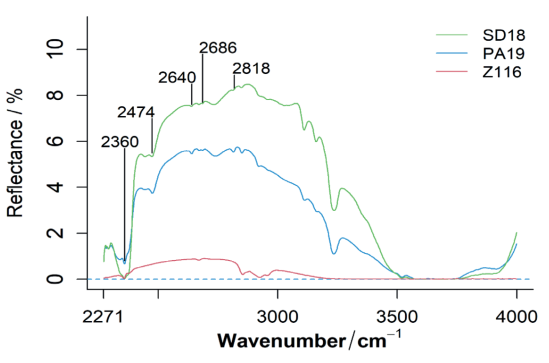
Figure 3
Typical reflectance FT-IR spectra of the emeralds studied in this work. The region from 2000 to 4000 cm-1 with the characteristic peaks found in the Colombian compared to the Zambian emeralds. From bottom to top: Kafubu - Zambia, Palo Arañado (Colombia, eastern emerald zone, Chivor district), and Santo Domingo tunnel – La Pava Mine (Colombia, western emerald zone, Muzo district).
The pretreated data were used for PCA, and only the region between 2,271 to 7,249 cm-1 was considered, eliminating zones with poor signal and too much noise. The spectra in Figure 3 and Figure 4 have noticeable differences. First, the reflectance intensity of the Colombian emeralds' spectra is higher than that of the Zambian emeralds, probably because the Colombian samples were thinner than the Zambian ones. Second, some bands are only present in the Colombian emeralds' spectra, or they are more evident than those in emeralds from Zambia.

Figure 4
Reflectance FT-IR spectra with the characteristic peaks found in the Colombian emeralds compared to the Zambian emeralds. The region is from 4,000 to 7,249 cm-1. From bottom to top: Kafubu - Zambia, Palo Arañado (Colombia, eastern emerald zone, Chivor district), and Santo Domingo tunnel – La Pava Mine (Colombia, western emerald zone, Muzo district).
The region from 2,000 to 4,000 cm-1
Some of the most relevant absorptions of the emeralds’ FT-IR spectra are related to the stretching vibrations of the water in the silica ring channels and the vibrations of other molecules such as CO2. Additionally, the latter vibrations are also influenced by cations in those channels. In the 2,000 to 4,000 cm-1 range (Figure 3), Colombian emeralds show a reflectance peak centred at 2,360 cm-1. In the literature, the peak at 2,359 cm-1 is linked to the CO2 vibration [1, 4]. The subtle signal at 2,818 cm-1 is attributed to HCl [34]. The zone around 3,500 cm-1 has been linked to the stretching of water molecules [35]. However, in the present study, all the samples have a reflectance close to zero in this zone, hindering any possible peak observation in this region; see figure 3 around 3,500 to 4,000 cm–1. Nonetheless, at least one report [36] mentioned weak bands in this zone.
The region from 4,000 to 7,249 cm-1
In the 4,000 to 7,249 cm-1 range (Figure 4), the emeralds from Colombia show a strong, thin peak around 5,272 cm-1 associated with type II water [1, 34], and a wide medium peak at 5,448 associated with type I water [1, 36]. The Zambian emeralds show the 5,272 cm-1 peak. However, it is wider than that of the Colombian emeralds, and the medium peak around 5,448 is absent. Zambian emeralds have the 5,272 cm-1 signal as a wide medium peak which is more related to type II water. Moreover, the Colombian emeralds have a clear peak at 6,815 cm-1 attributed to type I water, which is at most only insinuated in the Zambian emeralds. The literature reports the 6,820 cm-1 band for type I water and the 6,849 cm-1 band for type II water [1, 36]. The intensity of these two bands has been associated with the alkalinity of the environment where the emerald grew. Usually, the intensity of the band at 6,820 cm-1 is higher, while the intensity of the band at 6,849 cm-1 is lower for type I water (emeralds with low alkalinity). The literature confirms that the emeralds from Colombian tend to present higher peaks related to type I water, while Zambian emeralds present higher peaks related to type II water [14, 35].
Analysis using the PCA of each of the three groups of emeralds
After pretreatments, PCA was applied to each of the three groups of emeralds separately to detect outliers and extreme individuals.
Palo Arañado emeralds, Colombian eastern emerald zone, Chivor district
Figure 5 shows the PCA results for the samples from Palo Arañado. Figure 5A is the score plot of the first two principal components (PCs), where each reflectance FT-IR spectrum is represented as a point. Notice that most samples are grouped except for emerald PA41. Figure 5B shows the orthogonal distances where sample PA41 is once again apart from the other samples. According to Figure 5, sample PA41 is an outlier, which is reasonable because PA41 has higher reflectance than the other samples; this emerald differs from others due to its unique cylindrical and thin shape. Based on these facts, PA41 was eliminated from subsequent studies. Also, emerald PA12, although it is just an extreme individual, was removed to have a better classification.
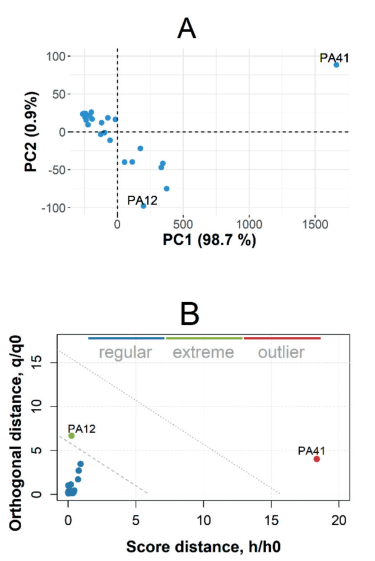
Figure 5
PCA results for the samples from Palo Arañado (Colombia, eastern emerald zone, Chivor district). A Score plot of PC2 vs. PC1 of the PCA model and B Orthogonal distance plot with critical limits
Santo Domingo tunnel - La Pava mine emeralds, Colombian western emerald zone, Muzo district
Figure 6A shows the first score plane of the PCA results for the Santo Domingo samples. In this case, there are four extreme samples: SD 02, 39, 47, and 49, see Figure 6B. These samples were also excluded to obtain a more precise classification. The SD emeralds have no outliers.
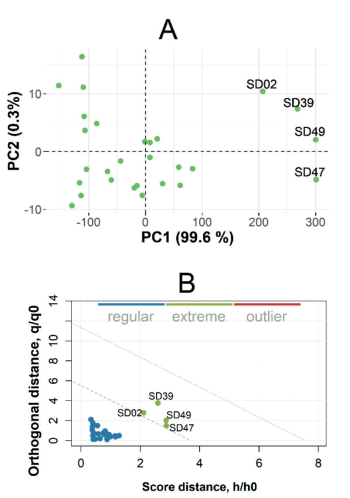
Figure 6
PCA results for the emeralds from Santo Domingo tunnel - La Pava Mine (Colombia, western emerald zone, Muzo district). A Score plot of PC2 vs. PC1 of the PCA model and B Distance plots with critical limits.
Kafubu - Zambia emeralds
Figure 7 shows the PCA results for the Zambian samples where one extreme, Z105, and one outlier, Z103, were identified. Figure 7A shows the first plane of the individuals (score plot PC2 vs. PC1), where Z103 and Z105 are far from the others. This fact is confirmed in Figure 7B, where Z105 is in the zone of extreme observations, and Z103 is in the outlier zone. Thereupon, we decided to exclude both samples, Z103 and Z105, from the following analysis.
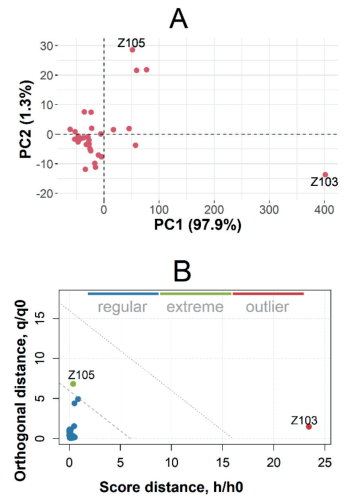
Figure 7
PCA results for the Kafubu - Zambian emeralds. A Score plot of PC2 vs. PC1 of the PCA model and B Distance plots with critical limits.
The PCA of the whole set of emeralds, after removing the outlier and the extreme samples
Once the outlier and extreme samples were eliminated, a PCA was made using the new set of 76 emeralds: 24 from PA, 24 from SD, and 28 from Z. Figure 8A shows the first plane of the PCA, where PC1 and PC2 explain 98.9 % and 0.5 % of the total variance, respectively.

Figure 8
The principal component analysis of the emeralds reflectance FT-IR spectra.
A. The first plane of individuals for 76 emeralds. The outliers and extreme samples were excluded. Palo Arañado (blue squares) PA, Santo Domingo tunnel – La Pava mine (green circles) SD, and Zambia (red triangles) Z. B and C are biplots for the 52 emeralds after removing PA emeralds, outliers, and extreme samples. SD emeralds are represented with green circles, Z emeralds with red triangles, and wavenumbers with vectors. In B, the wavenumbers 2,474; 2,640; and 2,686 cm-1 correspond to deuterated water and 2,360 cm-1 to CO2. In C, 5,448 cm-1 corresponds to chloride and 6,815 cm-1 to type I water.
In Figure 8A, the SD emeralds are together towards the bottom right zone of the plane, while the Z emeralds are grouped towards the left upper side. On the contrary, the PA emeralds are scattered over the plane, and only a few samples seem close to each other. This behaviour is due to the dispersion in the intensities of the reflectance signals in the reflectance FT-IR spectra of the PA samples, while the SD emeralds always have significant intensity signals, and the Z samples always have comparatively lower intensities. Consequently, the PA samples are sometimes close in reflectance intensity to the SD emeralds and sometimes are close to the Z samples or neither. Following a detailed analysis of the latter, the emeralds shapes, the reflectance FT-IR spectra, and the PCA results, we have concluded that the size and form of the emerald is a critical factor in generating the mentioned dispersion in the reflectance FT-IR spectra of the PA emeralds, and it must be considered more rigorously in future works.
The PCA of the selected set of SD and Z emeralds
The PCA results for the Santo Domingo and Zambia samples show a clear separation between them.
Figures 8B and 8C, show biplot graphs where emeralds are represented with circles (SD) and triangles (Z) and wavenumbers with vectors. The PC1 and PC2 explain 99.3 % and 0.4 % of the total variance, respectively. Then, the first plane of the individuals is a good description of the samples’ behaviour and a valuable tool to differentiate SD emeralds from Z emeralds.
In the biplots, the vectors represent the wavenumbers of the most representative peaks of the emeralds reflectance FT-IR spectra. The vector magnitude projected over the abscissas positively correlates with the contribution of those wavenumbers to PC1, which explains 99.3% of the total variance of the spectra. Therefore, the wavenumbers with the most significant contribution to this PC1 will be the most valuable criteria for separating the groups of emeralds by their geographical origin.
In consequence, and according to the previous discussion, we have found two groups of wavelengths that are the most relevant in the emeralds’ reflectance FT-IR spectra:
- 1. The peaks centered at 2,474; 2640; and 2,686 cm-1 in the studied emeralds (see Figure 3). These FT-IR spectra peaks are related to deuterated water vibrations [35]. Figure 8B shows the biplot where it is clear that the mentioned wavenumbers have a significant correlation to the PC1 (0.969, 0.985, and 0.984, respectively), and they are represented by the magnitude and direction of the vectors, which means that those wavenumbers are helpful when differentiating the two groups of emeralds. On the other hand, in the same figure 8B, the reported peak of CO2 vibration in emeralds [4], and here centred at 2,360 cm-1 for the studied emeralds, has its orientation towards the PC2 and lower magnitude with respect to the other wavenumbers in the first plane of the individuals (the correlation to PC1 is just -0.284 and to PC2 is 0.826). The interpretation can be that the 2,360 cm-1 peak is more related to the Z emeralds because it points upwards in the same direction where some of the Zambian emeralds are located. The general effect of the two groups of wavenumbers mentioned (related to deuterated water and CO2) is that the Zambian emeralds (Z) are upside towards the left, and the Colombian Santo Domingo tunnel – La Pava mine emeralds (SD) are towards the right and downside of the first individual plane. It is important to mention that the low value of the explained variance of PC2 (only 0.4 %) draws into question the conclusions regarding PC2; however, Figure 8B helps to support these conclusions.
- 2. The peaks at wavelengths of 2,818 cm-1; 5,448 and 6,815 cm-1. The 2,818 cm-1 peak is attributed to chloride vibrations [34], and the 5,448 and 6,815 cm-1 peaks are related to type I water [1, 36]. These wavenumbers have a considerable correlation to PC1 (0.989, 0.997, and 0.998, respectively), which means that those FT-IR peaks are helpful to differentiate SD from Z emeralds, Figure 8B y 8C.
The previous results were extended and confirmed using clustering and PLS-DA. In this case, the PA samples were not excluded. The clustering made to the PCA is shown in Figure 9. The most important result of the clustering is the clear discrimination between the Z and SD emeralds using only the reflectance FT-IR spectra. This can be clearly seen in Figure 9, where there are three clusters. The first cluster contains all the samples from Zambia and 11 samples from PA; the second cluster contains all the SD samples and eight emeralds from PA, and the third one contains five samples all from PA.
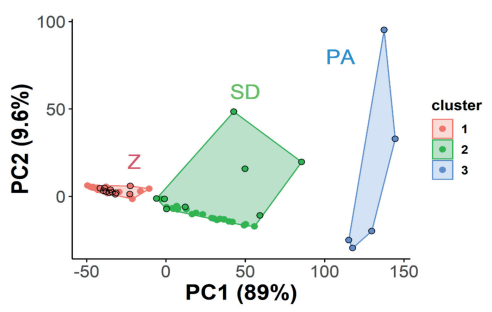
Figure 9
The studied emeralds clustering from the first plane of the PCA.
The algorithm discriminates three clusters: one with all Z emeralds and 11 from PA, a second with all the SD emeralds and eight from PA, and a third with only PA emeralds. The circles with a black border are the emeralds from PA. Observe that some of those black border circles (PA emeralds) are in the SD or Z clusters.
On the other hand, the PLS-DA results are consistent with the studies made by PCA (Figure 8A) and clustering (Figure 9). Hence, the multivariate tools used in this work have proven powerful in identifying the geographical origin of emeralds. In this sense, we differentiated Colombian (SD) from Zambian emeralds. However, the Colombian PA emeralds were not clearly separated from the other samples. Thus, the database of emeralds must be increased and depurated to obtain a reliable and well-established set of emeralds classified by geographical origin. Furthermore, the FT-IR spectra must be complemented with UV-Vis spectra, Raman [35, 37, 38], and other available measurements to improve the multivariate analysis prediction capabilities and help with the correct identification of PA samples, which showed high dispersion in this work.
Conclusions
The reflectance FT-IR spectra of emeralds following pretreatment and analysis with PCA, clustering, and PLS-DA allowed the identification of vibrational bands associated with their chemical composition. In this study, the previously reported characteristic bands of emeralds centred at 2,474; 2,640; and 2,686 cm-1 and related to deuterated water vibrations, 2,818 cm-1 attributed to chloride vibrations and 5,448 and 6,815 cm-1 which corresponded to type I water vibrations showed 100% efficiency in distinguishing the emeralds from Santo Domingo tunnel - La Pava Mine Colombian western zone (Muzo district) from the Kafubu - Zambian emeralds. Regarding the Colombian PA emeralds (Chivor district), although it was not possible to differentiate all the samples from those from SD and Z, PA has a subset of individuals clearly different from the others, which means that more studies must be undertaken to resolve this issue.
Acknowledgments
The authors would like to acknowledge the unconditional support given by the expert work staff from the Technological Development Centre for the Colombian Emerald (CDTEC), the gemologists Andrea Morales and Holman Alvarado, the geologist Valeria Ramirez and especially the CEO Gabriel Angarita.
References
[1] D. L. Wood and K. Nassau, “Infrared spectra of foreign molecules in beryl,” J. Chem. Phys., vol. 47, no. 7, pp. 2220–2228, 1967, doi: 10.1063/1.1703295.
[2] D. L. Wood and K. Nassau, “The characterization of beryl and emerald by visible and infrared absorption spectroscopy,” Am. Mineral., vol. 53, no. 5/6, pp. 777–800, 1968.
[3] G. Giuliani, Y. Branquet, A. Fallick, L. Groat, and D. Marshall, “Emerald deposits around the world, their similarities and their differences,” InColor, vol. Special Is, pp. 56–69, Jan. 2015.
[4] B. Charoy, P. De Donato, O. Barres, and C. Pinto-Coelho, “Channel occupancy in an alkali-poor beryl from Serra Branca (Goias, Brazil): Spectroscopic characterization,” Am. Mineral., vol. 81, no. 3–4, pp. 395–403, 1996, doi: 10.2138/am-1996-3-414.
[5] B. Kolesov, “Vibrational states of H2O in beryl: Physical aspects,” Phys. Chem. Miner., vol. 35, no. 5, pp. 271–278, Jun. 2008, doi: 10.1007/s00269-008-0220-z.
[6] E. S. Zhukova et al., “Vibrational states of a water molecule in a nano-cavity of beryl crystal lattice,” J. Chem. Phys., vol. 140, no. 22, Jun. 2014, doi: 10.1063/1.4882062.
[7] Gemological Institute of America, “Emerald Quality Factors.” https://www.gia.edu/emerald-quality-factor (accessed Aug. 22, 2021).
[8] G. Reinoso, “¿Cuál es el origen de la esmeralda colombiana?,” Portafolio, 2018. https://www.portafolio.co/economia/cual-es-el-origen-de-la-esmeralda-colombiana-524156 (accessed Aug. 22, 2021).
[9] G. R. Rossman, “The geochemistry of gems and its relevance to gemology: different traces, different prices,” Elements, vol. 5, no. 3, pp. 159–162, 2009, doi: 10.2113/gselements.5.3.159.
[10] C. Aurisicchio, O. Grubessi, and P. Zecchini, “Infrared spectroscopy and crystal chemistry of the beryl group,” Can. Mineral., vol. 32, no. 1, pp. 55–68, 1994.
[11] L. T. T. Huong, W. Hofmeister, T. Häger, S. Karampelas, and N. D. T. Kien, “A preliminary study on the separation of natural and synthetic emeralds using vibrational spectroscopy,” Gems Gemol., vol. 50, no. 4, pp. 287–292, Dec. 2014, doi: 10.5741/GEMS.50.4.287.
[12] L. T. T. Huong, T. Häger, and W. Hofmeister, “Confocal micro-raman spectroscopy: A powerful tool to identify natural and synthetic emeralds,” Gems Gemol., vol. 46, no. 1, pp. 36–41, Apr. 2010, doi: 10.5741/GEMS.46.1.36.
[13] S. Saeseaw, V. Pardieu, and S. Sangsawong, “Three-phase inclusions in emerald and their impact on origin determination,” Gems Gemol., vol. 50, no. 2, pp. 114–132, 2014, doi: 10.5741/GEMS.50.2.114.
[14] L. A. Groat, G. Giuliani, J. Stone-Sundberg, Z. Sun, N. D. Renfro, and A. C. Palke, “A review of analytical methods used in geographic origin determination of gemstones,” Gems and Gemology, vol. 55, no. 4. Gemological Institute of America (GIA), pp. 512–535, Dec. 01, 2019. doi: 10.5741/GEMS.55.4.512.
[15] S. Saeseaw, N. D. Renfro, A. C. Palke, Z. Sun, and S. F. McClure, “Geographic origin determination of emerald,” Gems Gemol., vol. 55, no. 4, pp. 614–646, Dec. 2019, doi: 10.5741/GEMS.55.4.614.
[16] D. P. Cronin and A. M. Rendle, “Determining the geographical origins of natural emeralds through non-destructive chemical fingerprinting,” J. Gemmol., vol. 33, no. 1, pp. 1–13, 2012.
[17] R. I. Mashkovtsev and S. Z. Smirnov, “The nature of channelconstituents in hydrothermalsynthetic emerald,” J. Gemmol., vol. 29, no. 4, pp. 215–227, 2004.
[18] F. Martin, H. Mkrigoux, and P. Zecchini, “REFLECTANCE INFRARED SPECTROSCOPY IN GEMOLOGY,” GEMS Gemol., pp. 226–231, 1989.
[19] R. Bro and A. K. Smilde, “Principal component analysis,” Anal. Methods, vol. 6, no. 9, pp. 2812–2831, 2014, doi: 10.1039/c3ay41907j.
[20] D. Vitali Čepo, M. Karoglan, L. Borgese, L. E. Depero, E. Marguí, and J. Jablan, “Application of benchtop total-reflection X-ray fluorescence spectrometry and chemometrics in classification of origin and type of Croatian wines,” Food Chem. X, vol. 13, 2022, doi: 10.1016/j.fochx.2022.100209.
[21] M. Ghidotti, Y. Fiamegos, C. Dumitrascu, and M. B. de la Calle, “Use of elemental profiles to verify geographical origin and botanical variety of Spanish honeys with a protected denomination of origin,” Food Chem., vol. 342, p. 128350, 2021, doi: 10.1016/j.foodchem.2020.128350.
[22] M. Gil et al., “Chemometric approaches for postharvest quality tracing of cocoa: An efficient method to distinguish plant material origin,” Heliyon, vol. 5, no. 5, p. e01650, 2019, doi: 10.1016/j.heliyon.2019.e01650.
[23] G. Capobianco et al., Chemometrics approach to FT-IR hyperspectral imaging analysis of degradation products in artwork cross-section, vol. 132. Elsevier B.V., 2017. doi: 10.1016/j.microc.2017.01.007.
[24] C. Aurisicchio, A. M. Conte, L. Medeghini, L. Ottolini, and C. De Vito, “Major and trace element geochemistry of emerald from several deposits: Implications for genetic models and classification schemes,” Ore Geol. Rev., vol. 94, pp. 351–366, 2018, doi: 10.1016/j.oregeorev.2018.02.001.
[25] H. A. O. Wang and M. S. Krzemnicki, “Multi-element analysis of minerals using laser ablation inductively coupled plasma time of flight mass spectrometry and geochemical data visualization using t-distributed stochastic neighbor embedding: Case study on emeralds,” J. Anal. At. Spectrom., vol. 36, no. 3, pp. 518–527, 2021, doi: 10.1039/d0ja00484g.
[26] V. Pardieu, “Field Gemology,” InColor, no. 46, pp. 36–43, 2020.
[27] R Core Team, “R: A Language and Environment for Statistical Computing.” Vienna, Austria, 2021. [Online]. Available: https://www.r-project.org/
[28] RStudio Team, “RStudio: Integrated Development Environment for R.” Boston, MA, 2021. [Online]. Available: http://www.rstudio.com/
[29] H. W. Borchers, “pracma: Practical Numerical Math Functions. R package version 1.8.8.https://CRAN.R-project.org/package=pracma,” https://CRAN.R-project.org/package=pracma. p. https://CRAN.R-project.org/package=pracma, 2015.
[30] K. H. Liland, T. Almøy, and B. H. Mevik, “Optimal choice of baseline correction for multivariate calibration of spectra,” Appl. Spectrosc., vol. 64, no. 9, pp. 1007–1016, Sep. 2010, doi: 10.1366/000370210792434350.
[31] S. Lê, J. Josse, and F. Husson, “FactoMineR: An R Package for Multivariate Analysis,” J. Stat. Softw., vol. 28, no. 1, pp. 1–18, 2008.
[32] A. Kassambara and F. Mundt, “Factoextra: Extract and Visualize the Results of Multivariate Data Analyses (Versión 1.0.5),” https://cran.r-project.org/package=factoextra, 2017. https://cran.r-project.org/package=factoextra
[33] S. Kucheryavskiy, “mdatools – R package for chemometrics,” Chemom. Intell. Lab. Syst., vol. 198, Mar. 2020, doi: 10.1016/j.chemolab.2020.103937.
[34] B. Rondeau, E. Fritsch, J. J. Peucat, F. S. Nordrum, and L. Groat, “Characterization of emeralds from a historical deposit: Byrud (Eidsvoll), Norway,” Gems Gemol., vol. 44, no. 2, pp. 108–122, 2008, doi: 10.5741/GEMS.44.2.108.
[35] S. Karampelas, A. Al-Alawi, B. Al-Shaybani, F. Mohamed, and S. Sangsawong, “Emeralds from the most important occurrences: Chemical and spectroscopic data,” Minerals, vol. 9, no. 9, Sep. 2019, doi: 10.3390/min9090561.
[36] X. Qiao et al., “Study of the differences in infrared spectra of emerald from different mining areas and the controlling factors,” Can. Mineral., vol. 57, no. 1, pp. 65–79, 2019, doi: 10.3749/canmin.1800042.
[37] J. Garcia-Toloza, M. J. Herreño-Daza, A. F. González-Duran, C. J. Cedeño-Ochoa, and L. G. Angarita–Sarmiento, “Photoluminescence analysis to determine the origin of emeralds from the Eastern and Western belts in Colombia,” 2019.
[38] I. Moroz, M. Roth, M. Boudeulle, and G. Panczer, “Raman microspectroscopy and fluorescence of emeralds from various deposits,” J. Raman Spectrosc., vol. 31, no. 6, pp. 485–490, 2000, doi: 10.1002/1097-4555(200006)31:6<485::AID-JRS561>3.0.CO;2-M.
Notas de autor
ecastillo@unal.edu.co
Recibido: 27 de septiembre de 2021; Revisión solicitada: 17 de enero de 2022; Aceptado: 15 de marzo de 2022
Abstract
Colombian emeralds, 26 from Palo Arañado (eastern emerald zone, Chivor district, Boyacá, Colombia), and 28 from Santo Domingo - La Pava mine (western emerald zone, Muzo district, Boyacá, Colombia), together with 30 from Kafubu - Zambia, were studied by reflectance Fourier transform infrared spectroscopy, principal component analysis, clustering, and partial least squares – discriminant analysis, in order to differentiate them by geographical origin. The spectra were smoothed and a baseline correction was made. The principal component analysis showed that the wavenumbers 2,474; 2,640; 2,686; 2,818; 5,448, and 6,815 cm-1 are the most significant in the first principal component and the most valuable in separating the emeralds by their geographical origin. This allowed us to completely discriminate emeralds from Santo Domingo and Zambia, while only five emeralds from Palo Arañado were 100 % differentiable from the other two groups of emeralds.
Keywords
Emeralds, geographical origin, principal component analysis, clustering, partial least squares – discriminant analysis.Resumen
Se estudiaron (usando espectroscopia de reflectancia infrarroja con transformada de Fourier, análisis de componentes principales, agrupamientos y análisis discriminante por mínimos cuadrados), 54 esmeraldas colombianas, 26 provenientes de Palo Arañado (zona esmeraldífera oriental, distrito de Chivor, Boyacá, Colombia), y 28 de Santo Domingo (mina La Pava, zona esmeraldífera occidental, distrito de Muzo, Boyacá, Colombia), junto a 30 esmeraldas de Kafubu (Zambia), con el fin de diferenciarlas por su origen geográfico. Los espectros fueron suavizados y se corrigió su línea base. El análisis de componentes principales permitió identificar que los números de onda 2474, 2640, 2686, 2818, 5448 y 6815 cm-1 son los de mayor contribución al primer componente principal y, por tanto, los más relevantes en la separación de los grupos de esmeraldas por su origen geográfico. Lo anterior hizo posible la discriminación completa entre las esmeraldas de Zambia y las de Santo Domingo, mientras que solo 5 muestras de Palo Arañado resultaron 100 % diferenciables de los otros dos grupos de esmeraldas estudiadas.
Palabras clave
esmeraldas, origen geográfico, análisis de componentes principales, agrupamientos, análisis discriminante-mínimos cuadrados parciales.Resumo
Um total de 54 esmeraldas colombianas, 26 originarias de Palo Arañado (região esmeraldífera oriental, distrito de Chivor, Boyacá, Colombia) e 28 de Santo Domingo, da mina La Pava (região esmeraldífera ocidental, distrito Muzo, Boyacá, Colombia), junto com 30 esmeraldas da Zâmbia (da região de Kafubu) foram estudadas para obter uma diferenciação por sua origem geográfica, usando espectroscopia de infravermelho por transformada de Fourier, análise de componentes principais, e agrupamento e análise discriminante de mínimos quadrados. Os espetros foram suavizados e a sua linha base foi corregida. A analise de componentes principais, permitiu identificar que os números de onda 2474, 2640, 2686, 2818, 5448 y 6815 cm-1 são os que mais contribuem ao primeiro componente principal e, por tanto, os mais importantes na separação dos grupos de esmeraldas por sua origem geográfica. Isto permitiu a completa discriminação entre as esmeraldas da Zâmbia e as de Santo Domingo, enquanto que apenas cinco amostras de Palo Arañado foram 100% diferenciáveis dos outros dois grupos de esmeraldas estudadas.
Palavras-chave
Esmeraldas, origem geográfica, análise de componentes principais, agrupamentos, análise discriminante- mínimos quadrados parciais.Introduction
An emerald is the green variety of the mineral beryl, which has the ideal formula Be3Al2Si6O18. Beryl is a cyclosilicate mineral constituted of six-membered rings of silica tetrahedra. The crystal structure of beryl stacks the silica rings one over the other forming channels that run parallel to the crystallographic c-axis of the emerald. The channels (not uniform cavities) with a diameter of approximately 0.51 nm separated by bottlenecks with a diameter of approximately 0.28 nm can be occupied by mineralising fluids that contain alkali ions (such as Na+, Li+, K+, Rb+, and Cs+), H2O and CO2 molecules. The mineralising fluids can be found in fluid inclusions [1–4]. The H2O molecules at the channels are held in two orientations relative to the c-axis. Water-I molecules have the vector connecting the two protons parallel to the c-axis. In contrast, water-II molecules have the previously mentioned vector perpendicular to the c-axis. Water-II molecules are found in beryl crystals containing alkali ions (Li, Na, or K) located at bottlenecks [2, 5, 6].
Colombia, Brazil, and Zambia are the largest producers of emeralds. Colombian deposits produce most of the world’s high-quality emeralds. The monetary value of the emerald can be influenced by clarity, brilliance, colour, and geographical origin [7–9]. The determination of the geographical origin of the emeralds is based on gem characteristics linked to their geological formation. Geological environments imprint physicochemical attributes on emeralds that differentiate them by geographic origin. However, the geographic determination is complicated considering that emeralds can have a similar appearance even if they were formed in different geological environments, e.g., the emeralds from Colombia and those from Zambia are similar despite the different origin: Colombian emeralds come from sedimentary rocks, while Zambian emeralds are formed by the interaction of schist with beryllium-bearing pegmatites [3, 7].
The determination of emerald origin requires the combination of several non-destructive analytical methods. Some of those methods are Fourier-Transform InfraRed spectroscopy (FT-IR), Ultraviolet-Visible spectroscopy (UV-Vis), Near InfraRed spectroscopy (NIR), Raman spectroscopy, inclusion analysis, and energy dispersive X-ray spectroscopy (EDX) [1, 2, 10–16]. FT-IR has been used mainly to differentiate natural from synthetic emeralds [11, 17]. In addition, FT-IR can be used to distinguish emeralds by their geographical origin [13, 14]. The reflectance FT-IR spectrophotometry is particularly well suited for the study of emeralds because it is a fast and cost-effective analysis [18].
On the other hand, chemometric data analysis procedures improve the ability of spectroscopy for sample classification, authentication, and denomination of origin. A standard chemometric method is Principal Component Analysis (PCA) [19]. PCA can be used for revealing relations between variables and between samples (e.g., clustering), detecting outliers, finding and quantifying patterns, and denomination of origin, especially in the fields of food [19–21], cultural heritage [23], and geology [24]. Several chemometric approaches have been reported for determining the geographical origin of natural emeralds through non-destructive chemical fingerprinting [16, 23, 24]. Reference [24] presents the PCA of major, minor, and trace elements of worldwide emerald samples measured by Electron Microprobe Analysis (EMPA) and Secondary Ion Mass Spectrometry (SIMS). In reference [25], the authors present a case study focused on the major, minor, and trace element analysis of emeralds using laser ablation inductively coupled plasma time-of-flight mass spectrometry (LA-ICP-TOF-MS) and chemometric analysis, including PCA. These mentioned references show that PCA helps in the discrimination of emeralds from various sources. However, those references used expensive and specialised instrumentation, which is not easy to access. In this work, we take the same approach as the mentioned references but using reflectance FT-IR spectroscopy, a cheaper and more accessible technique. Three emerald groups with different geographic origins were studied. Two groups are Colombian emeralds, and the third group is Zambian emeralds, Figure 1. We analysed the FT-IR spectra of the mentioned geographical groups of emeralds using PCA, clustering, and PLS-DA, which readily discriminate the geographical origin of the set of emeralds studied.
The geographic origin of the emerald is a significant value factor in the gem trade. Therefore, reliable provenance determination on such gemstones is requested by the trade and is offered as a service by specialised gemological laboratories. This study is intended to demonstrate how PCA in regards to reflectance FT-IR spectra can separate three emerald groups according to their geographical origin. As mentioned before, two groups come from Colombia, one from the eastern emerald zone, Chivor district, and the other from the western emerald zone, Muzo district. The third group comes from Kafubu - Zambia (Figure 1). Also, it is important to note that the PCA results were verified, supported, and extended using clustering and Partial Least Squares – Discriminant Analysis (PLS-DA).

Figure 1: Map of the studied emerald zones. Santo Domingo (La Pava mine) is located in the western Emerald Zone and Palo Arañado in the Eastern Emerald Zone of Colombia. The third group is the emeralds from Kafubu – Zambia.
Material and Methods
Samples
The total number of emeralds studied was 84: 26 from Palo Arañado, a deposit located in the Colombian eastern emerald zone (4°53’ 42” N, 73°20’ 51” W) with a light green colour (PA); 28 from La Pava mine - Santo Domingo tunnel in the Colombian western emerald zone (5°32’ 52” N, 74°09’ 49” W) with a light green to green colour (SD); and 30 from Kafubu – Zambia (13°05’ 32” S, 28°08’ 22” E) with a dark green colour (Z). The analysed emeralds belong to the Centro de Desarrollo Tecnológico de la Esmeralda Colombiana CDTEC. The Colombian samples were collected according to their stratigraphic position, hydrothermal alteration degree, and emerald occurrences. Whereas the Kafubu - Zambian emeralds were collected according to their occurrences. The samples obtained are type A (mined by a field trip team) [26]. All samples were cleaned with ethyl alcohol before collecting the spectra. Three representative samples are shown in Figure 2.

Figure 2: Representative emerald samples. From left to right: PA19 (Palo Arañado, sample 19), SD18 (Santo Domingo tunnel, sample 18), and Z116 (Kafubu – Zambia, sample 116).
Characterisation of emeralds by their Reflectance Infrared spectrum
The FT-IR analysis was performed using a Scientific Nicolet 6700 spectrometer (Thermo Fischer Scientific, Waltham, MA, USA) with the diffuse reflectance accessory. The spectra were acquired from 7,501 to 399.2 cm-1 with 4 cm-1 resolution and 32 scans per emerald. All diffuse reflectance spectral data were collected in triplicate and were perpendicular to the c-axis. The mean of the triplicate spectra for each emerald was used for the PCA, the clustering, and the PLS-DA.
Statistical Analysis
The reflectance FT-IR spectra were processed and analysed using R and RStudio software [27, 28]. The first step in processing the spectra was smoothing, using the Savitzky-Golay method from the Pracma package [29]. Then, a baseline correction was performed using the polylinear fit function from the Baseline package [30]. The PCA function was used from the FactoMineR package [31]. Data visualisation was carried out using the Factoextra [32] and the mdatools [33] packages. Clustering was made using the FactoMineR package after PCA, and PLS-DA was carried out using the mdatools package.
Results and discussion
Main features of the emeralds' reflectance FT-IR spectra
Typical reflectance FT-IR spectra from the 84 emeralds after pretreatment (smoothing and baseline correction) are shown in Figure 3 (region from 2,271 to 4,000 cm-1) and Figure 4 (region from 4,000 to 7,249 cm-1).

Figure 3: Typical reflectance FT-IR spectra of the emeralds studied in this work. The region from 2000 to 4000 cm-1 with the characteristic peaks found in the Colombian compared to the Zambian emeralds. From bottom to top: Kafubu - Zambia, Palo Arañado (Colombia, eastern emerald zone, Chivor district), and Santo Domingo tunnel – La Pava Mine (Colombia, western emerald zone, Muzo district).
The pretreated data were used for PCA, and only the region between 2,271 to 7,249 cm-1 was considered, eliminating zones with poor signal and too much noise. The spectra in Figure 3 and Figure 4 have noticeable differences. First, the reflectance intensity of the Colombian emeralds' spectra is higher than that of the Zambian emeralds, probably because the Colombian samples were thinner than the Zambian ones. Second, some bands are only present in the Colombian emeralds' spectra, or they are more evident than those in emeralds from Zambia.

Figure 4: Reflectance FT-IR spectra with the characteristic peaks found in the Colombian emeralds compared to the Zambian emeralds. The region is from 4,000 to 7,249 cm-1. From bottom to top: Kafubu - Zambia, Palo Arañado (Colombia, eastern emerald zone, Chivor district), and Santo Domingo tunnel – La Pava Mine (Colombia, western emerald zone, Muzo district).
The region from 2,000 to 4,000 cm-1
Some of the most relevant absorptions of the emeralds’ FT-IR spectra are related to the stretching vibrations of the water in the silica ring channels and the vibrations of other molecules such as CO2. Additionally, the latter vibrations are also influenced by cations in those channels. In the 2,000 to 4,000 cm-1 range (Figure 3), Colombian emeralds show a reflectance peak centred at 2,360 cm-1. In the literature, the peak at 2,359 cm-1 is linked to the CO2 vibration [1, 4]. The subtle signal at 2,818 cm-1 is attributed to HCl [34]. The zone around 3,500 cm-1 has been linked to the stretching of water molecules [35]. However, in the present study, all the samples have a reflectance close to zero in this zone, hindering any possible peak observation in this region; see figure 3 around 3,500 to 4,000 cm–1. Nonetheless, at least one report [36] mentioned weak bands in this zone.
The region from 4,000 to 7,249 cm-1
In the 4,000 to 7,249 cm-1 range (Figure 4), the emeralds from Colombia show a strong, thin peak around 5,272 cm-1 associated with type II water [1, 34], and a wide medium peak at 5,448 associated with type I water [1, 36]. The Zambian emeralds show the 5,272 cm-1 peak. However, it is wider than that of the Colombian emeralds, and the medium peak around 5,448 is absent. Zambian emeralds have the 5,272 cm-1 signal as a wide medium peak which is more related to type II water. Moreover, the Colombian emeralds have a clear peak at 6,815 cm-1 attributed to type I water, which is at most only insinuated in the Zambian emeralds. The literature reports the 6,820 cm-1 band for type I water and the 6,849 cm-1 band for type II water [1, 36]. The intensity of these two bands has been associated with the alkalinity of the environment where the emerald grew. Usually, the intensity of the band at 6,820 cm-1 is higher, while the intensity of the band at 6,849 cm-1 is lower for type I water (emeralds with low alkalinity). The literature confirms that the emeralds from Colombian tend to present higher peaks related to type I water, while Zambian emeralds present higher peaks related to type II water [14, 35].
Analysis using the PCA of each of the three groups of emeralds
After pretreatments, PCA was applied to each of the three groups of emeralds separately to detect outliers and extreme individuals.
Palo Arañado emeralds, Colombian eastern emerald zone, Chivor district
Figure 5 shows the PCA results for the samples from Palo Arañado. Figure 5A is the score plot of the first two principal components (PCs), where each reflectance FT-IR spectrum is represented as a point. Notice that most samples are grouped except for emerald PA41. Figure 5B shows the orthogonal distances where sample PA41 is once again apart from the other samples. According to Figure 5, sample PA41 is an outlier, which is reasonable because PA41 has higher reflectance than the other samples; this emerald differs from others due to its unique cylindrical and thin shape. Based on these facts, PA41 was eliminated from subsequent studies. Also, emerald PA12, although it is just an extreme individual, was removed to have a better classification.

Figure 5: PCA results for the samples from Palo Arañado (Colombia, eastern emerald zone, Chivor district). A Score plot of PC2 vs. PC1 of the PCA model and B Orthogonal distance plot with critical limits
Santo Domingo tunnel - La Pava mine emeralds, Colombian western emerald zone, Muzo district
Figure 6A shows the first score plane of the PCA results for the Santo Domingo samples. In this case, there are four extreme samples: SD 02, 39, 47, and 49, see Figure 6B. These samples were also excluded to obtain a more precise classification. The SD emeralds have no outliers.

Figure 6: PCA results for the emeralds from Santo Domingo tunnel - La Pava Mine (Colombia, western emerald zone, Muzo district). A Score plot of PC2 vs. PC1 of the PCA model and B Distance plots with critical limits.
Kafubu - Zambia emeralds
Figure 7 shows the PCA results for the Zambian samples where one extreme, Z105, and one outlier, Z103, were identified. Figure 7A shows the first plane of the individuals (score plot PC2 vs. PC1), where Z103 and Z105 are far from the others. This fact is confirmed in Figure 7B, where Z105 is in the zone of extreme observations, and Z103 is in the outlier zone. Thereupon, we decided to exclude both samples, Z103 and Z105, from the following analysis.
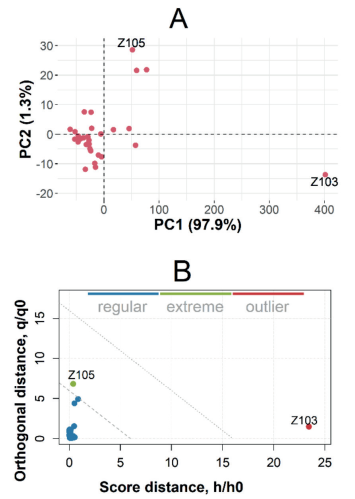
Figure 7: PCA results for the Kafubu - Zambian emeralds. A Score plot of PC2 vs. PC1 of the PCA model and B Distance plots with critical limits.
The PCA of the whole set of emeralds, after removing the outlier and the extreme samples
Once the outlier and extreme samples were eliminated, a PCA was made using the new set of 76 emeralds: 24 from PA, 24 from SD, and 28 from Z. Figure 8A shows the first plane of the PCA, where PC1 and PC2 explain 98.9 % and 0.5 % of the total variance, respectively.

Figure 8: The principal component analysis of the emeralds reflectance FT-IR spectra.
In Figure 8A, the SD emeralds are together towards the bottom right zone of the plane, while the Z emeralds are grouped towards the left upper side. On the contrary, the PA emeralds are scattered over the plane, and only a few samples seem close to each other. This behaviour is due to the dispersion in the intensities of the reflectance signals in the reflectance FT-IR spectra of the PA samples, while the SD emeralds always have significant intensity signals, and the Z samples always have comparatively lower intensities. Consequently, the PA samples are sometimes close in reflectance intensity to the SD emeralds and sometimes are close to the Z samples or neither. Following a detailed analysis of the latter, the emeralds shapes, the reflectance FT-IR spectra, and the PCA results, we have concluded that the size and form of the emerald is a critical factor in generating the mentioned dispersion in the reflectance FT-IR spectra of the PA emeralds, and it must be considered more rigorously in future works.
The PCA of the selected set of SD and Z emeralds
The PCA results for the Santo Domingo and Zambia samples show a clear separation between them.
Figures 8B and 8C, show biplot graphs where emeralds are represented with circles (SD) and triangles (Z) and wavenumbers with vectors. The PC1 and PC2 explain 99.3 % and 0.4 % of the total variance, respectively. Then, the first plane of the individuals is a good description of the samples’ behaviour and a valuable tool to differentiate SD emeralds from Z emeralds.
In the biplots, the vectors represent the wavenumbers of the most representative peaks of the emeralds reflectance FT-IR spectra. The vector magnitude projected over the abscissas positively correlates with the contribution of those wavenumbers to PC1, which explains 99.3% of the total variance of the spectra. Therefore, the wavenumbers with the most significant contribution to this PC1 will be the most valuable criteria for separating the groups of emeralds by their geographical origin.
In consequence, and according to the previous discussion, we have found two groups of wavelengths that are the most relevant in the emeralds’ reflectance FT-IR spectra:
-
The peaks centered at 2,474; 2640; and 2,686 cm-1 in the studied emeralds (see Figure 3). These FT-IR spectra peaks are related to deuterated water vibrations [35]. Figure 8B shows the biplot where it is clear that the mentioned wavenumbers have a significant correlation to the PC1 (0.969, 0.985, and 0.984, respectively), and they are represented by the magnitude and direction of the vectors, which means that those wavenumbers are helpful when differentiating the two groups of emeralds. On the other hand, in the same figure 8B, the reported peak of CO2 vibration in emeralds [4], and here centred at 2,360 cm-1 for the studied emeralds, has its orientation towards the PC2 and lower magnitude with respect to the other wavenumbers in the first plane of the individuals (the correlation to PC1 is just -0.284 and to PC2 is 0.826). The interpretation can be that the 2,360 cm-1 peak is more related to the Z emeralds because it points upwards in the same direction where some of the Zambian emeralds are located. The general effect of the two groups of wavenumbers mentioned (related to deuterated water and CO2) is that the Zambian emeralds (Z) are upside towards the left, and the Colombian Santo Domingo tunnel – La Pava mine emeralds (SD) are towards the right and downside of the first individual plane. It is important to mention that the low value of the explained variance of PC2 (only 0.4 %) draws into question the conclusions regarding PC2; however, Figure 8B helps to support these conclusions.
-
The peaks at wavelengths of 2,818 cm-1; 5,448 and 6,815 cm-1. The 2,818 cm-1 peak is attributed to chloride vibrations [34], and the 5,448 and 6,815 cm-1 peaks are related to type I water [1, 36]. These wavenumbers have a considerable correlation to PC1 (0.989, 0.997, and 0.998, respectively), which means that those FT-IR peaks are helpful to differentiate SD from Z emeralds, Figure 8B y 8C.
The previous results were extended and confirmed using clustering and PLS-DA. In this case, the PA samples were not excluded. The clustering made to the PCA is shown in Figure 9. The most important result of the clustering is the clear discrimination between the Z and SD emeralds using only the reflectance FT-IR spectra. This can be clearly seen in Figure 9, where there are three clusters. The first cluster contains all the samples from Zambia and 11 samples from PA; the second cluster contains all the SD samples and eight emeralds from PA, and the third one contains five samples all from PA.

Figure 9: The studied emeralds clustering from the first plane of the PCA.
On the other hand, the PLS-DA results are consistent with the studies made by PCA (Figure 8A) and clustering (Figure 9). Hence, the multivariate tools used in this work have proven powerful in identifying the geographical origin of emeralds. In this sense, we differentiated Colombian (SD) from Zambian emeralds. However, the Colombian PA emeralds were not clearly separated from the other samples. Thus, the database of emeralds must be increased and depurated to obtain a reliable and well-established set of emeralds classified by geographical origin. Furthermore, the FT-IR spectra must be complemented with UV-Vis spectra, Raman [35, 37, 38], and other available measurements to improve the multivariate analysis prediction capabilities and help with the correct identification of PA samples, which showed high dispersion in this work.
Conclusions
The reflectance FT-IR spectra of emeralds following pretreatment and analysis with PCA, clustering, and PLS-DA allowed the identification of vibrational bands associated with their chemical composition. In this study, the previously reported characteristic bands of emeralds centred at 2,474; 2,640; and 2,686 cm-1 and related to deuterated water vibrations, 2,818 cm-1 attributed to chloride vibrations and 5,448 and 6,815 cm-1 which corresponded to type I water vibrations showed 100% efficiency in distinguishing the emeralds from Santo Domingo tunnel - La Pava Mine Colombian western zone (Muzo district) from the Kafubu - Zambian emeralds. Regarding the Colombian PA emeralds (Chivor district), although it was not possible to differentiate all the samples from those from SD and Z, PA has a subset of individuals clearly different from the others, which means that more studies must be undertaken to resolve this issue.
Acknowledgments
The authors would like to acknowledge the unconditional support given by the expert work staff from the Technological Development Centre for the Colombian Emerald (CDTEC), the gemologists Andrea Morales and Holman Alvarado, the geologist Valeria Ramirez and especially the CEO Gabriel Angarita.
References
Referencias
D. L. Wood and K. Nassau, “Infrared spectra of foreign molecules in beryl,” J. Chem. Phys., vol. 47, no. 7, pp. 2220–2228, 1967, doi: 10.1063/1.1703295.
D. L. Wood and K. Nassau, “The characterization of beryl and emerald by visible and infrared absorption spectroscopy,” Am. Mineral., vol. 53, no. 5/6, pp. 777–800, 1968.
G. Giuliani, Y. Branquet, A. Fallick, L. Groat, and D. Marshall, “Emerald deposits around the world, their similarities and their differences,” InColor, vol. Special Is, pp. 56–69, Jan. 2015.
B. Charoy, P. De Donato, O. Barres, and C. Pinto-Coelho, “Channel occupancy in an alkali-poor beryl from Serra Branca (Goias, Brazil): Spectroscopic characterization,” Am. Mineral., vol. 81, no. 3–4, pp. 395–403, 1996, doi: 10.2138/am-1996-3-414.
B. Kolesov, “Vibrational states of H2O in beryl: Physical aspects,” Phys. Chem. Miner., vol. 35, no. 5, pp. 271–278, Jun. 2008, doi: 10.1007/s00269-008-0220-z.
E. S. Zhukova et al., “Vibrational states of a water molecule in a nano-cavity of beryl crystal lattice,” J. Chem. Phys., vol. 140, no. 22, Jun. 2014, doi: 10.1063/1.4882062.
Gemological Institute of America, “Emerald Quality Factors.” https://www.gia.edu/emerald-quality-factor (accessed Aug. 22, 2021).
G. Reinoso, “¿Cuál es el origen de la esmeralda colombiana?,” Portafolio, 2018. https://www.portafolio.co/economia/cual-es-el-origen-de-la-esmeralda-colombiana-524156 (accessed Aug. 22, 2021).
G. R. Rossman, “The geochemistry of gems and its relevance to gemology: different traces, different prices,” Elements, vol. 5, no. 3, pp. 159–162, 2009, doi: 10.2113/gselements.5.3.159.
C. Aurisicchio, O. Grubessi, and P. Zecchini, “Infrared spectroscopy and crystal chemistry of the beryl group,” Can. Mineral., vol. 32, no. 1, pp. 55–68, 1994.
L. T. T. Huong, W. Hofmeister, T. Häger, S. Karampelas, and N. D. T. Kien, “A preliminary study on the separation of natural and synthetic emeralds using vibrational spectroscopy,” Gems Gemol., vol. 50, no. 4, pp. 287–292, Dec. 2014, doi: 10.5741/GEMS.50.4.287.
L. T. T. Huong, T. Häger, and W. Hofmeister, “Confocal micro-raman spectroscopy: A powerful tool to identify natural and synthetic emeralds,” Gems Gemol., vol. 46, no. 1, pp. 36–41, Apr. 2010, doi: 10.5741/GEMS.46.1.36.
S. Saeseaw, V. Pardieu, and S. Sangsawong, “Three-phase inclusions in emerald and their impact on origin determination,” Gems Gemol., vol. 50, no. 2, pp. 114–132, 2014, doi: 10.5741/GEMS.50.2.114.
L. A. Groat, G. Giuliani, J. Stone-Sundberg, Z. Sun, N. D. Renfro, and A. C. Palke, “A review of analytical methods used in geographic origin determination of gemstones,” Gems and Gemology, vol. 55, no. 4. Gemological Institute of America (GIA), pp. 512–535, Dec. 01, 2019. doi: 10.5741/GEMS.55.4.512.
S. Saeseaw, N. D. Renfro, A. C. Palke, Z. Sun, and S. F. McClure, “Geographic origin determination of emerald,” Gems Gemol., vol. 55, no. 4, pp. 614–646, Dec. 2019, doi: 10.5741/GEMS.55.4.614.
D. P. Cronin and A. M. Rendle, “Determining the geographical origins of natural emeralds through non-destructive chemical fingerprinting,” J. Gemmol., vol. 33, no. 1, pp. 1–13, 2012. DOI: https://doi.org/10.15506/JoG.2012.33.1.1
R. I. Mashkovtsev and S. Z. Smirnov, “The nature of channelconstituents in hydrothermalsynthetic emerald,” J. Gemmol., vol. 29, no. 4, pp. 215–227, 2004. DOI: https://doi.org/10.15506/JoG.2004.29.4.215
F. Martin, H. Mkrigoux, and P. Zecchini, “REFLECTANCE INFRARED SPECTROSCOPY IN GEMOLOGY,” GEMS Gemol., pp. 226–231, 1989. DOI: https://doi.org/10.5741/GEMS.25.4.226
R. Bro and A. K. Smilde, “Principal component analysis,” Anal. Methods, vol. 6, no. 9, pp. 2812–2831, 2014, doi: 10.1039/c3ay41907j.
D. Vitali Čepo, M. Karoglan, L. Borgese, L. E. Depero, E. Marguí, and J. Jablan, “Application of benchtop total-reflection X-ray fluorescence spectrometry and chemometrics in classification of origin and type of Croatian wines,” Food Chem. X, vol. 13, 2022, doi: 10.1016/j.fochx.2022.100209.
M. Ghidotti, Y. Fiamegos, C. Dumitrascu, and M. B. de la Calle, “Use of elemental profiles to verify geographical origin and botanical variety of Spanish honeys with a protected denomination of origin,” Food Chem., vol. 342, p. 128350, 2021, doi: 10.1016/j.foodchem.2020.128350.
M. Gil et al., “Chemometric approaches for postharvest quality tracing of cocoa: An efficient method to distinguish plant material origin,” Heliyon, vol. 5, no. 5, p. e01650, 2019, doi: 10.1016/j.heliyon.2019.e01650.
G. Capobianco et al., Chemometrics approach to FT-IR hyperspectral imaging analysis of degradation products in artwork cross-section, vol. 132. Elsevier B.V., 2017. doi: 10.1016/j.microc.2017.01.007.
C. Aurisicchio, A. M. Conte, L. Medeghini, L. Ottolini, and C. De Vito, “Major and trace element geochemistry of emerald from several deposits: Implications for genetic models and classification schemes,” Ore Geol. Rev., vol. 94, pp. 351–366, 2018, doi: 10.1016/j.oregeorev.2018.02.001.
H. A. O. Wang and M. S. Krzemnicki, “Multi-element analysis of minerals using laser ablation inductively coupled plasma time of flight mass spectrometry and geochemical data visualization using t-distributed stochastic neighbor embedding: Case study on emeralds,” J. Anal. At. Spectrom., vol. 36, no. 3, pp. 518–527, 2021, doi: 10.1039/d0ja00484g.
V. Pardieu, “Field Gemology,” InColor, no. 46, pp. 36–43, 2020.
R Core Team, “R: A Language and Environment for Statistical Computing.” Vienna, Austria, 2021. [Online]. Available: https://www.r-project.org/
RStudio Team, “RStudio: Integrated Development Environment for R.” Boston, MA, 2021. [Online]. Available: http://www.rstudio.com/
H. W. Borchers, “pracma: Practical Numerical Math Functions. R package version 1.8.8.https://CRAN.R-project.org/package=pracma,” https://CRAN.R-project.org/package=pracma. p. https://CRAN.R-project.org/package=pracma, 2015.
K. H. Liland, T. Almøy, and B. H. Mevik, “Optimal choice of baseline correction for multivariate calibration of spectra,” Appl. Spectrosc., vol. 64, no. 9, pp. 1007–1016, Sep. 2010, doi: 10.1366/000370210792434350.
S. Lê, J. Josse, and F. Husson, “FactoMineR: An R Package for Multivariate Analysis,” J. Stat. Softw., vol. 28, no. 1, pp. 1–18, 2008. DOI: https://doi.org/10.18637/jss.v025.i01
A. Kassambara and F. Mundt, “Factoextra: Extract and Visualize the Results of Multivariate Data Analyses (Versión 1.0.5),” https://cran.r-project.org/package=factoextra, 2017. https://cran.r-project.org/package=factoextra
S. Kucheryavskiy, “mdatools – R package for chemometrics,” Chemom. Intell. Lab. Syst., vol. 198, Mar. 2020, doi: 10.1016/j.chemolab.2020.103937.
B. Rondeau, E. Fritsch, J. J. Peucat, F. S. Nordrum, and L. Groat, “Characterization of emeralds from a historical deposit: Byrud (Eidsvoll), Norway,” Gems Gemol., vol. 44, no. 2, pp. 108–122, 2008, doi: 10.5741/GEMS.44.2.108.
S. Karampelas, A. Al-Alawi, B. Al-Shaybani, F. Mohamed, and S. Sangsawong, “Emeralds from the most important occurrences: Chemical and spectroscopic data,” Minerals, vol. 9, no. 9, Sep. 2019, doi: 10.3390/min9090561.
X. Qiao et al., “Study of the differences in infrared spectra of emerald from different mining areas and the controlling factors,” Can. Mineral., vol. 57, no. 1, pp. 65–79, 2019, doi: 10.3749/canmin.1800042.
J. Garcia-Toloza, M. J. Herreño-Daza, A. F. González-Duran, C. J. Cedeño-Ochoa, and L. G. Angarita–Sarmiento, “Photoluminescence analysis to determine the origin of emeralds from the Eastern and Western belts in Colombia,” 2019.
I. Moroz, M. Roth, M. Boudeulle, and G. Panczer, “Raman microspectroscopy and fluorescence of emeralds from various deposits,” J. Raman Spectrosc., vol. 31, no. 6, pp. 485–490, 2000, doi: 10.1002/1097-4555(200006)31:6<485::AID-JRS561>3.0.CO;2-M.
Cómo citar
IEEE
ACM
ACS
APA
ABNT
Chicago
Harvard
MLA
Turabian
Vancouver
Descargar cita
CrossRef Cited-by
1. Yu-Yu Zheng, Xiao-Yan Yu, Bo Xu, Hong-Shu Guo, Si-Yi Zhao, Jun Tang, Ying Yan, Yu-Jie Gao. (2024). New insights of emerald geographic origin determination based on the infrared spectroscopy of D2O and HDO molecules. Vibrational Spectroscopy, 135, p.103746. https://doi.org/10.1016/j.vibspec.2024.103746.
Dimensions
PlumX
Visitas a la página del resumen del artículo
Descargas
Licencia
Derechos de autor 2022 Elianna Castillo Serna

Esta obra está bajo una licencia internacional Creative Commons Atribución 4.0.
Los autores/as conservarán sus derechos de autor y garantizarán a la revista el derecho de primera publicación de su obra, el cuál estará simultáneamente sujeto a la Licencia de reconocimiento de Creative Commons (CC. Atribución 4.0) que permite a terceros compartir la obra siempre que se indique su autor y su primera publicación en esta revista.
Los autores/as podrán adoptar otros acuerdos de licencia no exclusiva de distribución de la versión de la obra publicada (p. ej.: depositarla en un archivo telemático institucional o publicarla en un volumen monográfico) siempre que se indique la publicación inicial en esta revista.
Se permite y recomienda a los autores/as difundir su obra a través de Internet (p. ej.: en archivos telemáticos institucionales o en su página web) antes y durante el proceso de envío, lo cual puede producir intercambios interesantes y aumentar las citas de la obra publicada. (Véase El efecto del acceso abierto).